

Overview
Achieving ISO 27001 certification is a byproduct of rigorous security assurance, not a goal you can reach through automated checklists. You likely feel the pressure of the ISO/IEC 27001:2022 standard’s shift toward technical validation, especially with the 2024 environmental amendment now requiring specific risk assessments. It’s common to feel uncertain about which of the 93 updated Annex A controls, such as A.12.6.1 or A.8.29, require deep technical testing versus a simple policy review. This is where human-led penetration testing for ISO 27001 compliance becomes your most valuable strategic asset.
By moving beyond basic vulnerability scans, you’ll validate your ISMS controls with the precision an auditor expects. We understand that cybersecurity is about trust, and our methodology ensures you walk into your audit with zero major non-conformities. This guide outlines how to align your testing scope with specific technological controls, leverage human intelligence to close resilience gaps, and use the Pentesys Portal to provide the transparent remediation roadmap your stakeholders demand for 2026.
Does ISO 27001 Require Penetration Testing?
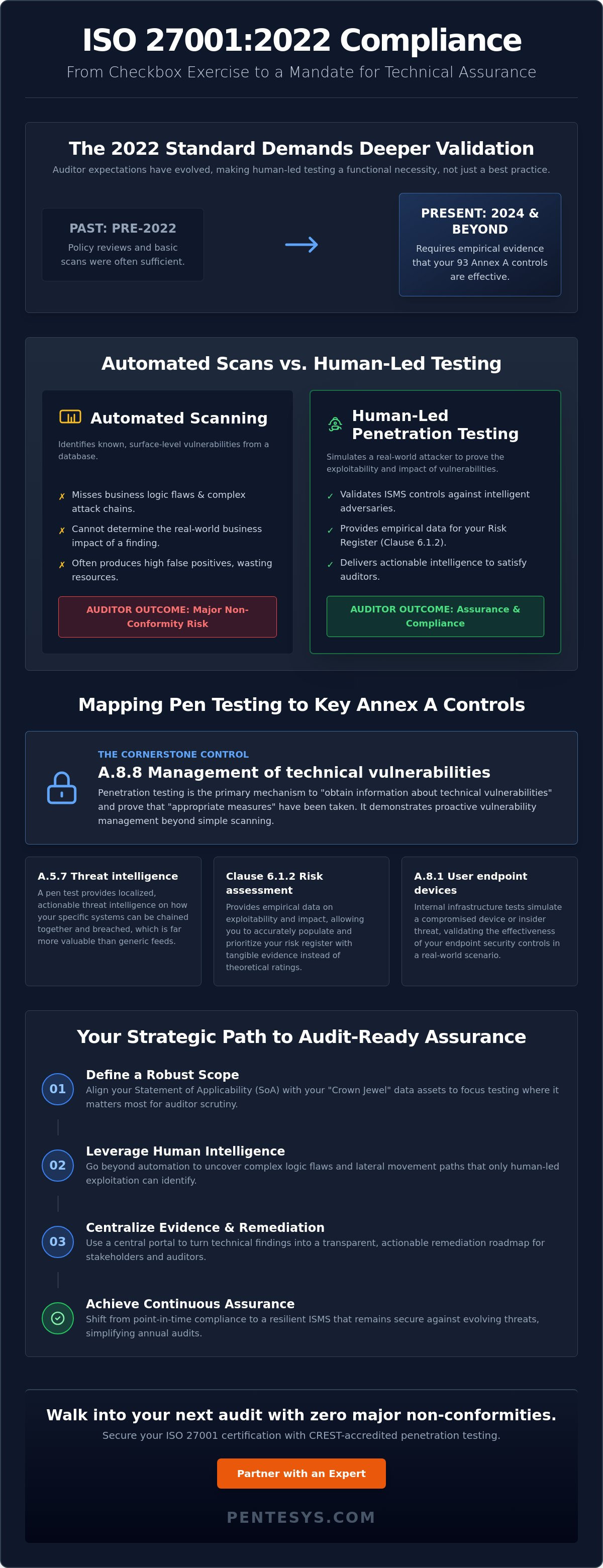
The short answer is that the word “penetration test” does not appear in the formal text of the ISO/IEC 27001 standard. However, the 2022 update significantly increased the emphasis on technical validation. For organisations operating in 2026, penetration testing for ISO 27001 compliance has transitioned from a recommended best practice to a functional necessity. This shift is driven primarily by Control A.8.8 (Management of technical vulnerabilities), which requires organisations to obtain information about technical vulnerabilities and take appropriate measures.
UK certification bodies now expect to see proactive evidence that your controls actually work. It’s no longer enough to claim a firewall is configured correctly; you must prove it can withstand a targeted simulation. This makes penetration testing the ultimate control validation mechanism. By adopting a risk-based approach, you determine the frequency and depth of your testing based on the criticality of your assets. High-risk environments often require quarterly assessments, while more stable infrastructures might move toward an annual cycle. This logic ensures your security spend aligns with actual business risk rather than arbitrary schedules.
Clause 6.1.2 and the Risk Assessment Link
Clause 6.1.2 requires a robust information security risk assessment process. Automated tools often identify surface-level flaws, but they fail to uncover complex logic errors or lateral movement paths that an adversary might exploit. Human-led penetration testing identifies these deep-seated technical risks, providing the empirical data you need to populate and refine your Risk Register. Instead of guessing the potential impact of a breach, you have a documented report showing exactly how an attacker could move through your network. Clause 8.1 relies on this technical validation data to ensure that planned actions to address risks are effectively implemented and monitored.
Auditor Expectations in 2026
Modern auditors have moved past the “checkbox” era of compliance. In 2026, they look for “assurance” rather than just “testing.” They want to see that your remediation process is closed-loop and that your methodology includes human-led exploitation. Relying solely on automated scans often leads to major non-conformities during a certification audit because scans don’t prove the effectiveness of detective controls. Engaging with crest accredited penetration testing uk provides the necessary authority and technical rigor that auditors trust. This level of accreditation signals that your security testing meets the highest industry standards, moving your organisation toward a model of continuous assurance that simplifies the annual audit cycle.
Mapping Penetration Testing to Annex A Controls
The 2022 update to the standard condensed the previous 114 controls into 93, organised into four distinct themes. This reorganization requires a precise mapping of your security activities to demonstrate compliance. Penetration testing for ISO 27001 compliance serves as the primary evidence for several of these new controls, moving beyond simple vulnerability management into the territory of proactive threat intelligence.
Control A.8.8 remains the cornerstone of technical validation. It mandates that organisations obtain information about technical vulnerabilities of information systems in use. While some companies attempt to satisfy this with automated tools, a professional methodology aligned with NIST SP 800-115 ensures that you’re not just identifying flaws, but assessing their exploitability. This distinction is vital for accurate risk reporting. An auditor wants to see that you’ve analysed the potential impact of a vulnerability, not just its existence on a list.
Control A.5.7 is a significant addition to the 2022 standard, requiring organisations to collect and analyse information about threats. A human-led penetration test acts as a primary source of internal threat intelligence. It reveals how vulnerabilities in your specific environment could be chained together to achieve a breach. This localized intelligence is far more actionable than generic industry feeds. Similarly, Control A.8.1 addresses user endpoint security. Internal infrastructure tests simulate an insider threat or a compromised workstation, allowing you to evaluate if your endpoint detection and response (EDR) tools actually trigger the alerts your policy claims they will.
Infrastructure Testing for Control A.8.8
Infrastructure assessments focus on the foundational layers of your estate. We validate that your patch management processes and configuration hardening standards are effective in practice. Testing both internal and external attack surfaces is essential to satisfy the depth requirements expected by modern auditors. Network testing provides the baseline for any ISO 27001 scope because it secures the pathways through which data travels. If you’re unsure where your technical boundaries lie, our team can help you define a compliant testing scope that covers your entire digital footprint.
Application Security and Control A.8.25
Control A.8.25 focuses on secure development and acceptance testing. For organisations building proprietary software, this control requires proof that security is integrated into the development lifecycle. Logic-based testing goes far beyond the OWASP Top 10 by simulating real-world business logic flaws that automated scanners can’t detect. By identifying how an attacker might manipulate a checkout process or bypass authentication, you prove the effectiveness of your development ISMS. This level of assurance demonstrates to stakeholders that your applications are resilient by design.
Vulnerability Scanning vs. Penetration Testing for Compliance
Distinguishing between automated vulnerability scanning and human-led penetration testing is critical for any organisation seeking certification. While both tools identify security flaws, they serve different functions within an Information Security Management System (ISMS). Vulnerability scans provide a broad, high-level overview of known weaknesses across a network, often identifying thousands of potential issues. However, penetration testing for ISO 27001 compliance requires manual exploitation to prove the actual impact of those weaknesses on your organisation’s specific risk profile. Without exploitation, a vulnerability is merely a theoretical threat; with it, you have empirical evidence for your Risk Register.
Auditors in 2026 are increasingly critical of organisations that rely solely on automated outputs. A scan report often contains false positives that clutter the audit process and waste valuable technical resources. In contrast, human-led testing filters out these inaccuracies, presenting only verified, actionable risks. This approach saves time during the audit and ensures that your remediation efforts are focused on flaws that pose a genuine threat to your business continuity. At Pentesys, we believe that true assurance comes from simulating how an adversary would actually navigate your specific environment, providing the technical authority that simple automation cannot replicate.
When is a Scan Enough?
Automated scanning plays a vital role in continuous penetration testing by maintaining baseline hygiene between deep-dive assessments. It’s an effective way to catch missing patches or simple configuration errors in real-time as your infrastructure evolves. However, an auditor will flag a scan report as insufficient if it lacks the “so what” factor. Automation cannot explain how a specific vulnerability threatens your Statement of Applicability or your “Crown Jewel” data assets. You should use scans for frequency and monitoring, but rely on human expertise for the depth required to satisfy Annex A technological controls.
The Value of Human Logic in Exploitation
Human intuition allows a tester to adopt an adversary mindset, identifying chained vulnerabilities that tools consistently miss. For example, a scanner might identify a low-priority information disclosure and an unrelated weak session management setting. A human tester sees the connection: using the disclosed information to hijack a session and escalate privileges. This narrative of risk provides the high-level assurance auditors demand. Our remediation guidance goes beyond generic software update prompts, offering specific, business-centric steps to harden your resilience. This ensures your security posture remains proactive rather than reactive, bridging the gap between deep-tech execution and business value.
Preparing Your Scope for an ISO 27001 Pen Test
Scoping is the most critical phase of the engagement because it determines the validity of your evidence during a certification audit. If the scope is too narrow, you risk a major non-conformity for failing to protect your “Crown Jewels.” If it’s too broad, you may waste resources on low-risk assets. Effective penetration testing for ISO 27001 compliance must align directly with your Statement of Applicability (SoA). The SoA defines which technical controls you’ve implemented, and your test plan should provide the empirical proof that these controls are operational and effective across your entire digital estate.
Your testing boundaries must encompass all environments where sensitive data resides or traverses. This includes cloud instances, on-premises servers, and remote access solutions like VPNs or Zero Trust Network Access (ZTNA). Scheduling is equally vital. You should complete your testing well before your Stage 2 audit. This timing allows you to present a clean report or, more importantly, a report followed by a re-test certificate. Presenting an unpatched list of “High” vulnerabilities to an auditor signals a failure in your vulnerability management process, potentially stalling your certification.
Scoping for Maximum Audit Impact
Collaborating with your provider ensures your testing remains within your ISMS boundaries while maintaining comprehensive coverage. You must identify every entry point that could lead to a compromise of your primary data assets. Excluding critical APIs from your compliance scope creates a blind spot that leaves your primary data pathways unvalidated and vulnerable to auditor scrutiny. To ensure your scope meets every regulatory requirement, you can speak with our technical team to align your testing plan with your specific Statement of Applicability.
Remiation and Re-testing
ISO 27001 requires a “closed-loop” process for managing technical risks. Identifying a flaw is only the first half of the requirement; proving you fixed it is what satisfies the auditor. This is why a re-test certificate is the most important document in your compliance folder. It demonstrates that your organisation is proactive and methodical in its approach to security. We recommend leaving at least a 4-week window between the initial test and your audit. This timeframe provides your technical teams enough room to apply remediation guidance and allows us to conduct a secondary assessment to verify the fixes. This structured rhythm transforms a point-in-time test into a reliable cycle of continuous security assurance.
Your Audit Evidence Vault
Efficiency during the certification cycle depends on clear, accessible documentation. The Pentesys Portal acts as your centralized evidence vault, specifically designed to satisfy the rigorous demands of ISO 27001 auditors. It provides a structured history of your security posture, documenting every stage of the vulnerability lifecycle. You can demonstrate exactly when a risk was identified, how it was assessed, and the specific date it was remediated. This level of transparency builds immediate trust with auditors, proving that your ISMS is a living, functional system. It eliminates the need for fragmented reports, consolidating everything into a single, secure repository that reduces your administrative burden.
Can we perform our own internal penetration testing for ISO 27001?
You can perform internal testing if your team possesses the necessary technical competence and maintains strict independence from the systems they are testing. However, most certification bodies prefer a third-party assessment to ensure there’s no bias in the results. An external, CREST-accredited provider offers a level of professional assurance that internal teams often struggle to replicate during a rigorous Stage 2 audit process.
Does the pen test scope have to match our entire network?
The scope of your penetration testing for ISO 27001 compliance must align exactly with the boundaries defined in your Statement of Applicability (SoA). You don’t need to test every secondary system, but you must include all assets and data pathways that handle sensitive information within the ISMS scope. A well-defined scope ensures that your technical validation is both comprehensive and cost-effective for your specific certification goals.
Will an ISO 27001 auditor accept a report from an unaccredited testing firm?
Auditors may accept reports from unaccredited firms, but they’ll likely scrutinize the tester’s methodology and qualifications much more closely. Using a CREST-accredited firm provides immediate technical authority and ensures that the testing meets recognised international standards. This accreditation acts as a quality marker, significantly reducing the administrative burden and questioning you might face during the certification process regarding the validity of your evidence.
Founder & CEO, Pentesys
James Hinton is the founder of Pentesys, a CREST-approved UK company working only on offensive security: penetration testing, PTaaS, CTEM, external attack surface management and red teaming. He built the business around one discipline rather than a broad consultancy menu, and most of his time still goes on how engagements get scoped, delivered and reported. He writes here about the practical side of security testing and what buyers should be asking for.
LinkedIn profile