

Overview
ISO 27001 is a management system standard, so most of the certification effort goes on documentation, ownership and evidence rather than on technical controls. The technical work still has to happen, and it is usually where organisations underestimate the effort involved. This is the order most of it tends to get done in.
This article provides a technical roadmap to master ISO 27001 requirements for 2026. We’ve developed a clear, actionable checklist that moves beyond automated scans to focus on human-led adversary simulation and precise remediation guidance. You’ll learn how to align your technical security with business value, ensuring your audit preparation delivers genuine peace of mind rather than just a certificate. We’ll examine exactly how to bridge the gap between deep-tech execution and executive-level assurance.
Understanding ISO Certification in the 2026 Security Landscape
ISO certification represents a strategic pivot for UK enterprises. It’s no longer just a compliance checkbox; it’s a foundational asset that secures market access. By 2026, the majority of UK government procurement frameworks require documented evidence of a robust Information Security Management System (ISMS). This shift reflects a broader demand for transparency within the digital supply chain. Organisations must distinguish between ISO, the body that establishes the framework, and the certification bodies that conduct the actual audits. Your iso certification is the result of a rigorous third-party validation of your internal controls.
The industry is moving away from point-in-time assessments. The traditional model of preparing for a single annual audit is being replaced by continuous compliance. This methodology integrates security into daily operations, utilising continuous monitoring and remediation guidance to ensure that risks are managed in real-time. This proactive stance provides stakeholders with ongoing assurance rather than a temporary snapshot of security health. It’s about building a resilient system that functions every day of the year, not just during an audit window.
Certification vs. Accreditation: Why it Matters
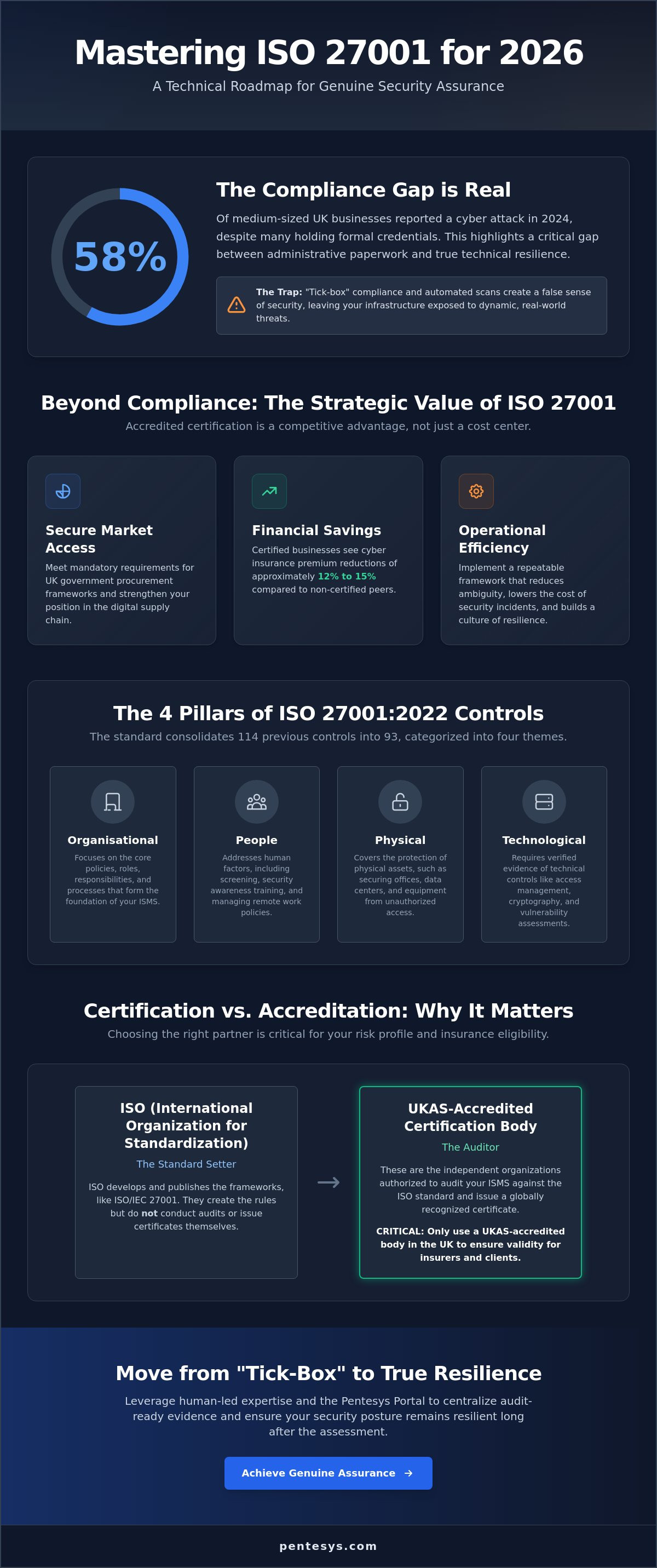
Choosing the right partner for your audit is critical for your risk profile. In the UK, you should only engage with a certification body that is UKAS-accredited. UKAS (United Kingdom Accreditation Service) ensures the auditor has the technical competence to evaluate your systems effectively. Certificates issued by unaccredited bodies often fail to meet the requirements of UK insurers, leading to rejected claims or higher premiums. You can verify the legitimacy of any certification body through the IAF CertSearch database to ensure your iso certification holds global weight and professional standing.
The Business Value of Standardisation
Standardisation drives operational efficiency by removing the ambiguity from security processes. When you align with the ISO/IEC 27001 Standard, you create a repeatable framework that reduces the cost of security incidents. In 2026, businesses with accredited certifications are seeing lower cyber insurance premiums compared to non-certified peers. This financial benefit is paired with a cultural shift. Employees become active participants in the company’s resilience, moving beyond passive compliance. It builds a narrative of trust that resonates with executive boards and international clients, positioning security as a competitive advantage rather than a cost centre.
Core Standards for Cybersecurity: ISO 27001 and Beyond
The 2022 update to ISO 27001 serves as the definitive framework for iso certification as we approach 2026. This version utilises the High-Level Structure (HLS), which allows for seamless integration with other management systems. By following the Plan-Do-Check-Act (PDCA) cycle, your organisation moves away from static security and toward a model of continuous improvement. This transition is essential for maintaining resilience against evolving threat actors.
The Statement of Applicability (SoA) remains the most critical document in your audit preparation. It functions as a roadmap, identifying which specific controls are relevant to your business and how they are implemented. Auditors look for a clear rationale for every exclusion, meaning your risk assessment must be thorough and documented. Relying on generic templates often leads to failure during the Stage 2 audit; precise, tailored documentation is the only path to professional assurance.
ISO 27001: The Gold Standard for Information Security
The 2022 revision consolidated the previous 114 controls into 93, categorised into four distinct themes: Organisational, People, Physical, and Technological. While policy documents satisfy organisational controls, technological controls require verified evidence of implementation. You can’t pass an audit by simply stating you have a firewall; you must demonstrate configuration management and regular vulnerability assessments. This is where human-led testing provides the depth that automated scans miss, ensuring your technical defences actually perform under pressure. For those beginning this journey, reviewing Practical Tips for ISO Certification can help clarify the bridge between policy and technical execution.
Complementary Standards for Enterprise Resilience
Achieving iso certification often involves more than a single standard. UK businesses increasingly adopt a multi-standard approach to satisfy complex supply chain requirements and regulations like NIS2. While ISO 27001 protects information, ISO 22301 focuses on business continuity, ensuring your operations remain functional during a significant disruption. For firms handling large volumes of personal data, ISO 27701 acts as a privacy extension that aligns directly with UK GDPR requirements.
Selecting the right combination of standards depends on your industry sector and risk appetite. Integrating these into a single management system reduces administrative overhead and provides a unified view of your security posture. You can monitor your progress and manage remediation guidance through the Pentesys Portal, which centralises your compliance and testing data for maximum clarity.
- ISO 9001: Focuses on quality management, ensuring your security services meet consistent delivery standards.
- ISO 27017 & 27018: These are essential for cloud-native organisations, providing specific controls for cloud service security and the protection of PII in public clouds.
- NIS2 Alignment: Strategic adoption of these standards helps UK entities meet the rigorous “duty of care” and incident reporting obligations mandated for those operating within EU critical infrastructure supply chains.
The Compliance Gap: Why a Certificate Does Not Equal Security
A paper certificate provides a snapshot of compliance at a specific point in time. It doesn’t guarantee security against active adversaries. Many organisations fall into the tick-box trap, treating iso certification as a destination rather than an ongoing process. Data breaches remain costly for UK organisations, even for those with established frameworks. Relying on self-attestation tools or basic automated software creates a false sense of safety. These tools often miss the nuanced configuration errors that modern attackers exploit. Securing an iso certification is a vital milestone, but it’s not the end of the journey. Static audits are insufficient for the 2026 threat landscape, where AI-driven social engineering and rapid zero-day exploitation are standard. You need offensive security simulations to prove your controls actually work when under pressure.
Compliance software can flag a missing patch, but it won’t tell you if your incident response team is prepared for a ransomware deployment at 3 AM on a bank holiday. The gap between being compliant and being secure is often where the most damaging breaches occur. True assurance comes from testing the human and procedural elements of your security stack, not just the technical settings. This requires moving beyond automated checklists toward a model of active validation.
Automated Scans vs. Human-Led Validation
Automated scanners are excellent for finding known, unpatched vulnerabilities. They can’t, however, identify complex logic flaws or understand how multiple low-risk issues can be chained together to compromise a system. This is why UK auditors are placing higher value on human intelligence. They want to see crest accredited penetration testing uk results. This level of validation moves beyond technical compliance. It focuses on adversarial resilience, ensuring your team can detect and respond to a real human attacker. Human-led testing uncovers the logic behind a vulnerability, providing the context necessary for effective remediation that software alone misses.
The Role of Continuous Security Validation
The transition from annual testing to continuous penetration testing is a strategic necessity for 2026. This approach aligns directly with ISO 27001:2022 requirements. Specifically, it supports requirement 8.10 regarding information deletion and requirement 8.8 for the management of technical vulnerabilities. By using the Pentesys Portal, you gain real-time telemetry of your attack surface. This provides auditors with live evidence of control effectiveness. It replaces the frantic scramble for documentation during audit week with a steady stream of verified security data. This methodical approach builds long-term trust and ensures your security posture remains robust between certification cycles. It transforms security from a seasonal event into a core business function.
The Technical ISO 27001 Readiness Checklist
Achieving iso certification requires a shift from policy-heavy documentation to verifiable technical controls. The 2022 update, which remains the benchmark for 2026 audits, emphasizes the integration of information security into the fabric of technical operations. This phase of the roadmap focuses on moving beyond static compliance into a state of active technical assurance.
Phase 1 & 2: Scoping and Asset Identification
Defining the Information Security Management System (ISMS) boundaries prevents scope creep and ensures the audit remains focused on critical infrastructure. The UK Government’s 2024 Cyber Security Breaches Survey found that most medium-sized businesses identified a breach in the last year. This highlights why accurate scoping is vital for resilience. You must identify every touchpoint where data resides.
- Document all hardware, software, and data assets within the audit scope to establish a clear inventory.
- Conduct a formal risk assessment using a methodology like ISO 31000 to identify specific vulnerabilities.
- Define the Statement of Applicability (SoA) with clear justifications for any excluded controls.
Phase 3 & 4: Implementation and Offensive Validation
Technical controls must align with the risks identified in your assessment. Pentesys advocates for a “security by design” approach that leverages both technology and human expertise. This phase moves beyond simple configuration. It’s about ensuring your defences actually work under pressure. By using the Pentesys Portal, teams can track remediation progress in real time, turning iso certification into a managed, transparent process.
- Implement multi-factor authentication (MFA) and robust access controls under Control A.9 to mitigate credential theft.
- Schedule a human-led penetration test to validate technical controls as required by Control A.12.6. This provides a depth of insight that automated scans cannot replicate.
- Establish a vulnerability management programme with remediation timelines, ensuring critical patches are applied within 14 days.
Phase 5: Internal Audit and Management Review
The final step before the external Stage 1 audit involves a rigorous internal review. This ensures the certification process doesn’t stall due to overlooked non-conformities. It’s a dress rehearsal that builds confidence across the technical team. We recommend a structured review of your incident response capabilities to ensure they’re more than just words on a page.
- Conduct an internal audit to identify and fix non-conformities before the external body arrives.
- Review incident response plans and test them with a tabletop exercise to ensure the team is ready for real-world scenarios.
- Ensure all technical staff receive training on the updated security policies and understand their role in maintaining compliance.
Expert-Led Testing for Annex A Compliance
Automated tools often miss the context-heavy vulnerabilities that lead to audit failures. Our human-led approach utilises CREST accreditation in cybersecurity to simulate real-world attacks against your environment. We map every finding to specific ISO 27001:2022 Annex A controls, such as A.8.8 (Management of technical vulnerabilities) or A.5.7 (Threat intelligence). This direct mapping simplifies the auditor’s job and demonstrates total control over your environment. Your team receives actionable remediation guidance, allowing them to fix high-risk issues within days. This level of detail provides the technical assurance required to satisfy the most stringent UKAS-accredited certification bodies.
Is penetration testing a mandatory requirement for ISO 27001?
Penetration testing is effectively mandatory under Annex A Control 8.8 of the ISO 27001:2022 standard. This control requires organisations to manage technical vulnerabilities through proactive testing. Pentesys recommends human-led testing over basic automated scans to provide the depth of assurance required by UKAS accredited auditors. This ensures your technical defences stand up to real-world adversary simulation.
What is the difference between an internal audit and an external certification audit?
An internal audit is a self-assessment performed by your team or a consultant to identify gaps before the official assessment. It’s a requirement of Clause 9.2 of the standard. An external certification audit is conducted by an independent UKAS accredited body to verify your compliance. The external auditor provides the final decision on whether your organisation receives its official iso certification.
What happens if we fail our ISO certification audit?
If you fail to meet specific requirements, the auditor issues a non-conformity report. Minor non-conformities won’t stop your certification, provided you create an actionable remediation plan within 60 days. A major non-conformity means your ISMS has a significant breakdown. In this case, the auditor won’t recommend certification until you provide evidence that the issue is resolved. Pentesys helps clients avoid this through rigorous pre-audit technical testing.
Founder & CEO, Pentesys
James Hinton is the founder of Pentesys, a CREST-approved UK company working only on offensive security: penetration testing, PTaaS, CTEM, external attack surface management and red teaming. He built the business around one discipline rather than a broad consultancy menu, and most of his time still goes on how engagements get scoped, delivered and reported. He writes here about the practical side of security testing and what buyers should be asking for.
LinkedIn profile