

Overview
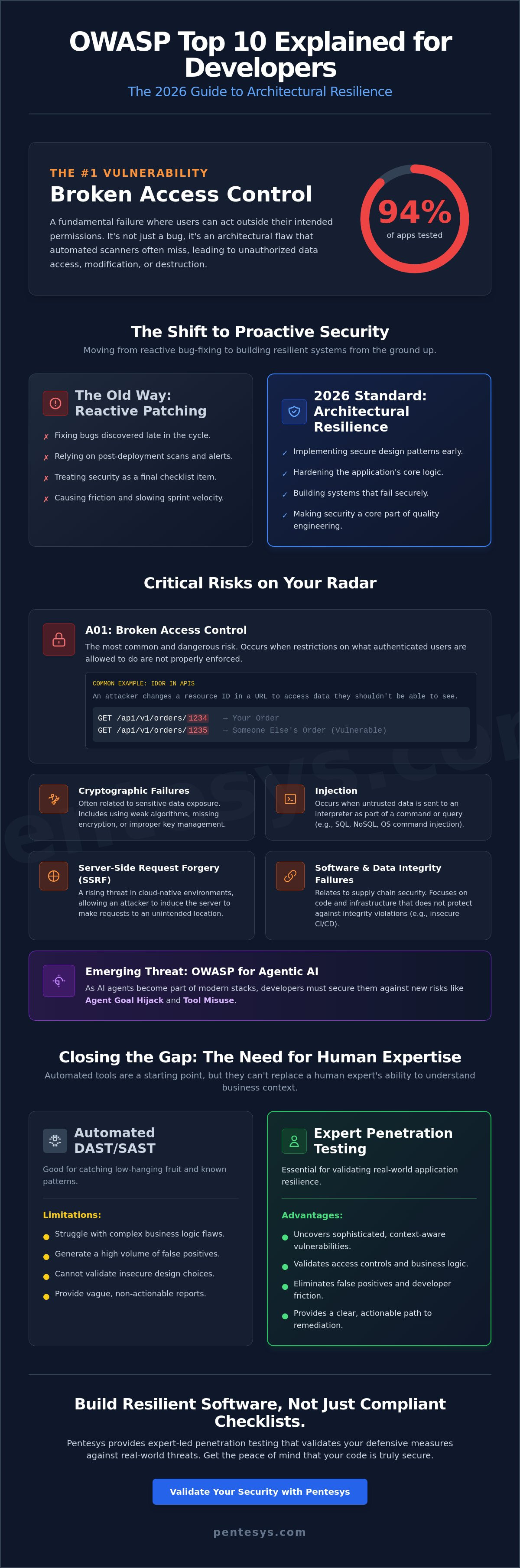
Broken Access Control sits at the top of the OWASP Top 10 for a reason: it appeared in 94% of the applications in the dataset behind the 2021 list. For developers the Top 10 is more useful as a set of design constraints than as something to audit against at the end. This guide works through each category with the questions worth asking while the code is still being written.
This OWASP top 10 explained for developers guide offers the technical clarity and practical strategies required to master critical web risks in 2026. We’ll bridge the gap between high-level security oversight and day-to-day execution by covering both established web vulnerabilities and the new standards for agentic AI applications. You’ll learn how to implement defensive design patterns that reduce vulnerabilities during pen testing and ensure your software remains resilient against sophisticated threats.
Understanding the OWASP Top 10 in the 2026 Development Landscape
The OWASP top 10 explained for developers is more than a simple vulnerability checklist; it represents a global consensus on the most critical security risks facing web applications. Maintained by the Open Web Application Security Project (OWASP), this framework helps engineering teams prioritise their defensive efforts based on real-world prevalence and impact. In 2026, the focus has shifted from merely patching individual bugs to building architectural resilience. This means designing systems that remain secure even when specific components fail.
Each category in the list maps to various Common Weakness Enumerations (CWEs). These provide the technical granularity needed for effective remediation. By understanding these relationships, you can establish secure coding standards that address the root causes of vulnerabilities. This logical progression ensures that your team isn’t just checking boxes but actually hardening the application’s core logic. It creates a steady, structured approach to security that aligns with business objectives and technical excellence.
The Evolution of Web Risks: From 2021 to 2026
The transition from the 2021 standards to the 2026 environment reflects a maturing threat landscape. Data-driven analysis shows that while classic vulnerabilities persist, the methods of exploitation have changed. Server-Side Request Forgery (SSRF) has seen a rise in priority because cloud-native environments and microservices are now the industry standard. Software and data integrity failures have also become critical. Automated supply chains and CI/CD pipelines introduce new points of failure that demand constant oversight and validation.
Despite these shifts, Broken Access Control remains the most frequent and dangerous risk. In the foundational dataset used for the 2021 list, this category appeared in 94% of tested applications. For modern APIs, this often manifests as unauthorised data access or privilege escalation. We also see the emergence of the OWASP Top 10 for Agentic Applications in 2026, which addresses risks like Agent Goal Hijack and Tool Misuse. While distinct from the core web list, it highlights the need for developers to secure autonomous AI agents within their modern stacks.
Why Developers are the First Line of Defence
Security isn’t an afterthought. It’s a core component of quality engineering. Fixing a vulnerability during the design phase is significantly more cost-effective than remediating a breach in production. This proactive approach moves your team beyond “security theatre” and toward genuine defensive programming. When you write code with a security-first mindset, you reduce the friction caused by failed audits and late-stage bug reports.
Pentesys supports this mission by providing web application penetration testing that goes beyond automated scans. Our expert-led evaluations help you validate your defensive measures. This ensures your architectural resilience holds up against sophisticated, manual exploitation attempts. By partnering with human experts, you gain the peace of mind that your code isn’t just compliant, but truly resilient against the evolving threats of 2026.
The Foundation: Broken Access Control and Cryptographic Failures
The OWASP top 10 explained for developers starts with the most pervasive risk in modern software: Broken Access Control. This category isn’t just a common bug; it’s a fundamental architectural failure that appeared in 94% of applications tested for the dataset behind the OWASP Top 10 2021. When access controls fail, users can act outside of their intended permissions. This often leads to unauthorised information disclosure, modification, or destruction of data. It’s the primary reason why manual, expert-led evaluation is so critical, as automated scanners frequently miss the nuanced business logic required to enforce these boundaries.
In RESTful APIs, this risk often manifests as Insecure Direct Object References (IDOR). For example, if an attacker changes a URL parameter from /api/v1/orders/1234 to /api/v1/orders/1235 and successfully views another user’s data, the application has failed to validate the relationship between the requester and the resource. These flaws are dangerous because they’re easy to exploit but difficult to detect without deep context of the application’s functional requirements.
Mastering Authorisation Logic
Broken Access Control occurs when an application fails to enforce server-side constraints that restrict users to only the data and functions they’re permitted to access. Relying on client-side checks is a form of “security theatre” that provides no real protection. An attacker can easily bypass hidden buttons or restricted UI elements by intercepting and modifying the outgoing request. To prevent this, you must implement the principle of Least Privilege at the code level. This means every request must be verified against a server-side authorisation matrix to ensure the user has the explicit right to perform that specific action on that specific resource.
Securing Data at Rest and in Transit
The shift from “Sensitive Data Exposure” to “Cryptographic Failures” highlights that the root cause of data breaches is often the failure to protect data correctly. In 2026, using outdated hashing algorithms like SHA-1 or MD5 is a significant liability. Modern standards require memory-hard functions such as Argon2 or bcrypt to protect passwords against brute-force attacks. Reliability in your security posture comes from using these proven, resilient methods rather than proprietary or legacy implementations.
Data in transit requires equal attention. While external TLS is standard, many teams neglect internal service-to-service communication. Every internal hop should be encrypted to prevent lateral movement after an initial breach. Additionally, managing secrets is a critical operational stage. Hardcoding keys or relying on basic environment variables for production secrets are non-starters. You should use dedicated vaulting solutions to ensure keys are rotated and access is audited. Validating these complex configurations is a core part of our API security testing methodology, ensuring your foundation remains secure as you scale.
The Design Challenge: Insecure Design and Injection
Injection and Insecure Design represent two sides of the same coin: how we handle external data and how we structure our systems. While the OWASP Top 10 has evolved, these risks remain foundational to web security. Injection is typically an implementation flaw where untrusted data is sent to an interpreter as part of a command. In contrast, Insecure Design is a broader category that focuses on risks related to design and architectural flaws. This distinction is vital for modern teams because a perfectly coded implementation of a flawed design remains inherently vulnerable.
This OWASP top 10 explained for developers guide emphasizes that security must be an architectural constant, not a final coat of paint. Threat modeling allows you to identify these flaws before a single line of code is written. It’s a proactive step that builds long-term resilience and reduces the need for emergency patches. Automated tools often miss these logical vulnerabilities because they lack the human intuition required to understand your specific business objectives. Professional validation ensures that your logic holds up under the pressure of manual exploitation attempts.
Beyond SQLi: Modern Injection Vectors
Injection hasn’t disappeared; it’s simply migrated to newer stacks. NoSQL injection targets document databases by manipulating query filters, while Command Injection often plagues serverless functions that interact with the underlying operating system. In 2026, we see a rise in unsanitized inputs within AI and Large Language Model (LLM) integration layers. If an LLM-powered agent processes untrusted data without strict boundaries, it can be manipulated into executing unauthorised actions, a risk now formally recognised in the Top 10 for Agentic Applications. To mitigate these risks, follow these defensive patterns:
- Use parameterized queries: This separates data from the command logic, ensuring interpreters treat user input as data only.
- Implement safe APIs: Choose libraries that handle context-aware escaping by default rather than relying on manual sanitization.
- Enforce strict input validation: Use “allow-lists” for all data entering AI processing pipelines to prevent prompt injection or goal hijacking.
Architecting for Security
Insecure Design covers risks that can’t be fixed by a simple code patch. Examples include a lack of rate limiting on sensitive endpoints, poor password recovery workflows that leak user existence, or weak business logic in checkout processes. These aren’t bugs in the traditional sense; they’re intentional features that lack defensive depth. They represent a failure to anticipate how an attacker might abuse a legitimate function.
Integrating security reviews into the early stages of the SDLC ensures that architectural decisions are validated before they become technical debt. You shouldn’t wait until a pen test to consider how an attacker might exploit your logic. Instead, organisations should rely on CREST-accredited testing to challenge their design assumptions. This expert-led evaluation provides the high-level certainty that your application is resilient by design, creating a steady foundation for future feature development.
Operational Risks: Misconfiguration and Integrity Failures
Operational security often represents the gap between a secure code base and a vulnerable production environment. While previous sections of this OWASP top 10 explained for developers guide focused on logic and design, these risks target the infrastructure and delivery pipelines. A05: Security Misconfiguration remains a persistent threat because it encompasses the failure to implement all security controls for a specific technology. This often occurs when teams prioritise deployment speed over hardening, leaving default settings or unnecessary features active in production builds.
Modern applications also face significant risks from A08: Software and Data Integrity Failures. This category focuses on the trust relationship within your CI/CD pipeline and the integrity of your code updates. If your build process lacks automated verification, an attacker could inject malicious code directly into your delivery stream. Hardening cloud-native deployments requires a methodical approach that extends beyond the application layer to include container orchestration and environment variables.
Hardening Your Environment
Default credentials and open ports are the low-hanging fruit for automated scanners. To achieve a resilient posture, you must eliminate unnecessary features and sample applications from your production images. Security Misconfiguration is the failure to implement all security controls for a specific technology. You can mitigate this risk by adopting “Security as Code” (SaC) practices. By defining your security configurations within your Infrastructure as Code (IaC) templates, you ensure that every environment, from dev to prod, adheres to the same hardened standard. This structured approach reduces human error and provides high-level certainty that your controls are active across all clusters.
Managing the Supply Chain
A06: Vulnerable and Outdated Components highlights the risk of the “hidden” supply chain. Most modern applications are composed of more third-party code than original logic. In 2026, maintaining a Software Bill of Materials (SBOM) is a foundational requirement for any development team. An SBOM acts as a comprehensive inventory of every library and dependency within your stack, allowing you to react quickly when a new CVE is announced.
Relying solely on automated dependency tracking isn’t enough. You must also guard against “Dependency Confusion” attacks, where attackers upload malicious packages to public repositories with the same names as your internal ones. Manual verification of critical libraries and the use of private package registries are essential operational stages. To ensure your environment is truly protected from these complex vectors, we recommend a regular Infrastructure Penetration Testing assessment to validate your hardening efforts. This expert-led evaluation identifies the misconfigurations that automated tools often overlook, providing the peace of mind that your entire stack is resilient.
The Human Element in Security Testing
Manual testing is essential for identifying categories like Broken Access Control and Insecure Design. These vulnerabilities often hide in the functional flow of the application rather than in individual lines of code. The Pentesys methodology combines technical expertise with adversarial thinking to probe your application from the perspective of a real-world attacker. We don’t just provide a list of bugs; we provide professional assurance by validating your entire security posture. Our assessments include detailed remediation advice that helps your team fix issues permanently. This structured approach ensures that the same vulnerabilities don’t reappear in future sprints, allowing your developers to focus on innovation.
What is the difference between an OWASP risk and a CVE?
An OWASP risk is a broad category of vulnerability, such as Injection or Cryptographic Failures, while a CVE (Common Vulnerabilities and Exposures) identifies a specific instance of a flaw in a particular software product. You use the OWASP framework to guide your general defensive coding strategy and architectural decisions. In contrast, you track CVEs to patch specific third-party libraries or components used within your stack, ensuring your software supply chain remains secure.
Can automated tools find all OWASP Top 10 vulnerabilities?
Automated tools cannot identify all vulnerabilities, particularly those rooted in complex business logic or architectural design. While DAST and SAST scanners are effective at finding known syntax errors or missing headers, they lack the human context required to spot Broken Access Control or Insecure Design. Expert-led manual evaluation is necessary to validate these nuanced areas and provide the high-level certainty required for production environments. It ensures that your logic remains resilient against manual exploitation.
How do developers start implementing OWASP standards in an existing project?
Start by conducting a baseline assessment to identify current gaps against the latest standards in your existing codebase. You should prioritise remediation based on the risk profile of your application, focusing first on high-impact areas like access control and data integrity. Integrating this OWASP top 10 explained for developers guide into your code review process and CI/CD pipeline ensures that security becomes a continuous, managed process rather than a chaotic or one-off event.
Founder & CEO, Pentesys
James Hinton is the founder of Pentesys, a CREST-approved UK company working only on offensive security: penetration testing, PTaaS, CTEM, external attack surface management and red teaming. He built the business around one discipline rather than a broad consultancy menu, and most of his time still goes on how engagements get scoped, delivered and reported. He writes here about the practical side of security testing and what buyers should be asking for.
LinkedIn profile