

Overview
A successful security assessment doesn’t end when you receive a list of vulnerabilities; it concludes only when those risks are demonstrably closed. For many organisations, the penetration test re-testing process feels like a high stakes race against auditor deadlines and the constant fear of regression. It’s natural to feel uncertain about whether internal fixes will satisfy external testing standards, especially as 2026 regulatory requirements like the NYDFS Cybersecurity Regulation demand rigorous annual validation.
Achieving a clean report requires more than just technical patches. It demands a structured alignment between your security and development teams to ensure long term resilience. This article provides a strategic roadmap to help you execute the penetration test re-testing process, moving your critical issues from “Open” to “Closed” with absolute certainty. You’ll learn how to validate your remediation efforts effectively, ensuring your security fixes are both compliant and resilient against future threats.
What is the Penetration Test Re-testing Process?
The penetration test re-testing process, often referred to as Remediation Validation Testing (RVT), is the formal phase where security experts verify that identified vulnerabilities have been successfully neutralised. While a standard What is a Penetration Test? focuses on discovery, re-testing focuses on confirmation. It’s the final gate in a security engagement that ensures your team’s efforts actually meet the rigorous standards of an external auditor.
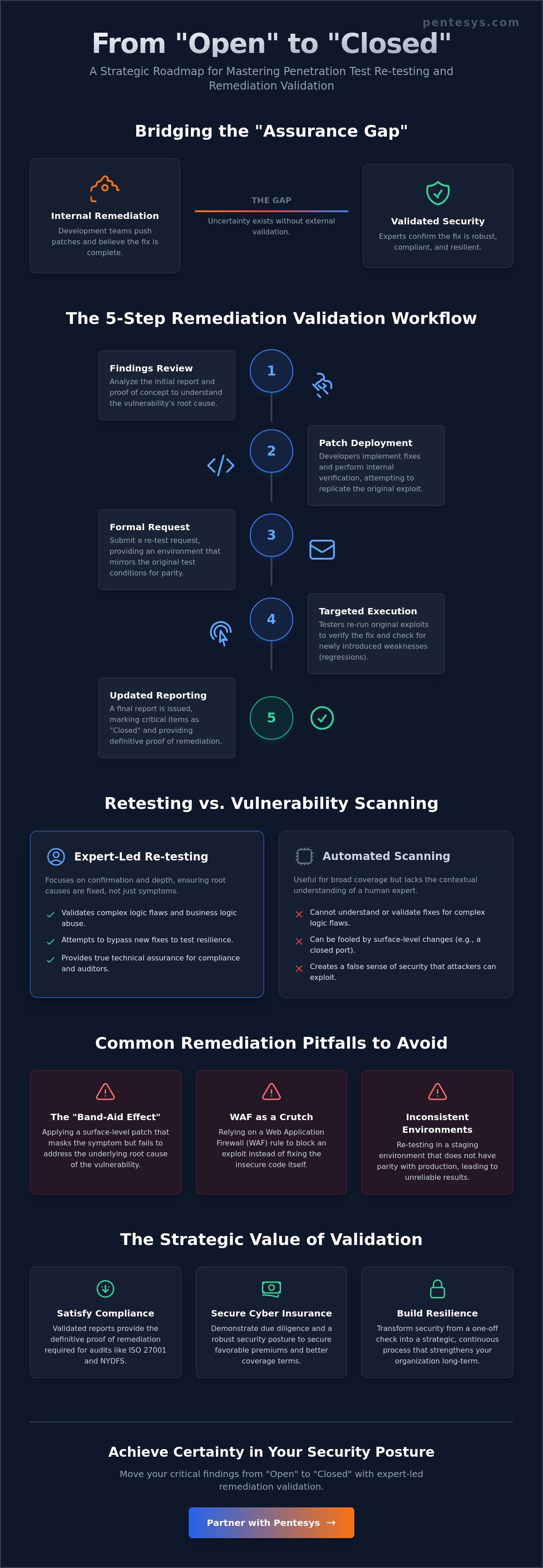
Between the moment a developer pushes a patch and the moment a tester confirms it, an “Assurance Gap” exists. Internal teams might believe a fix is solid, but without external validation, there’s no technical certainty. The primary goal is to move every critical finding from an “Open” status to “Remediated” in your final audit trail, providing a clear record of due diligence. Organisations can choose between a full re-test, which evaluates the entire environment for regressions, or a targeted remediation check that focuses solely on the specific vulnerabilities previously identified. Targeted checks are more common for routine compliance, while full re-tests are ideal for major architectural changes.
Retesting vs. Vulnerability Scanning
Automated vulnerability scans are useful for broad coverage, but they lack the depth required for true remediation validation. A scanner might report a “green” status because a specific port is closed, yet it can’t understand if a complex logic flaw still exists within your application code. Human intuition is vital here. A skilled tester will attempt to bypass the new fix, ensuring that the root cause was addressed rather than just masking the symptom. Relying on scans alone creates a false sense of security that sophisticated attackers can easily exploit.
The Role of the Remediation Window
Most security frameworks suggest a 30 to 90 day remediation window for addressing findings. This timeframe allows your development team to integrate security patches into their standard Software Development Life Cycle (SDLC) without disrupting planned sprints. Within the penetration test re-testing process, timing is everything. If you wait too long, the environment may have changed so much that the original findings are no longer relevant. For low priority items, your organisation might choose “risk acceptance”, documenting why a fix isn’t immediate while focusing resources on critical and high risk threats. This structured approach ensures that security remains a managed, ongoing process rather than a one off event.
A Step-by-Step Technical Workflow for Remediation Validation
Executing a successful security update requires more than just pushing code. To move from vulnerability to certainty, the penetration test re-testing process transforms from a simple checklist into a rigorous validation loop. This structured approach ensures that security fixes are not merely cosmetic but fundamentally robust against sophisticated attack vectors. By following a logical progression, your organisation can bridge the gap between development and security assurance.
For organisations looking to streamline this technical transition, engaging with a strategic ally like Pentesys can provide the high level certainty required to satisfy both technical and executive requirements.
- Step 1: Findings Review. Your team analyses the initial report, focusing on the specific proof of concept (PoC) provided by the tester. This phase involves understanding the root cause rather than just the surface symptom.
- Step 2: Patch Deployment. Developers deploy internal fixes and conduct their own verification. It’s vital that the development team attempts to replicate the original exploit before handing it back to the security experts.
- Step 3: Formal Request and Provisioning. Once internal verification is complete, you submit a formal request for re-testing. This includes providing an environment that mirrors the original test conditions.
- Step 4: Targeted Execution. The security tester executes the original exploits to verify the fix. They don’t just check if the vulnerability is gone; they check if the patch has introduced new weaknesses.
- Step 5: Updated Reporting. The tester issues a final report, ideally marking all critical items as “Closed.” This document serves as your definitive proof of remediation for stakeholders and auditors.
The Importance of a Consistent Test Environment
Parity is the foundation of a reliable re-test. If the testing occurs in a staging environment that differs in version or configuration from the initial assessment, the results lose their technical authority. Version mismatches often lead to false negatives, where a vulnerability appears fixed simply because the underlying code is different. You must provide testers with updated credentials, API keys, or network access that matches the original scope to ensure the results remain valid and actionable.
Evidence-Based Verification Methods
A professional re-test relies on documented proof of failure. Testers use logs and screenshots to demonstrate that the original exploit no longer functions. However, expert validation goes further by testing “around” the fix. This ensures that a flaw hasn’t simply been moved to a different parameter or masked by a temporary configuration. By Leveraging Re-testing for Compliance, you provide auditors with the evidence-based certainty they demand. The penetration test re-testing process ensures that every remediation step is technically sound and resilient against regression.
Common Pitfalls in Remediation and the Risk of Regression
Remediation is rarely a linear path. While the initial report provides a clear list of vulnerabilities, the way an organisation chooses to address them determines the ultimate success of the penetration test re-testing process. Many teams fall into the trap of the “Band-Aid Effect,” where a fix only addresses the specific symptom reported by the tester rather than the underlying root cause. If a developer patches a single input field to prevent cross-site scripting but leaves the rest of the application’s data handling unchanged, the system remains fundamentally insecure. Professional validation requires a more comprehensive look at how data is processed throughout the entire environment.
Another frequent obstacle is the over-reliance on Web Application Firewalls (WAFs) to “fix” findings. Implementing aggressive WAF rules might block the specific exploit used by the tester, but it doesn’t remove the vulnerability from the source code. In a CREST-level assessment, this is often flagged as partial remediation or a failure because the flaw still exists. By Optimizing Your Security Posture through code-level updates, you ensure that your defences don’t rely on a single, bypassable layer. True security is built into the application logic, providing a level of certainty that temporary configuration changes simply cannot offer.
Security patches also carry the risk of “Regression Bugs.” These occur when a security fix inadvertently breaks core business functionality. For instance, a strict new input validation rule might stop an exploit but also prevent legitimate users from submitting necessary information. This friction is why the penetration test re-testing process must be handled with technical precision. If a patch compromises the user experience, it’s likely to be rolled back or disabled, which leaves the organisation vulnerable once again. Balancing security requirements with operational stability is essential for long-term resilience.
Root Cause Analysis vs. Surface Patching
Developers should focus on underlying code patterns rather than localized fixes. Instead of patching one SQL injection point, the team should implement parameterized queries globally. This shift ensures that variant attacks can’t exploit the same flaw in a different location. Expert-led re-testing identifies whether a fix is robust enough to withstand these variations. It provides a clear narrative that the organisation hasn’t just hidden the problem but has actively improved its technical foundation.
The Collaborative Remediation Loop
Effective security isn’t a siloed activity. Our experts work directly with your engineering teams to clarify complex findings and provide actionable advice. This collaborative loop often includes interim check-ins before the formal re-test begins, which significantly reduces the friction between security auditors and developers. By aligning these teams early, you ensure that the final validation is a smooth, predictable transition. This partnership-driven approach turns a technical requirement into a strategic advantage for the entire business.
Leveraging Re-testing for Compliance and Cyber Insurance
Validation is the bridge between identifying a risk and officially mitigating it within a regulatory framework. For many UK businesses, re-testing is what maintains formal certifications and supports an insurance application. By closing the loop on technical findings, organisations demonstrate a mature approach to risk management that goes beyond simple identification. This phase provides the technical certainty that stakeholders and regulators demand in an increasingly scrutinized digital environment.
A “Clean Report” is often the final hurdle before a product launch or a successful audit. In government and financial supply chains, buyers often specify accredited testing, and retest evidence is commonly requested alongside the original report. These sectors require proof that vulnerabilities haven’t just been acknowledged, but have been effectively neutralised by experts. Beyond compliance, the results of a re-test serve as a vital KPI for board-level security reporting. It allows CISOs to move from discussing abstract threats to presenting concrete evidence of risk reduction and organisational resilience.
Retesting for ISO 27001 and SOC2
Auditors for ISO 27001 and SOC2 don’t just look for a list of bugs; they look for the “evidence of remediation.” The penetration test re-testing process satisfies ISO 27001 Requirement A.12.6.1, which focuses on Technical Vulnerability Management. This requires a clear audit trail from the initial discovery of a flaw to its final, verified closure. Without this documentation, an organisation may struggle to prove it’s managing its attack surface effectively. For a deeper look at how these standards intersect with technical assessments, see our guide on CREST Accredited Penetration Testing UK.
Satisfying Cyber Insurance Mandates
The cyber insurance market has shifted significantly in 2026. Insurers often ask for proof of fix rather than a simple list of vulnerabilities. A formal re-test report acts as a legal safeguard, demonstrating that the organisation took reasonable steps to secure its systems before any potential incident. Expert-led validation is consistently preferred over automated self-certification portals, as it provides a level of human intuition and technical authority that machines can’t replicate. This high-level certainty often leads to more favorable premiums and more robust coverage terms. To ensure your validation meets these rigorous standards, you can partner with Pentesys for expert-led remediation support.
What happens if a vulnerability fails the re-test?
If a vulnerability fails validation, it remains marked as “Open” or “Failed” in the final report. The tester will provide specific feedback on why the fix was unsuccessful, such as a bypass that still exists or a configuration error. Your team must then perform further remediation before requesting another check. This iterative loop ensures that the final audit trail reflects actual security improvements rather than just attempted ones.
Can we perform the re-test ourselves using automated vulnerability scanners?
Automated scanners cannot replace the manual penetration test re-testing process because they lack human intuition and the ability to test complex logic. While a scanner might confirm a closed port, it won’t identify if a sophisticated authentication bypass still exists. Professional validation requires a manual attempt to exploit the original finding to provide the high level certainty that auditors and insurers demand.
Can the same tester who found the bug also perform the re-test?
Having the same tester perform the validation is often preferred for technical continuity. They already understand the specific environment and the nuances of the original exploit, which makes the penetration test re-testing process more efficient. This consistency reduces the time spent on setup and ensures that the verification is as rigorous as the initial discovery phase.
Founder & CEO, Pentesys
James Hinton is the founder of Pentesys, a CREST-approved UK company working only on offensive security: penetration testing, PTaaS, CTEM, external attack surface management and red teaming. He built the business around one discipline rather than a broad consultancy menu, and most of his time still goes on how engagements get scoped, delivered and reported. He writes here about the practical side of security testing and what buyers should be asking for.
LinkedIn profile