

Overview
Customers and procurement teams increasingly ask for evidence of testing before they sign. Handing over the full technical report is rarely the right answer, because it contains reproduction steps for live issues. What most buyers actually need is confirmation that testing happened, who carried it out, what scope it covered, and that the findings were dealt with.
This guide will teach you how to leverage penetration test reports to provide absolute security certainty to your clients. You’ll learn to move beyond static, periodic evaluations toward a model of continuous assurance and human-led expertise. Your partners are looking for reliability and peace of mind rather than just a list of bugs. We will outline a clear framework for security attestation that satisfies ISO 27001 and SOC2 requirements while building lasting trust. By the end of this article, you’ll know how to present your security efforts as a managed, ongoing process that prioritises long-term resilience over temporary fixes.
Defining the Pen Test Report as a Strategic Assurance Tool
A professional security assessment yields more than a list of vulnerabilities. It produces a formal document of validation that serves as a cornerstone for organisational trust. While many technical teams understand what a penetration test is in a functional sense, few leverage the final deliverable as a strategic asset. In the current landscape, a simple evaluation of your defences is no longer enough to satisfy sophisticated partners. They require high-level certainty that your infrastructure can withstand targeted pressure over the long term.
The role of the report has evolved significantly within the third-party risk management (TPRM) lifecycle. Organisations are moving away from reactive bug-hunting toward proactive security storytelling. A pen test report for client assurance serves as the narrative bridge between complex technical findings and the strategic outcomes your stakeholders value. It transforms raw data into a structured roadmap for resilience, demonstrating that your security posture is a managed, ongoing process rather than a series of one-off fixes.
The Shift from Technical Output to Business Asset
Modern compliance frameworks like ISO 27001 and SOC2 require rigorous evidence of security oversight. A well-structured report provides this evidence by detailing not just the flaws found, but the expert-led methodology used to discover them. We prioritise manual validation because human intelligence uncovers logic flaws and complex attack chains that automated tools consistently miss. This human-centric approach provides the reliability that high-stakes B2B partnerships demand. When you present a report backed by manual expertise, you offer a level of assurance that automated scans cannot replicate. It moves the conversation from “we ran a tool” to “we have verified our resilience.”
Who is the Audience for Security Assurance?
Effective reporting must address multiple audiences simultaneously. The technical team requires granular detail to drive remediation, yet the Board of Directors needs a clear understanding of organisational risk. A professional pen test report for client assurance balances these needs by pairing technical depth with business-centric language. External auditors and procurement departments look for specific markers of rigor, such as adherence to NIST CSF 2.0 or PCI DSS 4.0 standards. They want to see that your scope was comprehensive and your testing was performed by qualified specialists. By addressing the specific concerns of client-side decision-makers, the report becomes a tool for accelerating deal cycles and solidifying market position.
Essential Components of a High-Assurance Pen Test Report
A high-quality pen test report for client assurance functions as a definitive record of security validation. It’s not a mere output of automated scanning; it’s a structured communication tool that defines the boundaries and the rigor of the assessment. By adhering to industry-standard reporting guidance, organisations demonstrate a commitment to transparency that builds immediate trust with partners. Utilising CREST accredited penetration testing UK ensures the report meets these high expectations for quality and technical accuracy.
The structure of the report must facilitate a logical progression from high-level risk to granular technical detail. This methodology ensures that the document remains useful throughout the entire remediation lifecycle. It begins with a clear definition of scope, establishing exactly what was tested and the specific constraints of the engagement. Without this foundation, stakeholders cannot accurately judge the depth of the security certainty you’re providing.
The Executive Summary: The Non-Technical Anchor
The executive summary serves as the primary communication point for the C-suite. It translates complex exploits into business impact, moving away from technical jargon to focus on strategic risk. A professional summary includes a “Security Posture Score,” providing a high-level benchmark that stakeholders use to track progress over time. It also identifies the “path of least resistance” found by testers, giving leadership a clear view of where an attacker is most likely to succeed. This clarity allows for informed decision-making without requiring a deep technical background.
Detailed Findings and Evidence
Precision in the technical section is what separates a premium report from a generic scan. Every vulnerability must include a proof-of-concept (PoC) to demonstrate exactly how a flaw can be exploited. This evidence distinguishes between a “theoretical risk” and an “exploitable reality,” preventing the technical team from wasting resources on false positives. Manual expert commentary is essential here; it provides the context that automated tools lack, explaining why a specific vulnerability matters in the unique environment of your infrastructure.
The final component is a structured remediation roadmap. This section demonstrates a commitment to ongoing resilience by prioritising fixes based on their CVSS score and their specific business context. If you’re looking to enhance your security documentation, consider how a specialized security assessment can provide the depth your clients require. This roadmap ensures that the report isn’t just a point-in-time evaluation, but a catalyst for long-term improvement.
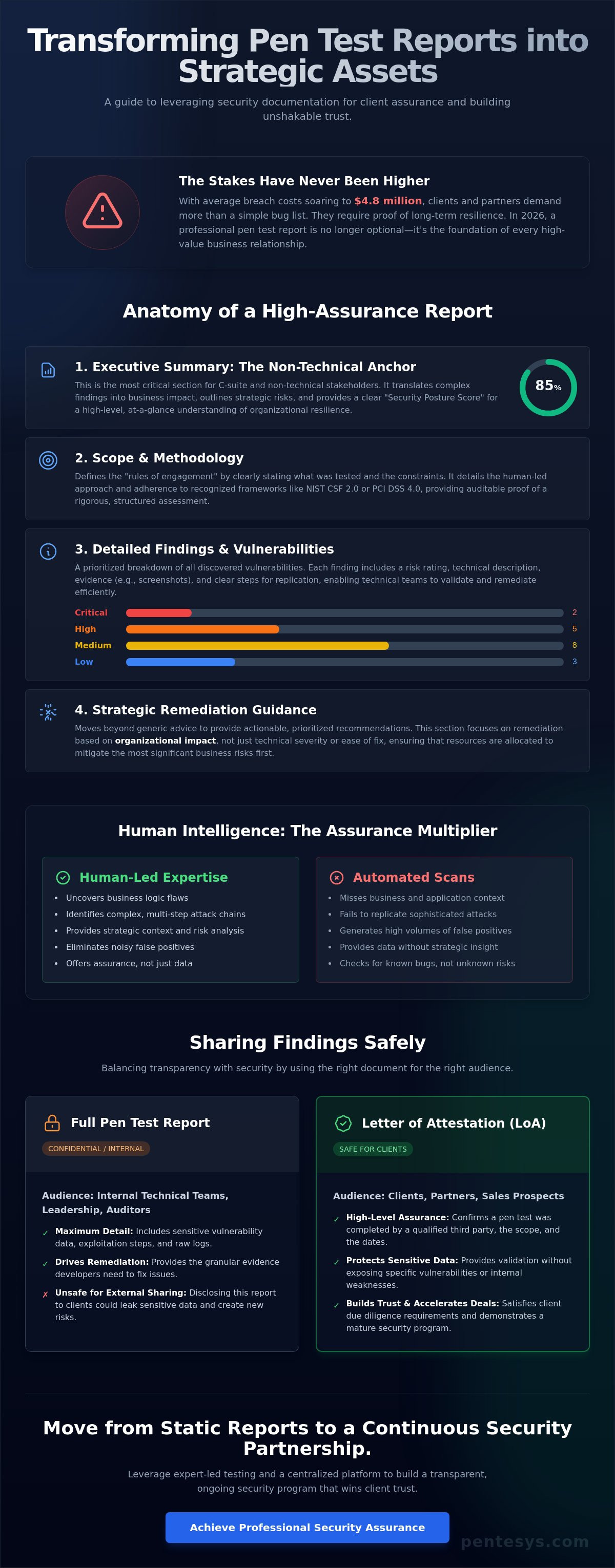
Sharing Findings Safely: Full Reports vs. Letters of Attestation
Managing the disclosure of vulnerability data is a delicate exercise in risk management. You need to prove your resilience to partners without handing them a blueprint of your internal weaknesses. A well-structured pen test report for client assurance allows you to provide this validation through tiered disclosure. Most stakeholders don’t require the granular details of every exploit; they need a formal statement that the testing was rigorous and the remediation is underway. By following NIST guidance on security testing, you ensure that the underlying methodology is sound, which adds weight to whatever level of documentation you choose to share.
A Letter of Attestation (LoA) serves as a solution to the transparency dilemma. It provides the necessary certainty while keeping your technical infrastructure details secure. This approach satisfies the majority of external requests by focusing on the validity of the process rather than the specifics of the findings. It transforms the pen test report for client assurance from a potential liability into a strategic communication tool.
The Anatomy of a Letter of Attestation
A professional LoA is a concise document that focuses on the qualifications of the testing team and the scope of the engagement. It includes the testing window, the methodologies employed, and a high-level summary of the results. This document is the preferred standard for Cyber Essentials Plus and various external audits because it confirms that a rigorous assessment took place without exposing sensitive data. Clients can validate these documents through secure verification channels, ensuring that the assurance you provide is both credible and current.
When is a Full Technical Report Necessary?
Full technical reports are typically reserved for deep-level due diligence in high-stakes industries like finance or healthcare. When these documents are required, you should use secure portals and strict NDAs to maintain control over the data. This level of transparency is often a prerequisite for partnerships where the client shares significant liability. To maintain this trust over time, many firms are evolving their strategy to include cyber security services that offer real-time visibility into their security posture. This proactive model ensures that assurance is an ongoing state rather than a yearly event, providing a higher level of certainty for critical business relationships.
The Remediation Roadmap
Effective remediation begins with clear ownership and accountability. You must assign specific vulnerabilities to the technical teams responsible for the affected systems, whether they’re managing cloud security assessments or API endpoints. Setting realistic timelines is equally vital; critical flaws require immediate intervention, while lower-risk issues can be scheduled based on resource availability. This structured approach prevents the “Ease of Fix” trap, where teams prioritise simple tasks over the complex changes that actually reduce organisational risk. The successful execution of this roadmap serves as the ultimate proof of a maturing security posture that prioritises long-term resilience over temporary fixes.
Continuous Monitoring vs. Annual Snapshots
The “one and done” approach to security testing is becoming obsolete in 2026. Annual snapshots offer limited value in an environment where new vulnerabilities emerge daily and infrastructure changes are constant. By integrating findings into your existing vulnerability management platform, you create a living record of your security status. This transition toward continuous validation provides ongoing assurance to stakeholders, moving away from periodic evaluations toward a steady state of reliability. It ensures that your security posture remains a managed, transparent process that evolves alongside the threat landscape.
If you’re ready to move beyond static reporting and implement a proactive defence strategy, our vulnerability management services provide the ongoing oversight and expert-led validation your organisation requires.
Expert-Led Validation, Not Just Automated Output
We distinguish our services through a recurring contrast between manual, expert-led evaluation and standard automated processes. While tools are useful for initial discovery, they lack the human intuition required to identify complex logic flaws or creative attack chains. Our testers provide actionable advice tailored to your specific environment, whether we’re conducting a Cloud Security Assessment or Infrastructure Penetration Testing. This human-centric approach ensures that the advice you receive is practical and impactful. Pentesys Limited bridges the gap between technical teams and executive decision-makers by pairing specialized execution with language that focuses on organisational value.
Can I share my full penetration test report with a prospective client?
Sharing a full technical report is generally discouraged because it provides a blueprint of your internal vulnerabilities. A professional pen test report for client assurance is typically delivered as a Letter of Attestation or a redacted summary. You should reserve full reports for high-stakes partnerships where a strict NDA and secure portal are in place to control data access.
How long is a pen test report valid for client assurance purposes?
Most industry standards consider a report valid for 12 months, though this period is shrinking as organisations move toward continuous testing models. Regulations such as the NYDFS Cybersecurity Regulation mandate annual testing to maintain compliance. If significant changes occur in your infrastructure, you should conduct a fresh assessment to ensure your assurance remains current and reliable.
What is a Letter of Attestation in cybersecurity?
A Letter of Attestation is a formal document signed by your security provider that confirms a penetration test was performed within a specific scope and timeframe. It provides the high-level certainty clients need without disclosing sensitive technical details or specific exploit paths. This document is the standard for satisfying third-party risk management requirements while protecting your internal infrastructure.
Founder & CEO, Pentesys
James Hinton is the founder of Pentesys, a CREST-approved UK company working only on offensive security: penetration testing, PTaaS, CTEM, external attack surface management and red teaming. He built the business around one discipline rather than a broad consultancy menu, and most of his time still goes on how engagements get scoped, delivered and reported. He writes here about the practical side of security testing and what buyers should be asking for.
LinkedIn profile