

Overview
Scope decides what a test can possibly find. Methodology, tooling and the seniority of the tester all operate inside that boundary. A well-run engagement against the wrong assets still tells you nothing about the thing that gets you breached.
This covers building an asset inventory that reflects reality, deciding what to exclude and why, choosing how much information to hand over, and setting testing windows that do not collide with your release schedule. It also covers the scoping mistakes that cost days.
The Strategic Foundation of Penetration Test Scoping
Scoping is the most critical phase of any security assessment. It’s the process of defining the specific boundaries, objectives, and constraints of your engagement. When you understand how to scope a penetration test, you ensure that your investment targets the areas of highest risk rather than wasting resources on low-value assets. This phase acts as the primary driver for both project cost and the eventual security value you receive. A precise scope provides the technical team with a clear roadmap while giving your leadership team confidence in the results.
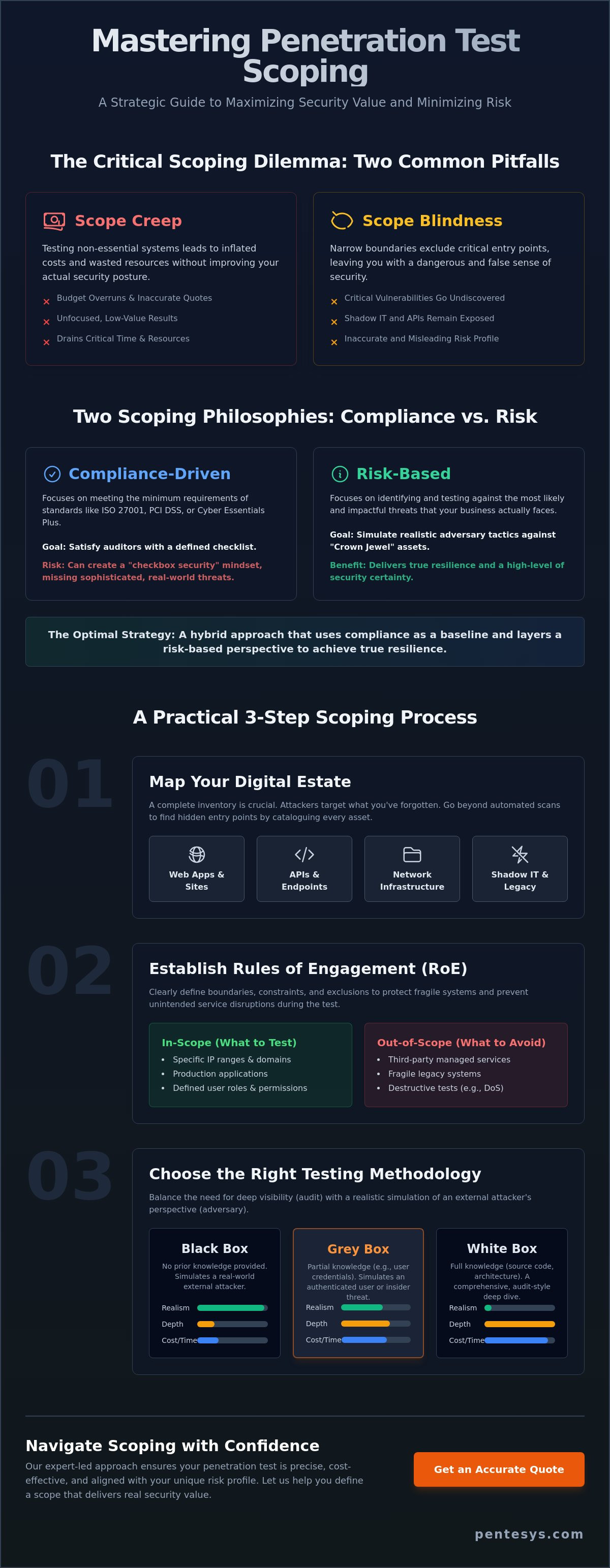
A poorly defined scope leads to two distinct problems. First, “scope creep” can inflate costs by including non-essential systems that don’t contribute to your overall security posture. Second, “scope blindness” occurs when narrow boundaries exclude critical entry points, such as forgotten development servers or third-party integrations. By establishing a clear primary driver, such as a mandatory compliance audit, a major software release, or a response to an emerging threat, you can maintain control over the project’s direction. This clarity allows a penetration test to be a surgical strike against vulnerabilities rather than a broad, unfocused scan.
Compliance vs. Risk-Based Scoping
Many UK organisations begin their scoping journey with compliance in mind. Understanding the requirements for CREST accredited penetration testing UK is vital for meeting industry standards and building trust with partners. Frameworks like ISO 27001 and PCI DSS often dictate a minimum viable scope for your audit. However, relying solely on compliance checkboxes can leave you vulnerable to sophisticated attacks. A risk-based approach moves beyond static lists to address real-world adversary tactics. This strategy ensures your assessment provides high-level certainty and long-term resilience rather than a simple evaluation of technical controls. Balancing these two perspectives is the key to knowing how to scope a penetration test that satisfies both auditors and security experts.
Technical Asset Identification and Inventory Mapping
Mastering how to scope a penetration test begins with a meticulous inventory of your digital estate. An incomplete asset list is one of the most common reasons for security failures. Attackers don’t limit themselves to your primary website; they often target the systems you’ve forgotten. This includes “shadow IT”, legacy servers, or abandoned development environments that still reside on your network. We move beyond basic automated discovery by using expert-led evaluation to help you identify your true external attack surface. This manual approach ensures that no hidden entry point is left unexamined, providing a level of certainty that simple software tools cannot match.
Cataloguing Web Applications, APIs, and Infrastructure
When categorising web applications, you should look beyond the main URL. It’s vital to count the number of static versus dynamic pages and identify the complexity of various user roles, as each role presents a different attack vector. APIs require similar scrutiny. You must identify all endpoints, review documentation like Swagger or OpenAPI, and verify authentication methods. For infrastructure, it’s essential to distinguish between internal server ranges and external-facing IP addresses. The PCI SSC penetration testing guidance provides a structured framework for defining these boundaries accurately. If you’re unsure where your perimeter ends, our external attack surface monitoring service can provide the necessary visibility to secure your environment.
Identifying Critical Data Paths and Special Category Data
Security testing should always follow the data. You must trace how sensitive information flows through your applications to understand where it’s most vulnerable. This is particularly important when handling special category data under UK GDPR. Your scope must account for the specific protection of this high-risk information to ensure full compliance. Determine if your assessment requires deep database testing, back-end cloud storage reviews, or API security evaluations. By focusing on these critical data paths, you ensure that your security efforts align with both legal requirements and your organisation’s operational risks. This methodical mapping transforms a generic test into a high-value strategic asset that protects your reputation.
Defining Testing Boundaries, Constraints, and Exclusions
Setting boundaries ensures that a security assessment remains a controlled exercise rather than a disruptive event. When learning how to scope a penetration test, you must establish clear Rules of Engagement (RoE). These rules dictate the techniques allowed, the specific targets, and the communication channels used during the engagement. This structured approach prevents unintended service disruptions and maintains the integrity of your production environment. It’s especially vital to identify “fragile” systems early. Legacy hardware or poorly documented applications can sometimes react unpredictably to standard testing payloads. By flagging these assets, you allow our experts to apply a more cautious, manual methodology that preserves uptime while still identifying vulnerabilities.
Distinguishing between technical and logical exclusions is another layer of strategic scoping. A technical exclusion might be a specific IP address that is currently being decommissioned or a server that is outside the current audit’s remit. A logical exclusion involves skipping a specific business process, such as a password reset flow that triggers high-volume SMS costs or a “delete account” function in a live production database. Clear definitions here ensure the technical team understands the operational limits of the assessment.
Establishing Out-of-Scope Assets and Third-Party Dependencies
Modern digital estates rarely exist in isolation. You likely rely on third-party SaaS providers or cloud hosting environments like AWS, Azure, or GCP. Understanding how to scope a penetration test in these environments requires knowing which assets you have the legal authority to test. Most major cloud providers have specific policies regarding security evaluations. Some require prior notification, while others permit testing within defined limits. You must secure legal authorisation for any asset you do not physically own. If your application relies heavily on a third-party API, you need to decide if that provider’s security is within your scope or if it remains a documented dependency that is excluded from active testing.
Determining Testing Windows and Operational Constraints
Timing is a strategic choice. Testing during business hours allows you to evaluate how your internal teams and monitoring systems respond to an active threat. However, out-of-hours testing is often preferred for high-traffic systems to minimise the risk of user impact. We recommend setting explicit start and end dates to maintain project momentum and ensure resources are allocated effectively. Your scope should also define emergency contact procedures and “Stop Test” triggers. If a system becomes unresponsive or a critical alert is triggered, both parties must know exactly who to call and when to pause activity. This level of preparation provides the peace of mind that your security posture is being improved without compromising operational stability.
Selecting the Optimal Testing Methodology for Your Scope
Methodology selection is a pivotal moment in determining how to scope a penetration test. The level of information you share with your testing partner directly impacts the depth of the manual exploitation phase and the eventual project cost. While an adversary-first perspective provides a realistic view of how an external threat actor might approach your perimeter, it must be balanced with an efficiency-first audit. This ensures that the technical team doesn’t spend valuable time on basic discovery that you could have provided upfront. A well-chosen approach ensures that the high-level certainty we provide translates into actionable resilience for your organisation.
Black Box, Grey Box, and White Box Approaches
The methodology you choose defines the starting point of the engagement. A Black Box test simulates an external attacker with zero prior knowledge of your systems. It’s excellent for testing your external perimeter and incident response, but it can be time-consuming for complex applications. Grey Box testing is often considered the “sweet spot” for web applications and APIs. By providing credentials, you allow testers to bypass the login screen and focus on the authenticated areas where your most sensitive data resides. For high-security internal applications, a White Box approach provides full architectural and code-level access. This allows for maximum security assurance by uncovering deep-seated logic flaws that might be missed during a more restricted assessment.
Transitioning from Periodic Testing to Continuous Monitoring
A scope agreed twelve months ago describes an estate that no longer exists. If you deploy regularly, the practical answer is to keep discovery running continuously through external attack surface management, so that when you next scope a test you are working from what is actually exposed rather than from a spreadsheet. CTEM formalises that into a repeating cycle rather than a one-off exercise.
The Expert-Led Scoping Workshop
The Pentesys Limited scoping call is a structured dialogue focused on technical clarity and business value. During this session, we’ll ask specific questions regarding your user roles, API documentation, and the sensitivity of the data being processed. These details are essential for defining a precise Statement of Work (SoW). A well-crafted SoW acts as a conceptual anchor for the project, ensuring all parties agree on the objectives and constraints. We also help you justify the chosen scope to your board or auditors by providing high-level certainty that the assessment aligns with your organisational risk profile. This collaborative process ensures that the final plan is both defensible and high-value.
How long does it typically take to scope a standard web application test?
Scoping a standard web application test typically requires a 30 to 60 minute technical workshop followed by 24 to 48 hours to produce a formal Statement of Work. During this phase, we discuss the number of user roles and the complexity of dynamic pages. This structured timeline ensures we capture all requirements accurately before the engagement begins.
Do I need to notify my cloud provider (AWS/Azure) before testing begins?
You generally don’t need to notify major cloud providers like AWS or Azure for standard penetration testing of your own instances, as they’ve pre-authorised many common testing activities. However, you must still adhere to their specific “Rules of Engagement” policies. It’s vital to verify the latest provider documentation during the scoping phase to ensure your testing remains compliant with their terms of service.
Can I change the scope of the penetration test once the testing has started?
You can change the scope of a penetration test after it’s started, though this requires a formal change control process or an addendum to the original Statement of Work. If our experts discover the environment is more complex than initially anticipated, we’ll discuss the implications with you immediately. This transparent approach prevents surprises and ensures the final report remains accurate and actionable.
What information should I have ready before I contact a pen testing provider?
Before contacting a provider, you should have a clear inventory of your target assets, including IP ranges, web application URLs, and the number of user roles. Understanding how to scope a penetration test effectively involves identifying your primary drivers, such as a specific compliance requirement like PCI DSS. Having documentation for APIs, such as Swagger files, also helps the technical team provide a more precise quote.
Is social engineering usually included in a standard infrastructure test scope?
Social engineering isn’t usually included in a standard infrastructure penetration test scope; it’s a distinct service that targets the “human element” of your security. While infrastructure tests focus on server configurations and network flaws, social engineering uses simulated phishing or physical site visits to test staff awareness. These services are often combined into a broader Red Teaming engagement for organisations seeking a more holistic assessment of their resilience.
What happens if the pen tester finds an asset that was not in the original scope?
If a tester identifies a vulnerable asset that wasn’t included in the original scope, they’ll pause and notify your primary point of contact immediately. You then have the option to formally expand the scope to include the new asset or document it as a separate finding for future investigation. Knowing how to scope a penetration test correctly from the start reduces these occurrences, but our partnership-driven approach ensures we handle such discoveries with professional assurance.
Founder & CEO, Pentesys
James Hinton is the founder of Pentesys, a CREST-approved UK company working only on offensive security: penetration testing, PTaaS, CTEM, external attack surface management and red teaming. He built the business around one discipline rather than a broad consultancy menu, and most of his time still goes on how engagements get scoped, delivered and reported. He writes here about the practical side of security testing and what buyers should be asking for.
LinkedIn profile