

Overview
The AICPA framework for SOC 2 doesn’t actually contain a mandatory requirement for penetration testing, yet failing to commission one is the fastest way to stall your UK audit. While the technical documentation remains ambiguous about testing frequency, your US-based clients and UK auditors certainly aren’t; they expect high-assurance, manual evidence that your controls can withstand a real-world attack. Understanding the specific SOC 2 penetration testing requirements UK organisations face in 2026 is no longer about checking a box. It’s about demonstrating a level of security maturity that automated scans simply cannot replicate.
We understand that the pressure to provide definitive proof of control effectiveness often leads to over-scoping and unnecessary spending. You need a clear path that distinguishes between basic vulnerability assessments and the audit-ready manual evaluations that satisfy the Trust Services Criteria. This guide provides a strategic breakdown of how to align your offensive security measures with current auditor expectations and the proposals in the Cyber Security and Resilience Bill. We’ll examine precise scoping strategies, the impact of the Data (Use and Access) Act 2025, and how to move from static evaluations to a proactive posture that secures your long-term resilience.
Is Penetration Testing a Hard SOC 2 Requirement in the UK?
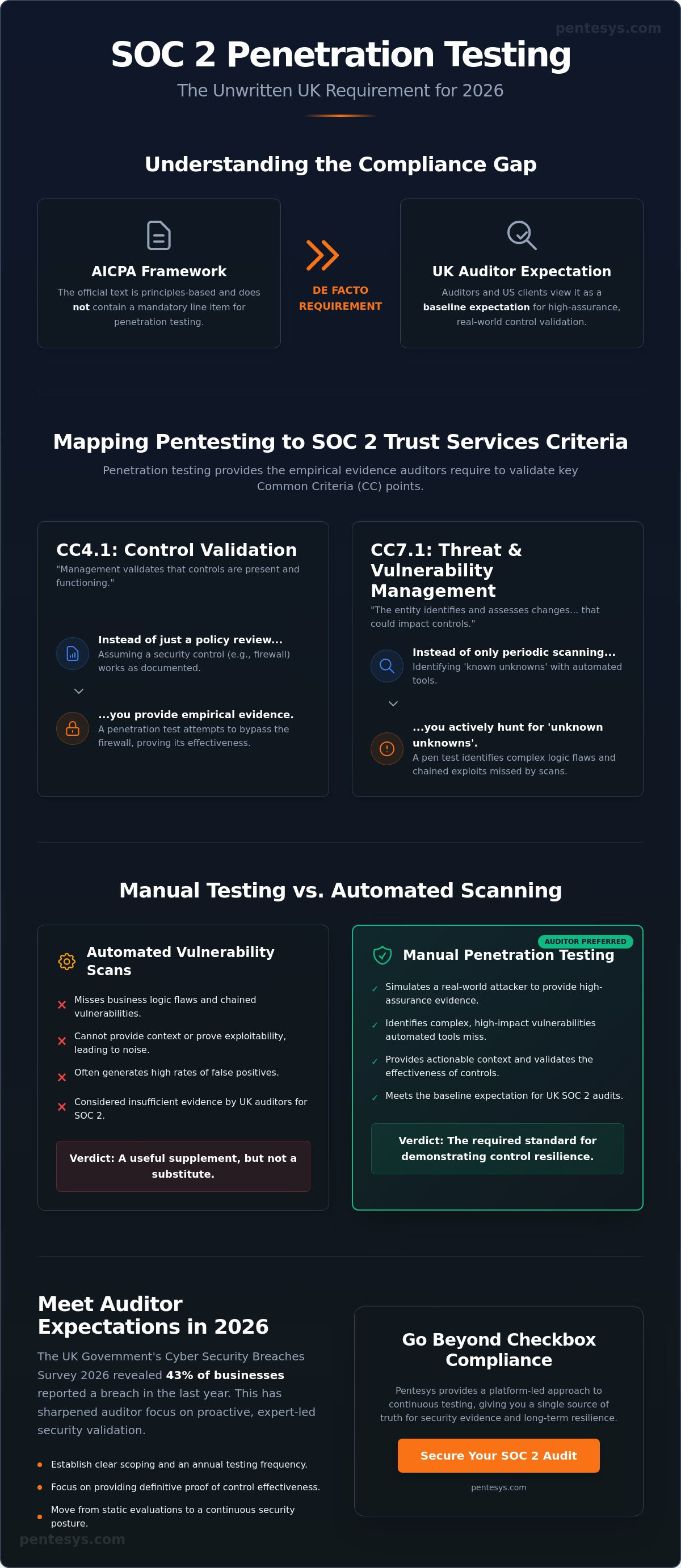
The short answer is that the American Institute of Certified Public Accountants (AICPA) does not explicitly list penetration testing as a mandatory line item. However, this technicality is often misunderstood by UK organisations preparing for their first audit. In the 2026 security landscape, meeting SOC 2 penetration testing requirements UK is treated as a baseline expectation by every reputable auditor. Without manual, expert-led validation, proving that your security controls actually work becomes an uphill struggle.
The framework is built around the Trust Services Criteria (TSC), specifically the ‘Security’ or Common Criteria. These criteria demand that an organisation identifies and assesses changes that could significantly impact the system of internal control. While the TSC doesn’t prescribe a specific tool, UK auditors almost universally require a penetration test to satisfy CC4.1 and CC7.1. They view it as the only definitive way to validate that your technical safeguards are functioning as described in your documentation.
Understanding the Principles-Based Framework
Unlike the prescriptive nature of standards such as PCI DSS, the System and Organization Controls (SOC) framework is principles-based. This means it focuses on outcomes rather than specific checkboxes. For a UK SaaS firm, this shift toward outcome-based evidence is significant. You aren’t just showing that you have a firewall; you’re proving the firewall prevents unauthorised access. Implied requirements often carry more weight during an audit because they represent the standard of care expected by your US clients and UK stakeholders.
The Auditor’s Perspective on Risk Validation
From an auditor’s viewpoint, independent third-party testing provides high-assurance evidence that internal teams might overlook. According to the UK Government’s Cyber Security Breaches Survey, breaches remain common among UK businesses. This reality has sharpened auditor focus. They now demand proof that you can identify ‘unknown unknowns’ within your environment. This is where SOC 2 penetration testing requirements UK become the primary vehicle for demonstrating control effectiveness.
Moving beyond a simple checkbox approach allows you to demonstrate long-term resilience. A manual penetration test explores complex attack vectors that automated tools miss, such as logic flaws or chained vulnerabilities. By choosing a partner who understands the offensive security landscape, you provide the high-level certainty auditors need. This process ensures your security posture is a managed, ongoing process rather than a static evaluation that becomes obsolete the moment the report is signed.
Mapping Pentesting to SOC 2 Trust Services Criteria (TSC)
The SOC 2 framework relies on the COSO internal control components to evaluate an organisation’s security posture. To satisfy SOC 2 penetration testing requirements UK, you must align your offensive testing activities with specific Common Criteria (CC) points. This mapping transforms a technical exercise into the high-assurance evidence auditors demand. It moves the conversation from “we have security” to “we have proven our security works.”
CC4.1: COSO and Control Validation
Criterion CC4.1 requires management to validate that controls are present and functioning. Traditional audits often rely on policy reviews, but 2026 threat vectors require more rigorous proof. Offensive testing, such as Infrastructure Penetration Testing, provides empirical evidence that your safeguards actually stop attackers. It’s the difference between assuming a lock works and attempting to pick it.
By simulating real-world exploits, you validate management’s assertions about system security. This aligns with the UK government’s penetration testing guidance, which emphasises that testing should be used to provide confidence in the effectiveness of security controls. In a cloud-native environment, this validation is critical. It proves that your configuration isn’t just correct on paper, but resilient against sophisticated intrusion attempts. Your auditor will look for this specific link between your COSO mapping and your technical results.
CC7.1 & CC7.2: Vulnerability Management and Response
Criteria CC7.1 and CC7.2 focus on the identification and communication of security deficiencies. SOC 2 auditors don’t expect a perfect environment; they expect a robust process for managing risk. A manual penetration test serves as the primary evaluation tool to identify exploitable flaws that automated tools frequently miss. It provides a deeper level of certainty than a standard scan.
Once the test is complete, CC7.2 mandates that these deficiencies are communicated to the appropriate parties in a timely manner. A high-quality report bridges the gap between technical findings and organisational oversight. It should include:
Using a centralised platform to track these findings ensures your evidence remains organised and accessible for the final audit. This methodical approach demonstrates that your vulnerability management is a managed, ongoing process. It provides the “Point in Time” evidence necessary to satisfy SOC 2 penetration testing requirements UK while building a foundation for long-term resilience. By documenting the full lifecycle of a vulnerability, from discovery to remediation, you provide the transparency auditors require.
- A clear breakdown of vulnerabilities mapped to business risk.
- A formal remediation plan that demonstrates management’s commitment to security.
- Evidence of re-testing to prove that critical flaws have been closed.
Manual Expert-Led Testing vs. Automated Scanning
Automated vulnerability scanners provide a useful baseline for security hygiene, but they fall short of satisfying the rigorous SOC 2 penetration testing requirements UK organisations face today. In 2026, auditors view automated-only reports with significant skepticism. A scan can identify missing patches or known software versions, but it cannot understand the unique business logic of your application. Relying solely on automation creates a false sense of security that often crumbles under the scrutiny of a high-assurance audit.
Manual, expert-led evaluation is now the premium marker of organisational maturity. It demonstrates to your US clients and UK stakeholders that you value human intelligence over the shortcuts of fully automated solutions. By commissioning a manual test, you provide your auditor with a narrative of certainty. You aren’t just presenting a list of potential flaws; you’re offering verified proof that your system’s defences are resilient against sophisticated, real-world attacks.
Why Automation Alone Fails the Audit
The primary limitation of automated tools is their high rate of false positives and negatives. Scanners lack the contextual awareness to assess complex authorisation flaws or broken access controls. For example, a scanner might see a functional API endpoint but fail to notice that an unauthenticated user can manipulate parameters to access sensitive data. These “logic flaws” are common targets for modern attackers and are a major focus for auditors in 2026.
Furthermore, an automated-only posture suggests a reactive approach to security. Auditors look for proactive, methodical evaluations that go beyond the surface level. If your security evidence consists only of automated PDF exports, you risk failing to meet the Trust Services Criteria related to ongoing system evaluations. Expert-led Web Application Penetration Testing ensures that these deeper, logic-based risks are identified and remediated before the auditor arrives.
The Value of Adversarial Intuition
Adversarial intuition is the defining factor in high-level security assessments. Human experts mimic the thought processes of real-world attackers. They don’t just follow a script; they explore hidden paths and chain together minor vulnerabilities that, individually, might seem low-risk. When these minor flaws are “chained,” they can lead to complete system compromise. This level of sophisticated analysis is exactly what satisfies the most demanding SOC 2 penetration testing requirements UK.
Our experts at Pentesys provide more than just a vulnerability list. We deliver a strategic security assessment that helps you understand the “real-world” impact of discovered flaws. This human-led approach ensures that your remediation efforts are focused on the areas of highest risk, providing the peace of mind that comes from knowing your environment has been tested by professionals who understand the current offensive security landscape. This methodical process turns your security posture into a managed, reliable asset for your business.
Scoping and Frequency: Meeting UK Auditor Expectations
Defining the ‘System Boundary’ is the first step in meeting SOC 2 penetration testing requirements UK. This boundary includes all infrastructure, software, and people that support the services in your report scope. While many organisations believe annual testing is the gold standard, it’s actually the absolute minimum. Rapid deployment cycles and frequent infrastructure updates in 2026 mean that a single point-in-time test often leaves gaps in your security evidence. Auditors expect you to demonstrate a managed, ongoing process rather than a one-off event.
Significant changes to your environment trigger an immediate need for re-testing. If you’ve migrated to a new cloud provider or overhauled your authentication logic, an outdated report won’t satisfy the Trust Services Criteria. Proactive organisations use these milestones to demonstrate resilience. This methodical approach ensures that your security posture remains reliable even as your technology stack evolves. To ensure your next audit is seamless, consider a professional Cloud Security Assessment to define your system boundaries with precision.
Defining an Audit-Ready Scope
An audit-ready scope ensures all technical assets within your system boundary are evaluated. Modern SaaS environments rely heavily on APIs and cloud-native services, which must be included in the assessment. Excluding these components creates a blind spot that auditors will quickly identify. We focus on a methodical approach that avoids scope creep while ensuring high-assurance coverage. Your testing should specifically include:
- External-facing infrastructure and network entry points.
- Web applications and customer-facing portals.
- API endpoints that handle sensitive data transfers.
- Cloud configuration and container orchestration layers.
The Importance of CREST Accreditation
SOC 2 is a US-born framework, but UK firms must satisfy local auditor expectations. Integrating CREST accredited penetration testing UK into your strategy provides a layer of formal assurance. This level of certification is often the deciding factor in satisfying SOC 2 penetration testing requirements UK for firms operating in highly regulated sectors. CREST accreditation simplifies the auditor’s review of your service provider by serving as a benchmark for professional standards and technical competence.
When an auditor sees a CREST-certified report, they have high-level certainty that the methodology follows industry-recognised best practices. This transparency builds trust with executive decision-makers and technical teams alike. By selecting a partner with formal accreditation, you ensure that your security evidence is both organised and dependable. This alignment between professional standards and reliable audit evidence is what defines a sophisticated security strategy in 2026.
Continuous Validation for SOC 2 Type II
A SOC 2 Type II report evaluates the operational effectiveness of controls over a specific observation window, typically lasting six to twelve months. A single point-in-time test at the start of this period doesn’t prove that controls remained effective throughout the entire duration. Continuous monitoring provides the persistent evidence auditors require to sign off on your Type II report with high-level certainty. It ensures that your security posture remains resilient even as your attack surface changes.
Using real-time security dashboards significantly reduces the compliance burden that typically precedes an audit. The platform captures every manual evaluation and remediation step, creating a structured audit trail that is easy to follow. You won’t find yourself scrambling for documentation at the last minute. Instead, you present a mature vulnerability management process that demonstrates a proactive commitment to security, satisfying the most rigorous SOC 2 penetration testing requirements UK auditors demand.
Can a vulnerability scan replace a penetration test for SOC 2?
No, a vulnerability scan cannot replace a penetration test because it lacks the human intelligence required to exploit complex logic flaws. Scans are automated tools that identify known software versions with potential issues, while a pentest involves an expert attempting to chain vulnerabilities together to gain unauthorised access. Auditors specifically look for this manual validation to satisfy SOC 2 penetration testing requirements UK and provide high-level certainty.
What is the difference between Type I and Type II testing requirements?
Type I reports evaluate the design of your security controls at a specific point in time, whereas Type II reports assess their operational effectiveness over a period of 6 to 12 months. For a Type II audit, you must provide evidence that your testing and remediation processes were active throughout the entire observation window. This often requires more robust, persistent documentation than the single snapshot provided by a Type I assessment.
Does the SOC 2 pentest need to be performed by a CREST-accredited firm?
AICPA doesn’t strictly mandate CREST accreditation, but UK auditors and stakeholders view it as a vital benchmark for technical competence. Using a CREST-certified provider simplifies your audit because it provides formal assurance that the testing methodology follows recognised professional standards. It signals to your US clients and UK partners that your security assessment was conducted by a sophisticated, transparent expert with verified offensive security skills.
Founder & CEO, Pentesys
James Hinton is the founder of Pentesys, a CREST-approved UK company working only on offensive security: penetration testing, PTaaS, CTEM, external attack surface management and red teaming. He built the business around one discipline rather than a broad consultancy menu, and most of his time still goes on how engagements get scoped, delivered and reported. He writes here about the practical side of security testing and what buyers should be asking for.
LinkedIn profile