

Overview
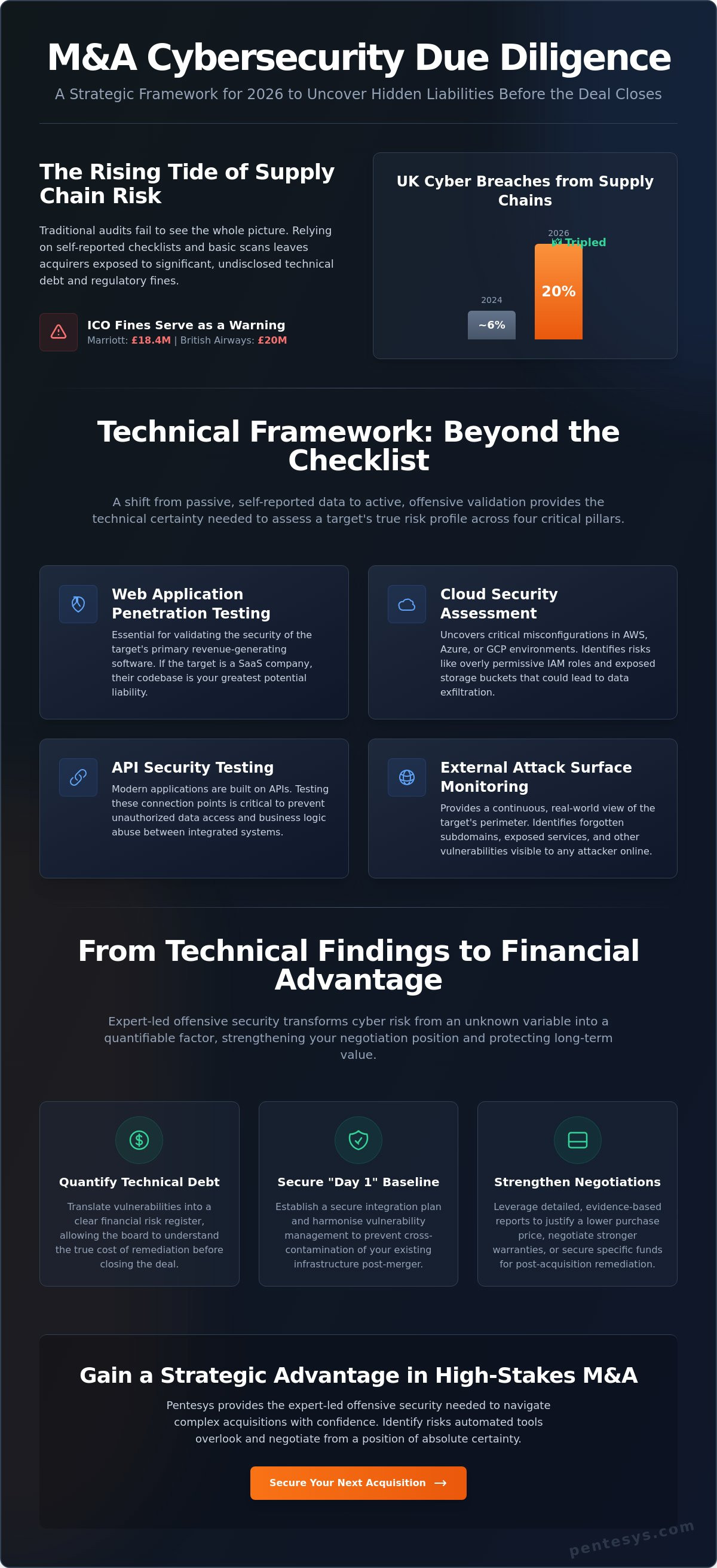
UK cyber breaches increasingly originate within the supply chain. When you’re in the middle of a high-stakes acquisition, this statistic isn’t just a number; it’s a warning that your target’s hidden technical debt could become your most expensive liability. Executing effective M&A cybersecurity due diligence uk requires more than a cursory review of a seller’s self-reported checklists. You need to identify precisely where the vulnerabilities lie before the deal’s signed.
We understand the pressure of the deal room. It’s difficult to quantify the cost of fixing a target’s security flaws when automated scanners provide inconsistent, surface-level reports. You’re likely concerned about inheriting a major data breach, like the ones that led to headline ICO fines against Marriott and British Airways. This guide will show you how to navigate complex acquisitions with confidence. We’ll help you identify hidden technical liabilities and accurately quantify cyber risks so you can negotiate from a position of absolute certainty.
We’ll explore a strategic framework for 2026 that aligns with the Money Laundering and Terrorist Financing (Amendment) Regulations and the Cyber Security and Resilience Bill. You’ll learn how expert-led offensive validation, including infrastructure penetration testing and external attack surface monitoring managed through a central platform, provides the clarity needed for accurate valuation and long-term resilience.
The Strategic Role of Cybersecurity Due Diligence in UK M&A
M&A cybersecurity due diligence uk is a focused technical audit designed to map the security posture of a target organisation’s digital footprint. It moves beyond financial and legal audits to examine the integrity of code, cloud configurations, and network architecture. In 2026, this process has become central to the broader due diligence process, as technical liabilities now carry significant weight in corporate valuations. A target’s security flaws are no longer just IT issues; they’re financial liabilities that can erode the value of an acquisition overnight.
Modern deal-making requires a deep dive into AI integrations and cloud-native infrastructure. We’ve seen a shift where simple compliance checklists are no longer sufficient to protect an acquirer’s interests. Instead, offensive security validation, such as Web Application Penetration Testing, provides the technical certainty needed to assess a target’s true risk profile. These findings don’t just inform the IT team. They directly shape the negotiation of warranties and indemnities, ensuring that the buyer isn’t left holding the bill for the seller’s past negligence.
Why Traditional Audits Fail in Modern M&A
Self-reported security questionnaires often present an optimistic, and sometimes inaccurate, view of a target’s resilience. These documents, paired with automated scanners, frequently miss sophisticated vulnerabilities that a human expert would find. Relying on these tools leads to “buyer’s remorse” when hidden breaches come to light after the deal closes. The UK regulatory environment, including the NIS Regulations and the Cyber Security and Resilience Bill now before Parliament, has increased the stakes. Non-compliance or inherited breaches can result in substantial ICO fines, making surface-level audits a dangerous shortcut that fails to account for the actual attack surface.
The ROI of Offensive Security During the Deal Cycle
Conducting offensive security assessments like Red Teaming or Cloud Security Assessments early in the cycle identifies potential deal-breakers before you commit significant capital. This proactive approach turns security from a cost centre into a powerful negotiation tool. If a target has significant technical debt, you can use our detailed reports to justify a lower purchase price or set aside specific funds for remediation. Most importantly, it prevents the target’s vulnerabilities from spreading to your own infrastructure. This ensures a secure transition on “Day 1” and protects your reputation from the fallout of a post-acquisition breach.
Technical Assessment Framework: Beyond the Compliance Checklist
Effective M&A cybersecurity due diligence uk requires a shift from passive observation to active validation. While financial audits examine the books, technical diligence must scrutinise the code and the perimeter. This framework prioritises offensive testing across four critical pillars: Web Applications, Cloud Infrastructure, APIs, and the External Attack Surface. We focus on these areas because they represent the most common entry points for attackers and the primary sources of technical debt. By validating these layers, you move beyond the limitations of self-reported questionnaires and gain an accurate view of the target’s security posture.
Web Application Penetration Testing is essential for validating the security of the target’s primary revenue-generating software. If the target operates a SaaS model, that codebase is their most valuable asset and your greatest potential liability. Simultaneously, a Cloud Security Assessment uncovers misconfigurations in AWS, Azure, or GCP environments that automated tools often overlook. These gaps frequently include overly permissive IAM roles or exposed storage buckets that could lead to data exfiltration. Integrating ICAEW cybersecurity guidance into your corporate finance strategy ensures these technical findings are correctly weighted alongside traditional financial risks.
API Security Testing evaluates the integrity of third-party integrations and data exchange points, which are often the weakest links in a modern software supply chain. We also employ External Attack Surface Monitoring to identify “shadow IT” or forgotten assets that the target’s IT team may have lost track of during periods of rapid growth. Identifying these hidden entry points is a core part of our methodology at Pentesys, where we prioritise human intelligence over automated shortcuts.
Offensive Testing Methodologies for Target Evaluation
Choosing between black-box and grey-box testing depends on your due diligence timeline. Black-box testing simulates an outside attacker with zero prior knowledge, while grey-box testing provides our experts with limited credentials to find deeper logic flaws. Manual, expert-led testing is non-negotiable here. Scanners find common vulnerabilities, but they can’t replicate the intuition required to exploit complex business logic errors. This approach also allows us to evaluate the target’s “Detection and Response” maturity by observing how their internal teams respond to our adversarial simulations.
Prioritising High-Value Digital Assets
Not all data carries the same risk profile. We focus our testing on the target’s Intellectual Property (IP) and customer data repositories to ensure maximum impact during the deal cycle. This includes assessing proprietary codebases and the security of their software supply chain. For institutional-grade assurance, many UK firms now require crest accredited penetration testing uk. This accreditation serves as a benchmark for technical competence and ethical conduct, giving you the high-level certainty needed to proceed with the transaction or adjust your valuation accordingly.
Quantifying Technical Debt and Security Liabilities
Finding a vulnerability is only the first step. To influence a deal, you must translate technical findings into financial reality. We define ‘Technical Security Debt’ as the total projected cost required to remediate inherited vulnerabilities and bring the target’s infrastructure up to your internal standards. In the context of M&A cybersecurity due diligence uk, this debt represents a hidden liability that can significantly impact the net value of an acquisition. If a target’s systems aren’t ‘fit for purpose’ for your specific risk appetite, the cost of alignment must be accounted for before the deal closes.
This quantification process directly affects warranties and indemnities (W&I) insurance in the UK. Insurers are now more sophisticated; they frequently request detailed technical reports to determine premium levels or to exclude specific known risks from coverage. By presenting a clear financial risk register to the board, you bridge the gap between specialized security execution and corporate objectives. It allows decision-makers to see security not as an IT hurdle, but as a manageable financial variable within the transaction.
The Financial Impact of Inherited Vulnerabilities
Calculating the true cost of remediation involves more than just software licenses. You must estimate the man-hours required for engineering teams to re-architect insecure cloud environments or patch proprietary codebases. Capital expenditure for immediate post-deal hardware or cloud upgrades often surprises buyers who rely on surface-level audits. There’s also the persistent threat of regulatory fines. Under the UK GDPR, inheriting a pre-existing breach can lead to substantial penalties. Recent history shows the scale of this risk, with the ICO issuing substantial fines against British Airways and Marriott for historical failures. Legacy systems present another hidden liability, as unpatchable assets often require expensive, isolated environments to remain operational without compromising the wider network.
Leveraging Findings in Deal Negotiation
A detailed remediation roadmap serves as a powerful tool for price adjustments or holdbacks. If our Cloud Security Assessment or Infrastructure Penetration Testing reveals significant flaws, these findings provide the evidence needed to renegotiate the purchase price. You can also set clear security milestones as conditions for deal completion, ensuring the seller addresses high-risk vulnerabilities before you take ownership. A quantified risk report acts as a technical lever by converting abstract vulnerabilities into a concrete financial ledger, allowing for precise price adjustments based on verifiable data.
The Transition: From Pre-Deal Diligence to Post-Merger Integration
The completion of a deal is often viewed as the finish line, but for security teams, it marks the start of a critical transition. Successful M&A cybersecurity due diligence uk provides the roadmap, yet the actual work of preventing network cross-contamination begins on Day 1. You must establish a security baseline that isolates the target’s environment until you’ve verified its integrity. This prevents a single compromised asset in the newly acquired company from moving laterally into your core infrastructure. It’s a methodical process of containment and verification.
Harmonising vulnerability management processes is the next logical step. You need a unified view of risk across both organisations. We recommend implementing continuous penetration testing to monitor the combined attack surface in real-time. Unlike periodic audits, this persistent approach ensures that new vulnerabilities introduced during the integration are identified and remediated before they can be exploited. Once the networks are unified, Red Teaming serves as the ultimate validation of your defensive posture. This simulates a full-scale attack to test the combined entity’s response capabilities under realistic conditions.
Securing the Integration Phase
Immediate technical actions are required to stabilise the environment. This includes rotating administrative credentials, conducting thorough firewall audits, and synchronising identity management systems. Once you have full access to the target’s estate, a post-deal deep-dive assessment is essential. This deeper look often reveals legacy systems that were hidden during the pre-deal phase. You should identify and decommission these redundant or high-risk systems quickly to reduce your overall attack surface. To secure your next integration, explore our infrastructure penetration testing services.
Bespoke Testing for the Deal Cycle
We understand that the deal room moves fast. Our team delivers rapid-turnaround assessments designed to fit within tight due diligence windows without sacrificing depth. We provide executive-ready reporting that translates complex findings from Infrastructure Penetration Testing or Cloud Security Assessments into strategic business impact. This allows your board to understand the financial implications of technical risks immediately. Our consultants work collaboratively alongside your legal and financial advisors. We ensure that our technical findings integrate seamlessly into the broader M&A cybersecurity due diligence uk process, providing a unified front during high-stakes negotiations.
How much access does a security firm need to the target’s systems during pre-deal diligence?
Pre-deal diligence often begins with external assessments that require no direct access to the target’s internal network. For a deeper evaluation, such as a Cloud Security Assessment, we require limited, read-only credentials to review configurations. This “grey-box” approach allows our experts to identify logic flaws and misconfigurations without disrupting the target’s operations or compromising sensitive data during the sensitive pre-close phase.
What are the most common security ‘deal-breakers’ found during M&A?
Common deal-breakers include active, undetected data exfiltration and the presence of unpatchable legacy systems that handle sensitive customer data. Significant non-compliance with the UK regulatory framework also serves as a major red flag. These issues often lead to substantial price adjustments or holdbacks, as the cost of remediation or potential ICO fines may outweigh the acquisition’s projected value.
How do we estimate the cost of remediating a target’s security flaws?
We estimate remediation costs by calculating the engineering man-hours required to fix identified vulnerabilities and the capital expenditure needed for infrastructure upgrades. This includes costs for re-architecting insecure cloud environments or replacing legacy hardware. By translating technical findings into a financial risk register, we help your board understand the technical debt they’re assuming and ensure these costs are factored into the final purchase price.
Founder & CEO, Pentesys
James Hinton is the founder of Pentesys, a CREST-approved UK company working only on offensive security: penetration testing, PTaaS, CTEM, external attack surface management and red teaming. He built the business around one discipline rather than a broad consultancy menu, and most of his time still goes on how engagements get scoped, delivered and reported. He writes here about the practical side of security testing and what buyers should be asking for.
LinkedIn profile