

Overview
AWS testing is largely an exercise in following permissions. Roles that can be assumed from somewhere unexpected, policies with wildcards in them, buckets whose policy contradicts their ACL, instance profiles reachable from a compromised application. It differs from traditional infrastructure testing because the attack surface is the control plane as much as the hosts.
This guide provides the strategic framework you need to move beyond automated checklists and achieve genuine cloud assurance. You’ll master the technical phases and strategic planning required to secure complex environments through sophisticated offensive testing. We provide a clear roadmap of the testing lifecycle, moving from initial scoping to the delivery of actionable insights via the Pentesys Portal. You’ll gain a firm understanding of the 2026 AWS policy updates. We also provide actionable advice on scoping for UK regulations, helping you manage costs based on your specific environment.
The AWS Shared Responsibility Model and Methodology Foundations
Effective cloud security begins with a precise understanding of where AWS’s duties end and your responsibilities begin. The Shared Responsibility Model dictates that while AWS manages the security “of” the cloud, you remain accountable for security “in” the cloud. This includes protecting your data, managing Identity and Access Management (IAM) configurations, and securing your operating systems. A robust aws penetration testing methodology must account for this boundary to ensure that testing stays within legal limits while providing comprehensive assurance for the assets you own.
As of April 2026, the AWS Customer Support Policy provides a clear framework for offensive testing. It’s no longer a matter of simply running a scan; it’s about validating the integrity of your specific implementation. A professional penetration test serves as a critical diagnostic tool in this process. By adopting a structured approach, we move beyond the limitations of automated tools to identify the logic-based vulnerabilities that often exist in the gaps between integrated services. This methodology prioritises long-term resilience over temporary fixes, providing the peace of mind that your enterprise-grade environment is truly secure.
Permitted Services for Testing
The 2026 AWS guidelines allow for the testing of most core services without prior notification. This includes EC2 instances, RDS databases, and Aurora clusters. We also conduct deep-dive assessments into serverless architectures like AWS Lambda and AppSync, alongside Edge services such as CloudFront and API Gateways. Because these services are often the entry points for modern adversaries, our methodology focuses on how these components interact. We ensure your external attack surface is mapped accurately, identifying misconfigurations that could lead to unauthorised data access or service disruption.
The Legal and Compliance Framework
Compliance in the UK requires more than just technical proficiency; it demands alignment with rigorous standards. Our methodology integrates CREST-accredited processes and maps findings to frameworks like ISO 27001 and the Data Protection Act 2018. While many activities are pre-authorised, certain high-impact simulations still require explicit approval. For example, any activity involving Command and Control (C2) infrastructure or simulated DDoS events requires a “Simulated Events form” submitted to AWS at least two weeks in advance. This structured preparation ensures all testing remains compliant with the Computer Misuse Act 1990, protecting your organisation from legal risk while delivering actionable insights through the Pentesys Portal.
The Technical Phases of an AWS Penetration Test
A sophisticated aws penetration testing methodology moves through a series of logical stages designed to mimic the lifecycle of a real-world adversary. Unlike simple vulnerability scans that provide a surface-level view, a technical assessment deep-dives into the configuration and logic of your cloud fabric. We align our processes with the NIST Technical Guide to Information Security Testing and Assessment to ensure every phase is methodical and repeatable. This structured approach moves from broad reconnaissance to targeted exploitation, providing a clear picture of your actual risk profile.
Discovery and Enumeration
The first phase focuses on mapping the external attack surface and identifying exposed assets. We hunt for misconfigured S3 buckets and publicly accessible EBS snapshots that could lead to immediate data leakage. Beyond storage, our team enumerates IAM users, roles, and groups to uncover overly permissive inline policies that violate the principle of least privilege. Mapping trust relationships between accounts is essential to understand how a vulnerability in a development environment might provide a bridge into production. This stage is about building a comprehensive map of your identities and assets before attempting any active exploitation.
Exploitation and Pivot Techniques
Once we identify potential entry points, we shift to active exploitation to validate the severity of each finding. This might involve simulating the compromise of an AWS Lambda function to determine if it can be used as a pivot point to access internal VPC resources. We also scrutinize the Instance Metadata Service (IMDS) for legacy v1 configurations, which remain a primary target for credential harvesting. By testing the resilience of VPC peering and Transit Gateway configurations, we determine if an attacker can move laterally across your network. This human-led analysis uncovers the complex attack paths that automated tools consistently miss.
The final technical stages focus on post-exploitation and detection bypass. We test data exfiltration techniques to see if sensitive information can be moved out of the environment without triggering alerts. We also evaluate the effectiveness of your logging and monitoring by attempting to bypass CloudTrail or GuardDuty detections. This provides a realistic assessment of your incident response capabilities. All technical data is then translated into actionable remediation guidance, which you can track in real-time through the Pentesys Portal to streamline your security operations. This transition from technical execution to strategic reporting ensures that stakeholders have the clarity needed to prioritise security investments effectively.
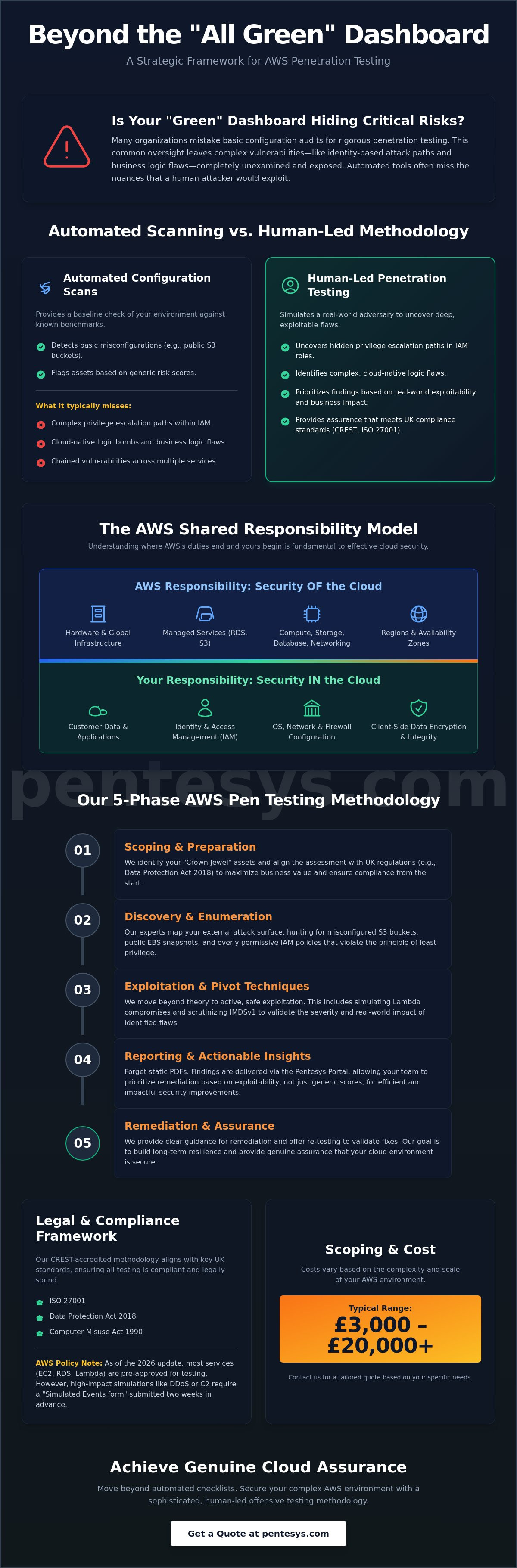
Automated Configuration Scanning vs. Human-Led Methodology
While automated scanners like AWS Inspector and Prowler offer a foundational baseline for security, they often fail to identify the nuanced vulnerabilities that a comprehensive aws penetration testing methodology reveals. These tools excel at flagging static misconfigurations, such as an open S3 bucket or an unencrypted volume. They lack the cognitive ability to chain together seemingly minor issues into a devastating attack path. A human-led approach provides the intuition required to find complex IAM logic bombs where permissions are technically valid but operationally dangerous. This distinction is critical for Building A Pentest Program that actually prevents breaches rather than just checking boxes.
What Automation Misses
Automation typically operates in silos. It misses vulnerabilities that only emerge when multiple services interact. A tool might see a Lambda function with read-only access to S3 as low risk. A human tester might discover that the specific data in that bucket contains environment variables for a separate production database. Identifying business-specific sensitive data stored in non-standard locations remains a purely human capability. A manual assessment also tests the effectiveness of your human response teams. We observe how your SOC reacts to a live adversary simulation. This provides a level of assurance that no automated report can match. Utilising CREST accredited penetration testing UK standards ensures these manual findings are verified by qualified experts.
The Synergy of PTaaS and Human Expertise
The most resilient organisations combine automated monitoring with manual deep-dive exercises. By adopting continuous penetration testing, you bridge the gap between static annual tests. This model uses automated discovery to flag changes in your environment, which then informs our targeted manual testing efforts. You maintain a real-time view of your attack surface through the Pentesys Portal. This moves your organisation away from point-in-time snapshots and toward a state of constant readiness. This strategic approach ensures that as your AWS environment evolves, your security posture scales alongside it. It transforms security from a chaotic event into a managed, dependable process.
Scoping and Preparation for Cloud Security Assessments
Scoping isn’t just an administrative step; it’s the strategic pillar of a successful engagement. A precise aws penetration testing methodology requires a granular understanding of your environment to ensure testing is both safe and effective. We begin by identifying “Crown Jewel” assets. These are the data points and services that would cause the most significant business impact if compromised, such as RDS instances containing sensitive customer records or S3 buckets holding proprietary code. By utilising your architecture diagrams, we map out these assets and their dependencies, ensuring the assessment covers the full breadth of your cloud footprint.
Determining the level of access is a key decision in the preparation phase. While Black Box testing mimics an external adversary with zero prior knowledge, White Box testing provides our team with architectural insights and documentation for a more exhaustive analysis. We often recommend a hybrid approach to maximise assurance. We also define testing windows with precision to avoid impacting production availability. AWS permits customer penetration testing against a defined list of services without prior approval, while some activities, such as simulated denial of service, still need to be requested in advance. Check the current policy at scoping rather than assuming.
Defining the Assessment Goals
Your goals must align with the specific threats your organisation faces. Whether you’re defending against ransomware or targeted data theft, we tailor the assessment to simulate these exact scenarios. We establish clear Rules of Engagement (RoE) that define the boundaries of the simulation, including specific IP ranges and permitted testing hours. It’s vital to ensure the scope covers all third-party integrations and APIs. Since many modern AWS environments rely on external SaaS providers, clarifying these touchpoints prevents the accidental testing of unauthorised infrastructure. To begin tailoring your assessment, contact our experts to define your testing scope.
Data Privacy and Special Category Data
In the UK, compliance with the Data Protection Act 2018 and UK GDPR is a core requirement of any security assessment. During a simulation, we ensure our testers have limited but sufficient access to validate vulnerabilities without unnecessarily exposing personal information. We maintain strict data handling protocols throughout the testing lifecycle to protect your organisation’s integrity. When we encounter special category data, such as health records or biometric information, the risk rating of a cloud finding increases significantly because the potential for severe regulatory penalties is substantially higher. This nuanced approach ensures that your remediation efforts are focused where they matter most for both security and compliance.
Do I need to notify AWS before starting a penetration test?
Notification is unnecessary for most core services like EC2, RDS, and Lambda as of April 2026. You only need to submit a Simulated Events form at least 14 days in advance for high-impact activities such as DDoS simulations, port flooding, or malware testing. This ensures your aws penetration testing methodology remains compliant with AWS legal policies while protecting the underlying cloud infrastructure.
What are the most common vulnerabilities found in AWS environments?
Identity and Access Management (IAM) misconfigurations remain the most prevalent issue, often involving overly permissive roles that allow for privilege escalation. Other frequent findings include legacy IMDSv1 configurations and unencrypted S3 buckets. These flaws often exist in the logical gaps between services, which is why human-led discovery is essential for identifying complex attack paths that automated scans miss.
Founder & CEO, Pentesys
James Hinton is the founder of Pentesys, a CREST-approved UK company working only on offensive security: penetration testing, PTaaS, CTEM, external attack surface management and red teaming. He built the business around one discipline rather than a broad consultancy menu, and most of his time still goes on how engagements get scoped, delivered and reported. He writes here about the practical side of security testing and what buyers should be asking for.
LinkedIn profile