

Overview
Most Azure findings worth having come from identity rather than networking. Managed identities holding more permission than anyone remembers granting, role assignments inherited at subscription scope, service principals with stale credentials. None of it looks wrong on a compliance dashboard, and all of it is a route to production data.
Security teams often feel overwhelmed by the volume of native cloud alerts. You likely share this frustration while facing pressure to satisfy ISO 27001 or cyber insurance mandates. It’s a common struggle to wonder if your current controls actually work against a sophisticated attacker or if they’re just satisfying a compliance checkbox.
This guide will help you evaluate and select the right assessment partner to secure your cloud environment against modern adversarial tactics. We’ll explore how to transform technical findings into a prioritised remediation roadmap and establish a repeatable process for continuous cloud assurance that provides lasting peace of mind.
Understanding Azure Security Assessment Services in the 2026 Threat Landscape
Professional azure security assessment services provide a methodical evaluation of your cloud environment to identify misconfigurations, identity flaws, and hidden vulnerabilities. Unlike a basic scan, this process scrutinizes the underlying architecture to ensure your defences are robust against modern adversarial tactics. In 2026, the baseline for security has shifted. Attackers now employ AI-augmented tools to perform rapid reconnaissance, identifying exploit paths across complex multi-tenant environments in minutes rather than days. This speed makes human-led validation more critical than ever before.
Relying solely on native dashboards like Microsoft Defender for Cloud often creates a false sense of security. While these tools provide valuable telemetry, they frequently lack the context of a real-world attack path. A dashboard might show a “secure” status for an individual resource, yet fail to flag how an adversary could chain together minor permissions to achieve a full tenant takeover. True operational resilience requires moving beyond “check-box” compliance toward a model of continuous assurance. It’s about knowing your controls work when they’re actually tested, not just when they’re configured.
The Evolution of Cloud Vulnerabilities
Cloud security has evolved far beyond the era of simple open storage buckets. Modern vulnerabilities often involve complex Entra ID (formerly Azure AD) permission chaining and the exploitation of gaps in the Shared Responsibility Model. As organisations adopt serverless functions and containerised workloads, the attack surface becomes increasingly identity-centric. Establishing a strong foundation in cloud computing security principles is essential, but validating those principles requires simulating the creativity of a human adversary. They look for the logical flaws that automated code alone cannot detect.
Regulatory and Insurance Drivers in the UK
For UK enterprises, the demand for rigorous validation is no longer optional. Meeting the stringent requirements for CREST accredited penetration testing UK has become a prerequisite for high-value contracts and supply chain assurance. Professional assessments are also vital for satisfying the updated cloud security controls within ISO 27001:2022. Cyber insurers also ask about cloud hardening and how it has been validated. They’ve recognised that most successful breaches stem from preventable misconfigurations that a professional assessment would have surfaced early.
Core Components of a Comprehensive Microsoft Azure Security Review
A comprehensive review isn’t just a checklist of settings. It’s a deep dive into how your environment handles real-world pressure. Leading azure security assessment services look beyond the surface. They analyse the relationships between your identity provider, your network controls, and your data storage. This holistic view is necessary because attackers don’t look at services in isolation; they look for the weakest link in the chain. We focus on validating that your security posture remains resilient when individual components are under stress.
Identity: The New Perimeter
Identity is the primary target in modern cloud breaches. A rigorous review examines Entra ID Conditional Access policies to find logical gaps or bypass opportunities. It’s not enough to have MFA; you must ensure it’s resistant to session hijacking and “fatigue” attacks. Adhering to the NIST access control guidance for cloud systems, assessments should validate Just-In-Time (JIT) and Privileged Identity Management (PIM) workflows. We also evaluate the blast radius of Managed Identities. If a single web app is compromised, can it reach your Key Vault? Auditing third-party application permissions and service principals is equally vital, as these often hold excessive, unmonitored privileges.
Infrastructure and Workload Hardening
Your workloads need specific, deep-tech validation. For Azure Kubernetes Service (AKS), this means reviewing pod security policies and container registry vulnerabilities. We also examine Azure SQL and Cosmos DB configurations to prevent unauthorised data egress. Since most cloud environments now use some form of automation, reviewing Infrastructure as Code (IaC) templates is a priority. This prevents recurring misconfigurations from being baked into your production environment from the start. Identifying these flaws early reduces the long-term cost of remediation.
Network, Data, and Detection
Network security architecture has moved away from simple perimeters. We evaluate the effectiveness of Network Security Groups (NSGs), Azure Firewall, and Private Link implementations to ensure true micro-segmentation. Data protection involves validating Key Vault management and ensuring storage accounts are hardened against public access. Finally, we look at your logging. If Microsoft Sentinel or Log Analytics aren’t tuned to detect specific adversarial tactics, they’re just generating expensive noise. You can strengthen your cloud assurance by ensuring your monitoring reflects actual threat models rather than generic alerts. This methodical approach ensures that every layer of your Azure environment is scrutinized by human intelligence.
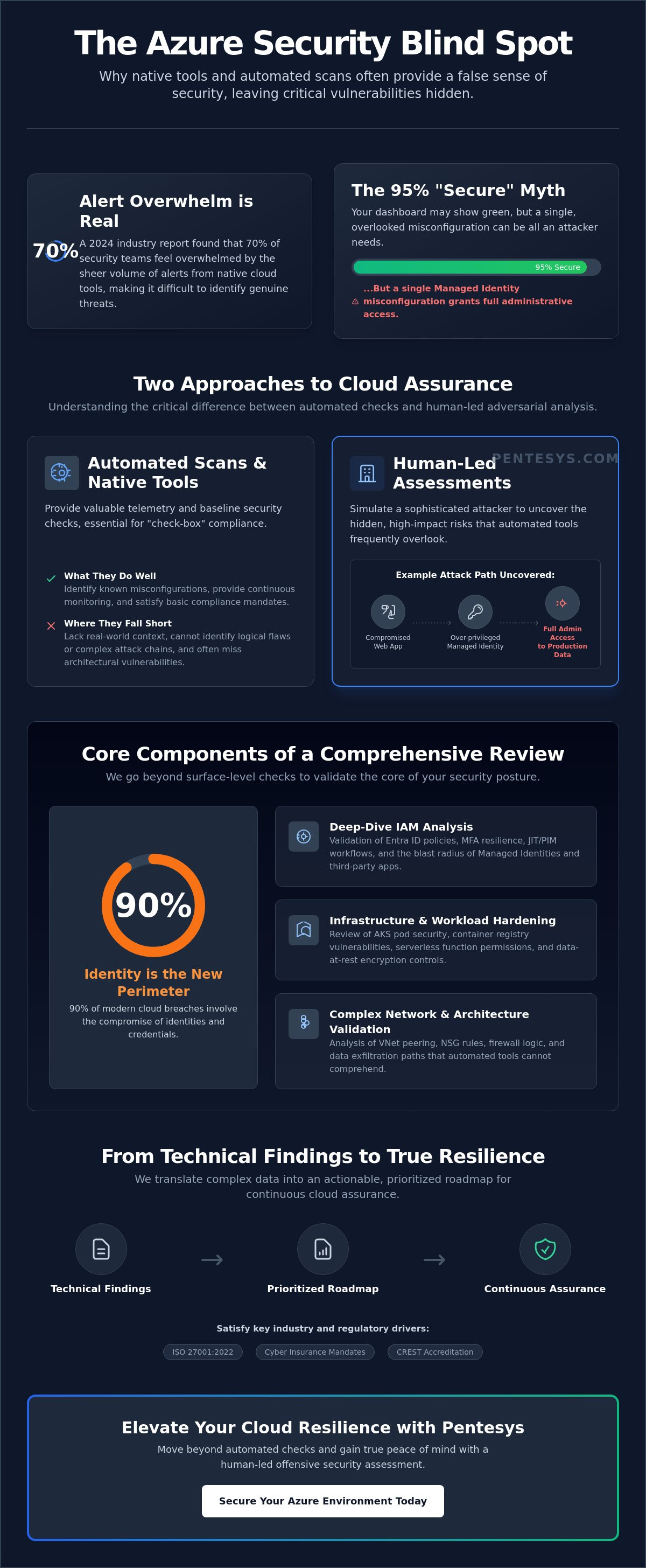
Automated Scans vs. Human-Led Offensive Assessments: Which Provides True Assurance?
Automated scanners are excellent at identifying missing patches or open ports, but they often struggle with the nuanced logic of cloud architecture. Fully automated tools routinely miss complex architectural vulnerabilities. These are the flaws that don’t trigger a standard alert but allow an attacker to move laterally through your environment. Professional azure security assessment services bridge this gap by applying human intuition to the testing process. Tools miss logic; humans don’t.
A human expert doesn’t just look for a misconfiguration; they look for a path. For example, a scanner might flag an over-privileged service account as a medium risk. An offensive tester, however, will attempt to use that account to access a Key Vault, extract a secret, and pivot from a low-privilege entry point to a Global Admin role. This type of adversary simulation provides the true validation that security controls are functioning as intended. It’s the difference between knowing a door is locked and knowing the wall next to it is made of paper.
The Role of Adversarial Simulation
Adversarial simulation goes beyond checking boxes against the CIS Benchmark. It applies red teaming principles to your Azure environment to test your detection and response capabilities. We identify unintended trust relationships between interconnected services, such as a Logic App that has been granted excessive permissions to an Entra ID tenant. This methodology reveals how an attacker would actually exploit your specific architecture rather than just listing generic vulnerabilities. It’s about testing the person and the process, not just the technology.
Why “Continuous” Trumps “Point-in-Time”
The traditional annual audit model is increasingly ineffective in a fast-moving DevOps environment where code is deployed multiple times a day. A single change in an ARM template can inadvertently expose sensitive data. Integrating continuous penetration testing into your cloud lifecycle ensures that your security posture evolves alongside your infrastructure. This approach provides your cloud engineers with actionable data in real-time. It moves your organisation away from static reports toward a model of constant assurance and resilience.
Strategic guidance is the final differentiator. A human-led assessment provides the context needed for effective remediation. Instead of a 200-page PDF filled with automated noise, you receive a prioritised roadmap. This ensures your team spends their time fixing the vulnerabilities that pose the greatest risk to your business operations. You gain a partner who understands your business goals, not just a tool that scans your IP addresses.
How to Evaluate Azure Security Providers: A Strategic Selection Framework
Selecting the right partner for azure security assessment services requires a framework that balances technical rigor with strategic business value. Many firms offer generic penetration testing, yet cloud-native environments demand a highly specialized approach. You should prioritise providers that demonstrate a commitment to industry-recognised standards and clear, actionable communication. The goal is to find a partner who acts as a sophisticated ally, not just a vendor delivering a list of problems.
Accreditations serve as the first essential filter. For UK enterprises, CREST and CHECK status are non-negotiable. These certifications ensure that the individuals performing your assessment have undergone rigorous technical examination and adhere to a strict code of ethics. UK CISOs increasingly prioritise CREST-accredited firms to meet supply chain assurance requirements and satisfy board-level risk concerns. Without these markers, you lack a baseline guarantee of technical competence.
The methodology must be transparent and comprehensive. A strategic provider uses the Microsoft Cloud Security Benchmark (MCSB) alongside the MITRE ATT&CK framework for Cloud. This combination ensures the assessment covers both defensive configurations and the actual techniques adversaries use to achieve persistence or exfiltrate data. It’s also vital to evaluate the team’s background. You need cloud-native security specialists who understand the intricacies of Azure logic, rather than generalist testers who apply on-premise mentalities to the cloud.
Vetting the Assessment Methodology
A robust methodology begins with the CIS Microsoft Azure Foundations Benchmark, but it shouldn’t end there. Ask potential providers if they use offensive cloud-specific tools and custom scripts to test your architecture. It’s essential to verify that post-exploitation simulation is included in the scope. This determines what an attacker can actually do once they gain an initial foothold. This level of detail provides a clearer picture of your true risk than a simple configuration check ever could.
A Sophisticated Methodology for Complex Clouds
We tailor every Azure assessment to your specific industry requirements and risk profile. A financial services firm requires a different testing focus than a global manufacturing entity. Our methodology integrates human intuition with our proprietary testing technology to identify the most critical exploit paths. We conduct our testing with a focus on stability, ensuring minimal disruption to your production environments. This methodical process allows us to provide deep insights without compromising your daily business operations.
Do we need to provide Global Admin access to the assessment team?
No, we don’t require permanent Global Admin access to perform our review. We typically request a dedicated account with “Global Reader” and “Security Reader” roles to conduct the initial analysis. For specific offensive testing stages, we use temporary, scoped permissions managed through Privileged Identity Management (PIM). This maintains the principle of least privilege throughout the engagement.
What deliverables should we expect at the end of the engagement?
You will receive a technical report, an executive summary, and full access to the Pentesys Portal. The portal acts as your central hub for tracking findings and remediation progress in real-time. Unlike a static 200-page PDF, our deliverables provide actionable data that your developers can use to fix vulnerabilities efficiently. This ensures the value of the assessment continues long after the testing phase ends.
Founder & CEO, Pentesys
James Hinton is the founder of Pentesys, a CREST-approved UK company working only on offensive security: penetration testing, PTaaS, CTEM, external attack surface management and red teaming. He built the business around one discipline rather than a broad consultancy menu, and most of his time still goes on how engagements get scoped, delivered and reported. He writes here about the practical side of security testing and what buyers should be asking for.
LinkedIn profile