

Overview
An automated security assessment might tell you that a control exists, but it cannot tell you if that control will actually hold under the pressure of a targeted attack. As supply chain breaches have quadrupled over the last five years, relying on static checklists is no longer a viable strategy for risk management. Professional third party security validation testing moves beyond the point-in-time audit to provide objective, offensive proof of your technical resilience. It’s the difference between assuming your perimeter is secure and knowing it can withstand a sophisticated breach attempt.
You likely feel the mounting pressure from regulators to provide more than just a passing scan, especially with the strict evidence requirements of DORA and NIS2 now in full effect. We understand that the distinction between a standard assessment and true validation often feels blurred when you’re managing complex vendor ecosystems. This guide will help you master the methodologies of independent validation to build a posture that’s both resilient and audit-ready. We’ll explore how human-led testing supports frameworks like ISO 27001 and SOC 2, while providing a clear framework to select the right validation methods for your specific infrastructure.
What is Third Party Security Validation Testing?
Third party security validation testing is the disciplined, independent execution of technical exercises designed to confirm that security controls perform as intended under adversarial conditions. It moves beyond the theoretical identification of vulnerabilities to provide empirical evidence of resilience. In an era where supply chain breaches have quadrupled, simply having a control in place isn’t enough; you must prove its efficacy. This process involves a range of technical exercises, such as Infrastructure Penetration Testing and Web Application Penetration Testing, to ensure that defensive layers aren’t just present but are actually impenetrable to known threat vectors.
While many organisations confuse this with a standard security assessment, the distinction is vital. An assessment identifies risks and catalogs vulnerabilities; validation proves whether those vulnerabilities can be exploited to reach critical assets. By utilising established Security Testing Methodologies, validation provides a higher level of certainty that is essential for executive decision-makers and regulatory bodies alike. This shift from “trusting the configuration” to “testing the outcome” is what defines a modern, resilient organisation.
Validation vs. Verification vs. Assessment
Understanding the nuances between these three pillars is fundamental to a mature security strategy. Verification focuses on technical checks to ensure a system is built according to its specifications; it asks if the system is built “right.” Validation determines if the system effectively stops threats in real-world scenarios, asking if we built the “right” system to achieve security outcomes. Assessment involves risk profiling to determine what potential threats exist and where they might strike. By combining these, organisations transition from a reactive posture to a state of continuous readiness, moving away from annual snapshots toward proactive, ongoing cycles of control testing.
The Role of Validation in UK Regulatory Compliance
The regulatory environment in 2026 demands objective scrutiny. Frameworks like DORA and NIS2 now mandate that financial and essential services entities maintain rigorous third-party oversight. This often requires CREST accredited penetration testing UK standards to ensure that the testing is performed by accredited professionals with verified skills. For those pursuing ISO 27001 or SOC 2, independent validation provides the “objective evidence” auditors require. It bridges the gap between internal claims and external reality, ensuring that your technical posture meets the high-level certainty expected by national and international standards. This independent status is critical; it removes the inherent bias of internal teams and provides a transparent view of your actual risk profile.
Adversarial Methods: How Validation Testing Works
Effective third party security validation testing operates on a simple premise: a control is only as good as its performance under fire. While standard audits rely on documentation, true validation adopts an offensive mindset to “test the test.” This approach moves beyond identifying missing patches to actively attempting to bypass existing defences. By simulating the tactics, techniques, and procedures of modern threat actors, organisations gain empirical evidence of their technical resilience. This level of scrutiny is essential given the critical need for auditing third-party access to organisational platforms, where a single misconfiguration can lead to widespread exposure.
Penetration testing serves as the primary tool in this validation process. It provides a structured, deep-dive evaluation of specific systems to confirm that defensive layers function as intended. For organisations seeking the highest level of assurance, Red Teaming represents the gold standard. Unlike scoped penetration tests, Red Teaming validates the entire ecosystem, including the efficacy of detection and response capabilities. It tests whether your internal security operations team can identify and neutralise a sophisticated intruder before they reach their objective. This human-led, adversarial approach ensures that security isn’t just a policy on paper but a functional reality.
Web Application and API Validation
Modern applications are often the most exposed part of the attack surface. Validation in this area requires offensive probing of input sanitization and authentication controls to ensure they can’t be circumvented. Automated tools frequently miss business logic flaws, such as the ability to manipulate pricing or access another user’s data through insecure direct object references. Expert-led API security testing is also vital for ensuring that third-party integrations don’t introduce transitive vulnerabilities. We focus on validating the actual outcomes of these controls, ensuring that your web assets remain resilient against targeted exploitation.
Infrastructure and Cloud Control Validation
Cloud environments in AWS and Azure present unique configuration challenges that require specialized validation. We rigorously test “Least Privilege” models to ensure that compromised credentials cannot be used for lateral movement within your network. This involves validating firewall configurations and network segmentation through manual attempts to bridge isolated zones. Additionally, external attack surface monitoring plays a key role in continuous validation. It provides a real-time view of your perimeter, ensuring that new assets or changes in configuration don’t create unintended entry points for attackers. This structured methodology ensures that your cloud infrastructure remains an audit-ready environment.
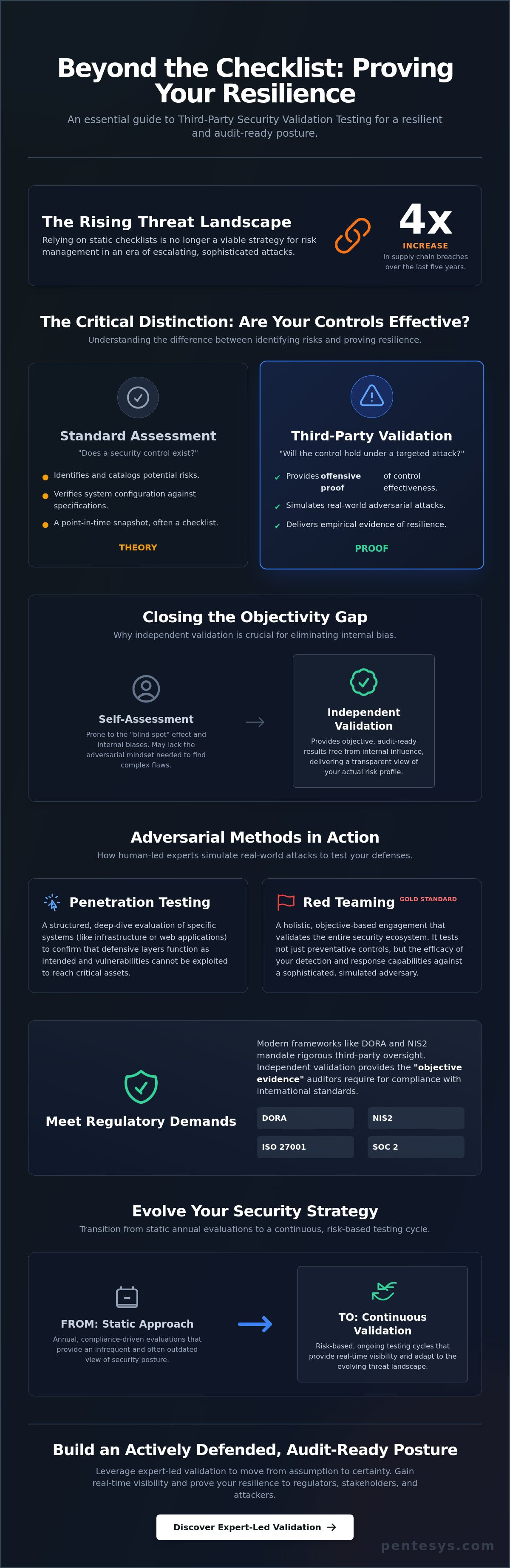
Third-Party Validation vs. Self-Assessment: The Objectivity Gap
Internal security teams often operate within an echo chamber. While these professionals possess deep institutional knowledge, they’re susceptible to the “Blind Spot” effect. This occurs when the same individuals who design and maintain a control are also tasked with testing its failure points. They’re likely to overlook subtle misconfigurations or logic flaws because they view the system through the lens of its intended function rather than its potential for exploitation. Professional third party security validation testing eliminates this inherent bias by introducing an objective, adversarial perspective that internal teams simply cannot replicate.
Relying on self-assessment is no longer sufficient in a high-stakes regulatory environment. Adhering to the NIST C-SCRM framework requires organisations to rigorously identify and mitigate risks throughout their supply chain. External validation from CREST-accredited specialists provides the technical authority needed to satisfy both internal stakeholders and external regulators. These validated reports also serve as a critical layer of defensibility for legal and insurance purposes. They provide empirical proof that your organisation took expert-led, reasonable steps to secure its infrastructure, which is a key requirement for modern cyber insurance underwriting.
The Limitations of Automated Validation Tools
Automated Breach and Attack Simulation (BAS) tools are useful for high-frequency, basic checks, but they’re a supporter, not a replacement for human intelligence. Clean automated scan reports often create a “False Sense of Security” by missing complex vulnerabilities that require lateral thinking. While automation covers the “known-knowns,” it lacks the depth required for true validation. To maintain a resilient posture, organisations should understand how Continuous Penetration Testing Explained provides a more comprehensive approach by combining persistent monitoring with expert-led manual probing. This ensures that logic flaws and transitive risks are identified before they can be exploited.
Expert-Led Validation: The Human Intelligence Factor
The true value of independent validation lies in human intuition. Skilled testers don’t just follow a checklist; they chain multiple low-risk vulnerabilities together to achieve a high-impact breach, mimicking real-world threat actor TTPs. This adversarial logic is something automated tools cannot replicate. By thinking like an attacker, human experts uncover the hidden pathways through your network that lead to critical assets. Furthermore, human-led reporting provides strategic value through context-aware remediation advice. We don’t just tell you what’s broken; we explain how to fix it within the specific context of your business operations and technical constraints.
Building a Third-Party Security Validation Roadmap
Establishing a structured roadmap for third party security validation testing ensures that your offensive security efforts align with your organisational risk appetite. A haphazard approach to testing often leads to wasted resources and overlooked vulnerabilities. By following a methodical progression, you move from reactive patching to a state of proactive resilience. This roadmap serves as a strategic blueprint, guiding your team through the complexities of modern supply chain oversight while maintaining a focus on technical certainty.
- Step 1: Define the Scope. Identify your most critical assets, sensitive data flows, and the third-party dependencies that touch them. You can’t validate every control simultaneously, so prioritise environments that handle high-value intellectual property or customer data.
- Step 2: Select the Cadence. Transition from static annual testing to risk-based continuous cycles. In 2026, the speed of deployment requires validation measures that keep pace with infrastructure changes rather than relying on a point-in-time snapshot.
- Step 3: Choose the Methodology. Align your testing methods to the specific risk profile of the asset. This might involve deep-dive Infrastructure Penetration Testing for core networks or Red Teaming to evaluate your detection and response capabilities against sophisticated intruders.
- Step 4: Execute and Remediate. Transform technical findings into actionable tasks within your Jira or DevOps pipelines. Security validation is only effective if it leads to measurable improvement in your defensive posture.
- Step 5: Re-Validate. Perform technical re-tests to prove that remediation efforts were successful. This closing of the loop is what provides the objective evidence required by auditors and stakeholders.
Scoping Validation for UK Enterprises
Scoping requires a nuanced understanding of your data landscape. For UK-based firms, identifying environments that process “Special Category Data” is a priority, as these require the most intensive validation to meet regulatory standards. We often balance “White Box” testing, where testers have full internal knowledge, with “Black Box” approaches to simulate an external attacker’s perspective. Defining clear Rules of Engagement (RoE) is essential during this phase. It ensures that testing remains rigorous while guaranteeing zero disruption to your business-critical operations. If you’re ready to secure your perimeter, our External Attack Surface Monitoring provides the real-time visibility needed to scope your validation efforts accurately.
Integrating Validation into the GRC Lifecycle
Technical validation shouldn’t exist in a silo; it must feed directly into your Governance, Risk, and Compliance (GRC) framework. We map validation results to specific ISO 27001 Annex A controls, providing the empirical proof that auditors demand. This evidence also helps with cyber insurance underwriters, who increasingly ask for proof of control efficacy at renewal. By automating the ingestion of findings into your risk management platforms, you create a transparent and repeatable process that supports long-term resilience and operational oversight.
Can automated tools replace manual third-party validation testing?
Automated tools cannot replace the human intuition required for effective validation. While scanners are efficient for identifying known vulnerabilities, they miss complex business logic flaws and chained exploits. Manual, expert-led testing simulates real-world threat actor tactics, providing a level of depth and contextual analysis that software alone cannot replicate. Human intelligence is essential for validating the effectiveness of sophisticated defensive layers.
What is the difference between security validation and a security audit?
A security audit focuses on compliance with policies and documentation standards. In contrast, security validation is an offensive technical exercise that proves whether those policies actually result in a secure environment. Validation tests the efficacy of the controls mentioned in the audit. It provides empirical proof of resilience rather than just administrative adherence to a specific framework or checklist.
Founder & CEO, Pentesys
James Hinton is the founder of Pentesys, a CREST-approved UK company working only on offensive security: penetration testing, PTaaS, CTEM, external attack surface management and red teaming. He built the business around one discipline rather than a broad consultancy menu, and most of his time still goes on how engagements get scoped, delivered and reported. He writes here about the practical side of security testing and what buyers should be asking for.
LinkedIn profile