
Overview
Organisations experience an average of 12 third-party breaches every year, a figure that persists despite the thousands of hours teams spend reviewing self-reported spreadsheets. Most security leaders are exhausted by the cycle of sending out questionnaires only to receive low-quality, optimistic responses that fail to quantify actual risk. You likely feel the pressure of NIST CSF 2.0 and its new focus on governance, yet you’re still struggling to provide the board with a clear picture of your supply chain’s vulnerabilities.
It’s time to move beyond the limitations of “trust but verify” and adopt a more rigorous methodology. This guide explains how to transform your vendor security assessment services into a proactive, technical strategy that prioritises offensive validation over simple paperwork. You’ll learn how to implement a repeatable framework that delivers higher certainty in your supply chain security and ensures demonstrable compliance for your next audit. We will detail the shift from static evaluations to a managed, expert-led approach that focuses on long-term resilience and measurable risk reduction.
What are Vendor Security Assessment Services?
A Vendor Security Assessment (VSA) is a formal, methodical process designed to evaluate the risk profile of third-party partners. It’s no longer enough to understand a vendor’s environment; you must validate the effectiveness of their security controls. While traditional audits often relied on static, self-reported data, modern vendor security assessment services provide a dynamic view of the risks inherent in your digital supply chain. The primary objective is to reduce the likelihood of a supply chain breach by identifying where a partner’s security posture fails to meet your organisation’s internal standards.
Effective oversight requires a clear distinction between business-level risk and specific technical vulnerabilities. Business risk might involve a vendor’s financial stability or geographical location, whereas technical vulnerability focuses on exploitable flaws in their web applications or cloud infrastructure. By utilising a structured security assessment framework, organisations can move from a state of uncertainty to one of high-level assurance, ensuring that every link in the chain is resilient against modern threats.
The Evolution of Third-Party Risk Management (TPRM)
The era of “check-box” compliance has ended. Adversaries now target the weakest links in the supply chain to bypass robust perimeter defences. This shift has forced the evolution of TPRM from periodic paperwork to ongoing technical validation. Adopting CREST accredited penetration testing UK standards ensures that assessments are conducted by experts with the technical depth to find real-world flaws. As organisations embrace digital transformation, the proliferation of SaaS platforms and APIs has expanded the external attack surface. Relying on outdated manual audits is a liability in an ecosystem where a single misconfigured API can expose sensitive data across multiple organisations.
Key Drivers for Professional Assessments in 2026
Regulatory pressure has become a primary catalyst for more rigorous oversight. Frameworks such as the Digital Operational Resilience Act (DORA) and the Telecommunications (Security) Act 2021 place obligations on in-scope firms to manage third-party risk. Whether either applies to you depends on your sector. Compliance is no longer optional; it’s a legal necessity. Additionally, the cyber insurance market has matured. Insurers frequently ask for proof of vendor oversight when underwriting policies, and some want technical evidence rather than policy documents alone. Protecting intellectual property and special category data in shared cloud environments requires a level of certainty that only professional vendor security assessment services can provide. This approach ensures long-term resilience by addressing the root causes of supply chain vulnerability rather than applying temporary fixes.
The Components of a Modern Security Assessment Framework
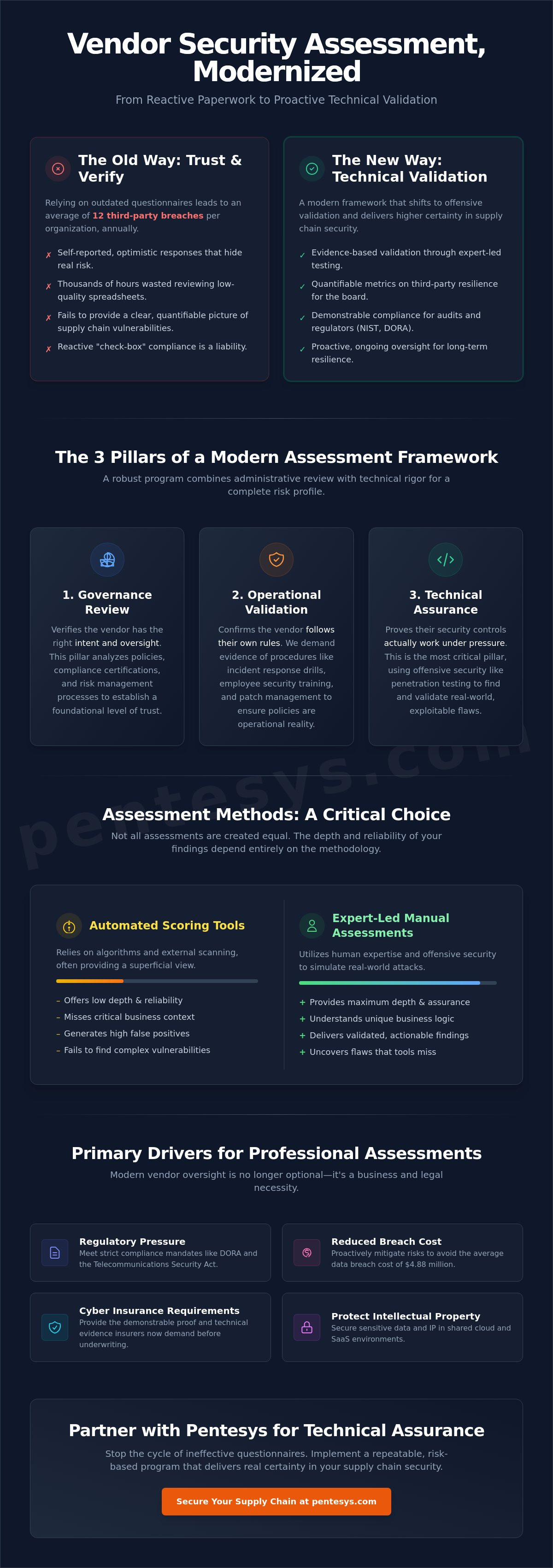
Modern vendor security assessment services must look past the surface level of policy documents to evaluate the actual operational reality of a partner. A robust framework rests on three critical pillars: Governance, Operational, and Technical. Governance ensures the vendor has the right intent and oversight. Operational checks confirm they follow their own rules. Technical validation proves their controls actually work. While many organisations rely on automated tools, comprehensive vendor security assessment services require a blend of administrative review and technical rigor to be effective.
Relying on a vendor’s self-assessment is a significant risk. Instead, organisations should demand evidence-based validation that matches the vendor’s specific level of access. If a partner handles sensitive personal data or has direct network connectivity, the assessment must be more intrusive than for a simple hardware supplier. This requires expert-led manual assessments to ensure the scope accurately reflects the potential impact of a breach. Security isn’t a point-in-time event. Integrating continuous penetration testing into the vendor lifecycle allows for real-time visibility into emerging risks. This proactive model replaces the annual audit with a steady stream of intelligence, ensuring that new vulnerabilities are identified before they can be exploited.
Governance and Policy Review
Assessments begin by evaluating formal certifications like ISO 27001, SOC 2, or Cyber Essentials Plus. These provide a baseline of maturity but aren’t the final word. It’s vital to review incident response plans and business continuity procedures to ensure the vendor can maintain service during a crisis. We also verify sub-processor management. Your data is only as secure as the weakest link in your vendor’s own downstream supply chain. This thorough review builds the foundational trust necessary for a long-term strategic partnership.
Technical Validation: The Offensive Edge
Pentesys advocates for direct technical testing of vendor-facing applications to move beyond theoretical security. This includes rigorous review of API security and identifying cloud configuration mismanagements that often lead to data exposure. By utilising external attack surface monitoring, we help organisations identify shadow IT and forgotten assets that vendors might have overlooked. This offensive edge provides the high-level certainty required to trust a third-party partner with your most critical assets. It’s about moving from a “trust but verify” mindset to one of technical assurance through offensive validation.
Automated Scoring vs. Expert-Led Manual Assessments
Modern risk management requires a clear distinction between broad visibility and deep technical certainty. Many organisations now utilise dedicated Third-Party Risk Management (TPRM) software. These platforms excel at providing rapid, automated “security ratings” based on public-facing data. However, few organisations consider their third-party risk mitigation efforts to be highly effective. This gap exists because automated tools often rely on superficial markers that fail to capture the complex, underlying vulnerabilities within a vendor’s internal environment.
Effective vendor security assessment services must strike a balance between the speed of automation and the precision of human intelligence. While a machine can scan for an outdated SSL certificate in seconds, it can’t replicate the intuition required to chain together minor configuration errors into a significant breach. Pentesys prioritises a methodology where human experts interrogate the logic of an application, finding flaws that automated scanners simply aren’t programmed to see. This approach ensures that your assessment results reflect real-world exploitability rather than just a checklist of theoretical concerns.
When to Rely on Automation
Automation serves as an excellent tool for scaling oversight across a vast supply chain. It’s particularly effective for managing hundreds of low-impact, Tier-3 vendors who don’t have access to your critical systems or sensitive data. You can use these tools for initial screening during the procurement phase or for continuous monitoring of basic hygiene markers like DNS health and certificate validity. This allows your team to maintain a baseline level of awareness without becoming overwhelmed by manual tasks for low-risk partners.
The Necessity of Manual Offensive Testing
Critical partners require a level of scrutiny that automation cannot provide. When a vendor handles sensitive customer data or integrates deeply with your infrastructure, vendor security assessment services must include manual offensive testing. Human specialists are essential for identifying sophisticated vulnerabilities such as Insecure Direct Object References (IDOR) or business logic bypasses. These flaws often reside in how an application processes specific user requests, which automated patterns frequently miss. Beyond just finding the flaw, manual testing provides actionable remediation advice tailored to the vendor’s specific architecture. This ensures that the partnership is built on a foundation of verified technical resilience, giving you the peace of mind that your most valuable assets are protected by more than just a passing automated score.
How to Build a Risk-Based Assessment Programme
Constructing a mature program requires moving from ad-hoc reviews to a structured, repeatable framework for vendor security assessment services. With many financial institutions employing only a small team to manage hundreds of vendors, efficiency is paramount. You can’t assess every partner with the same intensity. A risk-based approach ensures that your limited resources focus on the vendors that pose the greatest threat to your resilience. This aligns with the “Govern” function of NIST CSF 2.0, emphasizing that leadership must oversee third-party risk as a core business priority.
- Step 1: Inventory and Tiering. Categorize every partner based on their access to your sensitive data and critical systems.
- Step 2: Scoping. Define the technical and administrative boundaries of the assessment to ensure testing is relevant to the service provided.
- Step 3: Execution. Combine traditional questionnaires with technical adversarial simulations to validate security claims.
- Step 4: Remediation. Collaborate with the vendor to resolve identified vulnerabilities within an agreed, risk-appropriate timeframe.
- Step 5: Monitoring. Move away from point-in-time audits toward a model of continuous oversight and periodic re-testing.
Tiering Your Supply Chain
Effective vendor security assessment services rely on accurate tiering. High-risk vendors include those with access to special category data or direct connectivity to your production environment. Medium-risk partners might provide business-critical software without holding sensitive data, while low-risk vendors offer commodity services. For organisations in the UK, this tiering should align with NCSC guidance and, where applicable, the Cyber Assessment Framework (CAF) for Critical National Infrastructure. Using CREST-accredited providers for high-tier assessments ensures the technical depth required for these critical connections.
Establishing the Remediation Loop
Identifying a flaw is only half the battle; you must ensure it’s fixed. The remediation loop should be formalized within your contract negotiations and Service Level Agreements (SLAs). If a vendor fails to meet your security standards, you need a clear path for escalation or termination. Setting realistic but firm timelines for fixing critical vulnerabilities is a business necessity. You can enhance this process by using external attack surface monitoring to verify that promised fixes have been implemented correctly in the vendor’s public-facing infrastructure. This methodical approach transforms a simple audit into a strategic partnership that prioritises long-term supply chain security.
Expert-Led Penetration Testing for Vendors
Effective oversight requires a deep dive into the technical assets your vendors provide. Pentesys leverages specialized capabilities in Web Application Penetration Testing and Infrastructure Penetration Testing to uncover “unknown unknowns” within your third-party ecosystem. We don’t just identify flaws; we provide clear, actionable remediation guidance for your partners. This ensures that the technical burden of fixing vulnerabilities is met with expert support, reducing the time your team spends managing vendor follow-ups. This level of scrutiny is essential for vendors who integrate deeply with your internal infrastructure or cloud environments.
Can we perform penetration testing on a vendor’s platform without their consent?
You must never perform penetration testing on a vendor’s platform without their explicit, written consent. Unauthorised testing is illegal under the Computer Misuse Act and can disrupt the vendor’s operations. Instead, include “right to audit” and “right to test” clauses in your contracts. This formalizes the process and ensures that technical validation is conducted safely and within a defined legal framework that protects both parties.
What are the most common vulnerabilities found in third-party SaaS vendors?
SaaS vendors frequently exhibit vulnerabilities related to API security and broken access control. Common flaws include Insecure Direct Object References (IDOR) and misconfigured cloud storage buckets that expose sensitive data. These technical gaps often stem from rapid deployment cycles that prioritise functionality over security. Identifying these flaws requires expert-led manual testing rather than simple automated scans that only look for known signatures.
What should we do if a critical vendor refuses to participate in a technical assessment?
If a vendor refuses a technical assessment, you should review the “right to audit” clauses in your existing contract. You can also utilise non-intrusive vendor security assessment services, such as external attack surface monitoring, to gather risk data without requiring internal access. If the vendor remains uncooperative, it’s necessary to escalate the issue to procurement to evaluate the long-term viability of the partnership based on your risk appetite.
Founder & CEO, Pentesys
James Hinton is the founder of Pentesys, a CREST-approved UK company working only on offensive security: penetration testing, PTaaS, CTEM, external attack surface management and red teaming. He built the business around one discipline rather than a broad consultancy menu, and most of his time still goes on how engagements get scoped, delivered and reported. He writes here about the practical side of security testing and what buyers should be asking for.
LinkedIn profile