

Overview
With European data protection authorities receiving an average of 443 data breach notifications every single day, the ambiguity of Article 32 is no longer a theoretical risk. GDPR compliance penetration testing is a priority for any organisation handling sensitive personal data. You likely recognise that regular testing is a legal mandate, yet the regulation’s wording remains frustratingly vague for technical teams tasked with execution. It’s difficult to balance the fear of fines reaching 4% of global turnover with the lack of a specific technical checklist.
This article bridges that gap by detailing how human-led security assessments provide the technical assurance required to satisfy regulators. You’ll learn how to translate legal obligations into a strategic roadmap that protects your organisation from both data breaches and concurrent penalties under the EU AI Act. We’ll outline the exact steps for scoping a compliant assessment, providing you with the evidence of due diligence needed for auditors and insurers. By prioritising human-led intelligence over simple automated scans, you can establish the long-term resilience your stakeholders expect.
Article 32 and the Legal Requirement for Technical Testing
Article 32 of the General Data Protection Regulation (GDPR) establishes the technical foundation for data privacy. Specifically, Article 32(1.d) mandates that organisations implement a process for “regularly testing, assessing and evaluating the effectiveness of technical and organisational measures for ensuring the security of the processing.” While the regulation remains technology-neutral, it’s clear that passive defence is no longer sufficient. A professional penetration test has become the industry standard for fulfilling this requirement, providing the evidence-based assurance that regulators demand.
The regulation also introduces the “state of the art” requirement, which dictates that security measures must reflect the current technological landscape and threat environment. This means that security controls which were effective five years ago may now be considered inadequate. By conducting GDPR compliance penetration testing, you’re ensuring that your defences are calibrated against modern adversary techniques. The Information Commissioner’s Office (ICO) scrutinizes these efforts during post-breach investigations. They don’t just ask if you had a firewall; they ask if you actively tested that firewall’s ability to protect personal data against contemporary exploits.
The Consequences of Non-Compliance
The financial risks of failing to meet Article 32 standards are substantial. GDPR utilises a two-tiered fine system where the most serious infringements can result in penalties of up to €20 million or 4% of total worldwide annual turnover. Beyond the immediate fiscal impact, organisations face significant reputational damage and a breakdown in trust with partners who act as Data Controllers. Article 32 serves as a clear mandate for proactive risk discovery rather than reactive patching. It’s about identifying the vulnerability before it becomes a headline.
Demonstrating Due Diligence to Auditors
Auditors and insurers look for tangible evidence of a “security by design” approach. A comprehensive penetration test report provides exactly that, serving as a documented record of your commitment to data protection. This level of technical validation also supports broader compliance goals, such as maintaining ISO certification, which requires similar evidence of regular security evaluations. Relying on independent, third-party expertise is essential for legal defensibility. It ensures an objective perspective that internal teams might miss, positioning your organisation as a responsible steward of the data it processes.
Scoping Your GDPR Penetration Test: Protecting PII and Special Category Data
Effective GDPR compliance penetration testing begins with a precise definition of the Data Processing Cycle. This cycle acts as the primary boundary for your assessment, tracing the journey of personal data from the moment of ingestion through storage, processing, and eventual deletion. Unlike generic infrastructure audits, a compliance-driven test prioritises environments where Personal Identifiable Information (PII) is most concentrated. This usually points toward web applications, APIs, and cloud-native environments, which remain the most targeted vectors for data exfiltration.
Focusing solely on external-facing assets is a common mistake that leaves significant blind spots. While the perimeter is critical, an effective assessment must also evaluate internal lateral movement risks. If an attacker gains a foothold, you need to know if they can traverse your internal network to reach the SQL database containing customer records. Addressing Article 32 of the GDPR requires you to demonstrate that you’ve considered these internal pathways. This is especially vital for organisations handling “Special Category Data,” such as health records or biometric data, where the impact of exposure is significantly higher.
Mapping the Attack Surface for Data Privacy
Many organisations don't have complete knowledge of where all their sensitive data resides. This knowledge gap is the first vulnerability we address. We map every point where PII is stored, processed, or transmitted, paying close attention to API endpoints. These endpoints often facilitate high-volume data transfers between third-party processors and are frequently left under-secured. We also evaluate cloud storage configurations, as mismanaged permissions are a leading cause of public data exposure. If you’re unsure about your current cloud footprint, a tailored cloud security assessment can provide the necessary clarity.
Testing for Special Category Data Exposure
Data falling under Article 9 requires a more rigorous adversarial simulation due to its sensitive nature. Any breach involving biometric or health data carries an increased impact score in risk assessments and attracts higher regulatory scrutiny. Our human-led methodology evaluates the actual effectiveness of encryption-at-rest and in-transit for these specific datasets. We don’t just check for the presence of encryption; we simulate unauthorised access attempts to databases containing sensitive UK citizen information. This validates that even if a perimeter breach occurs, the core data remains unreadable and protected, providing the high-level assurance required for modern compliance.
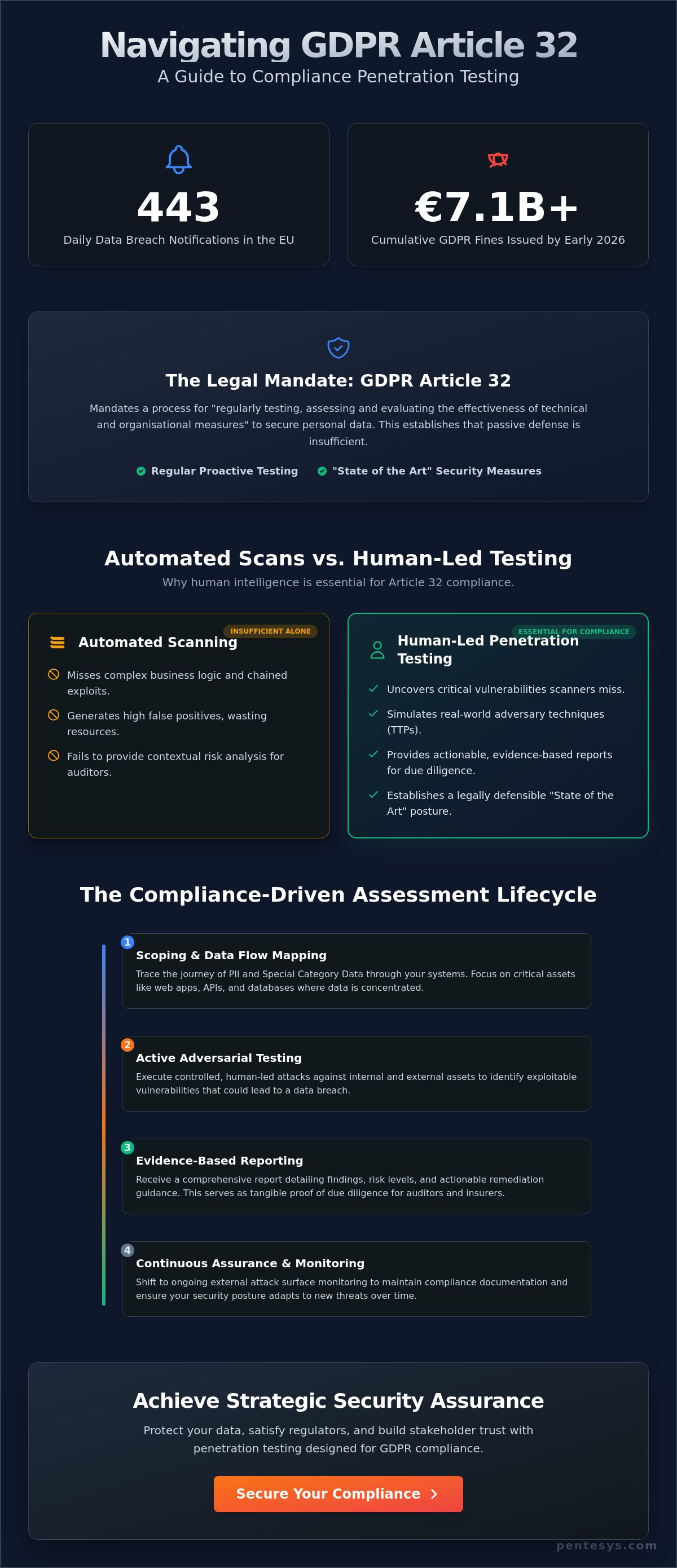
Vulnerability Scanning vs. Human-Led Penetration Testing for GDPR
Automated vulnerability scanners provide a useful baseline for identifying known software flaws and missing patches. However, relying solely on automation fails to satisfy the rigorous requirements of Article 32 of the General Data Protection Regulation (GDPR). Regulators expect a level of security assurance that reflects the sophistication of modern adversaries. Effective GDPR compliance penetration testing requires human intuition to identify the complex logic flaws that automated scripts inevitably overlook.
The most significant danger of relying on scanners is the “Logic Flaw” problem. A scanner might confirm that a web application uses modern encryption or lacks SQL injection vulnerabilities, but it doesn’t understand the context of your data access. For instance, a scanner won’t identify broken horizontal authorisation, where one user can access another user’s personal data simply by changing a numerical ID in a URL. Human testers replicate the creative thinking of an attacker, chaining together seemingly minor vulnerabilities to achieve a full database dump that would otherwise go undetected.
The Limitations of Automated Compliance Scans
Automated tools often produce a high volume of false positives, creating “noise” that distracts security teams from genuine data risks. These tools lack the capability to navigate complex authentication workflows or test multi-step business processes where PII is often most vulnerable. The ICO views manual testing as the benchmark for “state of the art” protection because it demonstrates a deeper commitment to discovering how data could actually be compromised. High-level cyber security services move beyond these point-in-time scans toward a model of continuous assurance.
The Value of Human-Led Security Assurance
Manual exploitation allows a tester to prove the real-world impact of a vulnerability, providing clear evidence for executive decision-makers. By utilising CREST-accredited testers, organisations receive high-fidelity results that carry weight with auditors and insurers. Manual testing is the only way to validate that access controls actually work as intended. This human-led approach transforms a compliance checkbox into a strategic asset, ensuring your organisation’s resilience is built on more than just an automated checklist.
The Lifecycle of a Compliance-Driven Assessment
A structured lifecycle ensures that security testing translates into measurable risk reduction rather than just another document for the archive. This process begins with meticulous scoping and data flow mapping to define the rules of engagement. By identifying exactly how personal data moves through your infrastructure, we ensure the assessment targets the specific systems where PII is most at risk. This preparatory phase prevents wasted effort and ensures that GDPR compliance penetration testing provides the maximum possible value to your security posture.
Once the boundaries are set, the assessment moves into active testing. This phase involves human-led adversarial techniques designed to locate weaknesses that automated tools miss. We simulate real-world attack paths, attempting to bypass access controls and extract sensitive datasets. The goal isn’t just to find vulnerabilities, but to understand the business risk they represent. Clear reporting then follows, providing technical remediation steps alongside a strategic overview for executive stakeholders. This transparency is a core pillar of our philosophy that cybersecurity is fundamentally about trust.
Prioritising Remediation Based on Data Risk
We don’t treat all vulnerabilities equally. While we use the Common Vulnerability Scoring System (CVSS) as a baseline, we layer this with a GDPR-specific “Impact” assessment. A medium-severity vulnerability that provides a path to special category data often requires more urgent attention than a high-severity flaw in a non-sensitive environment. Our methodology provides actionable guidance for development teams to patch these high-impact flaws quickly. You can track this remediation progress in real-time through the Pentesys Portal, which acts as the central hub for your compliance journey.
Retesting: The Final Step in Technical Compliance
A security assessment isn’t truly complete for GDPR purposes until you’ve verified that the identified risks are mitigated. Retesting is the critical final step that closes the compliance loop. It allows us to document the “delta” between your initial findings and your final, hardened security posture. This documentation is essential for auditors and insurers, as it proves you’ve taken the necessary steps to remediate discovered flaws. Regular retesting also prevents “regression,” where new software updates might accidentally re-introduce old data leaks. To ensure your organisation maintains this high standard of resilience, you can schedule a GDPR-focused assessment with our expert team today.
Does GDPR explicitly mention penetration testing?
GDPR doesn’t use the specific term “penetration test,” but it mandates a process for regularly testing and evaluating technical measures under Article 32. Regulators and auditors recognise GDPR compliance penetration testing as the industry standard for fulfilling this legal obligation. It provides the evidence-based assurance required to prove that your security controls are effective and up to date.
Is a vulnerability scan enough to satisfy Article 32?
A vulnerability scan is insufficient on its own because it only identifies known software flaws and missing patches. It cannot replicate the creative problem-solving of a human attacker or identify broken business logic. To satisfy Article 32, you need the depth of a human-led assessment that validates whether your technical controls actually prevent unauthorised access to sensitive personal data.
How do we scope a pen test if we use a third-party cloud provider like AWS?
Scoping for cloud environments focuses on your specific deployment, configurations, and API integrations rather than the provider’s physical infrastructure. You are responsible for the security “in” the cloud, meaning your test should target your specific data flows and access permissions. We coordinate these assessments to align with the shared responsibility models used by major providers like AWS, Azure, and Google Cloud.
Founder & CEO, Pentesys
James Hinton is the founder of Pentesys, a CREST-approved UK company working only on offensive security: penetration testing, PTaaS, CTEM, external attack surface management and red teaming. He built the business around one discipline rather than a broad consultancy menu, and most of his time still goes on how engagements get scoped, delivered and reported. He writes here about the practical side of security testing and what buyers should be asking for.
LinkedIn profile