

Overview
Most of what makes a penetration test go well or badly is decided before anyone starts testing. Scope, credentials, environment, and who to call when something breaks. Get those wrong and you pay consultancy rates for someone to spend two days working out what they are allowed to touch.
This walks through an engagement end to end: the scoping call, the rules of engagement, what happens during the testing window, how findings reach you, and what the report should contain. If you have not commissioned one before, it should remove most of the surprises.
Understanding the Purpose and Scope of a Penetration Test
A professional penetration test is a controlled, expert-led simulation of a real-world cyber attack. It’s a methodical process where security specialists use the same techniques as malicious actors to identify vulnerabilities. Unlike a criminal breach, this exercise happens within a strictly defined legal and technical framework. When you’re determining what to expect from a penetration test, you should view it as a strategic stress test for your digital defences rather than a simple audit. The goal isn’t just to find flaws, but to prove whether those flaws can be exploited to gain unauthorised access or disrupt business operations.
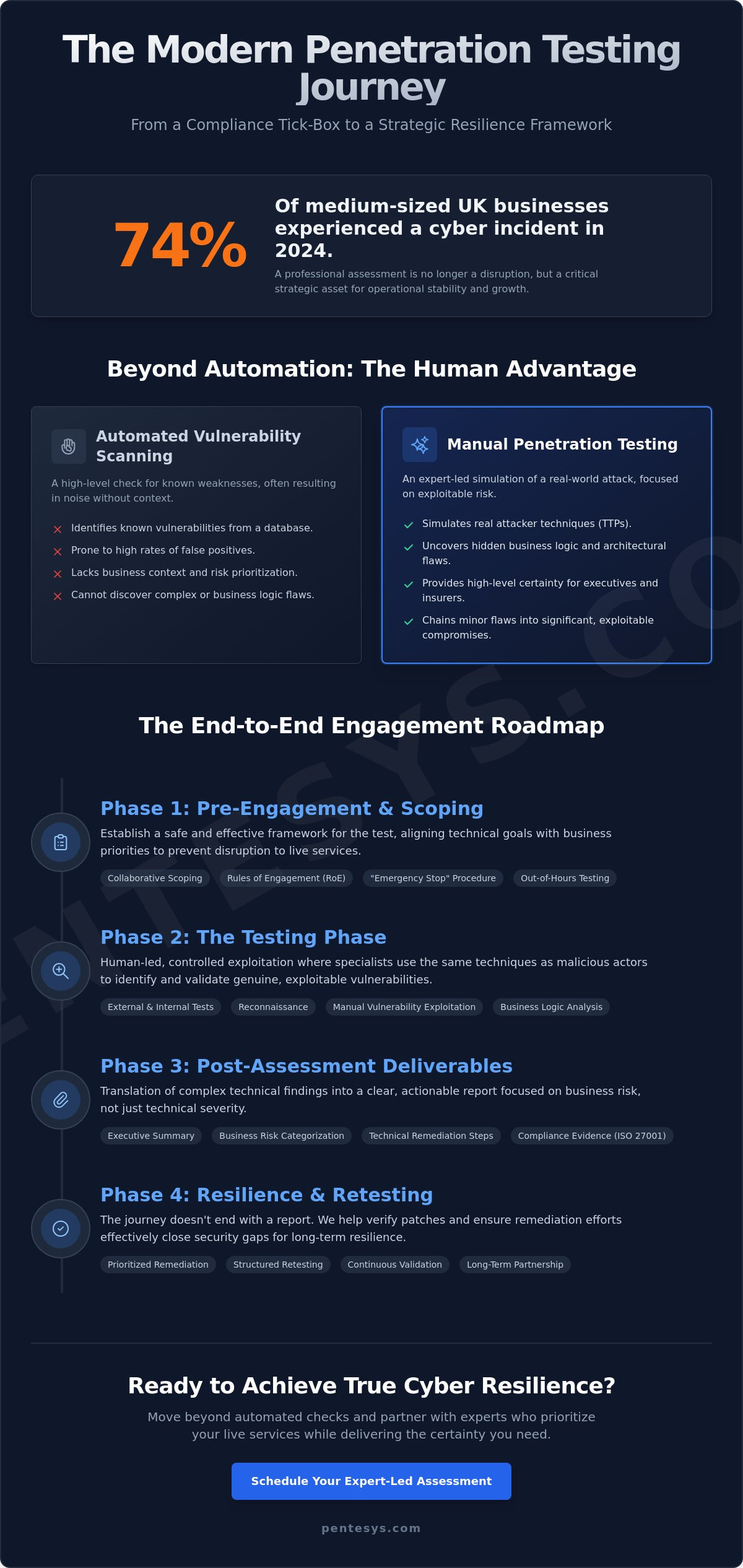
Many organisations confuse vulnerability scanning with penetration testing. A scan is an automated tool that identifies known weaknesses, often producing a long list of false positives that lack context. In contrast, a penetration test relies on human intuition to chain multiple minor flaws together to achieve a significant compromise. This manual rigour provides high-level certainty. It focuses on exploitable weaknesses that pose a genuine threat to your operations, not just technical anomalies that appear on a dashboard. Understanding what to expect from a penetration test helps you move beyond automated shortcuts toward a more resilient security posture.
Compliance vs. Risk-Based Testing
Regulatory mandates often serve as the initial catalyst for security assessments. Many UK firms pursue testing to satisfy ISO certification requirements or to demonstrate “appropriate technical measures” under UK GDPR. While compliance is a valid driver, a purely “tick-box” approach often misses deep-seated architectural flaws. A strategic partner aligns the test with your specific business risks. For instance, a Fintech firm might prioritise API security and data integrity, whereas a SaaS provider might focus on tenant isolation and cloud infrastructure resilience. Shifting from a compliance-only mindset to a risk-based model ensures your investment translates into long-term resilience rather than a temporary certificate.
Defining the Testing Environment
A clear scope is the foundation of a successful engagement. This involves identifying which assets are “in-scope,” ranging from internet-facing web applications and mobile apps to complex cloud environments and internal network infrastructure. Understanding the distinction between external and internal testing is vital. External tests evaluate your perimeter from the perspective of an anonymous attacker on the internet. Internal tests simulate a breach-and-pivot scenario, assessing what an intruder could do once they’ve gained a foothold. During these assessments, protecting Special Category Data is paramount. Specialists use specific methodologies to validate security controls without accessing or compromising sensitive personal information, ensuring your GDPR obligations remain intact throughout the process.
The Pre-Engagement Phase: Scoping and Rules of Engagement
Preparation is the most critical factor in ensuring a successful security assessment. Many organisations feel a natural anxiety about the potential for system instability, but a structured pre-engagement phase mitigates these risks. This stage involves a collaborative dialogue between your technical leads and the testing team to identify critical business functions and the specific assets requiring evaluation. By aligning the technical scope with your operational reality, we ensure the test provides maximum value without compromising service availability. Knowing what to expect from a penetration test starts with this rigorous definition of boundaries, which prevents scope creep and keeps the project on schedule.
The output of these discussions is the Rules of Engagement (RoE). This formal document acts as a safeguard, specifying exactly how and when testing occurs. It includes contact details for an “Emergency Stop” procedure, giving your team absolute control to halt activity at any moment. We also establish clear communication channels, often via a dedicated project hub, to provide real-time updates. If your business relies on high-traffic periods, we can arrange out-of-hours testing to further minimise any perceived risk to live production environments. This level of planning aligns with the guidance provided by the UK National Cyber Security Centre, which emphasizes the importance of a well-defined testing agreement.
White Box, Black Box, and Grey Box Testing
The methodology chosen dictates the depth of the assessment. Black Box testing involves zero prior knowledge of your systems, effectively mimicking an external threat actor. White Box testing provides the testers with full architectural details and source code access, allowing for a deep, exhaustive review. Most organisations opt for Grey Box testing. This approach provides testers with limited credentials or documentation, balancing the realism of an outside attack with the efficiency of a targeted internal review. Choosing the right model is a key part of what to expect from a penetration test tailored to your specific risk profile.
Establishing Safeguards and Boundaries
Safety is built into every stage of our methodology. We use IP whitelisting to ensure your internal monitoring teams can distinguish authorised testing activity from genuine threats. This prevents your security operations centre from being overwhelmed by false alarms. If our testers encounter sensitive data during the assessment, they follow strict, pre-agreed protocols to ensure no data is exfiltrated or compromised. For those requiring a more continuous approach to security, an external attack surface monitoring service can complement these periodic deep dives by providing ongoing visibility of your perimeter between formal tests.
The Testing Phase: Where Manual Expertise Meets Technical Rigour
Once the scope and boundaries are firmly established, the active testing phase begins. This stage starts with reconnaissance, where testers map your organisation’s external attack surface to identify every visible entry point. They look for exposed services, misconfigured cloud buckets, and leaked credentials that could provide an initial foothold. While NIST defines penetration testing as a specialised security exercise, the actual execution relies on a blend of technical precision and creative problem-solving. This isn’t a passive scan; it’s an active pursuit of exploitable weaknesses that could jeopardise your business operations.
After mapping the environment, testers use a combination of commercial and proprietary tools to identify potential vulnerabilities. However, the true value of the engagement lies in the manual exploitation phase. This is where human intelligence takes over, attempting to bypass security controls and gain deeper access to your systems. Experienced testers look for complex business logic flaws that automated scripts simply cannot detect. Understanding what to expect from a penetration test involves recognising this shift from automated discovery to manual rigour, where the focus moves from identifying “flaws” to demonstrating real-world “impact.”
Manual Exploitation vs. Automated Scanning
Automated tools are efficient at finding low-hanging fruit, such as missing patches or outdated software versions. Yet automated scanners do not reliably find critical web application vulnerabilities, particularly those rooted in logic and session management. Manual testers excel at “vulnerability chaining,” a process where they combine several low-level, seemingly insignificant flaws to create a high-impact exploit. This sophisticated approach is the hallmark of crest accredited penetration testing uk, providing a level of certainty that automated solutions cannot replicate. It ensures that your security investment uncovers the deep-seated risks that real-world attackers would actually target.
Adhering to Global Standards (OWASP & OSSTMM)
To ensure high-quality and repeatable results, professional testers follow established global frameworks. For web applications, the OWASP Top 10 provides a structured list of the most critical security risks, such as injection flaws and broken access control. Following these methodologies ensures that every layer of your application is scrutinised against known attack vectors. The process also includes a “Post-Exploitation” phase. Here, the tester determines what an attacker could actually achieve once they’ve breached the perimeter. Could they exfiltrate sensitive customer data, or move laterally into your core infrastructure? This analysis is a vital part of what to expect from a penetration test, as it translates technical findings into clear business risks.
Post-Assessment Deliverables: Interpreting the Penetration Test Report
The report is the most critical output of the entire engagement. It transforms technical manual exploitation into a strategic roadmap for your organisation. A high-quality report does not just list vulnerabilities; it provides the high-level certainty needed to justify security investments to stakeholders. When considering what to expect from a penetration test, you should look for a document that balances deep technical evidence with clear business context. This ensures that both your developers and your executive team understand the risks and the necessary steps for remediation.
Every finding in the report is categorised by severity: Critical, High, Medium, or Low. This prioritisation allows your team to focus resources on the most pressing threats first. To maintain transparency, specialists include detailed technical evidence for every vulnerability. This typically includes screenshots, code snippets, and clear reproduction steps. Providing this level of detail ensures your internal teams don’t waste time trying to verify whether a finding is a false positive. It establishes a methodical record of the assessment that serves as a baseline for future security validation.
The Executive Summary: A Strategic Overview
The executive summary translates complex technical risks into tangible business impacts, allowing non-technical stakeholders to grasp the current security state quickly. It often features a “Security Posture Score” or a similar high-level metric to provide an immediate snapshot of your resilience. This section is designed to support budgetary requests for security improvements by clearly outlining the potential consequences of inaction. It moves the conversation away from abstract “bugs” and toward strategic risk management, helping leadership teams make informed decisions about resource allocation.
Detailed Findings and Remediation Guidance
Each vulnerability is mapped to the Common Vulnerability Scoring System (CVSS), providing a standardised framework for assessing risk. Beyond the score, the report offers specific remediation advice tailored to your environment. This guidance is essential for developers, as it provides the exact technical fixes required to close the gap. A core component of our service is the technical debrief meeting. This session allows your team to discuss complex findings directly with the testers, ensuring complete clarity before the remediation phase begins. If you want to ensure your digital assets remain secure between these deep-dive assessments, consider implementing vulnerability management as part of your ongoing security strategy.
Turning Insights into Resilience: Remediation and Beyond
Remediation is where the technical findings of an assessment translate into tangible organisational resilience. While the report provides a comprehensive roadmap, the actual hardening of your environment occurs during this phase. A common strategic error is treating the delivery of the final report as the conclusion of the engagement. In reality, it marks the start of a collaborative cycle aimed at closing security gaps. Understanding what to expect from a penetration test means recognising that the process isn’t complete until every identified risk is either mitigated, transferred, or formally accepted within your risk management framework.
Effective remediation requires you to prioritise fixes based on your specific business context. While the CVSS scores provided in the report offer a technical baseline, they don’t always reflect the operational impact on your unique infrastructure. You should weigh technical severity against the criticality of the affected asset. For example, a medium-rated flaw on a server handling customer payments often demands more immediate attention than a high-rated flaw on a non-critical internal test system. Once your team implements the necessary patches, a formal retesting process is essential. This step provides high-level certainty that the vulnerabilities are closed and that the fixes haven’t introduced new configuration errors.
The Remediation Lifecycle
Managing the transition from discovery to resolution requires a structured approach. You should assign each finding to a specific owner within your technical team and track progress through a centralized hub. This ensures accountability and prevents critical issues from being overlooked. Occasionally, you may encounter vulnerabilities that cannot be immediately patched due to legacy system requirements. In these instances, you must document “Risk Acceptance” and implement compensating controls to minimise potential impact. Performing a root cause analysis during this stage is also vital. By identifying why a flaw existed, you can improve your internal development standards and prevent the same vulnerabilities from re-emerging in future deployments.
Moving Toward Continuous Security Validation
An annual cycle assumes the estate holds still between tests. Most do not. Continuous penetration testing spreads consultant time across the year, so new services get looked at when they ship rather than eleven months later.
External attack surface management covers the other half of the problem, which is knowing what is exposed in the first place. Most organisations turn up assets they had forgotten about the first time they run discovery properly, and those tend to be the ones nobody has been patching.
How long does a typical penetration test take to complete?
A typical engagement usually spans between three and ten days for the active testing phase, though the specific duration depends on the complexity of your environment. Factors such as the number of web applications, IP addresses, and APIs within the scope will influence the timeline. Following the execution phase, the delivery of the comprehensive report and the technical debrief usually takes an additional few days. We provide a structured schedule during the scoping phase so your team can plan around the assessment.
Will a penetration test crash my website or server?
We prioritise service stability by establishing strict Rules of Engagement before any activity begins. Our specialists use controlled, non-disruptive manual exploitation techniques rather than aggressive automated scripts that can overwhelm system resources. While the nature of security testing involves probing for weaknesses, our methodical approach ensures that live production environments remain operational. You maintain absolute control through an emergency stop procedure, providing peace of mind throughout the entire engagement.
What information do I need to provide before the test starts?
You need to provide a clear list of target assets, including IP ranges, domain names, and API endpoints. For grey box or white box assessments, providing test credentials and architectural diagrams allows for a much deeper and more efficient evaluation of your internal controls. We also require a designated technical point of contact who can authorise activity and respond to any urgent findings. This collaborative preparation ensures the testing team focuses on your most critical business functions.
Does a penetration test guarantee that we won’t be hacked?
No security assessment can guarantee against future breaches, as new vulnerabilities and attack techniques emerge constantly. A penetration test provides a high-level certainty of your security posture at a specific point in time by identifying and remediating existing exploitable weaknesses. It significantly reduces your attack surface and improves your resilience. Combining periodic deep-dives with ongoing external attack surface monitoring is the most effective way to maintain a robust defence over time.
What happens if the testers find a critical vulnerability mid-test?
If our specialists identify a critical vulnerability that poses an immediate threat to your data or operations, we notify your technical lead immediately. You don’t have to wait for the final report to begin remediation for high-risk findings. This real-time communication is a vital part of what to expect from a penetration test driven by a partnership model. Once the issue is resolved, we can verify the fix as part of the ongoing assessment process to ensure the vulnerability is fully closed.
Founder & CEO, Pentesys
James Hinton is the founder of Pentesys, a CREST-approved UK company working only on offensive security: penetration testing, PTaaS, CTEM, external attack surface management and red teaming. He built the business around one discipline rather than a broad consultancy menu, and most of his time still goes on how engagements get scoped, delivered and reported. He writes here about the practical side of security testing and what buyers should be asking for.
LinkedIn profile