

Overview
A penetration test report is not a simple checklist of technical failures; it’s a strategic risk narrative that determines your organisation’s long-term resilience. It’s common to feel overwhelmed when you first learn how to read a penetration test report, especially when a dense document filled with CVSSv4.0 scores lands on your desk. With ransomware activity rising and breach costs climbing, the need for technical clarity has never been more urgent.
We’ll show you how to extract actionable intelligence from these findings and bridge the gap between technical vulnerabilities and business risk. This guide provides a structured approach to moving beyond static PDFs to build a defensible remediation roadmap that satisfies both auditors and executive stakeholders. By the end, you’ll have the confidence to turn complex security data into a clear plan for protecting your operations and ensuring compliance with standards like GDPR Article 32.
Understanding the Anatomy and Purpose of a Penetration Test Report
A penetration test report serves as the definitive record of a security assessment. It is a formal document that details identified security weaknesses, the specific attack paths a threat actor might exploit, and clear, actionable remediation advice. To understand what a penetration test is in a business context, you must view the final report as a bridge between technical debt and organisational resilience. The primary goal is to move your team from simply knowing a problem exists to fully understanding the risk that problem poses to your operations.
In the UK, these reports are critical for meeting regulatory expectations. Whether you’re satisfying the requirements of GDPR Article 32 or verifying technical controls for an ISO 27001 audit, a professional report provides the evidence needed to demonstrate due diligence. It goes beyond a simple list of bugs by providing the context required to make informed commercial decisions. Learning how to read a penetration test report effectively allows you to justify security spend and prioritise the fixes that actually move the needle on your security posture.
Expert-Led Insights vs. Automated Scanner Output
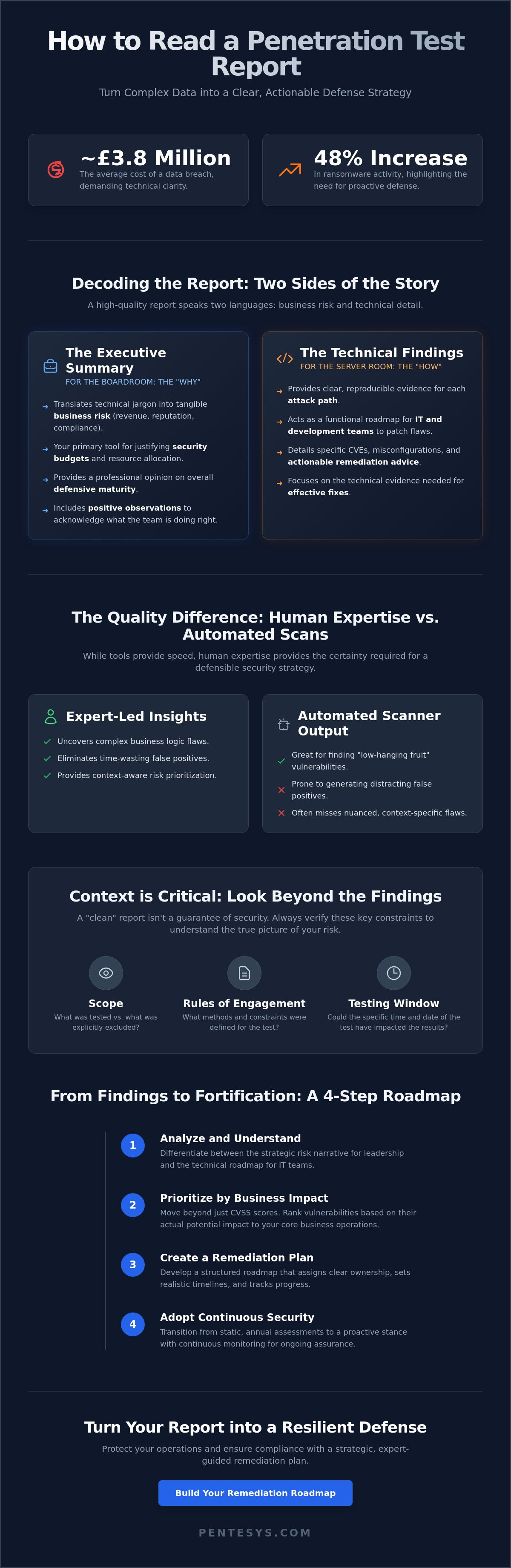
The most significant marker of a high-quality assessment is the presence of manual verification. Automated scanners are excellent for finding “low-hanging fruit,” but they often generate false positives that can waste your internal team’s time. A human expert scrutinises these results, filtering out the noise and focusing on vulnerabilities that software often misses. For example, human intuition is essential for uncovering complex logic flaws within web applications, such as an attacker bypassing a checkout process or escalating their user privileges. While tools provide speed, human expertise provides the certainty required for a defensible security strategy.
The Importance of Scope and Rules of Engagement
You cannot accurately interpret findings without first reviewing the Rules of Engagement (RoE) and the defined scope. These sections explain exactly what was tested and, perhaps more importantly, what was explicitly excluded. If your report shows no vulnerabilities in your cloud environment, but the scope was limited to your on-premise infrastructure, you don’t actually have a complete picture of your risk. The “Testing Window” also impacts the results. A test conducted during a quiet weekend might not reveal vulnerabilities that only surface under heavy traffic loads. Always check these constraints to ensure you aren’t mistaking a narrow scope for a perfect security posture.
Deciphering the Executive Summary vs. Technical Findings
A comprehensive report acts as a dual-purpose tool. It translates complex cyber threats into a language that both the boardroom and the server room can understand. One of the most critical skills in learning how to read a penetration test report is knowing which section to prioritise based on your organisational role. While the technical findings provide the “how,” the executive summary provides the “why” and the “so what.”
The high-level narrative must always correlate with the technical evidence. If the executive summary describes a “resilient infrastructure,” but the technical findings list multiple unpatched critical vulnerabilities, there’s a disconnect that could lead to a false sense of security. Central to this is the “Security Posture” statement. This is where the tester provides their professional opinion on the organisation’s overall defensive maturity. It offers a qualitative benchmark that goes beyond raw data points, giving you a clear indicator of where you stand against modern threats.
The Executive Summary: Communicating Risk to Stakeholders
The executive summary distils technical jargon into business risk. Instead of focusing on CVE codes or memory corruption details, it highlights the potential impact on revenue, reputation, and compliance. This section is your primary tool for justifying security budgets or resource allocation. By framing vulnerabilities as business risks, you make it easier for non-technical stakeholders to support necessary security investments. A high-quality summary also includes a “Positive Observations” section. It’s vital to acknowledge what your team is doing right. This provides a balanced view, showing that while gaps exist, your existing controls are providing value. For organisations looking to maintain this balance, effective vulnerability management starts with this high-level strategic alignment.
Technical Evidence: Reproducing the Attack Path
For the IT and development teams, the technical findings are the most functional part of the document. This section must provide a clear “Attack Vector” description, explaining exactly how the tester gained access. Without clear reproduction steps, your team will struggle to verify the fix or understand the underlying logic of the flaw. Clear documentation ensures that remediation is targeted and efficient.
Proof of Concept (PoC) evidence is the backbone of this section. This typically includes screenshots, code snippets, or server responses that prove the vulnerability is real and exploitable. These PoCs eliminate the guesswork and help your developers understand the flaw’s mechanics. When technical evidence is presented with this level of clarity, the transition from discovery to remediation becomes a streamlined, logical process rather than a series of trial-and-error attempts. This level of detail is what separates a professional assessment from a basic automated scan.
Evaluating Vulnerability Severity and Business Impact
Interpreting severity ratings is often the most challenging part of learning how to read a penetration test report. Most modern assessments utilise the Common Vulnerability Scoring System (CVSS), with version 4.0 serving as the current global standard. While CVSS provides a consistent numerical framework for technical severity, it’s a common mistake to treat these scores as absolute priorities. A numerical score is a technical measurement, not a business one.
Context determines the true risk. A vulnerability rated as ‘Medium’ on a core production database containing sensitive financial records is far more critical than a ‘High’ rated flaw on an isolated development server with no access to live data. You must also consider ‘Exploitability’. If a weakness is technically severe but exists on a system that isn’t reachable from the internet, the immediate threat to your operations is significantly lower. The Pentesys Limited approach pairs this technical certainty with strategic oversight, ensuring that remediation efforts align with your actual exposure.
Contextualising Risk for Your Organisation
Effective risk evaluation requires you to factor in your existing security stack. You may have ‘Compensating Controls’ in place, such as a Web Application Firewall (WAF) or robust network segmentation, that mitigate a specific threat even if the underlying vulnerability exists. When reviewing the report, assess the data sensitivity of the affected system. Does the flaw expose Personally Identifiable Information (PII) subject to UK GDPR? Use a ‘Likelihood vs. Impact’ matrix to prioritise your response. This ensures you aren’t just fixing every red flag, but rather addressing the flaws that pose the greatest threat to your continuity and compliance posture.
Common Vulnerability Categories in 2026 Reports
This highlights why certain findings should command more immediate attention in your report. You’re likely to encounter these common categories:
By categorising findings this way, you can identify systemic issues rather than treating every bug as an isolated incident. This structural view allows you to implement broad security improvements that prevent entire classes of vulnerabilities from recurring across your estate.
- Cloud Misconfigurations: Errors in AWS or Azure identity and access management that leave data buckets exposed to the public internet.
- Broken Access Control: Insecure Direct Object Reference (IDOR) flaws in modern APIs that allow one user to view another’s private records.
- The Human Element: Results from social engineering exercises that reveal how easily credentials can be harvested through sophisticated phishing.
Transforming Findings into a Practical Remediation Roadmap
Understanding how to read a penetration test report is only half the battle; the real value lies in the execution of a structured remediation strategy. A report that sits on a shelf provides no protection. To build resilience, you must translate technical findings into a functional project plan. This process begins with triage, where security teams and business stakeholders meet to align on the findings’ real-world implications. Remediation isn’t just an IT task; it’s a business-wide commitment to risk reduction.
A professional roadmap follows a logical, five-step progression:
- Step 1: Triage. Review the report with developers, IT managers, and business owners to ensure everyone understands the context of each vulnerability.
- Step 2: Assign Ownership. Clearly define who is responsible for each fix. Vulnerabilities in a web portal belong to the development team, while server misconfigurations fall to infrastructure leads.
- Step 3: Establish Timelines. Create a schedule based on risk severity and resource availability. Critical flaws should be addressed within days, while lower-risk issues may follow standard patch cycles.
- Step 4: Document Risk Acceptance. If a fix is technically impossible or commercially unviable at this stage, document the decision to accept the risk. This provides a clear audit trail for regulators.
- Step 5: Schedule Validation. Never assume a patch has worked. Plan for a formal retest to confirm that the fix works and hasn’t introduced new issues.
Prioritising Fixes: The ‘Quick Wins’ vs. Strategic Projects
Focus first on “quick wins”, which are low-effort, high-impact changes such as disabling insecure protocols or updating security headers. These often provide immediate gains with minimal resource expenditure. Strategic projects, such as re-architecting how an API handles authentication, require more time and budget. Pentesys Limited recommends using the report’s findings to justify these larger investments. Beyond fixing the immediate bugs, use the data to drive secure coding training. If your report shows recurring vulnerabilities, it’s a clear signal that your development team needs specific guidance on defensive programming.
The Role of Retesting and Validation
Retesting is a fundamental requirement of any credible assessment. Marking your own homework is a dangerous practice; it’s easy to believe a vulnerability is fixed when you’ve only addressed a symptom rather than the root cause. A professional retest provides the technical certainty that the attack path is truly blocked. There is a significant difference between a temporary patch and a permanent solution. Formal retest certificates are often essential for satisfying third-party audits or insurance requirements, proving that you’ve closed the loop on identified risks. This methodical approach ensures your security posture is based on verified facts rather than assumptions.
Ready to secure your network? Explore our infrastructure penetration testing services for a comprehensive assessment of your defensive maturity.
The Shift to Platform-Based Security Delivery
A proprietary central platform acts as the primary hub for service delivery, fundamentally changing how you interact with security data. Instead of digging through historical email attachments, you can track vulnerabilities in real-time from the moment of discovery to verified closure. This modular, searchable format significantly reduces report fatigue and allows stakeholders to filter findings by asset type or business impact. It turns a dense document into a functional dashboard that supports daily operational decisions.
High-level certainty is reinforced by CREST accredited penetration testing, which ensures that the manual, expert-led evaluation follows rigorous industry standards. This platform-based approach ensures that human intuition is paired with the efficiency of modern technology. It moves the conversation from what was found months ago to what your current risk level is today. This transparency is vital for maintaining a defensible security posture that satisfies both the board and external auditors.
What are the most important sections of a penetration test report?
The most important sections are the executive summary, the detailed technical findings, and the remediation roadmap. These components ensure that both stakeholders and technical teams understand the identified risks and the steps required to mitigate them. A professional report also includes the rules of engagement to define testing boundaries and ensure the assessment’s validity.
What happens if we cannot fix all the vulnerabilities immediately?
If you cannot address every vulnerability immediately, you should document your decision through a formal risk acceptance process. This involves identifying compensating controls that might mitigate the threat in the interim. Regulators and auditors look for clear evidence that risks are understood and managed, even if the final fix is scheduled for a future development cycle.
Can a penetration test report be used for compliance audits like SOC2 or ISO 27001?
Yes, a professional penetration test report is a foundational requirement for demonstrating compliance with SOC2, PCI DSS, and ISO 27001. It provides objective evidence that your technical controls are effective. In the UK, these reports are also essential for satisfying the ongoing security evaluation requirements mandated by GDPR Article 32.
Founder & CEO, Pentesys
James Hinton is the founder of Pentesys, a CREST-approved UK company working only on offensive security: penetration testing, PTaaS, CTEM, external attack surface management and red teaming. He built the business around one discipline rather than a broad consultancy menu, and most of his time still goes on how engagements get scoped, delivered and reported. He writes here about the practical side of security testing and what buyers should be asking for.
LinkedIn profile