

Overview
PCI DSS is one of the few standards that sets out testing obligations in detail rather than in principle. Requirement 11.4 covers internal and external testing, testing after significant change, and, where you rely on segmentation to limit scope, testing that the segmentation actually holds. Most of the difficulty in practice is defining the cardholder data environment, not the testing itself.
This article provides a definitive checklist to help you master PCI DSS v4.0 penetration testing with confidence. We’ll clarify the technical requirements and outline exactly what’s needed to satisfy a QSA. You’ll discover how to manage “significant change” triggers, why authenticated scanning is now required, and how human-led expertise provides the strategic assurance that automated tools simply can’t match.
Understanding PCI DSS v4.0 Penetration Testing Requirements in the UK
PCI DSS penetration testing is a controlled, human-led simulation of an adversary’s tactics to identify exploitable vulnerabilities within the Cardholder Data Environment (CDE). Under the Payment Card Industry Data Security Standard (PCI DSS) v4.0, this process has evolved from a simple compliance hurdle into a critical security validation tool. For firms managing PCI DSS penetration testing requirements uk, the 2026 landscape demands a move away from static, point-in-time audits. Modern threats are dynamic; therefore, your security assurance must be equally adaptive. It is no longer enough to simply find flaws. You must demonstrate that your controls can withstand a sophisticated, multi-stage attack.
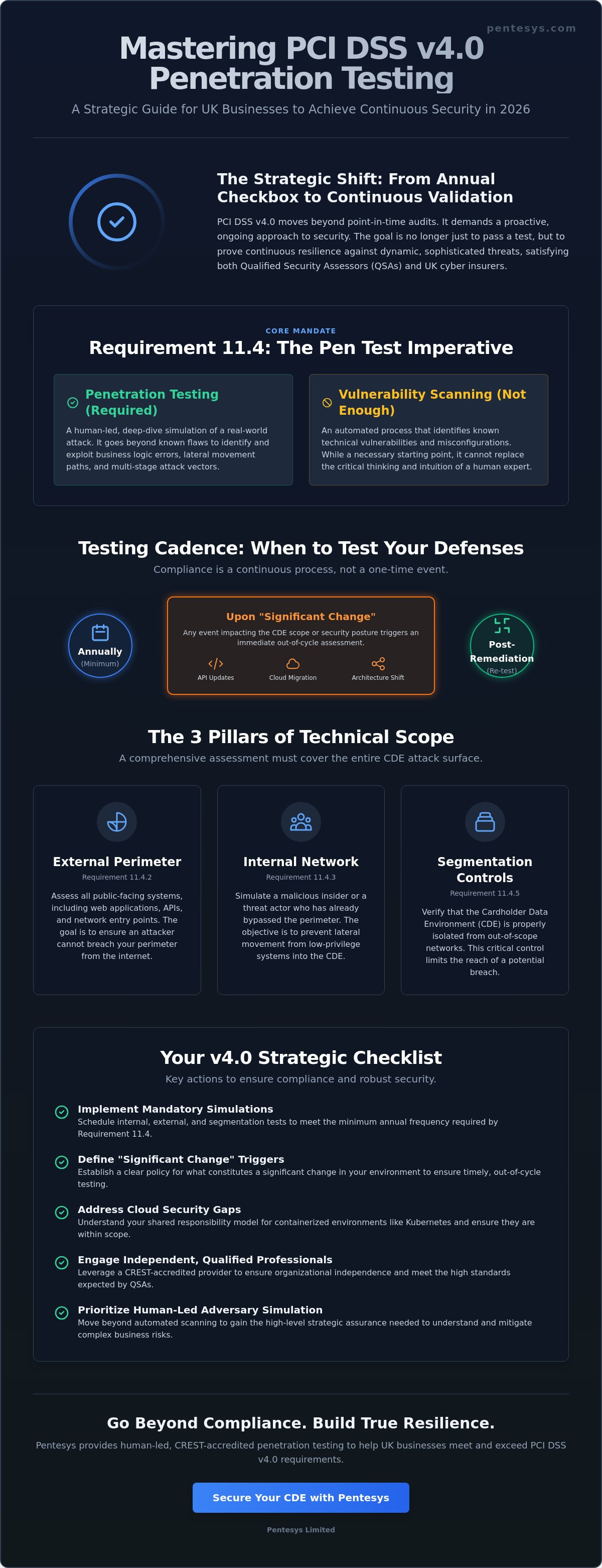
Requirement 11.4 serves as the primary mandate for these assessments. It differentiates itself from standard vulnerability scanning by requiring a manual, deep-dive analysis of both network and application layers. While automated scans identify known technical flaws, a full penetration test explores logic errors and lateral movement risks that machines often miss. This distinction is vital for maintaining long-term resilience rather than just achieving temporary compliance. The Council has made it clear that automated tools are a starting point, but they cannot replace the intuition of a qualified human tester.
Mandatory Frequency and Triggers
Compliance requires annual testing at a minimum, but Requirement 11.4.1 introduces the concept of “significant change” triggers. In the UK’s cloud-heavy 2026 environment, a significant change often includes major API updates, migrations to new containerized clusters, or shifts in network architecture that impact the CDE. These events necessitate an immediate out-of-cycle assessment to ensure the security posture remains intact. Following the completion of remediation work, you must perform a formal re-test to verify that the identified vulnerabilities have been successfully mitigated and that no new risks have been introduced.
The Role of the Qualified Professional
The standard emphasizes organisational independence. This means the individual performing the test must not be responsible for the management or maintenance of the systems being tested. While some large enterprises attempt to use internal security teams, many find that achieving true independence is difficult under the scrutiny of a Qualified Security Assessor (QSA). In the UK, leveraging a provider with CREST accreditation ensures that the assessment meets the highest industry benchmarks for technical competence and ethical conduct. Engaging a specialist helps bridge the gap between technical execution and business value. You can find more details in our strategic guide for CREST accredited penetration testing UK.
The Technical Scope: Internal, External, and Segmentation Testing
To satisfy the PCI DSS penetration testing requirements uk organisations must follow, your testing strategy needs to cover the entire technical stack. Requirement 11.4.2 mandates a rigorous assessment of your external network perimeter and all public-facing applications. This isn’t a simple scan for open ports. It involves active exploitation across layers 3 through 7, ensuring that everything from network protocols to complex application logic is resilient against modern attack vectors. While automated tools might identify a missing security header, they can’t simulate the creative persistence of a human adversary attempting to bypass your defences.
Requirement 11.4.3 shifts the focus to your internal environment. This test simulates the perspective of a malicious insider or an attacker who has already breached your perimeter. The goal is to identify how easily a threat actor can move laterally from a low-privilege workstation into the Cardholder Data Environment (CDE). By validating internal controls, you ensure that a single point of failure doesn’t lead to a total data compromise. Following NCSC guidance on penetration testing helps ensure these internal assessments are conducted with the technical depth required by UK regulators.
External Perimeter Assessments
Your external perimeter includes every digital entry point that touches cardholder data, including public APIs and third-party integrations. These integrations are frequently the weakest link in the chain. Automated scans often fail to meet the “exploit” requirement of 11.4.2 because they don’t verify if a vulnerability is truly reachable or actionable. A human-led test goes further, attempting to chain small misconfigurations together to gain unauthorised access, which provides the high-level assurance a QSA expects to see in your report.
Segmentation Validation: The QSA’s Primary Focus
Requirement 11.4.5 introduces segmentation validation, which is arguably the most scrutinized part of a UK audit. If you use network isolation to reduce your compliance scope, you must prove that “out-of-scope” systems cannot communicate with the CDE. We often find that UK corporate networks suffer from legacy VLAN configurations or overly permissive firewall rules that inadvertently allow traffic leakage. In hybrid-cloud environments, these misconfigurations are even more common, as cloud security groups and on-premise firewalls may not align perfectly.
Rigorous segmentation testing reduces total audit costs by formally excluding non-essential systems from the rigorous assessment criteria of the full PCI DSS framework. If you’re concerned about how your isolation holds up under scrutiny, our infrastructure penetration testing provides the technical evidence needed to confirm your scope is secure and compliant.
Your PCI DSS Penetration Testing Compliance Checklist
Navigating the PCI DSS penetration testing requirements uk businesses face requires a methodical approach to both planning and execution. Compliance isn’t just about the test itself; it’s about the evidence you gather before, during, and after the assessment. To ensure your organisation meets the rigorous PCI DSS v4.0 Requirements, we’ve structured this checklist to align with the expectations of UK-based QSAs and international standards. Following these steps ensures that your security posture is validated by human intelligence rather than just automated scripts.
- Step 1: Scope Definition. You must accurately map your Cardholder Data Environment (CDE) and identify all connected systems. Failure to document “connected-to” systems that could impact CDE security is a leading cause of audit failure.
- Step 2: Methodology Selection. Your testing framework should align with industry-recognised standards like NIST SP 800-115. This ensures the assessment is repeatable, technically sound, and covers all necessary attack surfaces.
- Step 3: Execution. Move beyond simple scans. Use human-led testing to target known vulnerabilities and explore potential zero-day exploits within your specific architecture. This stage should simulate actual adversary tactics.
- Step 4: Reporting. Generate the specific evidence required by Requirement 11.4.4. This includes detailed logs of the testing methodology, the timeline of activities, and the raw results of the simulation.
- Step 5: Remediation and Clean-up Testing. Once the initial test is complete, you must validate that all ‘High’ and ‘Critical’ risks are closed. A formal re-test is mandatory to prove the fix is effective and hasn’t introduced new issues.
Pre-Test Preparation
Success begins with preparation. You’ll need to provide your tester with up-to-date network diagrams and data flow charts that clearly delineate the CDE. For a “grey-box” testing scenario, which offers a more efficient use of time and resources, ensure that all necessary white-listing is completed before the engagement starts. This proactive stance prevents technical delays and allows the tester to focus on complex vulnerabilities. You can see how continuous penetration testing supports this ongoing readiness by keeping your documentation and defences in a state of constant audit-preparedness.
The Reporting Phase
A compliant PCI DSS report must be more than a list of technical bugs. It needs an executive summary for stakeholders, detailed technical findings for your security team, and raw output to satisfy your QSA. We use the Pentesys Portal to provide real-time tracking of identified vulnerabilities. This allows your team to begin remediation work before the final report is even issued. When you present these findings to your QSA, include a clear remediation plan with documented timelines. This level of transparency demonstrates control and significantly reduces the likelihood of non-compliance findings during your final assessment.
Common Compliance Pitfalls: Cloud Environments and Multi-Tenant Security
Adopting cloud infrastructure doesn’t exempt an organisation from the rigorous PCI DSS penetration testing requirements uk regulators demand. A frequent misconception is that the cloud service provider (CSP) assumes all security responsibilities. While providers like AWS or Azure secure the underlying physical hardware and hypervisor, you remain responsible for the security of your guest operating systems, applications, and data configurations. This Shared Responsibility Model means that your penetration testing must specifically target the layers you manage, ensuring that your cloud-native configurations don’t inadvertently expose cardholder data.
Scope creep is a significant risk in interconnected UK enterprise cloud architectures. As businesses integrate various SaaS and PaaS solutions, the boundaries of the Cardholder Data Environment (CDE) often become blurred. Requirement 12.8 mandates the management of third-party service providers, which includes verifying their own testing obligations. If your CDE relies on a third-party for hosting or processing, you must ensure their security posture doesn’t compromise your compliance. Testing containerized environments, such as Kubernetes or Docker, adds another layer of complexity. You must validate that container isolation is robust and that an attacker cannot break out of a container to access the underlying host or other sensitive segments of the CDE.
Cloud-Specific Testing Challenges
Misconfigured storage solutions, such as S3 buckets or Azure Blobs, remain a primary vector for data exposure. Our assessments frequently identify overly permissive access policies that allow public read access to sensitive archives. Beyond storage, Identity and Access Management (IAM) roles are a critical focus. Attackers often target these roles to escalate privileges or move laterally across your cloud environment. Cloud-native testing requires specialized offensive security expertise because traditional network scanning tools often fail to interpret the ephemeral nature of serverless functions and dynamic orchestration layers.
Service Provider Requirements
Requirement 11.4.1.1 introduces a stricter timeline for multi-tenant service providers, who must perform penetration testing at least every six months. This increased frequency reflects the higher risk associated with environments that host data for multiple clients. Proving to your customers that your UK-based cloud infrastructure is secure requires more than just a summary of your latest scan. You’ll often need to provide a “letter of engagement” or a redacted executive summary from your third-party assessment to demonstrate that your controls have been independently validated. This documentation is essential for building trust and satisfying the due diligence requirements of your own clients.
If you’re unsure how your current cloud configuration stands up against these standards, our cloud security assessment provides the deep-tech validation needed to secure your environment and maintain compliance.
The Human Element vs. Automated Scans
Automated vulnerability scans are a necessary component of compliance, yet they often fail to detect the complex business logic flaws found in UK fintech applications. These sophisticated vulnerabilities require the intuition of a qualified professional who can think like an adversary. Our human-led testing mimics real-world attack patterns to provide true security validation. This level of professional assurance is vital for board-level risk reporting, where executive stakeholders require clear, actionable insights rather than just a list of technical bugs. By focusing on quality over automation, we bridge the gap between deep-tech execution and business value.
Continuous Assurance for 2026
The 2026 compliance landscape requires a move toward continuous external attack surface monitoring. Waiting for an annual test to discover critical flaws creates a period of unnecessary risk. We help you integrate your PCI obligations into a year-round vulnerability management program, which significantly reduces the stress of the annual audit cycle. The Pentesys Portal serves as the central hub for this process, allowing you to track remediation progress and store evidence for your QSA in a single, secure location. This methodical, ongoing approach transforms cybersecurity from a chaotic event into a managed business process built on trust and reliability.
Secure your PCI DSS compliance with Pentesys Limited today and experience the peace of mind that comes from enterprise-grade offensive security.
How often does PCI DSS v4.0 require penetration testing for UK businesses?
Standard requirements mandate a full assessment at least once every 12 months. However, the PCI DSS penetration testing requirements uk service providers must follow are stricter, requiring segmentation validation every six months. You must also trigger a new assessment immediately following any significant change to your infrastructure or applications to ensure new vulnerabilities haven’t been introduced into the environment.
Does PCI DSS v4.0 require testing of cloud-based CDE environments?
Yes, cloud-based CDEs are subject to the same rigorous testing standards as on-premise environments. Under the Shared Responsibility Model, you’re responsible for testing the security of your guest operating systems, APIs, and cloud configurations. This includes validating that your IAM roles and storage buckets don’t expose sensitive cardholder data to the public internet through misconfiguration or overly permissive access rules.
Do we need to test our segmentation if we don’t have a CDE?
Segmentation testing is only required if you’re using network isolation to reduce the scope of your PCI DSS audit. If you claim that certain parts of your network are “out of scope,” you must technically prove that no communication is possible between those segments and your CDE. This validation is a mandatory part of the framework for any environment that uses isolation to limit the reach of compliance requirements.
Founder & CEO, Pentesys
James Hinton is the founder of Pentesys, a CREST-approved UK company working only on offensive security: penetration testing, PTaaS, CTEM, external attack surface management and red teaming. He built the business around one discipline rather than a broad consultancy menu, and most of his time still goes on how engagements get scoped, delivered and reported. He writes here about the practical side of security testing and what buyers should be asking for.
LinkedIn profile