

Overview
Sales teams are paid to open attachments from strangers. That is the job, and no amount of awareness training changes it. Social engineering testing that treats this as a staff failing rather than a process problem tends to produce resentment and very little improvement.
We want to provide the professional assurance you need to grow without fear. You’ll learn how cybercriminals exploit your sales pipeline and why business prospects represent the newest frontier for targeted social engineering attacks. We will debunk five dangerous myths that leave your team exposed and provide actionable insights on how human-led testing can secure your growth. This guide outlines a strategic approach to protecting your CRM and ensuring your sales team remains an asset, moving your focus from simple testing to true security assurance.
What are “Prospects” in a Cybersecurity Attack Surface?
In a security context, prospects represent the specific individuals or data points targeted during the reconnaissance phase of a cyber attack. While your sales team views a lead as a potential revenue stream, an adversary views that same individual as a vulnerability to be exploited. Sales teams are the soft underbelly of modern corporate security because their primary role requires them to engage with unknown external parties. This open-door policy creates a paradox where the very activities driving business growth also expand the organisational attack surface.
By 2026, we’ve seen a definitive shift from broad, generic phishing campaigns to highly targeted spear-prospecting. This methodology involves adversaries conducting deep research into your sales pipeline to craft believable narratives. They use social engineering to manipulate public-facing staff who are conditioned to be helpful and responsive. Because sales professionals often operate outside the stricter technical controls applied to IT departments, they remain the primary gateway for adversarial entry. Pentesys views this as a critical area for adversary simulation to ensure your team can identify these sophisticated lures.
The Value of Prospect Data on the Dark Web
Leaked CRM data provides a roadmap for attackers. When a database is compromised, the stolen information fuels convincing campaigns that bypass traditional email filters. Within dark web marketplaces, your curated prospect lists are recontextualised as high-priority hit lists for sophisticated adversaries. There’s a clear financial incentive here. Targeting a live sales pipeline often yields higher returns than attacking hardened IT infrastructure directly. A single successful compromise of a high-value deal can lead to invoice redirection fraud, where large payments are diverted to offshore accounts.
Reconnaissance: How Hackers Use Your Leads
Adversaries spend weeks identifying high-value targets through LinkedIn and corporate “meet the team” pages. They don’t just look for names; they study your Ideal Customer Profile (ICP) to mimic the exact type of client your team expects to see. If your marketing strategy targets UK-based manufacturing firms, the attacker will adopt that persona perfectly. This creates a direct link between outbound marketing and inbound security vulnerabilities. Your team’s desire to land a new contract often overrides their natural suspicion. This makes them more likely to click a “specification document” that actually contains a malicious payload, bypassing automated scans that lack the context of human-led testing.
5 Dangerous Myths About Business Prospects and Security
- Myth 1: Only IT and Finance departments are targets for sophisticated attacks.
- Myth 2: Standard email filters catch all fake lead-gen enquiries.
- Myth 3: LinkedIn prospects are inherently safer than cold email leads.
- Myth 4: Social engineering is just ‘phishing’ and doesn’t require technical testing.
- Myth 5: Automated vulnerability scans protect your sales team’s data.
Debunking the “Low Risk” Sales Team Fallacy
Sales teams operate on a culture of responsiveness. Their primary incentive is to engage with every potential lead as quickly as possible. This speed often bypasses cautious judgment. Hackers exploit this by sending malicious attachments disguised as “Request for Proposal” documents or “Budget Approval” spreadsheets. Because a salesperson’s commission depends on these interactions, they’re far more likely to click a link from an unknown source than an IT professional.
The psychological triggers are precise. Adversaries use “enforced urgency” and “implied authority” to manipulate staff. A London-based recruitment firm suffered a significant loss after a consultant opened a “CV” file that contained a sophisticated banking trojan. These attacks succeed because they mimic the standard workflow of managing prospects. Standard security training often fails to address these specific vocational pressures, leaving a gap that only rigorous assurance can close.
The Reality of Modern Social Engineering
By 2026, the landscape has shifted toward high-fidelity deception. Adversaries now use AI-generated deepfakes to clone the voices of senior stakeholders during the prospecting phase. A simple “introductory call” can now be a sophisticated vishing attempt designed to harvest internal credentials. These cybersecurity threats in 2026 require more than just a static firewall. They demand a strategy that accounts for human fallibility and technical exploitation alike.
Automated spam filters are ineffective against human-led adversarial simulation. While a bot might send ten thousand generic emails, a targeted attacker will spend weeks researching a single sales executive to craft a perfect lure. This is why CREST accredited penetration testing is essential. It provides a methodical validation of your defences by mimicking real-world attacker behaviour. Relying on basic scans creates a false sense of security; true resilience comes from identifying how an attacker would actually move through your network after that first click. You can monitor these evolving risks and track remediation progress directly through the Pentesys Portal to ensure your team remains protected.
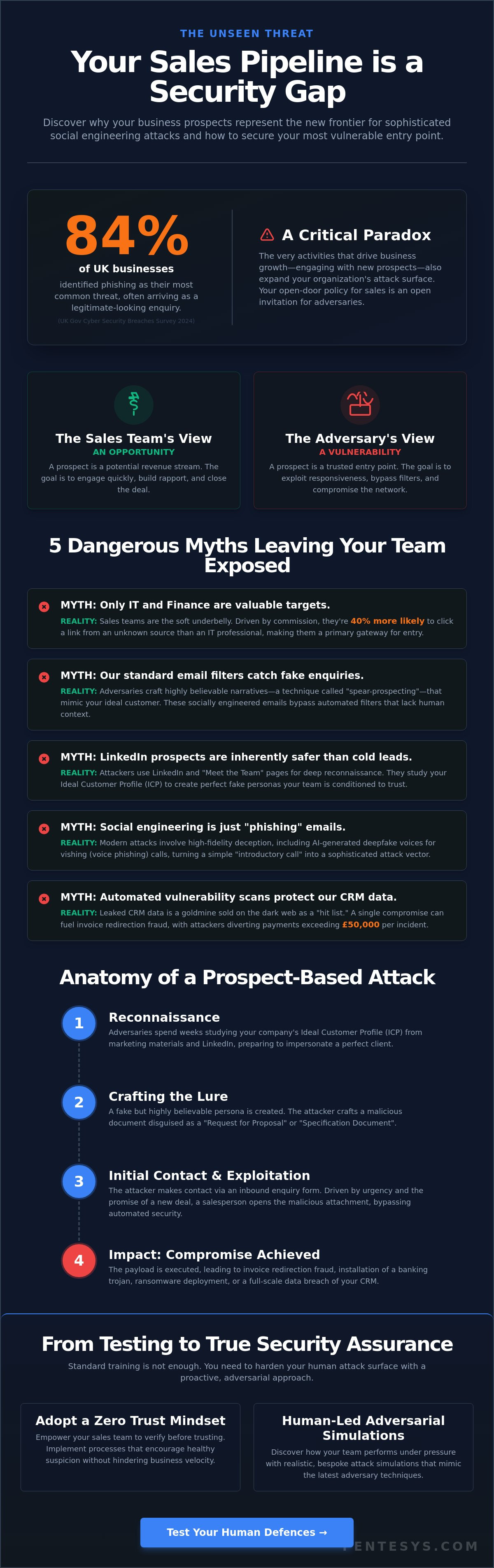
The Anatomy of a Prospect-Based Phishing Attack
The methodology of a modern social engineering campaign is methodical and patient. Unlike broad-spectrum spam, a prospect-based attack is a high-precision operation that exploits the natural incentives of your sales and business development teams. Phishing remains the primary entry point for most businesses that identify an attack. The process typically follows a four-stage lifecycle designed to bypass technical filters through human psychology.
- Step 1: Persona Development. The adversary conducts deep reconnaissance on LinkedIn and corporate “About Us” pages to create a fake identity. They mirror the characteristics of your ideal prospects, ensuring their industry, tone, and seniority level appear entirely legitimate.
- Step 2: Rapport Building. Contact begins with a low-pressure enquiry via a website form or social media. There are no links or attachments at this stage. The attacker simply asks a valid question about service availability to establish a conversation.
- Step 3: Payload Delivery. Once the sales representative responds, the attacker sends a “Detailed Brief” or “RFP Document.” Because the employee is now expecting the file, they’re significantly more likely to ignore security warnings.
- Step 4: Lateral Movement. After the initial infection or credential theft, the adversary moves through the corporate network. They often target the Pentesys Portal or internal CRM systems to escalate privileges and access sensitive client data.
Payload Delivery via Fake RFPs and Briefs
Attackers frequently use .XLSB or .ZIP formats to bypass basic sandbox environments that only scan for more common extensions. Macro-enabled spreadsheets in lead-gen are particularly dangerous because they allow an adversary to execute malicious scripts the moment a staff member enables content to view “confidential pricing tables.” The perceived urgency of a high-value contract enquiry often causes employees to override cautious security protocols, prioritising a fast response over digital safety.
Credential Harvesting: The Silent Threat
Adversaries often deploy sophisticated login portals designed to look identical to legitimate CRM or project management tools. When a sales person enters their details to “download the brief,” the attacker captures their credentials in real time. A single compromised sales account can expose the entire organisation’s pipeline and client contact list, providing a platform for secondary attacks. Pentesys simulates these scenarios using human-led adversary simulation to identify exactly where your team’s defences might falter when facing realistic prospects. This strategic approach provides the remediation guidance needed to strengthen long-term resilience without relying on automated scans alone.
Hardening Your Human Attack Surface: A Guide for Sales Teams
Sales teams represent the frontline of your organisation. They interact with hundreds of external entities every week, which makes them prime targets for sophisticated social engineering. Adopting a Zero Trust mindset for all inbound business enquiries is no longer optional. You must treat every initial contact as unverified until its identity is proven through established protocols. This approach isn’t about cynicism; it’s about building long-term resilience in an era where deepfakes and AI-driven phishing are common.
Technical controls like Multi-Factor Authentication (MFA) and endpoint protection are non-negotiable for sales staff. The UK Government’s Cyber Security Breaches Survey continues to show that most medium-sized businesses identify a breach or attack each year. Sales professionals often prioritise speed over security, sometimes bypassing controls to close a deal. Robust endpoint detection and response (EDR) provides the visibility needed to block malicious payloads hidden in “briefing documents” or “tender requirements.”
Static, point-in-time audits cannot keep pace with evolving threats. Pentesys recommends moving toward continuous penetration testing to identify vulnerabilities in real-time. This proactive methodology ensures that as your sales tech stack evolves, your security posture remains enterprise-grade. It shifts the focus from reactive patching to strategic assurance.
Lead Validation Protocols
Verifying the identity of new prospects before sharing sensitive data prevents costly leaks. Sales teams should use Open Source Intelligence (OSINT) techniques to verify LinkedIn profiles. Check for account age, connection quality, and consistent professional history. If a domain was registered less than 30 days ago, flag it immediately. We advocate for a “safe reporting” culture. If a salesperson flags a suspicious lead, they should be supported by the security team rather than pressured to hit a volume KPI.
Technical Hardening for Remote Sales Staff
Remote work is the standard for UK sales teams, yet it introduces significant risk. Securing mobile devices used for CRM access is critical to protect your pipeline. Use managed VPNs and secure browsers to isolate prospects‘ data from personal web activity. API security testing is also vital. Most modern sales stacks rely on dozens of third-party integrations. A single insecure API can expose your entire customer database to an adversary. Human intuition must be paired with rigorous technical testing to ensure total coverage.
Secure your sales pipeline and build lasting trust with a strategic security assessment from Pentesys.
Adversarial Simulations: Testing Your Defence Against Fake Prospects
Static security awareness training often relies on predictable, annual modules that fail to reflect the evolving tactics seen in 2026. These passive methods don’t prepare your team for the nuance of a sophisticated threat actor. Adversarial simulation succeeds because it creates a living laboratory within your organisation. Pentesys mimics the psychological triggers used by attackers who pose as high-value business prospects to bypass technical filters. We move beyond the outdated “people problem” mindset. Our goal is to transform your workforce into a strategic detection layer that identifies threats before they breach the perimeter.
Measuring Success in Security Assurance
Data drives effective security assurance. The Pentesys Portal serves as the central hub for tracking human-centric security metrics in real-time. We focus on key performance indicators that matter, such as:
This simulation data informs your long-term security strategy. It allows executive decision-makers to allocate resources based on proven vulnerabilities rather than guesswork. By adopting this methodical approach, you turn human intuition into a measurable business asset. It’s about moving from a reactive posture to one of continuous assurance. Strengthen your human firewall with Pentesys today.
- Mean Time to Report: How quickly your team identifies and alerts the security team to a suspicious interaction.
- Escalation Accuracy: The percentage of staff who follow the correct internal protocols when contacted by unverified prospects.
- Resilience Growth: Tracking the decline in successful compromises over multiple simulation cycles.
Is it possible for a “prospect” to hack our company through a contact form?
Yes, an adversary posing as a prospect can exploit vulnerabilities like SQL injection or Cross-Site Scripting (XSS) through contact form input fields. The 2021 OWASP Top 10 report ranks injection attacks as a critical risk for web applications. These malicious actors use forms to bypass authentication or execute scripts that steal session cookies. Implementing strict input validation and sanitisation is the primary defence against these entry points.
How can I tell if a LinkedIn prospect is a fake profile used for reconnaissance?
Identifying a fraudulent LinkedIn profile requires a methodical review of their activity and imagery. Fake profiles often use AI-generated headshots, which you can identify by looking for blurred backgrounds or asymmetrical earrings. LinkedIn’s own transparency reporting shows it regularly removes large numbers of fake accounts. Check for a lack of mutual connections or a work history that doesn’t align with the prospect’s stated expertise.
What is the difference between a spear-phishing attack and a generic phishing email?
Generic phishing involves sending bulk messages to thousands of recipients, while spear-phishing is a highly targeted attack aimed at a specific individual. A spear-phishing email often uses the name of a real prospect or refers to a recent industry event to build trust. The Verizon Data Breach Investigations Report notes that social engineering remains a primary entry point for breaches. These targeted attacks are significantly more difficult for standard filters to detect.
Founder & CEO, Pentesys
James Hinton is the founder of Pentesys, a CREST-approved UK company working only on offensive security: penetration testing, PTaaS, CTEM, external attack surface management and red teaming. He built the business around one discipline rather than a broad consultancy menu, and most of his time still goes on how engagements get scoped, delivered and reported. He writes here about the practical side of security testing and what buyers should be asking for.
LinkedIn profile