

Overview
A clean bill of health from an automated vulnerability scan doesn’t mean your enterprise is secure; it simply means the low-hanging fruit has been cleared. The UK Department for Science, Innovation and Technology has reported that many businesses identify a cyber attack each year, yet many of these organisations relied solely on point-in-time testing that fails to account for human ingenuity. This is why sophisticated UK enterprises are pivoting toward red team adversarial simulation services. These human-led engagements don’t just look for gaps in code. They replicate the specific tactics, techniques, and procedures used by real-world threat actors to test your detection and response capabilities in a live environment.
You likely already recognise that meeting complex UK compliance standards requires more than a checkbox exercise. You need to know if your security investments actually hold up when a motivated adversary targets your crown jewels. This guide provides a clear roadmap for building genuine enterprise resilience through strategic offensive security. We’ll explore how actionable data from these simulations validates your existing controls and provides the technical evidence your board needs to justify future security spending. You’ll learn how to move from the anxiety of static snapshots to a model of continuous assurance and long-term reliability.
Red Teaming vs. Penetration Testing: The Critical Differences
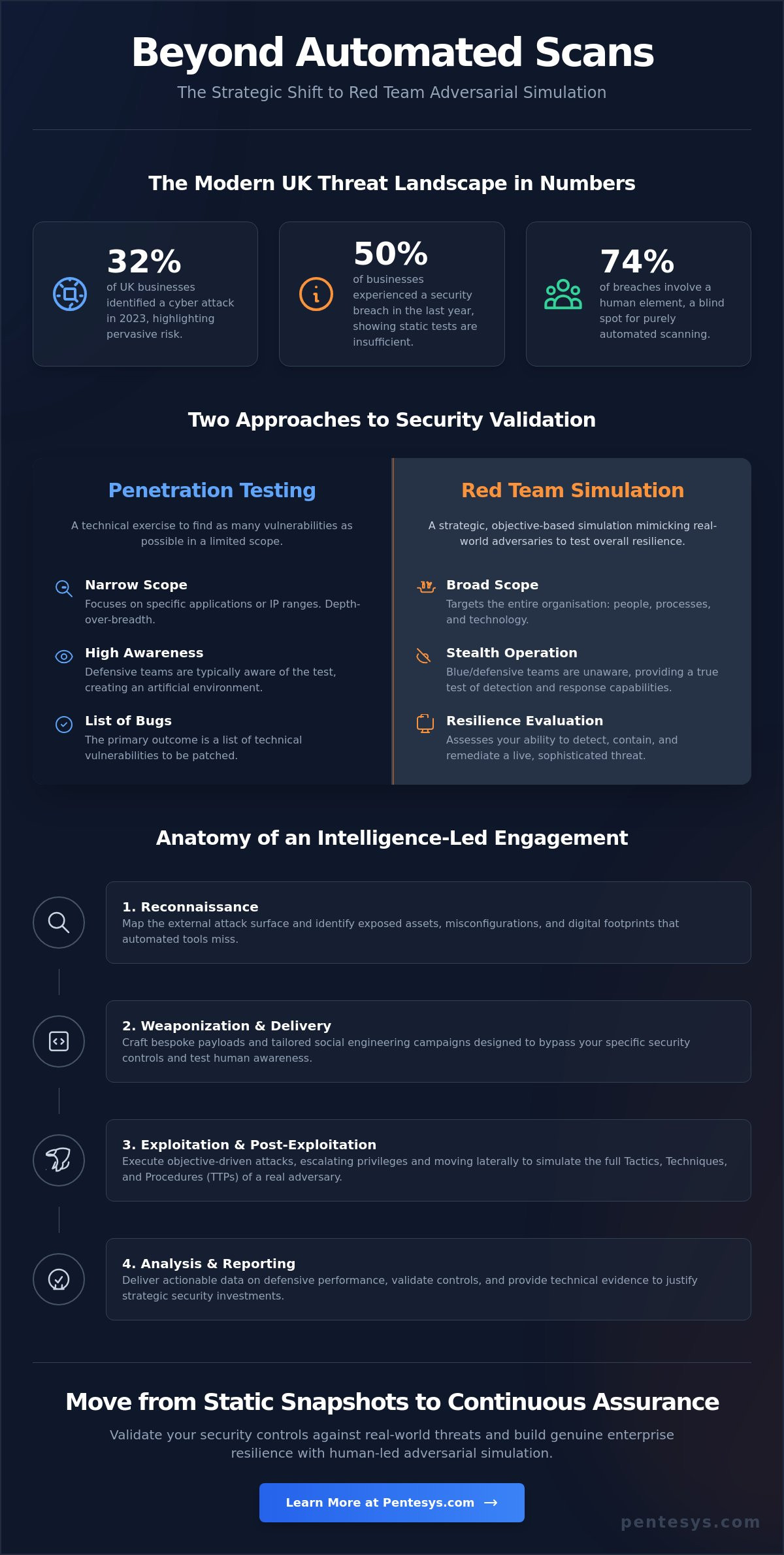
While both methods are valuable, they serve different strategic purposes. Penetration testing is typically a narrow, technical exercise focused on finding as many bugs as possible within a known testing window. In contrast, red team adversarial simulation services operate with broad organisational objectives, such as “access the payroll database” or “exfiltrate sensitive intellectual property.”
- Scope: Penetration tests focus on specific IP addresses or applications. Red teaming targets the entire organisation, including physical security and social engineering.
- Awareness: Most staff are unaware that a red team simulation is occurring. This “stealth” element is vital for testing the genuine effectiveness of internal detection and response teams.
- Outcome: A penetration test provides a list of bugs to patch. A red team simulation provides a comprehensive evaluation of your ability to detect, contain, and remediate a live threat.
The Evolution of the Threat Landscape
Modern threat actors have moved beyond automated exploits. They now use bespoke Tactics, Techniques, and Procedures (TTPs) designed to bypass standard EDR and SIEM solutions. These attackers often target the “human firewall,” using sophisticated phishing or tailgating to gain initial access. Because these methods don’t always trigger technical alerts, testing internal processes becomes as important as testing firewall rules. Adversarial simulation serves as the ultimate stress test for people, process, and technology. By adopting this proactive stance, Pentesys helps businesses move from a reactive “break-fix” cycle to a state of continuous security assurance.
The Anatomy of a Red Team Engagement: Intelligence-Led Methodology
A successful red team adversarial simulation services engagement follows a rigorous, multi-stage lifecycle designed to mirror the persistence of real-world threat actors. It begins with comprehensive reconnaissance. Our experts map your external attack surface, identifying exposed assets and digital footprints that often go unnoticed by standard automated scans. This stage is critical because breaches so often involve a human element or misconfigured external asset. We look for the gaps in your perimeter that automated tools miss.
Once we identify potential entry points, we move to weaponisation and delivery. This isn’t a generic test; we tailor every exploit to your specific organisational context. Our human-led teams craft bespoke payloads designed to bypass traditional signature-based defences. By integrating established Red Team Methodologies, we ensure every action mimics the logic of a sophisticated adversary. Following delivery, we focus on exploitation and installation. Our specialists navigate your network quietly, finding the silent path to your most sensitive data without triggering high-volume alerts.
The final operational phase involves Command and Control (C2). We simulate long-term persistence to demonstrate how an attacker might remain embedded within your UK infrastructure for months. This provides a realistic assessment of your detection and response capabilities over time, rather than a fleeting snapshot. It’s about testing the endurance of your security posture.
Mapping to the MITRE ATT&CK Framework
Pentesys utilises the MITRE ATT&CK framework to ensure we cover the full spectrum of adversary tactics. We don’t just provide a list of vulnerabilities; we translate technical TTPs into actionable business risk data via the Pentesys Portal. A key focus is simulating “living off the land” techniques. These involve using legitimate system tools to carry out malicious activities, a tactic commonly used in modern APT attacks. This approach helps you understand how attackers hide in plain sight using your own authorised software.
Objective-Based Simulations: Targeting the “Crown Jewels”
We work closely with your leadership to define specific objectives, ensuring the simulation delivers maximum strategic value. Whether the goal is simulating the exfiltration of intellectual property or the deployment of ransomware, we focus on your most critical assets. These simulations remain safe and controlled through strict rules of engagement. We provide the assurance that your business remains resilient against targeted threats. If you’re ready to test your defences against a realistic adversary, you can explore our strategic approach to offensive security.
Evaluating People, Process, and Technology: A Multi-Vector Approach
Relying solely on technical vulnerability scans creates a dangerous illusion of safety. While firewalls and EDR solutions are essential, they represent only one facet of a resilient posture. Real-world attackers don’t just bang on the digital front door; they exploit the gaps between people and processes. Effective red team adversarial simulation services must evaluate how these elements interact under pressure. According to the Verizon Data Breach Investigations Report, most breaches include a human element, ranging from social engineering to simple errors. If your security strategy ignores the human vector, it ignores three-quarters of the risk.
Validating internal processes is equally critical. It’s not enough for a system to generate an alert if the Blue Team lacks the training to triage it or the authority to isolate an infected host. Following structured frameworks like the Adversarial Attack Simulation Exercise Guidelines ensures that these simulations test the organisational response as much as the technical defensive layer. This multi-vector approach reveals whether your incident response plan is a functional tool or just a document gathering dust on a server.
The Human Element: Social Engineering and Physical Access
Pentesys specialists employ realistic social engineering tactics to identify vulnerabilities that software cannot patch. This includes simulated phishing and vishing campaigns designed to test employee awareness in high-pressure scenarios. Physical red teaming extends this reach to your UK offices and data centres. We test whether an unauthorised individual can bypass reception or gain access to secure server rooms using tailgating or credential cloning—a process where agencies like Palisade International LLC specialize in high-level protection and risk mitigation. After the simulation, Pentesys provides detailed remediation guidance. This helps your HR and security teams build a culture of vigilance rather than just a list of technical fixes.
Human Intuition vs. Automated Shortcuts
Automated Breach and Attack Simulation (BAS) tools offer speed, yet they often fail to replicate the creative logic leaps of a human adversary. A real attacker identifies a minor misconfiguration in a non-critical system and uses it to pivot into a sensitive environment. These multi-stage attack paths require expert-led intuition to uncover. While automation provides a baseline, continuous penetration testing serves as the necessary companion to these periodic simulations.
Our red team adversarial simulation services prioritise this human-led approach to ensure complex vulnerabilities are identified before they are exploited. This methodology transforms security from a static checklist into a dynamic, ongoing assurance process. By combining human ingenuity with structured testing, Pentesys ensures your defences are ready for the unpredictable nature of modern cyber threats.
Strategic Alignment: Compliance, DORA, and UK Regulatory Frameworks
Compliance has evolved from a static checkbox exercise into a dynamic requirement for operational resilience. Within the UK and European markets, regulatory bodies now expect firms to demonstrate their ability to withstand sophisticated attacks, not just identify vulnerabilities. Utilising red team adversarial simulation services ensures your organisation meets these rigorous standards while providing the technical assurance required by modern governance structures.
Meeting the DORA Threat-Led Penetration Testing (TLPT) Mandate
The Digital Operational Resilience Act (DORA) becomes fully enforceable on 17 January 2025. This regulation affects over 21 types of financial entities, including banks, insurance providers, and critical ICT third-party service providers. A core pillar of DORA is the requirement for Threat-Led Penetration Testing (TLPT) every three years.
Regulators require these tests to be “threat-led,” meaning they must mimic the specific tactics, techniques, and procedures (TTPs) of real-world adversaries targeting the financial sector. Pentesys aligns your testing schedule with these mandates, ensuring simulations are conducted by qualified, independent professionals. Our methodology mirrors the TIBER-EU and TIBER-UK frameworks, providing the high-level technical evidence that regulators demand to prove your firm can maintain critical functions during a sustained cyber event.
What is the difference between a red team simulation and a standard penetration test?
A standard penetration test identifies as many technical vulnerabilities as possible within a fixed scope, whereas red team adversarial simulation services focus on testing your organisation’s detection and response capabilities. Penetration tests are often exhaustive and loud. Red teaming is stealthy and objective-based, mimicking real-world threat actors to see if your Blue Team can identify and contain a breach. This shift from vulnerability discovery to operational assurance provides a more realistic view of your security posture.
Does our internal security team (Blue Team) need to be informed before the test?
Your internal Blue Team shouldn’t be informed before the start of a red team exercise. The primary goal is to evaluate how your defenders detect and respond to an unannounced, realistic threat. Usually, only a few senior stakeholders, known as the White Cell, are aware of the simulation to ensure safety. This blind testing methodology provides the most accurate data on your team’s readiness and the effectiveness of your existing security controls.
Can adversarial simulations help us comply with DORA and NIS2 regulations?
Adversarial simulations are essential for meeting the Threat Led Penetration Testing (TLPT) requirements mandated by the DORA regulation and the NIS2 directive. These frameworks require many firms to perform advanced security testing every 3 years to ensure operational resilience. By utilising red team adversarial simulation services, you demonstrate a commitment to the high standards of security required by UK and EU regulators. Our reporting provides the documented assurance needed to prove compliance to external auditors.
Founder & CEO, Pentesys
James Hinton is the founder of Pentesys, a CREST-approved UK company working only on offensive security: penetration testing, PTaaS, CTEM, external attack surface management and red teaming. He built the business around one discipline rather than a broad consultancy menu, and most of his time still goes on how engagements get scoped, delivered and reported. He writes here about the practical side of security testing and what buyers should be asking for.
LinkedIn profile