

Overview
Red teaming has moved away from proving a network can be breached, which is generally assumed, towards testing whether the organisation notices and responds. The output is less a list of vulnerabilities than a timeline: what was done, when it was detected, and what happened next.
We believe that cybersecurity is about trust and long-term resilience. This article explores how adversarial simulation has evolved into a model of continuous, human-led assurance that transcends the limitations of automated scans. You’ll learn how to transition from point-in-time testing to a strategic approach that aligns with the UK regulatory landscape, including frameworks like DORA. We’ll provide a clear roadmap for using the Pentesys Portal to turn technical findings into actionable business value, giving you the confidence that your entire enterprise is truly secure.
The Shift from Static Defence to Offensive Security Assurance
Traditional security models often rely on point-in-time audits that provide a fleeting snapshot of a network’s health. By 2026, these static methods have proven insufficient against sophisticated multi-stage breaches that bypass standard perimeter defences. A clean report from an annual audit doesn’t account for the rapid evolution of threat actor tactics or the introduction of new assets. Modern red team cyber security moves beyond simple vulnerability scanning. It provides a holistic evaluation of an organisation’s people, processes, and technology by simulating the persistence and ingenuity of a real-world adversary.
In the UK enterprise landscape, the focus has shifted from “checking boxes” for compliance to “validating resilience.” This change is driven by the reality that an Red Team exercise uncovers how security controls perform under actual pressure. It isn’t just about finding a flaw; it’s about seeing if that flaw allows an attacker to move laterally or exfiltrate sensitive data. Maintaining organisational trust now requires a proactive mindset where offensive security assurance acts as the ultimate stress test for your defensive posture. This methodology ensures that security is a lived reality rather than a theoretical policy.
The Limitations of Annual Compliance Testing
A “clean bill of health” issued in April offers zero guarantee of security by October. Vulnerabilities emerge daily, and a static report quickly becomes obsolete. There’s a massive gap between a vulnerability being “identified” on a spreadsheet and that same vulnerability being “exploitable” in a live environment. To bridge this gap, many UK firms are moving toward continuous penetration testing explained as a new baseline for security. This approach ensures that human-led intelligence identifies risks as they appear, rather than waiting for the next scheduled audit cycle. It prioritises high-impact exploits over low-risk automated findings.
Anatomy of a Modern Red Team Engagement
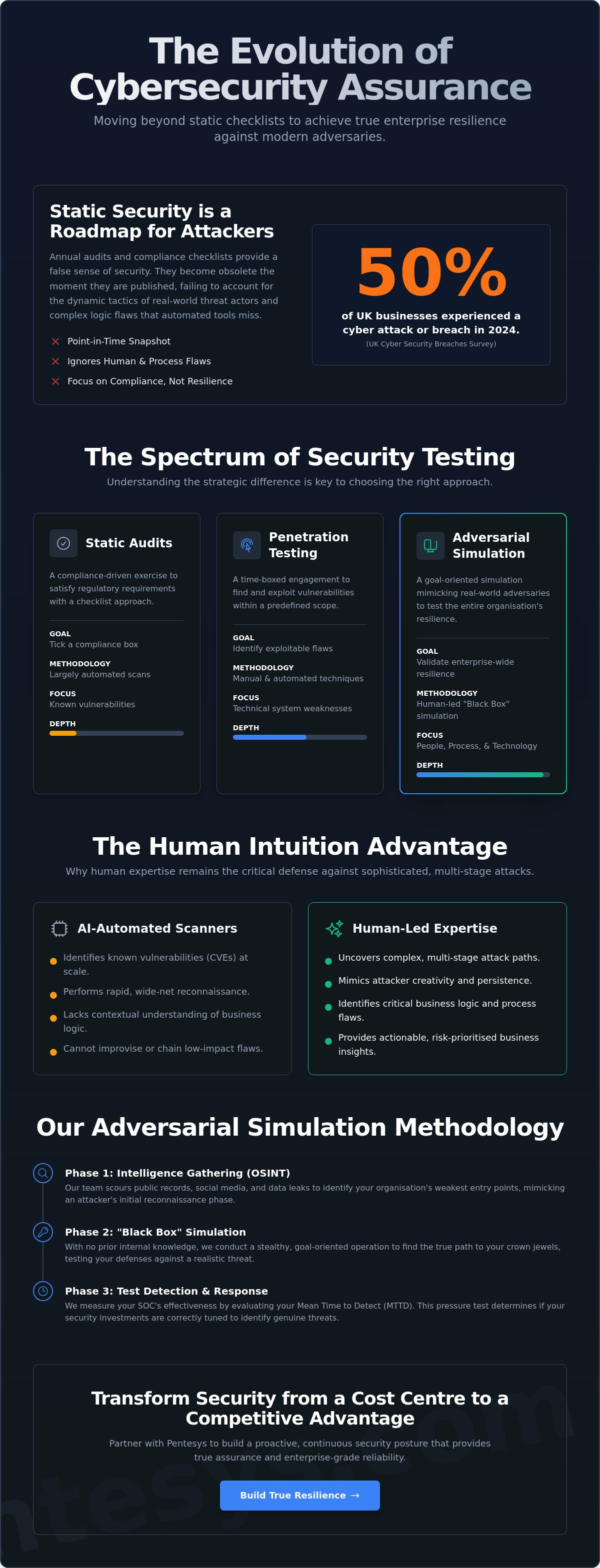
Modern adversary simulations are rigorous, multi-layered operations designed to measure an organisation’s resilience against actual threats. Unlike traditional vulnerability assessments, red team cyber security focuses on the effectiveness of your people, processes, and technology under the pressure of a simulated attack. We utilise “Black Box” testing to ensure the simulation remains authentic. This methodology provides no prior knowledge of your internal systems to our consultants, forcing them to find entry points exactly as an external threat actor would. This approach uncovers blind spots that internal teams often overlook because of their proximity to the infrastructure.
Stealth is a defining characteristic of our engagements. We don’t just look for vulnerabilities; we test how long your Security Operations Centre (SOC) takes to detect and respond to suspicious activity. This pressure test determines if your internal defence systems are tuned correctly to filter out noise and identify genuine indicators of compromise. By mimicking the quiet, persistent tactics of modern attackers, we provide a realistic assessment of your defensive maturity. You can learn more about the strategic relationship between attackers and defenders in this guide on Red Team vs. Blue Team dynamics.
Phases of an Adversarial Simulation
Our methodology follows a structured path that begins with intelligence gathering and Open Source Intelligence (OSINT). Our team identifies the weakest entry points by scouring public records, social media, and leaked credential databases. We then move to the initial compromise phase, adopting an “Assume Breach” mentality. This allows us to test lateral movement across your network to see how easily an attacker could reach sensitive assets. The engagement concludes with objective execution, where we simulate data exfiltration or system disruption. These actions are performed safely to demonstrate impact without causing actual damage to your UK operations.
Testing the Human Element: Social Engineering
Human intuition remains a primary target for attackers. In 2026, social engineering has evolved beyond simple phishing emails to include sophisticated pretexting and physical security bypasses. Attackers might use AI-generated voice cloning or deepfake technology to manipulate employees into granting access. Our simulations reflect these advanced threats, testing whether your staff can identify high-level manipulation. We design these ethical simulations to be educational. Instead of punishing errors, we provide clear remediation guidance via the Pentesys Portal to help your team improve their security posture.
The final deliverables of a Pentesys engagement move beyond a simple list of software bugs. We provide a strategic remediation roadmap that prioritises fixes based on their potential business impact. This ensures that executive decision-makers receive actionable insights rather than just technical data. By focusing on long-term resilience, we help you transition from reactive patching to a state of continuous security assurance.
Red Teaming vs. Penetration Testing: Defining the Strategic Difference
Many organisations conflate penetration testing with red teaming, yet they serve distinct roles in a security lifecycle. A penetration test acts as a technical scalpel. It systematically identifies as many vulnerabilities as possible within a fixed scope, such as a specific IP range or web application. In contrast, red team cyber security is a goal-oriented exercise. It simulates a specific adversary’s tactics to test an organisation’s detection and response capabilities across people, processes, and technology.
While a pen test aims to provide a comprehensive list of flaws, a red team exercise focuses on the path to the crown jewels. It doesn’t seek to find every open port; it seeks the single path that leads to the domain controller or the customer database. This shift from scope-based to objective-based testing requires a solid foundation of CREST accredited penetration testing UK. Without this baseline, a red team exercise often becomes an expensive way to find basic vulnerabilities that a standard assessment would have caught.
These two disciplines work together in a mature vulnerability management program. Penetration testing clears the “noise” of common vulnerabilities, allowing the red team to focus on sophisticated, multi-stage attacks. This creates a layered assurance model that builds long-term resilience.
Choosing the Right Assessment for Your Maturity Level
Your organisation’s maturity dictates the assessment type. If you haven’t conducted regular infrastructure or web application testing, a red team simulation is premature. You’ll likely be overwhelmed by findings that could’ve been identified through simpler means. Mature organisations use Blue Teams for daily defence and Purple Teaming for collaborative knowledge transfer. Pentesys facilitates these through our central portal, ensuring human-led insights drive resilience. Infrastructure and web application testing remain essential prerequisites for any successful red team cyber security engagement.
Regulatory and Compliance Drivers in the UK
UK-specific regulations increasingly mandate advanced offensive testing. The Financial Conduct Authority (FCA) and the Bank of England utilise frameworks like CBEST to ensure systemic resilience in the financial sector. ISO 27001:2022 also emphasises the need for independent, third-party assurance. CREST standards provide the necessary framework for this, guaranteeing simulations are ethical and technically rigorous. This level of assurance is vital for board-level reporting. UK directors increasingly view cyber risk as a top-tier business threat, requiring clear, evidence-based reporting from accredited partners.
The 2026 Trend: Human Intuition in an AI-Driven Attack Landscape
The 2026 threat landscape is defined by the industrialisation of AI-driven reconnaissance. Attackers now deploy autonomous agents to probe UK infrastructure 24/7, searching for the smallest oversight in code or configuration. While these automated tools identify surface-level entry points at incredible scale, they lack the creative logic required to chain minor misconfigurations into a critical breach. This creates a gap that only professional red team cyber security can bridge. By integrating Continuous External Attack Surface Monitoring (CEASM) into our methodology, we provide a real-time view of your digital footprint. This allows our experts to identify and secure forgotten assets before they appear on an adversary’s radar. Social engineering has also shifted, with deepfake audio now featuring in targeted pretexting attempts against UK executive teams. Detecting these sophisticated lures requires human intuition and refined verification protocols that static software cannot provide.
The Myth of Fully Automated Red Teaming
Automation provides the speed necessary to scan thousands of assets in minutes, but it fundamentally fails to understand business context. A scanner might flag an unpatched service; a human operative understands how that service connects to your core financial data. Human-in-the-loop oversight remains the definitive requirement for 2026 security assurance, ensuring that technical findings are contextualised within the specific business risks of a UK enterprise. We balance automated vulnerability management with expert adversarial logic to uncover the complex paths that algorithms miss. Our process focuses on:
- Identifying logic flaws in bespoke business applications that automated scanners overlook.
- Testing the effectiveness of internal incident response protocols during a simulated breach.
- Simulating multi-stage attacks that bypass standard AI-based security filters.
Adversarial Simulation in Cloud and API Environments
Modern infrastructure relies on serverless architectures and intricate microservices. These environments frequently blur the boundaries of the Shared Responsibility Model within AWS, Azure, and Google Cloud. Our simulations focus on the hidden attack paths created by misconfigured API permissions and over-privileged service accounts. Mismanaged API tokens are a growing driver of cloud data exfiltration incidents across the UK tech sector. We rigorously test these permissions to ensure that a single compromised key doesn’t lead to a total environment takeover. All findings and remediation guidance are delivered through the Pentesys Portal, providing a transparent and methodical roadmap to resilience. This strategic approach provides the actionable insights your team needs to maintain control in a distributed, cloud-native world.
Ensure your organisation is prepared for the next generation of threats with professional red team cyber security.
What is the primary difference between a red team and a blue team?
A red team acts as a simulated adversary to test your defences, while a blue team consists of your internal or outsourced security personnel who defend against these attacks. This exercise provides a realistic assessment of how your people, processes, and technology respond to a live threat. By using human-led red team cyber security simulations, we identify gaps that automated scans miss, helping your blue team improve their detection and response capabilities.
Do I need to be CREST certified to hire a red team?
You don’t need any specific certifications to hire a red team, but your service provider should hold recognised accreditations like CREST. Choosing a CREST-accredited firm ensures the consultants follow a rigorous code of conduct and possess the technical skills required for complex simulations. This accreditation provides assurance that the red team cyber security exercise meets high industry standards for quality and ethical behaviour.
What happens if the red team successfully breaches our defences?
If the red team successfully breaches your defences, we document the exact path taken and provide clear remediation guidance to close the identified gaps. This is a positive outcome that allows you to fix vulnerabilities before a real attacker exploits them. We focus on long-term resilience, turning the findings into actionable insights that help your team build a more secure infrastructure through our structured reporting process.
Founder & CEO, Pentesys
James Hinton is the founder of Pentesys, a CREST-approved UK company working only on offensive security: penetration testing, PTaaS, CTEM, external attack surface management and red teaming. He built the business around one discipline rather than a broad consultancy menu, and most of his time still goes on how engagements get scoped, delivered and reported. He writes here about the practical side of security testing and what buyers should be asking for.
LinkedIn profile