

Overview
Red teaming is a harder sell than penetration testing because it does not produce a tidy list of vulnerabilities to fix. What it produces is an answer to a question most boards have never had answered: if someone competent targeted us specifically, would we notice, and how far would they get before we did. Framing the spend around that question works better than framing it around coverage.
You likely feel the pressure to replace expert-led testing with automated tools to reduce overhead. It’s a common struggle to explain why a failed simulation is actually a high-value win for organisational resilience. This guide covers how to translate adversarial testing into terms a finance director will engage with. We will examine how to align human-led red teaming with regulatory requirements like the EU AI Act and demonstrate the strategic value of proactive, ongoing security measures over one-off evaluations.
Beyond Compliance: Why Red Teaming is Essential for Modern Risk Management
Compliance is no longer a reliable proxy for security. In 2026, the gap between meeting a regulatory standard and surviving a sophisticated breach has widened significantly. For many CISOs, understanding What is Red Teaming? begins with a fundamental shift in perspective. Red teaming is a full-spectrum adversarial simulation that targets your people, processes, and technology simultaneously. It doesn’t just check for vulnerabilities; it tests how your organisation responds under pressure. This distinction is critical for a successful red teaming budget justification, as it moves the conversation from checking a box to validating resilience.
Traditional audits often fail to predict real-world outcomes because they’re static. While your infrastructure might pass a compliance check, it may still crumble against AI-enhanced social engineering or stealthy persistence tactics. We advocate for a move toward “Security Assurance.” This is a higher tier of reliability where your defences aren’t just tested; they’re proven to be dependable through rigorous, manual evaluation.
The Evolution of Offensive Security in 2026
Attackers have evolved far beyond simple exploits. In 2026, we see multi-stage campaigns that leverage generative AI to bypass traditional filters. These threats require a human touch to counter. Scanners often miss complex business logic flaws that a manual expert can identify and exploit. In the UK, the regulatory environment is shifting. Authorities now prioritise operational resilience validation over simple technical patches. This shift makes a robust red teaming budget justification easier to present to a board that values long-term stability over temporary fixes.
Why Annual Penetration Tests Are No Longer Sufficient
Annual penetration tests provide a useful snapshot of your technical vulnerabilities at a specific moment. However, they lack the scenario-based nature of a red team engagement. Red teaming exposes the “defender blind spot.” This occurs when your technical patches exist, but your detection and response teams fail to see the adversary moving through your network. While penetration testing focuses on the software, red teaming tests the defenders. For organisations looking for a more persistent approach, our guide on Continuous Penetration Testing Explained outlines how to maintain validation between major simulations. Red teaming provides the deep, adversarial context that a standard test simply cannot replicate.
Red Teaming vs. Penetration Testing: Articulating the Value Differential
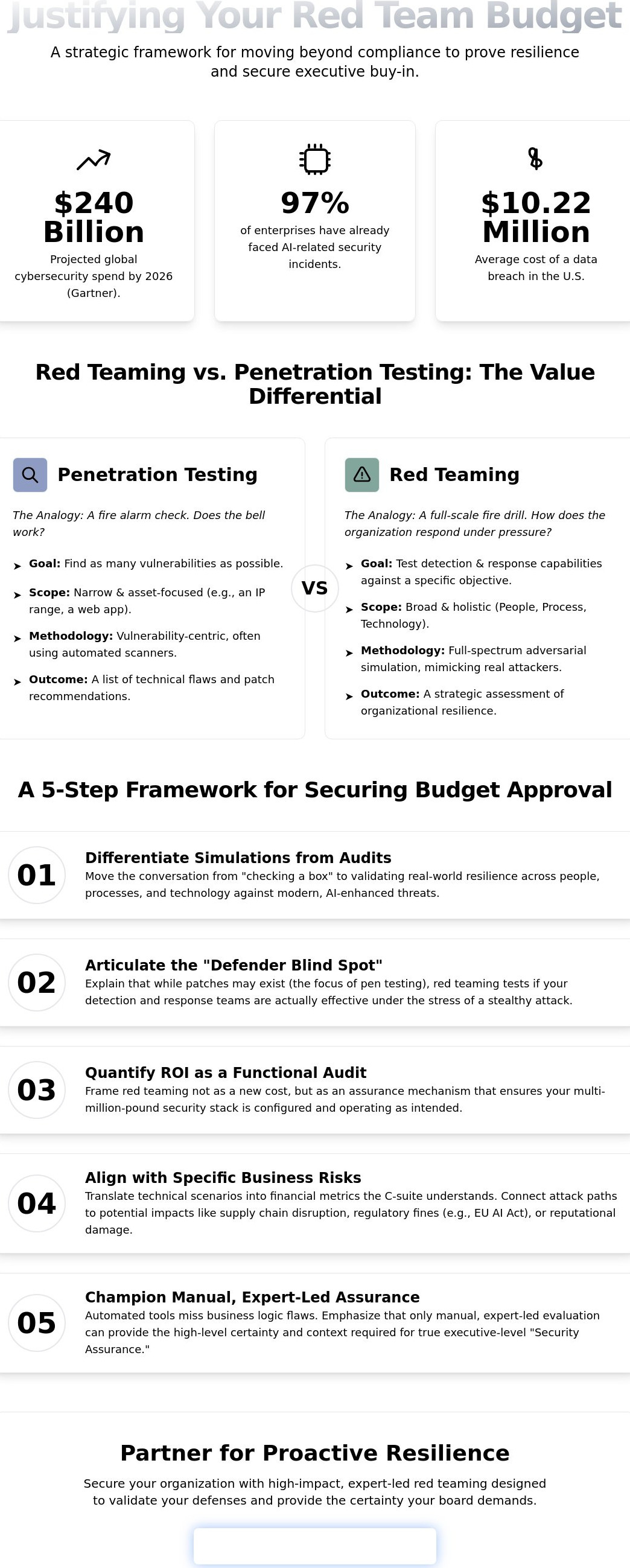
Executives often view security testing as a monolithic category. To secure approval, you must clarify that while penetration testing identifies holes in a fence, red teaming tests if the guards are awake and the alarm system actually rings at the police station. Think of a penetration test as a fire alarm check. You verify that the sensors function and the bells sound. In contrast, a red team engagement is a full-scale fire drill. It evaluates how people react, which exits they use, and whether the marshals follow the correct protocols under stress.
For a successful red teaming budget justification, you should emphasize the shift from technical validation to “Adversarial Simulation.” This term resonates with the board because it focuses on business outcomes rather than just technical debt. It reframes the service as a stress test for the entire organisation, not just the IT department. By adopting this language, you position the service as a strategic investment in business continuity.
Scope and Methodology Differences
Penetration testing is traditionally vulnerability-centric. It focuses on a specific asset, such as a web application or an IP range, to find as many flaws as possible within a fixed window. It’s an essential hygiene factor for any modern enterprise. However, red teaming is goal-centric. The objective isn’t to find every bug, but to “exfiltrate the crown jewels” by any means necessary. This might involve chaining multiple low-risk vulnerabilities to achieve a high-impact result that a standard scan would never detect.
Stealth is a core metric here. Unlike a standard test where the security team is often alerted beforehand, red teams operate without the knowledge of the internal defenders. These engagements often span weeks or months to mimic the persistence of a real threat actor. Success is measured by the ability to evade detection and the time taken for the Blue Team to identify the intrusion. Understanding these nuances is a core part of a CISO’s guide to red teaming outcomes, as it helps you present findings as strategic risk data that the CFO can appreciate.
Testing the Human and Procedural Element
Modern security is a blend of technology and human intuition. Red teaming is the only method that evaluates your Incident Response (IR) playbooks under genuine pressure. It reveals whether your team can separate signal from noise when a human adversary is actively trying to stay hidden. You aren’t just testing software; you’re testing the people who manage it. This provides a level of certainty that automated tools cannot replicate.
Social engineering often plays a pivotal role. An attacker might bypass a multi-million-pound firewall simply by convincing a staff member to share a credential or open a malicious file. By simulating these human-centric attacks, you validate the communication chain between IT, Security, and Legal during a crisis. This level of certainty is what separates a mature security posture from a reactive one. If you’re ready to move beyond basic testing, exploring professional Red Teaming services can provide the adversarial context your strategy needs to remain resilient.
Quantifying the ROI of Adversarial Simulations
ROI in cybersecurity often feels abstract until a crisis occurs. A robust red teaming budget justification hinges on your ability to prove that offensive simulations are actually a cost-saving measure. By framing red teaming as an “Audit of the Security Stack,” you demonstrate that its primary purpose is to ensure your existing tools and personnel are performing at their peak. It’s the only way to confirm that your multi-million-pound investments aren’t just shelfware. This process identifies “unproductive spend” by highlighting security tools that provide no actual protection against sophisticated, human-led attacks.
To resonate with the CFO, you must shift the conversation toward primary financial metrics. Two of the most critical are:
Reducing these metrics through regular, expert-led simulations directly correlates to lower financial impact during a real event.
- Mean Time to Detect (MTTD): How quickly your SOC identifies an active, stealthy adversary.
- Mean Time to Respond (MTTR): The duration between detection and full neutralisation of the threat.
Validating Your Existing Security Investments
Many organisations deploy expensive Endpoint Detection and Response (EDR) solutions without ever testing them against a skilled human actor. Does your EDR actually alert when a sophisticated actor moves laterally using legitimate administrative tools? Red teaming provides the answer. It also identifies misconfigurations in cloud environments that automated scanners frequently overlook. By providing your SOC with realistic, high-fidelity attack data, you improve their efficiency and reduce the volume of false positives. This ensures your team spends their time on genuine threats rather than chasing ghosts.
Reducing the Total Cost of Breach (TCOB)
Early detection via red team training can save millions in ransomware recovery and business interruption costs. When your team has practiced their response playbooks against a live simulation, they move with a level of certainty that’s impossible to achieve through table-top exercises alone. In the UK, professional security validation is becoming a key factor in determining cyber insurance premiums. Demonstrating a proactive, ongoing testing schedule can lead to more favorable terms. Most importantly, these simulations protect your brand reputation by ensuring the “first time” your defences are truly tested isn’t during a real, catastrophic attack.
A 5-Step Framework for Securing Red Team Budget Approval
Securing executive buy-in for offensive security requires a shift from technical vulnerability reporting to strategic risk communication. Boards in 2026 are increasingly weary of “security for security’s sake.” They demand to see how every pound spent protects the bottom line. This 5-step framework provides a structured approach to red teaming budget justification, ensuring your proposal resonates with both the CFO and the Board of Directors.
- Step 1: Align with Specific Business Risks. Instead of discussing abstract threats, map the simulation to high-priority concerns like supply chain disruption or the compromise of proprietary AI models. This contextualises the service as a business continuity safeguard.
- Step 2: Use “Intelligence-Led” Terminology. This phrasing signals a sophisticated, strategic approach. It differentiates the engagement from standard scanning by showing it is based on the actual tactics, techniques, and procedures (TTPs) of adversaries targeting your specific sector.
- Step 3: Present a Tiered Proposal. Offer options that scale in intensity. You might start with targeted Social Engineering to test human resilience before moving to a full-scale adversarial simulation.
- Step 4: Benchmark Against Quality Standards. Utilise established frameworks like CREST Accredited Penetration Testing UK to provide the high-level certainty and professional assurance required for modern audits.
- Step 5: Redefine Success Metrics. Define a successful engagement not by the absence of vulnerabilities, but by the measurable improvement in your team’s detection and response capabilities.
Aligning with Executive Priorities
To win approval, you must translate technical “Attack Paths” into “Business Interruption Scenarios.” If a red team finds a way to move laterally through your network, the board needs to understand that this translates to 48 hours of downtime or a total loss of customer trust. Map every finding directly to the corporate risk register. When the board sees that a simulation identified a gap in their top three risks, they stop viewing the service as a cost and start seeing it as a vital audit tool. It’s essential to communicate that a “successful” attack by a red team is a strategic win for the organisation. It provides the opportunity to fix a flaw before a real adversary exploits it.
The Importance of Accreditation and Expert-Led Evaluation
Manual, human-led evaluation remains the signature quality marker for high-level certainty in security assessments. While the market for automated tools is growing, they lack the nuance and intuition of a professional adversary. Relying solely on automation creates a false sense of security; it cannot replicate the creative problem-solving of a human attacker. CREST accreditation acts as a conceptual anchor for your proposal. It proves that the specialists conducting the simulation meet rigorous, formal standards. This level of transparency is vital for UK audits and regulatory compliance, ensuring your red teaming budget justification is backed by recognised industry authority. If you are ready to build a more resilient defence, consider partnering with our expert red team to validate your security posture.
What is the main difference between red teaming and purple teaming?
The primary difference lies in the level of collaboration and stealth. Red teaming is a silent adversarial simulation designed to test the detection and response capabilities of your defenders without their prior knowledge. Purple teaming is a collaborative exercise where offensive and defensive teams work together in real-time to share knowledge and improve specific detection rules. Both serve different strategic objectives within a mature security program.
How do we measure the success of a red team engagement if they successfully breach us?
Success is measured by the improvement in your team’s detection and response metrics, such as Mean Time to Detect (MTTD). A successful breach by the red team provides a wealth of data on where your defences failed and how to strengthen them. These insights are essential for a red teaming budget justification, as they prove the simulation identified a gap before a real adversary could exploit it.
Should we inform our IT team before the red team simulation begins?
Generally, the internal IT and security teams should not be informed of the specific timing of the simulation. This “no-notice” approach is vital for obtaining an accurate assessment of your organisation’s real-world readiness and response capabilities. A small group of “trusted agents” within executive leadership typically manages the engagement to ensure safety while the defenders operate as they would during a genuine incident.
Founder & CEO, Pentesys
James Hinton is the founder of Pentesys, a CREST-approved UK company working only on offensive security: penetration testing, PTaaS, CTEM, external attack surface management and red teaming. He built the business around one discipline rather than a broad consultancy menu, and most of his time still goes on how engagements get scoped, delivered and reported. He writes here about the practical side of security testing and what buyers should be asking for.
LinkedIn profile