

Overview
Despite decades of documentation, SQL injection (CWE-89) remained the most common critical web application vulnerability through 2025. This persistence highlights a difficult reality for security leaders: the gap between knowing a fix exists and implementing it across a complex, high-velocity development environment. You likely feel the pressure to ship code quickly while wondering if automated tools are catching every edge case in your legacy systems or modern ORM escape hatches. We understand that managing these vulnerabilities is about more than just reading a checklist. It’s about building a reliable, expert-validated framework that ensures your data remains inaccessible to unauthorised actors. Understanding how to prevent SQL injection attacks requires a shift from static evaluations to a more proactive, human-led strategy.
In this guide, you’ll master the technical and strategic layers required to neutralise these threats and secure your organisation’s data assets. We provide a clear roadmap for long-term prevention, moving beyond temporary fixes toward a state of high-level certainty. You’ll discover how to balance rapid development with rigorous security compliance through expert testing and methodical oversight. This structured approach moves your team from uncertainty to a position of technical authority, ensuring your security posture is resilient enough for the challenges of 2026.
Understanding the SQL Injection Mechanism in Modern Web Assets
SQL injection (CWE-89) occurs when untrusted data enters a database query, allowing an attacker to manipulate the backend logic. While the industry has understood this vulnerability for decades, it remains a persistent challenge for modern enterprises. In the 2026 OWASP Top 10, Injection still holds the #5 position, reflecting the ongoing difficulty organisations face when securing legacy codebases alongside rapid-release microservices. This SQL injection overview highlights how these flaws lead to severe business outcomes, including large-scale data exfiltration, credential theft, and unauthorised administrative access. Understanding these mechanics is the first step in learning how to prevent SQL injection attacks across your entire infrastructure.
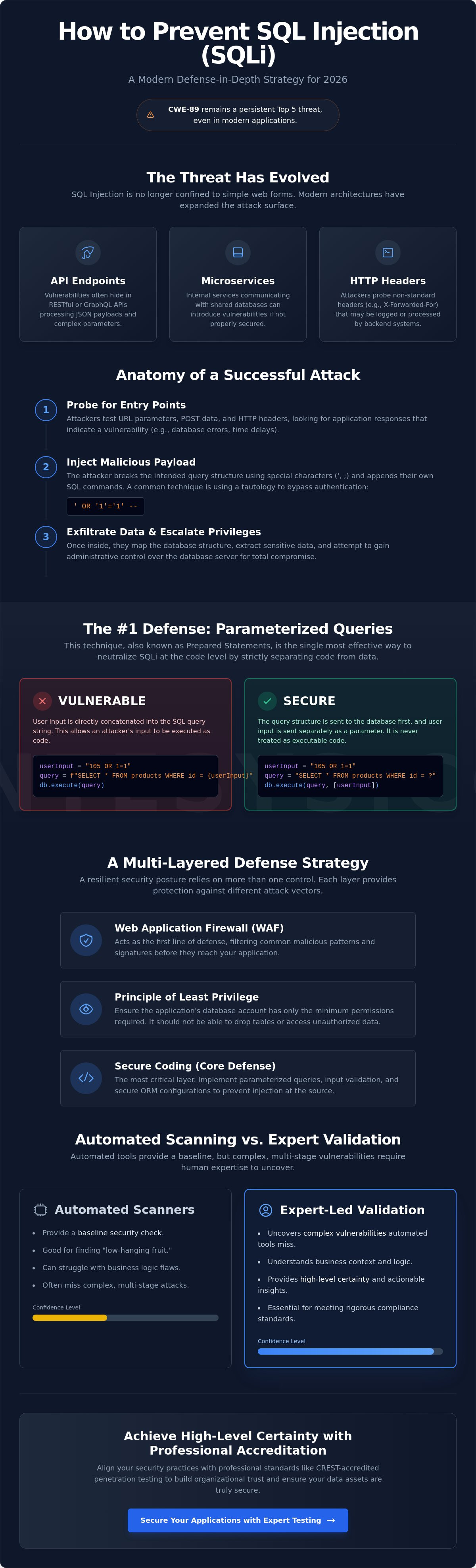
The threat surface has expanded significantly. It’s no longer just about a search bar or a login page. In a modern environment, SQLi vulnerabilities often hide within API endpoints, JSON payloads, and hidden HTTP headers that interact with backend databases. These sophisticated vectors require a technical approach that prioritises human expertise over basic, automated scanning. Without a strategic view of your application estate, these hidden entry points can remain exposed for months, creating a silent risk to your organisational resilience.
How Attackers Probe for SQLi Vulnerabilities
Attackers begin by identifying potential entry points where user input meets database queries. They test URL parameters, POST data, and even metadata within HTTP headers to see how the application responds. We often see attackers use error-based techniques, where they purposefully trigger database errors to reveal information about the database structure. Alternatively, they may use Blind SQLi, which is an attack where the database doesn’t return direct data but reacts to logical queries through observable changes like response time delays. These probing methods allow attackers to map out your data architecture before they even launch a full-scale exploit.
The Anatomy of a Successful Injection Attack
A successful exploit typically starts by breaking the intended query structure using special characters like single quotes or semicolons. This allows the attacker to append their own commands to the existing SQL string. They often use tautologies, such as ‘OR 1=1’, to bypass authentication logic and gain access without valid credentials. Once they’ve established a foothold, attackers look for ways to escalate privileges to gain full control over the database server. This escalation can lead to the total compromise of your organisational data assets, making it impossible to ensure data integrity. Mastering how to prevent SQL injection attacks requires a methodical understanding of these stages to build a resilient, multi-layered defence.
Primary Technical Defences: Neutralising the Threat at the Code Level
Securing the application layer against modern threats requires a shift from reactive patching to structural integrity. The most effective method for how to prevent SQL injection attacks is the consistent use of parameterized queries, often referred to as prepared statements. This approach ensures that the database treats user-supplied data as a literal value rather than executable code. By separating the query logic from the data inputs, you eliminate the primary vector used by attackers to manipulate backend processes. While many developers understand the concept, maintaining this standard across a vast enterprise estate requires a strategic commitment to code quality and oversight.
In addition to prepared statements, stored procedures can offer a secondary layer of defence by encapsulating queries within the database itself. However, it’s essential that these procedures don’t internally concatenate raw SQL strings, which would reintroduce the very vulnerability they’re meant to solve. For a deeper technical dive into these methods, the OWASP prevention cheat sheet provides an excellent reference for development teams. Relying on “escaping” special characters or blacklisting specific keywords is an unreliable strategy. Attackers constantly find ways to bypass these filters; therefore, we prioritise structural defences that neutralise the threat at its source.
Implementing Parameterized Queries Correctly
Correct implementation varies across different programming environments, but the underlying principle remains the same. In Java, developers should utilise the PreparedStatement class to handle inputs securely. For those working within the .NET ecosystem, the SqlCommand object with typed parameters is the standard. PHP developers should adopt PDO (PHP Data Objects) with prepared statements to ensure broad database compatibility and security. Achieving consistency across legacy codebases and modern frameworks is a significant hurdle. If you’re unsure if your current implementations are sufficient, a professional security assessment can provide the necessary validation to confirm your defences are robust.
Allow-list Input Validation and Sanitization
While structural defences are paramount, input validation serves as a vital secondary buffer. We recommend implementing strict allow-lists that only permit data matching specific, predefined criteria. This involves defining exact data types, such as integers for ID fields or alphanumeric constraints for usernames. Regular expressions are highly effective for enforcing these format requirements. Validation must be context-aware; a field accepting a date requires different rules than a field accepting a text-based comment. This methodical approach ensures that even if a structural defence were to fail, the data entering your system is already restricted to safe, predictable formats. This dual-layered strategy is fundamental to understanding how to prevent SQL injection attacks effectively in 2026.
The Critical Role of Expert-Led Validation vs. Automated Scanning
Many organisations rely heavily on automated vulnerability scanners as their primary defence mechanism. These tools offer efficient, broad coverage, but they frequently create a false sense of security among technical teams. While these scanners can identify basic syntax errors, they often miss the complex, multi-stage injection points that modern attackers prioritise. True resilience requires understanding how to prevent SQL injection attacks through a strategic combination of technology and human intelligence. By moving beyond a “check-the-box” mentality, you ensure your data assets aren’t left vulnerable to sophisticated logic flaws that software simply cannot perceive. This human-led approach provides the professional assurance needed to trust your security posture in a volatile threat environment.
Where Automated Scanners Fall Short
Software-driven assessments struggle significantly when they encounter complex authentication flows or session-dependent queries. A scanner follows a rigid, pre-programmed path, whereas a critical injection vulnerability might only trigger under specific business logic conditions that the tool doesn’t understand. For example, while basic technical defences against SQLi are well-documented, scanners often fail to account for how data travels through multiple microservices or specialized API gateways before reaching the database. Automated tools typically find ‘low-hanging fruit’ but miss deep structural vulnerabilities. This inherent limitation means that relying solely on automation leaves a significant window of risk open for attackers who use manual probing to find these hidden, high-impact flaws.
A Multi-Layered Strategy for SQL Injection Prevention
Relying on a single defensive layer creates a precarious security posture. While parameterized queries form the foundation of code-level security, a comprehensive approach to how to prevent SQL injection attacks requires hardening the entire operational environment. This defence-in-depth strategy ensures that if one control fails, secondary measures are in place to contain the threat. A Web Application Firewall (WAF) serves as an essential initial buffer, utilising signature-based detection to identify and block common attack patterns before they reach your application. However, a WAF is a supplementary tool, not a replacement for secure configuration and expert-led oversight.
Secure database configuration is equally vital for neutralising post-exploitation activities. This involves hardening the database environment by removing default accounts, changing standard ports, and ensuring all security patches are applied promptly. We also recommend disabling advanced features that aren’t required for daily operations, as these often provide attackers with the tools needed for OS-level command execution. Transitioning from periodic audits to a model of continuous monitoring allows your team to maintain real-time threat awareness, ensuring that new vulnerabilities are identified as soon as they emerge in your production environment.
Enforcing the Principle of Least Privilege
The principle of least privilege is one of the most effective ways to limit the blast radius of a successful exploit. We advocate for strict segregation of database accounts, ensuring that the application uses a low-privileged user for standard operations. For instance, an account used for generating reports should have read-only permissions, while administrative tasks should be isolated to a separate, highly restricted credential. Disabling unnecessary stored procedures and isolating the database from the broader network prevents lateral movement, making it significantly harder for an attacker to pivot from a single web asset to your entire infrastructure.
Meeting Regulatory and Insurance Requirements
Regulators and, increasingly, cyber insurers look for clear evidence of due diligence. Simply stating that you know how to prevent SQL injection attacks is insufficient; you must demonstrate that your controls are effective through detailed, technical reporting. Professional security assessments satisfy these requirements by providing a transparent record of your defensive measures. This documentation is vital for demonstrating compliance with data protection laws, especially when your systems process special category data. By securing your digital estate through expert-led testing, you provide stakeholders with the high-level certainty they require to trust your organisational resilience.
Can SQL injection occur in NoSQL databases?
Injection vulnerabilities aren’t exclusive to SQL-based systems. NoSQL databases like MongoDB or CouchDB are susceptible to similar attacks, often called NoSQL injection, where attackers manipulate query operators or JavaScript-based functions. These exploits can lead to unauthorised data access or the bypass of application logic. Securing these environments requires specific validation of the query objects and a deep understanding of the unique syntax used by each NoSQL platform.
How do parameterized queries actually prevent injection?
Parameterized queries prevent injection by separating the query’s executable code from the user-supplied data. The database engine compiles the SQL statement’s structure before the parameters are even added; this ensures that inputs are treated strictly as literal values rather than commands. This structural separation makes it technically impossible for an attacker to alter the query’s logic. It’s a methodical approach that provides a reliable foundation for application security and data integrity.
Can a Web Application Firewall (WAF) replace secure coding practices?
A Web Application Firewall (WAF) is an important defensive buffer, but it cannot replace secure coding practices. WAFs rely on signature-based detection to block known attack patterns, which sophisticated actors can often bypass through specialized encoding or novel techniques. You should view a WAF as a secondary layer that buys your team time to implement permanent, code-level fixes. Relying solely on perimeter defence leaves your application vulnerable to deep structural flaws.
Founder & CEO, Pentesys
James Hinton is the founder of Pentesys, a CREST-approved UK company working only on offensive security: penetration testing, PTaaS, CTEM, external attack surface management and red teaming. He built the business around one discipline rather than a broad consultancy menu, and most of his time still goes on how engagements get scoped, delivered and reported. He writes here about the practical side of security testing and what buyers should be asking for.
LinkedIn profile