

Overview
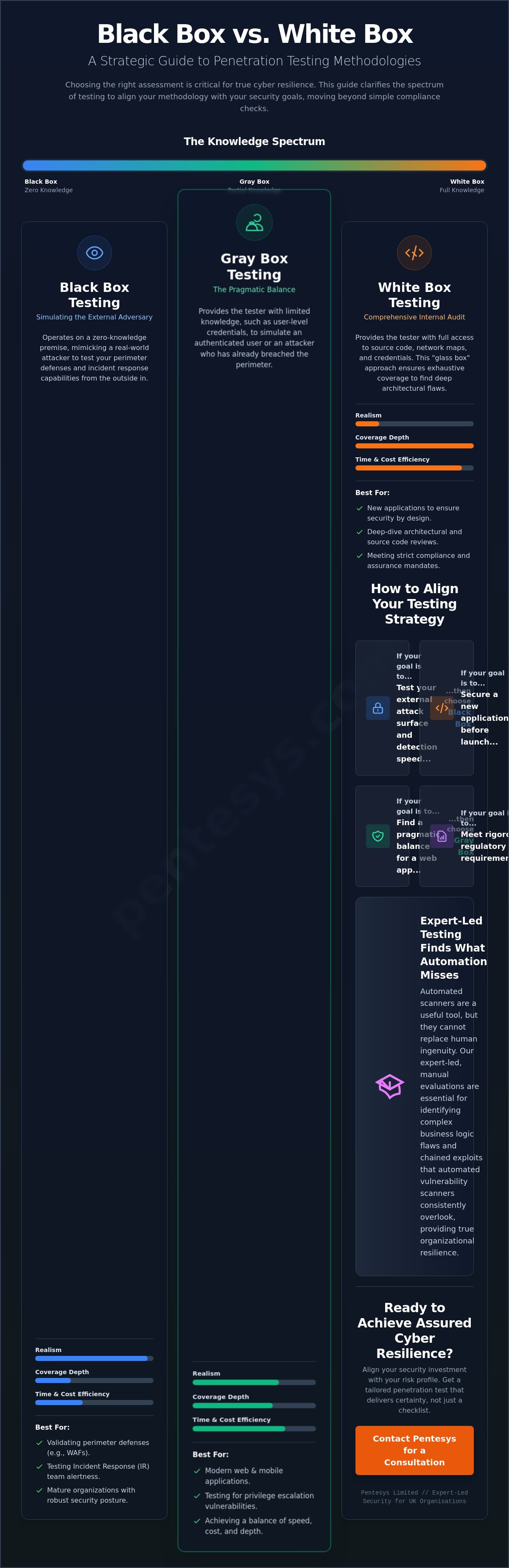
How much you tell a tester changes what they find in the time available. Black box testing spends the early part of the engagement on discovery that white box testing gets for free, which usually means less time left for exploitation. Grey box, where the tester gets credentials, documentation and architecture but no source, is the pragmatic middle ground and what most engagements end up being.
We recognise that your objective is to move beyond static evaluations toward a state of assured cyber resilience. This guide provides the technical clarity required to align your testing methodology with your specific security goals, whether you’re simulating a blind attack or hardening your core architecture. You’ll gain a clear framework to justify your investment to executive stakeholders and the confidence that your chosen path will provide a reliable defence against everyday cybercrime in the UK. We will break down the operational differences of each approach and explain how to select the right assessment for your organisational maturity.
Understanding the Methodology Spectrum: Information vs. Impact
A Penetration test isn’t a monolithic product; it’s a flexible assessment framework that exists on a spectrum of visibility. At one end, you have the external attacker’s perspective, and at the other, the internal architect’s deep-dive. The decision between black box vs white box penetration testing dictates how much information a consultant possesses before they begin their engagement. This choice isn’t just a technical detail. It’s a strategic move that affects your project’s scoping, your budget’s efficiency, and the ultimate resilience of your infrastructure. While some organisations need to simulate a blind attack to test detection speed, others require a transparent audit to verify the integrity of their source code.
In the UK, where the Cyber Security and Resilience Bill signals greater emphasis on assured resilience, methodology selection is a board-level concern. You aren’t just buying a test; you’re buying certainty. By defining the “box” correctly, you ensure that the assessment aligns with your specific risk profile. Whether you’re hardening a medium complexity web application or securing a vast cloud environment, the relationship between tester knowledge and assessment outcomes remains the most critical factor in your security roadmap.
The Role of Information in Penetration Testing
Information acts as the primary fuel for any security assessment. In a black box scenario, the consultant starts with zero knowledge, mimicking a real-world threat actor who must perform their own reconnaissance. This approach tests your external attack surface monitoring and incident response capabilities, but it’s often slower because the tester spends time discovering what you already know. Conversely, white box testing provides the expert with full access to network maps, credentials, and source code. This transparency eliminates the discovery phase, allowing the consultant to focus immediately on complex logic flaws. While black box testing offers realism, white box testing provides exhaustive coverage that ensures no stone is left unturned in your internal architecture.
Black Box Penetration Testing: Simulating the Adversary’s Path
Black box testing operates on a zero-knowledge premise. The consultant starts with no information regarding the internal network architecture, source code, or IP ranges. This approach provides the most authentic “Attacker’s Eye View” of your organisation. It forces the tester to rely on the same reconnaissance and enumeration techniques used by a real-world threat actor. By following the technical framework established in NIST SP 800-115, our experts systematically identify, analyse, and exploit vulnerabilities from an external perspective.
The primary goal is to evaluate how well your perimeter defences hold up against a blind attack. This methodology is particularly effective for testing mature environments where the security team wants to validate their incident response times and the efficacy of their Web Application Firewalls (WAF). If you are looking to understand how an outsider might first gain a foothold, an External Attack Surface Monitoring strategy often begins with this black box mindset. The process moves through three distinct phases:
- Passive Reconnaissance: Identifying public-facing assets and leaked credentials through open-source intelligence.
- Active Enumeration: Probing for open ports, services, and misconfigured headers on discovered systems.
- Exploitation: Attempting to bypass security controls to gain unauthorised access and escalate privileges.
Advantages of the Zero-Knowledge Approach
This methodology delivers unbiased results. Because the tester isn’t guided by your internal documentation, they find exactly what a motivated adversary would see. It’s a pure test of your “security by obscurity” and perimeter configurations. Organisations often choose this path to validate their firewalls and external-facing assets without the administrative overhead of preparing extensive technical briefs. It provides a high-level snapshot of your exposure at a specific point in time, making it a useful tool for board-level reporting on external resilience. This lack of prior knowledge ensures the assessment remains focused on the paths of least resistance that an actual criminal would exploit.
Limitations and Strategic Drawbacks
Despite its realism, black box testing has inherent inefficiencies. The “Time-Sink” risk is a significant factor; testers may spend several days performing basic reconnaissance that an internal team could have provided in minutes. This reduces the time available for actual exploitation and deep-dive analysis. The risk of missing deep-seated logic flaws is also significantly higher. Without access to source code or internal diagrams, a tester might never reach the complex vulnerabilities hidden behind multiple authentication layers. When comparing black box vs white box penetration testing, it’s clear that the black box approach often results in a higher cost per vulnerability found. It prioritises the “how” of an initial breach over the “what” of a comprehensive system audit. This can lead to a surface-level understanding that ignores critical risks buried within the application’s internal logic.
White Box Penetration Testing: Comprehensive Assurance from the Inside Out
If black box testing is about the “how” of a breach, white box testing is about the “why” of a vulnerability. In this methodology, the consultant receives complete documentation, including source code, network diagrams, and administrative credentials. This level of disclosure shifts the focus from external reconnaissance to the internal logic of your systems. When evaluating black box vs white box penetration testing, it’s clear that the white box approach provides the highest level of certainty for critical applications and infrastructure. It’s a deep-dive methodology that identifies flaws that would remain invisible to an external observer.
This approach is essential for high-risk assets such as API Security Testing or Cloud Security Assessment, where logic flaws often reside deep within the configuration. It aligns perfectly with the UK government’s “Security by Design” principles, as highlighted in the PSTI Act 2022. By integrating white box assessments into your Software Development Life Cycle (SDLC), you move from reactive patching to proactive resilience. This ensures that new application launches or major infrastructure changes are hardened before they ever face a real-world threat actor.
The Benefits of Total Transparency
Total transparency allows for exhaustive coverage. A consultant can identify vulnerabilities that are impossible to find from the outside, such as flawed cryptographic implementations or insecure direct object references. It’s an inherently efficient model. Because the tester doesn’t waste time on guesswork or discovery, they can go straight to the most critical components of the architecture. This efficiency translates into more detailed remediation advice. Instead of a general description of a bug, your developers receive specific, code-level fixes that accelerate the patching process and reduce the risk of re-introduction.
Challenges of the Full-Knowledge Model
Full knowledge brings its own set of technical hurdles. One common issue is the “Information Overload” problem. When presented with every detail of a system, a tester might focus on theoretical flaws that are difficult to exploit in a real-world scenario, potentially leading to a list of low-impact findings. It also lacks the realism of an adversary simulation. It doesn’t test your security team’s detection capabilities or your incident response protocols. Finally, the preparation intensity is significant. Your internal IT and development teams must commit time to gathering documentation and provisioning access, which can delay the start of the engagement if not managed correctly. Choosing between black box vs white box penetration testing requires balancing this need for internal resources against the requirement for comprehensive security assurance.
Choosing the Right Approach: Gray Box Hybrid and Strategic Selection
While the technical debate often focuses on the extremes of black box vs white box penetration testing, most UK organisations find their answer in the pragmatic middle ground. Gray box testing combines the visibility of an insider with the perspective of an outsider. By providing the tester with partial knowledge, such as user-level credentials or basic network documentation, you eliminate the time-consuming reconnaissance phase of a black box test without the intensive preparation required for a full white box audit. This hybrid approach allows for a more focused evaluation of internal controls while maintaining a degree of real-world simulation.
UK regulators and standards bodies are increasingly prescriptive regarding how these assessments are conducted. For ISO 27001 compliance, the focus is on the regular testing of technical vulnerabilities to ensure Annex A controls remain effective. SOC2 requires proof that security controls are functioning as intended across the five Trust Services Criteria. Cyber Essentials Plus specifically mandates a verified assessment of your external perimeter. Choosing the right “box” is a matter of mapping these specific regulatory requirements to your organisational risk profile.
The Pragmatic Choice: Why Gray Box Often Wins
Gray box testing is the gold standard for web application penetration testing because it simulates the most common real-world threat: the authenticated attacker. Most modern breaches occur after a threat actor has already compromised a set of user credentials. By starting the test from within a user session, our experts bypass the login screen and immediately begin testing the internal logic, permissions, and data handling of the application. This maximises your ROI by ensuring the tester’s time is spent on high-impact exploitation rather than basic port scanning or reconnaissance that your internal team already understands.
A Framework for UK IT Leaders
When you’re deciding on your next engagement, use this three-point framework to ensure alignment with your corporate objectives. First, identify if this is for a new product or a mature environment; new products favor the exhaustive nature of white box testing. Second, determine if you’re testing the code integrity or the detection team’s response speed. Finally, verify the specific CREST accredited penetration testing UK requirements your industry demands. Many organisations follow a maturity model, starting with white box testing to secure the foundation before moving toward gray box for regular audits and black box simulations for red teaming exercises.
If you’re ready to define a testing strategy that balances technical depth with organisational efficiency, explore our Infrastructure Penetration Testing services to secure your core assets.
Manual Expertise in a World of Automation
The industry is increasingly flooded with low-cost, fully automated solutions that promise speed but sacrifice depth. Pentesys distinguishes itself by championing human intelligence. Our CREST-accredited testers apply a rigorous methodology to every engagement, whether they are conducting black box vs white box penetration testing. This manual focus allows us to uncover complex exploit chains and business logic vulnerabilities that automated software simply cannot perceive. By bridging the gap between technical flaws and organisational risk, we provide the high-level certainty required to satisfy both technical leads and executive board members.
Can you combine black box and white box testing in a single engagement?
You can certainly combine both methodologies within a single engagement, often referred to as a phased approach. Many organisations start with a black box phase to test their detection and response capabilities without alerting the internal team. Once that phase is complete, they provide full documentation for a white box deep-dive. This ensures you receive both a realistic simulation and an exhaustive security audit in one project.
How does gray box testing differ from black and white box methods?
Gray box testing acts as a pragmatic hybrid that provides partial knowledge to the consultant. Unlike black box testing, the tester receives user-level credentials and basic network information, which bypasses the initial reconnaissance phase. However, unlike white box testing, they do not have access to the underlying source code. This balance allows for a realistic simulation of an authenticated attacker while maintaining the efficiency of a targeted audit.
Founder & CEO, Pentesys
James Hinton is the founder of Pentesys, a CREST-approved UK company working only on offensive security: penetration testing, PTaaS, CTEM, external attack surface management and red teaming. He built the business around one discipline rather than a broad consultancy menu, and most of his time still goes on how engagements get scoped, delivered and reported. He writes here about the practical side of security testing and what buyers should be asking for.
LinkedIn profile