

Overview
The report landing in your inbox is the start of the work, not the end of it. What follows usually decides whether the engagement was worth commissioning: a debrief while the detail is still fresh, a triage pass that turns findings into tickets with owners against them, and a retest that proves the fixes hold.
Understanding exactly what happens after a penetration test is the difference between a temporary patch and a measurable improvement in your security posture. This guide offers a comprehensive framework to help you navigate remediation and ensure your organisation meets the latest UK GDPR and cyber insurance requirements. We’ll explore how to move from technical discovery to a validated state of security through methodical retesting, expert-led evaluation, and strategic oversight.
Receiving and Interpreting Your Penetration Test Report
The arrival of your final report marks the formal start of the remediation lifecycle. Many organisations mistake the delivery of a PDF as the conclusion of the engagement. In reality, the true value of the assessment lies in how you translate these findings into a more resilient security posture. Understanding what happens after a penetration test begins with a structured review of the documentation provided, moving beyond a simple list of bugs to a strategic understanding of your risk profile.
A high-quality penetration test report uses the Common Vulnerability Scoring System (CVSS) to provide a standardised measure of severity. However, raw scores are often abstract. Our methodology emphasizes environmental context over generic numbers. A vulnerability that is technically difficult to exploit might still carry high risk if it sits on a server containing unencrypted customer data. This distinction ensures your team doesn’t waste resources on technically critical issues that pose little actual threat to your specific business operations. By focusing on business impact, you move away from the shortcuts of fully automated solutions toward a strategy informed by human intelligence.
The Executive Summary vs. Technical Breakdown
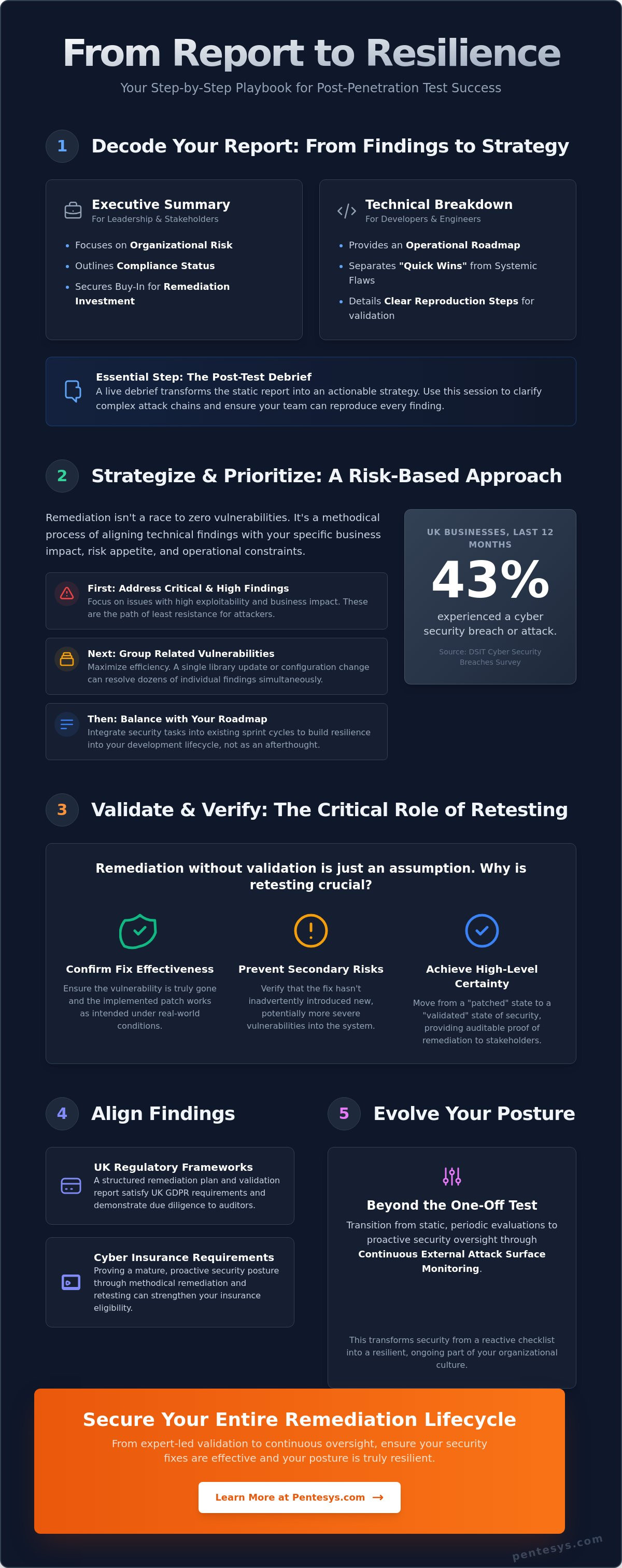
The executive summary serves as a strategic tool for leadership. It avoids technical jargon to focus on organisational risk, compliance status, and the necessary investment for remediation. You can use this section to secure board-level buy-in for the resources your team needs. Conversely, the technical breakdown provides the operational roadmap for your developers or infrastructure engineers. It separates “Quick Wins,” such as simple configuration changes, from systemic architectural flaws that might require a longer-term project to resolve. This dual-layered approach ensures that both technical teams and executive decision-makers are aligned on the path forward.
The Post-Test Debrief: Clarifying the Path Forward
A written report is a static document. It cannot answer follow-up questions or explain the nuance of a complex attack chain. This is why a live debrief with your lead tester is essential. During this session, your team should ask how an attacker might chain several low-risk vulnerabilities together to achieve a high-impact breach. You also need to confirm that the reproduction steps are clear. If your internal team cannot recreate the finding, they cannot effectively validate that a fix has worked. This human-to-human exchange transforms a list of problems into a clear, actionable strategy for improvement, providing the high-level certainty required for modern security management.
Developing a Risk-Based Remediation Plan
Remediation is not a race to zero vulnerabilities. Instead, it’s a methodical process of aligning technical findings with your organisation’s specific risk appetite and operational constraints. Once you understand the findings, the next phase of what happens after a penetration test is the creation of a structured roadmap. This plan ensures that your security team isn’t simply reacting to a list of bugs but is instead making strategic improvements that offer the highest return on investment for your security posture.
Effective triage requires you to evaluate findings based on three primary factors: exploitability, data sensitivity, and business continuity. This statistic underscores why remediation cannot be delayed by internal ambiguity. Clear ownership is vital. You must determine whether a fix requires a simple patch from the infrastructure team or a complex code change from the development squad. Documenting these responsibilities within a formal roadmap is essential for satisfying UK GDPR requirements and providing high-level certainty to auditors. For organisations following strict frameworks, the PCI SSC Penetration Testing Guidance provides an authoritative benchmark for how these remediation activities should be structured and recorded.
Prioritisation and Triage Strategies
Focus your immediate efforts on “Critical” and “High” findings. these represent the path of least resistance for an attacker. To maximise efficiency, group related vulnerabilities together. For instance, updating an outdated library might resolve dozens of individual findings simultaneously. It’s also necessary to balance these security fixes with your existing product roadmap. Integrating security tasks into your current sprint cycles ensures that resilience becomes a foundational part of your development process rather than a disruptive afterthought. For ongoing support in managing these findings, a structured approach to vulnerability management can help maintain this momentum between assessments.
Handling Risk Acceptance and Compensatory Controls
There are instances where a direct fix isn’t feasible due to legacy system constraints or business necessity. In these cases, you must adopt a strategy of risk acceptance or implement compensatory controls. If a vulnerable service cannot be patched, you might mitigate the threat by applying strict Web Application Firewall (WAF) rules or IP whitelisting to limit exposure. This isn’t a shortcut; it’s a calculated security decision. You must formally document these accepted risks and the rationale behind them. This documentation is a signature of a mature security programme, and supports both regulatory and insurer questions even when a traditional fix is unavailable.
The Critical Role of Remediation Validation and Retesting
Applying a patch is only half the battle. Many organisations assume that once their IT team marks a ticket as “resolved,” the risk has vanished. However, the phase regarding validation is a vital component of what happens after a penetration test. Verification ensures that the remediation was not only applied but implemented correctly without introducing secondary vulnerabilities. This step moves your organisation beyond a simple checklist and into a state of verified resilience. It’s the difference between assuming a door is locked and having a specialist try the handle.
Self-certification often leads to a dangerous false sense of security. Internal teams might verify that a specific service is now running a newer version, but they might miss that the underlying configuration still allows for a similar exploit. Professional validation provides the high-level certainty that stakeholders require. This process creates a measurable “delta” between your initial assessment and your current state, proving a tangible improvement in resilience. By focusing on manual, expert-led evaluation rather than standard automated processes, you ensure that complex vulnerabilities are truly neutralised.
Why Internal Verification Often Fails
The “False Sense of Security” trap occurs when a technical fix satisfies a checklist but fails to address the attacker’s logic. For example, a developer might sanitize a specific input field to stop an injection attack while leaving a parallel API endpoint exposed. Attackers frequently look for these simple bypasses that circumvent superficial fixes. CREST accredited penetration testing UK providers insist on manual verification because automated scanners often fail to detect logic-based bypasses that a human expert can identify. Manual testing ensures that the root cause of a vulnerability has been addressed rather than just the symptoms.
Formalising the “Clean” Report
Once your remediation efforts are complete, the objective is to secure an updated report that reflects your current, hardened status. This document is far more than just internal record-keeping. A formal “clean” report serves as essential evidence for management response to uncovered risks during third-party vendor assessments and supply chain audits. It provides a clear audit trail that demonstrates your commitment to proactive security management.
For businesses operating in the UK, this document is often required to maintain cyber insurance coverage or to meet specific regulatory standards like the Data Protection Act 2018. A “Certificate of Security” or a finalized remediation statement builds immediate trust with your clients. It demonstrates that your organisation views security as a managed, ongoing process rather than a one-off event. By moving from technical discovery to validated remediation, you provide the transparency and reliability that modern business partnerships demand. This final documentation acts as a conceptual anchor for your security program, signifying that you have successfully navigated the post-assessment roadmap.
Aligning Findings with UK Compliance and Cyber Insurance
The transition from technical remediation to regulatory alignment is a pivotal stage in what happens after a penetration test. For UK organisations, a successful assessment is only the first step. You must translate technical findings into the specific language of compliance frameworks to demonstrate high-level certainty to auditors and stakeholders. Documented proof of proactive security has become a baseline requirement for modern corporate governance.
Your final report serves as a primary evidence artifact. It proves that your organisation identifies, assesses, and manages technical risks in a methodical fashion. This documentation is essential for maintaining formal accreditations and ensuring that your security posture meets the evolving expectations of the UK’s regulatory landscape. By moving beyond a simple list of fixes, you establish a narrative of ongoing resilience that satisfies both technical and executive oversight requirements.
ISO 27001 and PCI DSS Compliance
For organisations maintaining ISO 27001:2022 certification, your post-test activities directly support Clause 10, which focuses on “Continual Improvement.” You can use the remediation roadmap and subsequent retesting results to prove that your Information Security Management System (ISMS) is functioning effectively. Similarly, PCI DSS 4.0 places a heavy emphasis on the timely remediation of significant vulnerabilities. You must draft a formal Corrective Action Plan (CAP) based on your findings. This CAP demonstrates to QSA auditors that you aren’t just identifying flaws, but are actively reducing risk to acceptable levels within the mandated timeframes.
Preparing for DORA and UK GDPR Oversight
The Digital Operational Resilience Act (DORA) has significantly impacted the UK financial sector and its supply chain. It requires firms to maintain a robust testing program that includes the remediation of identified gaps. UK GDPR Article 32 requires appropriate technical and organisational measures, taking into account the state of the art and the risk involved. It does not prescribe a particular form of testing. Documenting your response to a penetration test is your best defence against claims of negligence in the event of a future incident. It shows you’ve taken appropriate technical and organisational measures to protect personal data. For organisations seeking to align their technical assessments with these complex regulatory requirements, our compliance-driven security assessment provides the documented evidence needed for high-level certainty.
Cyber insurance renewals in 2026 have become increasingly rigorous. Insurers now frequently demand evidence of recent penetration testing and a completed remediation lifecycle before offering coverage. A “Snapshot in Time” approach no longer suffices. By aligning your findings with these external requirements, you ensure that your security investment also protects your organisation’s insurability and legal standing, bridging the gap between specialized execution and corporate objectives.
Beyond the One-Off Test: Moving to Continuous Security Oversight
The traditional approach to security evaluation is undergoing a fundamental shift. While an annual assessment provides a vital baseline, what happens after a penetration test should involve a transition toward persistent visibility. Relying on a single point-in-time report creates a dangerous lag between the identification of a vulnerability and the emergence of new threats. Modern cyber security services now prioritise ongoing resilience, recognising that your digital estate changes daily through software updates, new user accounts, and infrastructure adjustments. This evolution from static evaluation to proactive oversight ensures that your security posture remains aligned with your organisational objectives.
A structured post-assessment roadmap doesn’t end with a final report. It marks the beginning of a partnership focused on long-term stability. By moving away from reactive patching and toward a managed, ongoing process, you establish a narrative of reliability that resonates with both technical teams and executive leadership. This methodical progression ensures that security isn’t treated as a chaotic one-off event but as a foundational pillar of your business operations.
The Limitations of Annual Testing
The “Snapshot in Time” model is becoming obsolete because it fails to account for the rapid release of new exploits. If a critical CVE is published the day after your assessment concludes, your organisation remains vulnerable until the next scheduled test. This security gap is particularly prevalent in cloud environments like AWS and Azure, where configuration drift can occur in seconds. While automated scanners provide basic coverage, they lack the human intuition required to identify complex logic flaws. Manual, expert-led testing must be augmented by continuous visibility to ensure that your defences remain robust against an evolving threat landscape. High-level certainty requires more than a periodic check; it demands a constant awareness of your external attack surface.
Is a retest really necessary if our internal team says they fixed the issues?
Professional retesting is essential because internal verification often fails to identify logic-based bypasses. Even when a patch is applied, a configuration error can leave the asset exposed. A formal retest provides the high-level certainty that the vulnerability is neutralised. This step is a critical part of what happens after a penetration test to ensure your security posture has truly improved rather than just appearing fixed on a checklist.
What should we do if we cannot fix a high-risk vulnerability immediately?
If an immediate fix isn’t possible, you must implement compensatory controls to reduce the risk to an acceptable level. This might involve applying strict WAF rules or restricting network access via IP whitelisting. You should formally document this as a risk acceptance in your security registry. This documentation provides a clear audit trail for UK regulators and insurance providers, demonstrating that the risk is actively managed rather than ignored.
Can we share the full penetration test report with our customers?
Sharing a full technical report with customers is generally discouraged as it contains sensitive details about your infrastructure. Instead, you should provide an executive summary or a Certificate of Security that confirms the assessment took place and findings were remediated. This approach builds trust without exposing the specific reproduction steps or architectural details that could be exploited if the report fell into the wrong hands.
Founder & CEO, Pentesys
James Hinton is the founder of Pentesys, a CREST-approved UK company working only on offensive security: penetration testing, PTaaS, CTEM, external attack surface management and red teaming. He built the business around one discipline rather than a broad consultancy menu, and most of his time still goes on how engagements get scoped, delivered and reported. He writes here about the practical side of security testing and what buyers should be asking for.
LinkedIn profile