

Overview
A report full of unvalidated findings costs more than it saves. Developers stop trusting security the first time they lose a day to something that turns out to be a scanner artefact, and after that everything gets treated as noise. Validation is the step where a tester confirms the flaw is real, works out what it actually lets an attacker do, and writes it up with evidence attached.
You already know that security is about more than just checking boxes; it’s about building a resilient environment where human intuition complements technical oversight. With the NIST CSF 2.0 now focusing heavily on risk-informed decision-making, the need for high-level certainty in your assessments has never been greater. This guide will teach you how to establish a clear triage process that distinguishes real-world threats from false positives. You’ll learn how to spend your remediation budget with confidence, improve alignment between teams, and transform raw vulnerability data into actionable business intelligence.
What is Penetration Test Validation and Why Does it Matter?
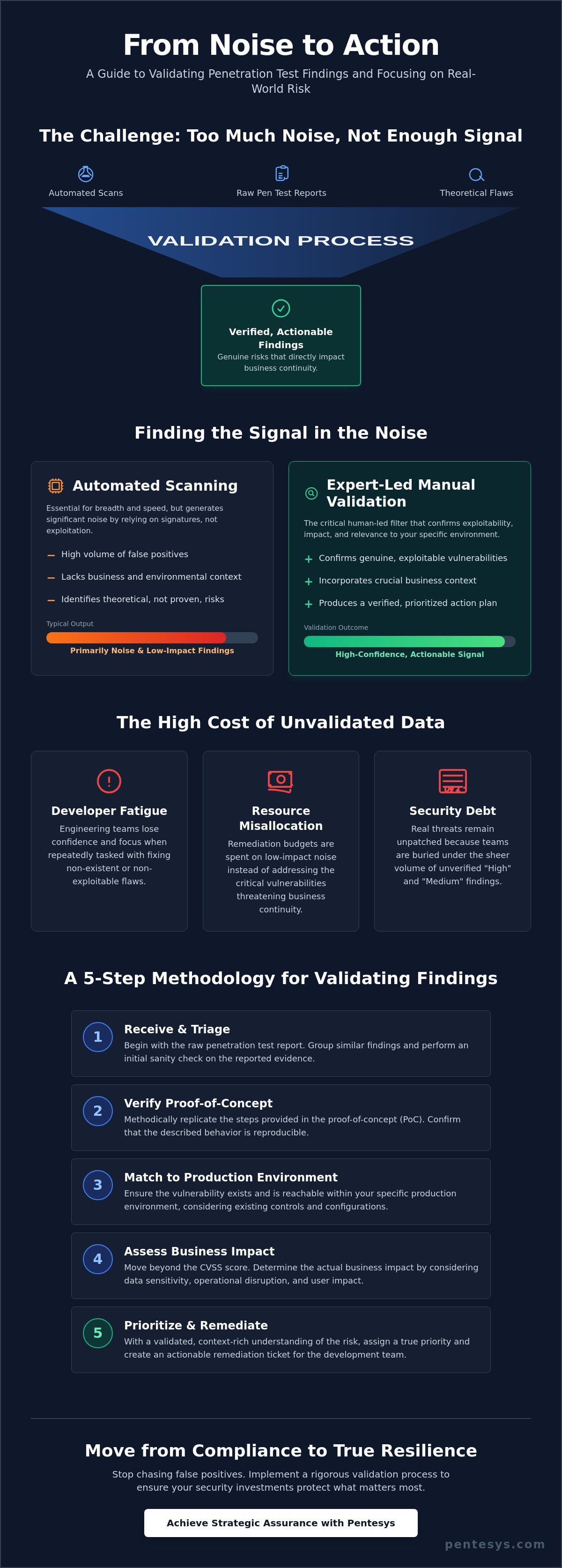
A penetration test is a fundamental component of a modern security strategy, but the resulting report is merely raw data until it’s processed through a rigorous filter. Validation is the methodical process of verifying the accuracy, exploitability, and specific business impact of each reported issue. It transforms a broad list of potential flaws into a verified roadmap for action. When you focus on validating penetration test findings, you’re filtering out the noise to ensure your remediation resources are directed toward genuine risks rather than theoretical anomalies or automated errors.
It’s helpful to distinguish between a vulnerability and a finding. A vulnerability is a technical flaw or weakness in a system’s design or implementation. A finding, however, is the documented evidence of that flaw as it exists within your specific environment. Validation bridges the gap between these two concepts by confirming that the identified flaw is not only present but also reachable and impactful to your operations. This distinction is critical for maintaining a lean and effective security programme.
The “Audit of the Audit” Philosophy
Think of validation as an “audit of the audit.” While a security assessment provides a snapshot of your posture, validation ensures the integrity of that snapshot. It moves your organisation from simply checking boxes to verifying that your defences actually stand up to scrutiny. This methodology protects the integrity of your vulnerability management process, ensuring that every prioritised task represents a legitimate threat to your long-term resilience. By treating the report as a starting point rather than a final verdict, you maintain a high level of certainty in your security investments and avoid the trap of superficial compliance.
The Risk of Unvalidated Data
Accepting reports at face value carries significant operational risks. Chasing false positives in a production environment leads to inefficiencies that can be measured in both time and capital. Poor validation practices often result in the following issues:
These systemic frictions often damage the trust between security and engineering teams, as developers lose confidence in the accuracy of security mandates. The assurance gap is the disconnect between a perceived security posture based on unverified reports and the actual, exploitable state of an organisation’s environment.
- Developer Fatigue: Engineering teams lose patience and focus when they’re repeatedly tasked with fixing non-existent or non-exploitable flaws.
- Resource Misallocation: Remediation budgets are spent on low-impact noise instead of addressing the critical vulnerabilities that threaten business continuity.
- Security Debt: Real threats remain unpatched because teams are overwhelmed by the sheer volume of unverified “High” and “Medium” findings.
Manual Validation vs. Automated Scanning: Finding the Signal in the Noise
Automated scanning tools are essential for maintaining visibility across vast digital estates. They provide the breadth necessary to identify known vulnerabilities across thousands of assets quickly. However, these tools operate on signatures and version banners rather than actual proof of exploitability. Relying solely on automation often results in a flooded inbox of potential risks that lack the necessary business context. This is where the process of validating penetration test findings becomes vital. It transforms a list of theoretical weaknesses into a verified set of priorities that demand action.
False positives are a byproduct of the heuristic nature of automated scanners. These tools often guess based on incomplete data, such as a software version that appears vulnerable but has been patched by a vendor using backported fixes. Following NIST’s Technical Guide to Information Security Testing, security professionals must move beyond identification into the execution phase, where manual verification confirms if a threat is genuine. Without this human-led filter, your engineering team may spend hours investigating non-issues, leading to friction and diminished trust in security mandates.
Why Automation Flags the “Uncertain”
Scanners frequently fail in complex scenarios, such as when vulnerabilities are hidden behind multi-factor authentication or within intricate state-based workflows. They struggle with bespoke web applications where the logic is unique to the business. To achieve true security assurance, Pentesys Limited integrates manual oversight into the assessment process. This human-led layer investigates uncertain flags, ensuring that only verified, actionable data reaches your development team. By eliminating the automated noise at the source, we provide the high-level certainty required for strategic decision-making.
The Power of Chained Exploits
A human expert understands how to chain seemingly minor issues into a significant breach. An automated tool might flag three separate “Low” vulnerabilities, such as an information disclosure, a weak session cookie, and a lack of rate limiting. While the scanner sees isolated flaws, a tester sees a path to account takeover. Manual verification is the only reliable way to demonstrate this real-world exploitability to executive stakeholders. It provides the clarity needed to justify remediation budgets and focus on the most critical risks. If you want to move from simple scanning to a resilient defence, consider how expert-led vulnerability management from Pentesys Limited can streamline your internal operations and provide lasting peace of mind.
Prioritisation Frameworks: Moving Beyond the CVSS Score
The Common Vulnerability Scoring System (CVSS) provides a standard language for technical severity, but it’s often a poor indicator of business risk when used in isolation. A high score on an isolated development server doesn’t carry the same weight as a moderate score on a public-facing database. When you’re validating penetration test findings, your goal is to overlay technical data with your specific operational reality. This process ensures that your engineering resources aren’t diverted toward theoretically severe issues that have no clear path to impacting your core business functions.
For UK-based organisations, regulatory requirements like GDPR add a layer of mandatory prioritisation. Any finding that involves electronic protected health information or personal customer data carries an “Adjusted Risk” that a standard CVSS score won’t reflect. Validation allows you to account for existing compensating controls, such as Web Application Firewalls (WAFs) or strict network segmentation, which might significantly lower the actual exploitability of a flaw. By documenting these nuances, you can confidently categorise certain issues as “Risk Accepted” or “Won’t Fix” while maintaining a clear audit trail for compliance purposes.
Technical Severity vs. Business Risk
Determining the “Crown Jewels” of your network is a prerequisite for effective remediation. These are the assets that, if compromised, would lead to significant financial loss or reputational damage. The OWASP Web Security Testing Guide (WSTG) offers a comprehensive framework for identifying these application-level vulnerabilities, yet the final prioritisation remains a business decision. Implementing a strategy of continuous vulnerability management helps you track how these risks evolve as your infrastructure changes, ensuring that your security posture remains resilient against new attack vectors.
Triage Categories for Security Teams
Organising your findings into functional categories helps bridge the gap between technical discovery and executive oversight. Use the following structure to guide your team:
This structured approach ensures that validating penetration test findings becomes a repeatable, strategic process. It builds trust with development teams by proving that security mandates are based on verified, high-impact data rather than just an unedited list of automated alerts.
- Immediate Action: Verified findings with high exploitability that target critical, internet-facing assets. These require an emergency patch or configuration change.
- Scheduled Remediation: Findings that are technically severe but exist in segmented environments or have limited business impact. These can be addressed in the next sprint cycle.
- Compensating Controls: Risks that are mitigated by other layers of your security stack. These findings are noted and monitored, but they don’t require immediate code changes.
A Step-by-Step Methodology for Validating Findings Internally
Receiving a technical report is only the beginning of the assurance process. To transform raw data into a remediation plan, your team needs a repeatable, structured methodology. This internal filter ensures that every issue passed to your developers is a verified threat that justifies their time and attention. A disciplined approach to validating penetration test findings prevents the friction caused by unverified alerts and maintains the integrity of your security posture.
Follow these five steps to validate findings effectively:
- Step 1: Evidence Review. Analyse the “Proof of Concept” (PoC) provided by the tester. A valid finding must include enough evidence for your team to understand the vulnerability without guessing.
- Step 2: Environment Matching. Verify if the finding exists in your production environment or if it was isolated to a staging mirror with different security configurations.
- Step 3: Exploitability Testing. Safely attempt to replicate the finding using the specific steps provided in the report. This confirms that the flaw is reachable and not a theoretical anomaly.
- Step 4: Root Cause Analysis. Determine if the finding is an isolated bug or a symptom of a larger architectural flaw, such as a systemic failure in your identity management or input validation logic.
- Step 5: Impact Assessment. Quantify what an attacker could actually achieve if they successfully exploited the flaw. Focus on data exfiltration, unauthorised access, or service disruption.
Reviewing the Proof of Concept
A high-quality report should provide clear screenshots, request and response logs, and a logical progression of steps. If a PoC is “lazy” or lacks sufficient detail, it shouldn’t be accepted for remediation until the tester provides clarity. You can verify a web application vulnerability by examining the request and response headers to confirm that security directives like Content Security Policy are either absent or misconfigured as the report claims. This level of technical scrutiny ensures that your remediation queue remains free of speculative findings.
Safe Replication in Production
Replicating findings in a live environment requires a careful balance to avoid disrupting business operations. While some tests can be performed safely on production assets, complex or destructive exploits should always be moved to a sandbox or staging environment to prevent data corruption. For sensitive replication tasks, it’s often necessary to rely on CREST accredited expertise to ensure the process is handled with professional oversight. If your internal team lacks the bandwidth to conduct these deep-dive verifications, you can leverage our professional security assessment services to bridge the gap between discovery and verified remediation.
How do I handle a finding that I cannot replicate internally?
If you cannot replicate a finding, you should request the detailed Proof of Concept (PoC) and request/response logs from your testing provider. Discrepancies often occur due to differences in network configuration, such as WAF rules or IP whitelisting, between the tester’s environment and your own. A collaborative review of the technical evidence usually clarifies why a finding was triggered and whether it represents a genuine risk.
What should I do if I disagree with a finding in a penetration test report?
You should raise any disagreements during the report review phase and provide evidence of existing mitigating controls. A professional testing firm will work with you to adjust the finding’s risk rating if you can demonstrate that the vulnerability isn’t exploitable or that its impact is lower than initially reported. This dialogue is a vital part of validating penetration test findings correctly to ensure remediation efforts are proportional.
What is a false positive and how common are they in pen testing?
A false positive is an alert that incorrectly identifies a vulnerability where none exists, often caused by a scanner misinterpreting a software version banner. These are highly common in fully automated reports and can make up a significant portion of the initial raw data. Manual validation filters out this noise, ensuring your developers don’t waste valuable time investigating and trying to fix non-existent threats.
Founder & CEO, Pentesys
James Hinton is the founder of Pentesys, a CREST-approved UK company working only on offensive security: penetration testing, PTaaS, CTEM, external attack surface management and red teaming. He built the business around one discipline rather than a broad consultancy menu, and most of his time still goes on how engagements get scoped, delivered and reported. He writes here about the practical side of security testing and what buyers should be asking for.
LinkedIn profile