

Overview
Firewall problems are almost never the firewall. They are rule bases that have accumulated for years, temporary rules nobody removed, any-any entries added during an incident, and management interfaces reachable from more places than intended. Hardening one is mostly an exercise in working out what the rules are actually for.
We believe cybersecurity is built on trust and technical precision, not alarmist shortcuts. This guide provides the strategic framework to master your network defences against 2026 adversarial tactics. We’ll outline a methodical path to achieve a lean rule base, robust segmentation, and full compliance with ISO 27001 and Cyber Essentials Plus. By the end, you’ll have a clear roadmap to transition from static, point-in-time checks to a state of continuous technical assurance.
Beyond the Perimeter: Firewalls in a Zero Trust World
Modern UK networks lack a defined edge, making micro-segmentation essential. We use firewalls to isolate sensitive workloads, ensuring that a breach in one segment doesn’t lead to a total network compromise. This strategy relies on tight integration with Identity and Access Management (IAM) systems. By 2026, firewalls don’t just look at IP addresses; they verify the user’s identity and the health of their device before allowing a single packet through. This creates a granular level of control that automated scans often miss, requiring human expertise to refine.
Zero Trust Firewalling is a security architecture where no network entity is trusted by default, requiring continuous verification of identity and device posture for every connection attempt.
The Business Impact of Misconfiguration
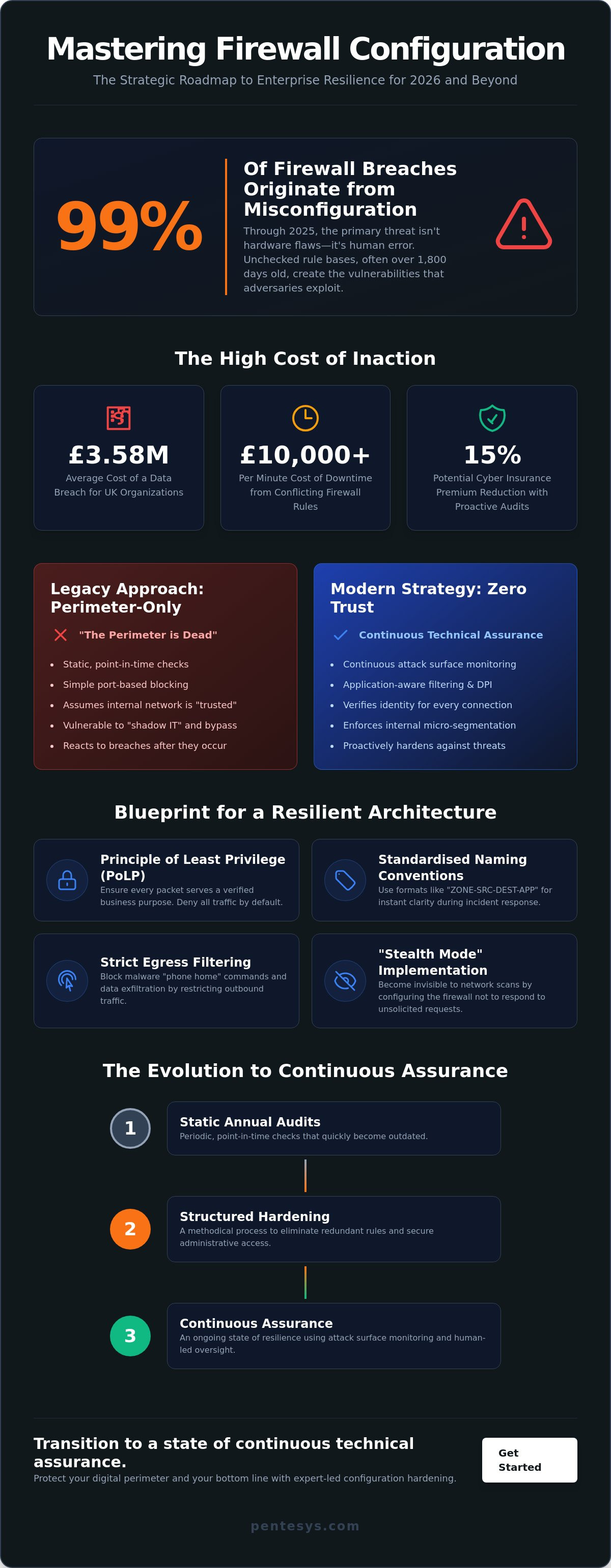
Misconfiguration remains a primary entry point for adversaries. According to the IBM Cost of a Data Breach Report, the average cost of a breach for UK-based organisations is substantial. This figure dwarfs the investment required for proactive technical hardening and regular audits. Poor firewall configuration often leads to “shadow IT,” where unmonitored traffic bypasses security controls because of overly permissive rules or forgotten legacy settings.
In the UK market, insurers are becoming more selective. Insurers increasingly reward organisations that demonstrate human-led firewall reviews with lower premiums. This financial incentive reinforces the fact that robust security is a sound business strategy. By moving from a reactive “break-fix” model to a state of continuous assurance, you protect both your digital perimeter and your bottom line.
- Downtime Costs: Unplanned outages caused by conflicting rules can cost enterprise firms heavily in lost revenue.
- Insurance Premiums: UK cyber insurance providers now scrutinize configuration hygiene during renewals.
- Regulatory Compliance: Precise configuration is a mandatory requirement for maintaining Cyber Essentials Plus and ISO 27001 certifications.
Architecting a Resilient Firewall Environment
Effective security begins with the Principle of Least Privilege (PoLP). This foundation ensures every packet entering or leaving your network serves a verified business purpose. A robust firewall configuration requires a documented IP address structure and standardised naming conventions, such as “ZONE-SRC-DEST-APP”. Without these, rule bases become unmanageable over time. Clear labelling allows your security team to identify the source and intent of traffic in seconds during an incident. The NIST Guidelines on Firewalls and Firewall Policy emphasise that technical implementation must always follow a well-defined organisational policy.
Egress filtering is a critical yet frequently overlooked component of this architecture. By restricting outbound traffic to known, necessary services, you can prevent data exfiltration and stop “phone home” commands from malware. Implementing “Stealth Mode” adds another layer of assurance. This setting ensures your firewall doesn’t respond to unsolicited ICMP requests, making your infrastructure invisible to basic reconnaissance scans.
Implementing Network Segmentation and Zones
Effective segmentation divides the network into functional zones like DMZs, Internal, and Guest. This architecture prevents lateral movement if one segment is compromised. IoT devices, which often lack enterprise-grade security, must reside in isolated VLANs with no access to sensitive data stores. For organisations managing hybrid environments, traffic between on-premises servers and cloud instances requires dedicated inspection. Pentesys recommends a strategic approach where security follows the data, ensuring consistent protection across all boundaries. This methodology aligns with the requirements for UK Cyber Essentials Plus certification, providing a clear path to compliance.
Engineering Effective Access Control Lists (ACLs)
ACLs act as the primary gatekeepers of your network. Standard ACLs filter by source address, while extended ACLs provide granular control by inspecting destination IPs and specific port numbers. Dynamic ACLs offer a sophisticated layer by granting access only after successful user authentication. It’s vital that every list terminates with an explicit “Deny All” rule. This ensures that any traffic not specifically permitted is blocked by default. To manage temporary access for third-party vendors, use time-limited rules rather than permanent exceptions. This prevents the “rule bloat” that affects many legacy firewalls. While automated tools can find basic errors, a human-led review via the Pentesys Portal identifies the logical flaws that automated scripts often miss.
Common Vulnerabilities: How Attackers Bypass Firewalls
A green light on a security dashboard is a measure of uptime, not a validation of your defensive posture. Many technical teams mistake operational status for security efficacy, yet a running service can still be transparent to an advanced adversary. Attackers frequently bypass simple filters using protocol tunneling. This involves hiding malicious payloads within standard traffic types like DNS or HTTPS. Because the traffic appears legitimate to basic inspection tools, the breach remains undetected. This highlights why a static approach to security is no longer sufficient for UK enterprises.
Rule bloat is a silent contributor to technical debt. As businesses evolve, technical teams often add new rules without auditing or decommissioning old ones. Hidden within these thousands of lines are “Any-Any” rules. These are often created for temporary troubleshooting and then forgotten, providing a direct path for attackers to navigate your infrastructure without resistance. Without regular human-led reviews, these permissions become permanent backdoors. Addressing this challenge requires a structured approach to vulnerability tracking; a dedicated continuous vulnerability management platform can replace the overwhelming noise of automated scanning with the actionable, human-led insights needed to close these gaps systematically.
The Hidden Danger of Overly Permissive Rules
During infrastructure penetration testing, our specialists frequently identify misconfigured VPN gateways as a primary point of failure. These entry points often lack the rigorous controls required to stop modern exploits. When a firewall configuration is designed only to face outward, it ignores the reality of internal threats. If an attacker gains access to a single low-privilege workstation, the absence of internal segmentation allows them to move laterally across the network to reach sensitive UK financial data or intellectual property. Relying on a “hard shell, soft centre” architecture is a legacy mindset that doesn’t survive modern adversary simulation.
Legacy Protocols and Firmware Vulnerabilities
Unpatched firmware provides a predictable path for initial access. In 2023, several high-profile vulnerabilities were weaponised by state-sponsored actors within 48 hours of being identified. Maintaining legacy support for protocols like Telnet or older versions of TLS significantly increases the attack surface. Following the NIST firewall configuration guidelines helps teams implement a lifecycle management policy that mitigates these risks. It’s vital to remember that the half-life of a firewall configuration is approximately six months; after this period, the accumulation of minor, undocumented changes usually results in a measurable decline in security assurance and technical integrity.
Step-by-Step Guide to Hardening Your Firewall Configuration
Effective firewall configuration isn’t a static task; it’s a continuous process of technical refinement. Hardening your perimeter requires a move away from “set and forget” mentalities toward a model of active management and human-led validation. By following a structured hardening path, you transform your firewall from a simple gatekeeper into a sophisticated defensive asset.
Phase 1: Administrative and Interface Hardening
The management plane is your first line of defence. If an attacker gains administrative access, your entire network perimeter collapses. You must restrict management access to specific, encrypted VLANs and disable all unused physical ports to prevent unauthorised local connections. Implement multi-factor authentication (MFA) for every administrative account. For UK organisations, this aligns with NCSC guidance and is a mandatory requirement for achieving Cyber Essentials Plus certification. Every rule update must pass through a formal Change Management procedure to ensure accountability and prevent accidental misconfigurations.
Phase 2: Rule Base Optimization
A bloated rule base creates latency and hidden security gaps. Use hit counters to identify and prune unused rules; if a policy hasn’t seen traffic in 90 days, it likely serves no current business purpose. Grouping rules by business function, such as “Finance-to-Cloud” or “HR-Internal,” improves readability and simplifies the audit process. Every rule in your firewall configuration needs a documented business justification. Redundant or conflicting firewall rules increase the attack surface during a breach.
Beyond basic filtering, you must enable Deep Packet Inspection (DPI) and Intrusion Prevention Systems (IPS). These features examine the actual payload of traffic rather than just the headers. Pair this with a rigorous logging framework. Establish alerts for anomalous traffic patterns, such as repeated “deny” logs from a single external IP or unusual outbound data spikes. This provides the actionable insights necessary for rapid remediation.
Phase 3: Validation and Testing Protocols
Validation ensures your theoretical security matches your operational reality. ISO 27001 compliance necessitates regular firewall rule audits to maintain the integrity of your Information Security Management System. While automated tools are excellent for identifying syntax errors, they often lack the context to understand complex network logic. Manual verification by a technical expert remains the gold standard for identifying “shadow” rules that might bypass your security controls. Before concluding your hardening cycle, it’s vital to verify your defences with a professional infrastructure penetration test to uncover vulnerabilities that automated scans miss.
The Evolution to Continuous Security Validation
Real-time monitoring identifies misconfigurations the moment they occur, preventing minor errors from becoming enterprise-wide entry points. By integrating firewall logs into a wider vulnerability management strategy, the firewall evolves from a passive barrier into an active sensor within your security ecosystem. This allows teams to correlate traffic patterns with known threats instantly. Automated tools often miss the nuance of business logic, which is why Pentesys prioritises human-led assurance to validate every rule change against your specific risk profile. It’s about moving from reactive patching to proactive hardening that adapts as your infrastructure grows. As artificial intelligence capabilities become embedded across enterprise security tooling in 2026, understanding how these systems interact with your firewall policy becomes an essential part of maintaining a resilient posture.
Leveraging Professional Expertise for Network Hardening
Maintaining long-term resilience requires more than software; it demands a strategic partnership. Pentesys helps UK firms navigate complex infrastructure challenges, ensuring compliance with local standards while hardening defences against global threats. Our “Trusted Expert” model focuses on delivering actionable insights rather than generic alerts. By choosing human intelligence over basic automated scans, you gain a sophisticated ally dedicated to your enterprise-grade security. Our methodology replaces uncertainty with methodical, transparent validation that supports your business objectives. Strengthen your network with a Pentesys security assessment to move beyond basic testing and achieve true technical assurance.
What is the most common mistake in firewall configuration?
The most frequent error is the implementation of overly permissive rules, specifically the “Any/Any” rule that allows unrestricted traffic flow. This oversight negates the security perimeter and is a common factor in breaches attributed to misconfigurations, according to the Verizon DBIR. Administrators should apply the principle of least privilege, ensuring every rule serves a documented business purpose. This proactive approach ensures your firewall configuration remains a robust barrier against external threats.
What are firewall zones and why do I need them?
Firewall zones are logical segments that group network assets based on their security requirements and trust levels. You need them to implement micro-segmentation, which prevents an attacker from moving freely between a public-facing web server and your internal database. By isolating guest Wi-Fi from corporate data, you limit the blast radius of any potential compromise. This methodical approach to network architecture is a hallmark of a mature and resilient security strategy.
Should I block all outbound traffic by default?
You should adopt an “egress filtering” stance by blocking all outbound traffic by default and only permitting specific, known destinations. This prevents malware from “calling home” to command-and-control servers and stops unauthorised data exfiltration. Implementing this level of control ensures your outbound traffic is as strictly managed as your inbound connections. It’s an enterprise-grade practice that significantly reduces the risk of a successful breach going undetected for long periods.
Founder & CEO, Pentesys
James Hinton is the founder of Pentesys, a CREST-approved UK company working only on offensive security: penetration testing, PTaaS, CTEM, external attack surface management and red teaming. He built the business around one discipline rather than a broad consultancy menu, and most of his time still goes on how engagements get scoped, delivered and reported. He writes here about the practical side of security testing and what buyers should be asking for.
LinkedIn profile