

Overview
A methodology is what stops a penetration test being one person's improvisation. It sets out what gets covered, in what order and to what depth, so the engagement is repeatable and any gaps are deliberate rather than accidental.
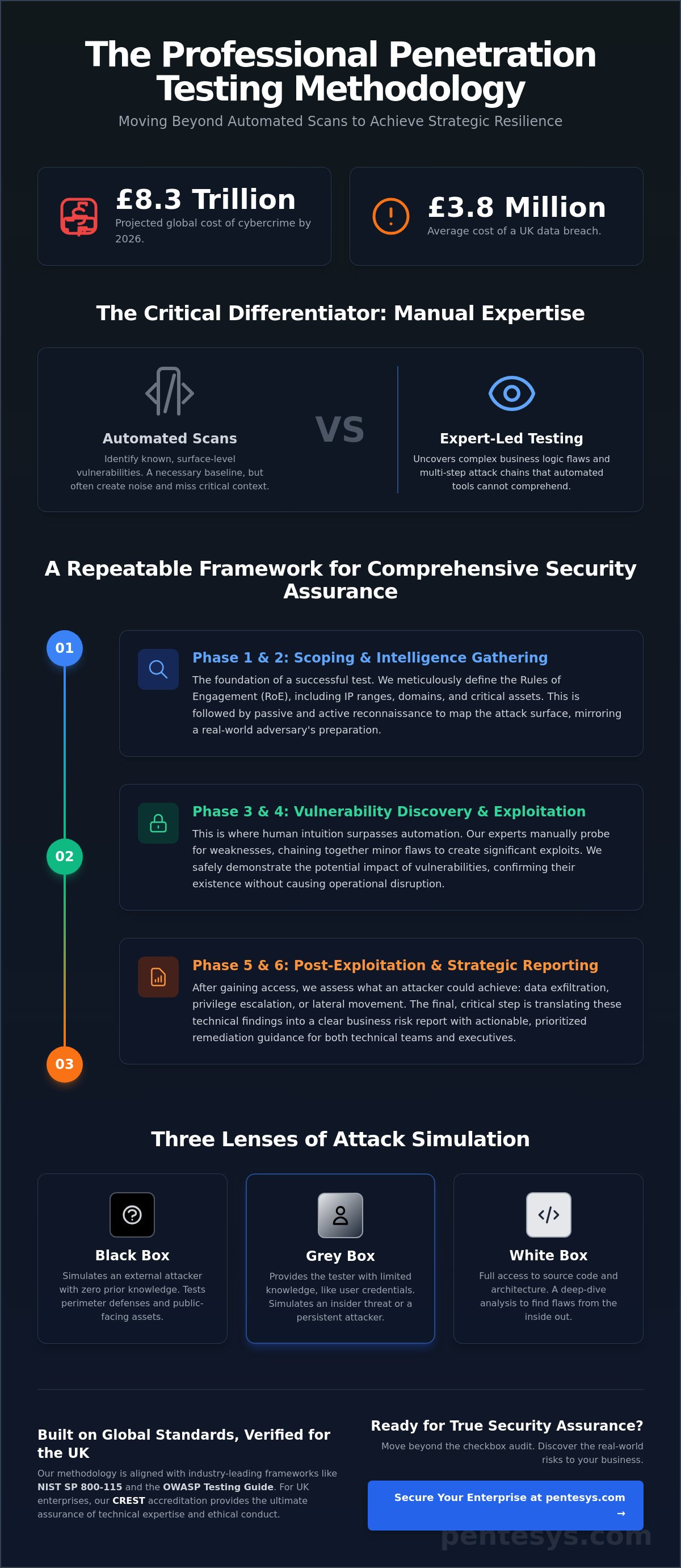
This goes through the phases in the order they happen: scoping and rules of engagement, reconnaissance, vulnerability discovery, manual exploitation, post-exploitation and reporting. The interesting part is usually the transition from discovery to exploitation, which is where automated tooling stops and judgement starts.
What is a Penetration Testing Methodology?
A Penetration test is more than a series of technical exploits; it’s a systematic evaluation of an organisation’s security posture. At its core, a methodology provides the structured framework that ensures consistency, safety, and depth throughout the engagement. Without following defined penetration testing methodology steps, an assessment risks becoming a chaotic exercise that misses critical flaws or, worse, causes unintended operational disruption. A robust methodology prioritises manual, expert-led evaluation over the shortcuts of fully automated solutions, ensuring that complex business logic is thoroughly interrogated.
For UK firms, this structured approach is often a non-negotiable requirement for regulatory compliance. Frameworks like ISO 27001 and PCI DSS demand rigorous, periodic testing to prove that security controls are effective. However, moving beyond simple compliance requires a shift from “Vulnerability Assessment” to “Security Assurance.” While an assessment identifies known weaknesses, assurance provides high-level certainty that your specific business logic and data remain protected against sophisticated threats. This distinction is vital for executive decision-makers who need to understand the actual business risk rather than just a list of technical bugs.
The depth of these tests usually falls into three categories based on the information provided to the tester. Black box testing simulates an external attacker with zero prior knowledge of the environment. White box testing provides the consultant with full access to source code and internal architecture. Grey box testing sits in the middle, offering a balanced view that mirrors the perspective of a malicious insider or a persistent threat actor. Choosing the right approach depends on your specific goals and the maturity of your security programme.
Standard Industry Frameworks (NIST, OWASP, OSSTMM)
Several foundational standards guide the execution of modern security assessments. NIST SP 800-115 provides a technical baseline for information security testing, while the OWASP Testing Guide remains the definitive standard for web application security. For firms operating within the British market, choosing CREST accredited penetration testing UK is the gold standard. It ensures that the consultants performing the work have met rigorous technical benchmarks and adhere to the highest ethical standards. This accreditation provides the peace of mind that your penetration testing methodology steps are being executed by verified experts who understand the local regulatory landscape.
Phase 1 & 2: Pre-Engagement Scoping and Reconnaissance
The success of a security assessment depends entirely on the precision of its foundation. The first two penetration testing methodology steps focus on defining the operational environment and gathering the intelligence necessary to simulate a real-world threat. Without a rigorous scoping phase, testing can quickly become unfocused, leading to missed vulnerabilities or, in the worst cases, unintended impact on production systems. By adhering to the guidelines set out in NIST SP 800-115, consultants ensure that every technical action is rooted in a clear, documented strategy.
Step 1 is Scoping. This stage involves defining the exact boundaries of the engagement, including specific IP ranges, domain names, and critical business assets. It’s during this phase that we identify which systems are most vital to your UK operations and ensure they’re prioritised for deep analysis. Clear communication channels and legal sign-off are established here to ensure that all parties understand the technical objectives. This transparency prevents the “checkbox” audit trap, where vague parameters lead to a superficial evaluation of your security posture.
Step 2 is Intelligence Gathering, often referred to as Open Source Intelligence (OSINT). This is the process of collecting data on the target without direct interaction with the client’s infrastructure. This reconnaissance informs the subsequent attack vectors by identifying potential entry points that an attacker might find through public records, social media, or technical databases. If you are concerned about what information is currently visible to threat actors, an external attack surface monitoring exercise can provide immediate clarity before a full test begins.
Defining the Rules of Engagement
The Rules of Engagement (RoE) serve as the formal contract that protects both the tester and the client while establishing the legal and operational boundaries of the test. This document identifies “out of bounds” systems that are too fragile or critical for aggressive testing, ensuring business continuity remains intact. We also establish a strict timeline for testing and emergency contact protocols so that your internal teams are never left in the dark. The RoE acts as the primary safeguard against operational downtime, providing a structured path for the technical team to follow.
Passive vs. Active Reconnaissance
Reconnaissance is a dual-layered process that shifts based on the type of testing required. Passive reconnaissance uses OSINT tools to find leaked credentials, forgotten subdomains, and exposed metadata without alerting the target’s security systems. Active reconnaissance involves more direct interaction, such as port scanning and service banner grabbing, to map out the live network. For infrastructure penetration testing, this might involve identifying outdated server versions, whereas a web application test focuses more on the underlying software stack and API endpoints. This phase is about finding the “low-hanging fruit” that often serves as the initial foothold for a breach.
Phase 3 & 4: Vulnerability Discovery and Manual Exploitation
The transition from reconnaissance to active evaluation marks the beginning of the most technical penetration testing methodology steps. In this phase, the focus shifts from mapping the environment to identifying and validating specific weaknesses. This process is divided into two distinct stages: automated discovery and manual exploitation. While automation provides a baseline of known issues, manual analysis provides the human intuition required to uncover complex flaws that software alone cannot detect.
Step 3 involves vulnerability scanning. Consultants use specialised tools to identify known Common Vulnerabilities and Exposures (CVEs) and misconfigurations across the scoped infrastructure. However, automated scans are notorious for the “false positive” problem, where benign configurations are flagged as critical risks. Manual verification is therefore non-negotiable. By manually validating each finding, professional testers ensure that your technical teams don’t waste time chasing non-existent threats. This rigour ensures the final report focuses exclusively on verified risks that impact your business operations.
Step 4 is the manual analysis and exploitation phase. This is the human element that separates a professional pen test from a basic vulnerability scan. During this stage, consultants attempt to safely exploit identified weaknesses to prove the depth of the risk. Professional testers mitigate the inherent risks of exploitation by adhering strictly to the Rules of Engagement established in the scoping phase. This controlled approach allows for the demonstration of impact without compromising the stability of your production systems.
Automated Scanning vs. Expert Manual Testing
Automated tools are efficient at finding missing patches, but they consistently fail to identify complex business logic flaws or chained vulnerabilities. Human experts use intuition to pivot between seemingly minor issues to uncover a path to sensitive data. This manual rigour is a signature quality marker of a premium service, moving beyond the limitations of a “scan-only” approach. For web-based assets, consultants rely on the OWASP Web Security Testing Guide to ensure every potential attack vector, from broken access control to insecure design, is systematically explored.
The Exploitation Process: Proving the Risk
Exploitation is about proving risk through controlled action. It involves attempting to bypass security controls such as Web Application Firewalls (WAFs) or Endpoint Detection and Response (EDR) systems to gain an initial foothold. Once access is gained, the focus shifts to privilege escalation. Here, the tester attempts to move from a standard user account to an administrative or “root” level. Finally, lateral movement demonstrates how an attacker could navigate through the internal network to reach your most critical assets. This process provides a realistic view of how a breach would unfold in your specific environment, allowing for more effective long-term resilience.
Phase 5 & 6: Post-Exploitation and Strategic Reporting
The final penetration testing methodology steps are where technical exploitation evolves into strategic intelligence. Post-exploitation involves determining the actual value of a compromised system and the sensitivity of the data it contains. Instead of stopping at the point of entry, consultants analyse the potential for lateral movement and data exfiltration to simulate a realistic breach scenario. This phase is crucial for understanding the impact on “special category data” as defined by UK GDPR, ensuring that the business understands its regulatory exposure and potential for financial loss.
Reporting is the most critical deliverable of the entire engagement. It serves as a bridge between technical execution and corporate objectives, providing a dual-layered view of the organisation’s security posture. A high-quality report translates complex exploit data into an actionable business roadmap, moving beyond a simple list of bugs to provide a clear path toward remediation. By using the Common Vulnerability Scoring System (CVSS), we ensure that findings are prioritised based on their objective severity and the specific context of your environment.
Evidence of Impact and Data Exfiltration
Every vulnerability identified during the test requires a documented “proof of concept” to validate its existence and demonstrate the potential for harm. This evidence shows exactly how an attacker could bypass existing controls without causing unintended operational downtime. Once the assessment is complete, a meticulous cleanup process ensures that no backdoors, test accounts, or temporary files remain on your systems. This restoration of the environment is a hallmark of professional reliability and ensures your infrastructure returns to its baseline state immediately after testing concludes.
Building a Remediation Roadmap
A professional report provides two distinct perspectives. The executive summary focuses on business risk, strategic outcomes, and the overall resilience of the organisation. Conversely, the technical summary provides IT teams with the specific, step-by-step guidance needed to patch flaws and harden configurations. We categorise findings by risk level, from Critical to Low, allowing your leadership to allocate resources where they are needed most. If you require assistance in tracking and resolving these issues over time, our vulnerability management service provides the ongoing oversight necessary for sustained security. A final debrief meeting ensures all stakeholders are aligned on the remediation roadmap and the necessary steps for long-term resilience.
Beyond the Methodology: Moving to Continuous Validation
The cyber threat landscape for 2026 moves at a pace that renders static, annual assessments insufficient. While the foundational penetration testing methodology steps provide a necessary baseline for security, their value diminishes if they’re only applied once every twelve months. Modern UK organisations now face AI-powered phishing and rapid supply chain exploits that can emerge days after a successful audit. This shift has led to the rise of Penetration Testing as a Service (PTaaS), a model that prioritises ongoing validation over one-off events. By adopting a continuous approach, you ensure your security posture remains resilient against the evolving global intrusions expected by the end of the year.
A critical component of this evolution is the re-test phase. It’s not enough to simply identify a flaw; you must verify that the remediation was successful. Without this step, many organisations find that patches are either incorrectly applied or inadvertently bypassed by other system changes. Professional validation provides the high-level certainty that your critical business assets are truly protected. It’s about establishing a cycle of reliability that keeps pace with your digital transformation.
What are the 7 stages of penetration testing?
The standard 7 stages include pre-engagement, reconnaissance, vulnerability analysis, exploitation, post-exploitation, reporting, and remediation. These penetration testing methodology steps provide a logical path for consultants to move from initial data gathering to deep manual analysis. Following this structured framework ensures that every assessment is repeatable, safe, and produces consistent results for the organisation.
Can a penetration test methodology be applied to cloud environments like AWS?
Yes, these methodology principles are essential for a robust cloud security assessment. The process focuses on cloud-specific risks such as misconfigured S3 buckets, overly permissive IAM roles, and insecure API endpoints. It’s vital to follow the specific rules of engagement provided by cloud providers like AWS or Azure to ensure the test remains compliant with their terms of service.
What is the most critical step in a penetration testing methodology?
Scoping is the most critical stage because it establishes the legal and technical boundaries of the entire engagement. Accurate scoping ensures that the technical team focuses on your most vital business assets while avoiding “out-of-bounds” systems that could be sensitive to testing. It provides the foundational safety and clarity needed to protect your operational continuity throughout the process.
What qualifications should a professional pen tester hold in the UK?
In the UK, professional testers should hold formal accreditations from recognised bodies like CREST. Look for certifications such as the CREST Registered (CRT) or Certified (CCT) status, which signal high-level technical competence. These qualifications ensure that the consultant has met rigorous benchmarks and adheres to the ethical standards required for handling sensitive organisational data.
What happens if a penetration test causes a system crash?
Professional testers use controlled exploitation techniques designed to minimise the risk of technical instability. If a system becomes unresponsive, the team immediately follows the emergency contact protocols established in the Rules of Engagement. This structured response ensures that your internal IT teams are notified instantly and can work alongside the testers to restore services without delay.
Founder & CEO, Pentesys
James Hinton is the founder of Pentesys, a CREST-approved UK company working only on offensive security: penetration testing, PTaaS, CTEM, external attack surface management and red teaming. He built the business around one discipline rather than a broad consultancy menu, and most of his time still goes on how engagements get scoped, delivered and reported. He writes here about the practical side of security testing and what buyers should be asking for.
LinkedIn profile