

Overview
The margin for error in your security procurement has vanished. You’ve likely felt the frustration of comparing multiple vendor quotes only to find they’re speaking entirely different languages. It’s difficult to ensure you aren’t missing critical gaps like the new OWASP “Software Supply Chain Failures” or failing to meet the strict April 2026 Cyber Essentials requirements due to poor scoping. This guide provides a comprehensive penetration testing proposal template designed to bring technical rigour and clarity to your security assessments.
We believe that effective security oversight requires a move from static evaluations to proactive, expert led assessments. You’ll learn how to standardise your evaluation framework to compare quality accurately while avoiding the hidden costs of out of scope surprises. We’ll examine how to define precise technical boundaries and present a board ready justification for your security investment that aligns with CVSS v4.0 standards and UK regulatory expectations.
The Anatomy of a Professional Penetration Testing Proposal
A professional proposal acts as a technical blueprint for resilience, establishing a clear line of sight between security vulnerabilities and business outcomes. It’s far more than a simple cost estimate. A robust penetration testing proposal template ensures that every stakeholder, from the technical lead to the Chief Risk Officer, understands the specific objectives and boundaries of the engagement. This document defines the legal framework, the rules of engagement, and the expected depth of the final output, providing the assurance needed for high-stakes security investments.
Why Accreditation is the Foundation of Your Proposal
In the UK market, technical competence isn’t just claimed; it’s verified. A quality proposal must lead with formal accreditations, specifically CREST status. This body provides a rigorous framework for validating a provider’s methodology and ethical standards. When you review a proposal, look for testers holding certifications like the CRT (CREST Registered Tester) or OSCP (Offensive Security Certified Professional). These credentials differentiate expert-led, manual evaluations from the automated, surface-level scans that often miss complex logic flaws. Your template should also explicitly confirm professional indemnity and cyber liability insurance. This protects your organisation against unforeseen operational disruptions during the testing window.
The Executive Summary: More Than Just an Introduction
While the technical team needs granular details, the board requires a narrative focused on operational resilience. The executive summary must translate technical risk into business impact, explaining how the test supports strategic goals like ISO 27001 compliance or GDPR data protection requirements. It should move beyond a basic What is a Penetration Test? overview to address specific business drivers. For instance, if you’re preparing for a new product launch, the summary should explain how the testing frequency and window align with your release cycle. This ensures that the security spend is viewed as an investment in long-term stability rather than a one-off compliance checkbox.
Beyond these summaries, a comprehensive penetration testing proposal template must identify the specific personnel assigned to your project. You need to know that the individuals conducting the test possess deep expertise in your specific environment, whether that involves complex cloud architectures or legacy internal networks. Finally, define the reporting deliverables clearly. A high-quality report includes a prioritised remediation plan based on CVSS v4.0 scoring, providing your team with a methodical path toward risk reduction rather than a chaotic list of findings.
Technical Scoping and Methodology: The Core of the Template
A comprehensive penetration testing proposal template must pivot on technical precision. Without clear boundaries, the engagement risks missing critical vulnerabilities or causing unintended service interruptions. Scoping defines the depth of the assessment, whether it involves web applications, cloud infrastructure, or internal networks. By establishing these parameters early, you ensure the testing team focuses on your most significant risks rather than wasting time on low-priority assets. This clarity is essential for translating your technical requirements into a document that stakeholders can trust.
Detailed Scoping for Web and Infrastructure Assets
Effective scoping requires unambiguous documentation of IP ranges, URLs, and API endpoints. When dealing with cloud environments like AWS or Azure, the proposal should outline the necessary notifications to the provider to remain compliant with their terms of service. It’s also vital to define exclusion zones for fragile legacy systems or specific production databases that shouldn’t be touched. Following NCSC guidance on penetration testing helps in setting these boundaries, ensuring the test remains safe yet rigorous. Clear scoping prevents “out of scope” surprises that can lead to budget overruns or security gaps.
Methodology: Beyond the Vulnerability Scan
Methodology is where the value of human expertise becomes apparent. While automated tools are useful for initial reconnaissance, they often fail to identify complex business logic flaws or mishandling of exceptional conditions. A professional proposal should detail how testers will manually exploit vulnerabilities to demonstrate real-world risk. This is especially true for continuous penetration testing, which moves away from the “snapshot in time” approach to provide ongoing assurance in agile development cycles. This methodology should align with the OWASP Top 10: 2025, specifically addressing new categories like software supply chain failures and ensuring all findings are scored using CVSS v4.0.
Organisations must also decide between black box (zero knowledge) and white box (full knowledge) testing. White box testing often yields more thorough results as it allows testers to bypass the discovery phase and focus on deep-seated vulnerabilities within the code or architecture. For those operating in dynamic environments, incorporating a cloud security assessment into your penetration testing proposal template provides the specialised oversight needed to manage ephemeral assets. This structured approach ensures that the final assessment is not just a list of bugs, but a strategic narrative of your organisation’s defensive posture.
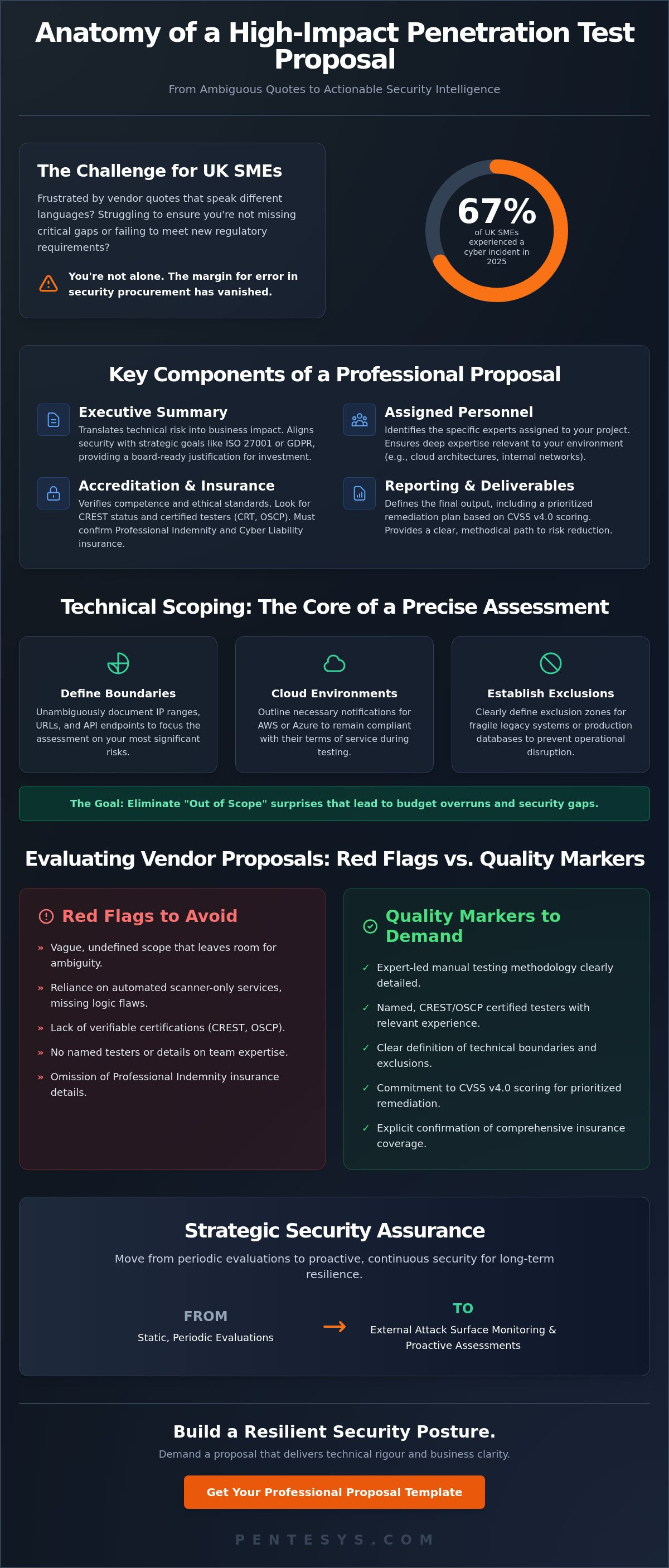
Evaluating Vendor Proposals: Red Flags vs Quality Markers
Once you’ve defined your scope, the next stage involves filtering potential partners through a critical lens. A high-quality penetration testing proposal template acts as a vital filter during the procurement process. It allows you to distinguish between providers who offer genuine security insight and those who rely on automated shortcuts. You should look for a narrative that prioritises human intelligence and manual exploitation over the simple output of a vulnerability scanner. This ensures the assessment uncovers complex logic flaws that automated tools consistently miss.
One of the most common pitfalls in security procurement is the “scanner-only” trap. Automated tools are necessary for efficiency, but they can’t replicate the intuition of a skilled human tester. If a proposal lacks a detailed breakdown of manual testing hours, it’s likely a glorified vulnerability scan. You need to see a methodology that references established frameworks. While the NCA Penetration Testing Standard provides a solid baseline for technical consistency, a UK-centric proposal should go further by aligning with local regulatory demands like the April 2026 Cyber Essentials update. Confirm which Cyber Essentials question set is current when you scope the work, and how multi-factor authentication on cloud services will be evidenced.
Red Flags to Watch For in Security Bids
Vague language regarding post-test support is a significant warning sign. If a vendor doesn’t explicitly state how they handle re-testing or remediation advice, you’ll likely face hidden costs later. Many organisations find themselves paying extra for a simple verification of their fixes. A professional proposal includes a dedicated remediation window as standard. Effective communication protocols also distinguish a partner from a mere contractor. Your proposal should specify the exact channels used to report “Stop-Ship” vulnerabilities during the testing phase, ensuring your developers can start patching critical flaws before the final report is even delivered.
Quality Markers of a Strategic Security Partner
Reliability is the conceptual anchor of a successful security partnership. Seek evidence of CREST accredited penetration testing within the firm profile. This accreditation ensures the provider adheres to strict ethical and technical standards recognised by the NCSC. A strategic partner also looks beyond the one-off assessment, integrating services like external attack surface monitoring to maintain your security posture between formal tests. This transition from static evaluations to proactive oversight is essential for managing the 59,427 new CVEs forecast for 2026.
Finally, evaluate the quality of their sample reports. The output should be clear, concise, and actionable for both technical teams and executive decision-makers. It must include tailored risk scoring based on CVSS v4.0 that reflects your organisation’s unique threat model. If the remediation advice is generic or copied directly from a tool’s output, the service is likely automated. A superior penetration testing proposal template ensures that the final deliverable provides a methodical path toward long-term resilience rather than just a list of bugs.
Step-by-Step: Building Your Penetration Testing Proposal Template
Constructing a modular penetration testing proposal template requires a logical progression from broad business goals to granular technical constraints. This structure ensures that both procurement teams and technical leads find the information they need to approve the engagement. A well-organised template prevents the ambiguity that leads to scope creep or missed vulnerabilities. It acts as a definitive contract of work, ensuring all parties are aligned on the expected outcomes and the methodology used to achieve them.
The process begins with five essential steps. First, define the Background and Objectives to establish the “why” of the test, such as preparing for a 2026 Cyber Essentials audit. Second, create a Detailed Scope by listing every URL, IP range, and user role. Third, outline the Methodology and Tools, focusing on manual exploitation and CVSS v4.0 scoring. Fourth, establish the Reporting and Timeline, setting clear deadlines for draft and final reports. Finally, break down the Costing and Investment to reflect the resource requirements for the specific environment. For organisations with complex digital footprints, incorporating Web Application Penetration Testing into this framework ensures that high-risk entry points receive the expert-led scrutiny they require.
Drafting the Scope and Limitations Section
Precision in the limitations section is what protects your operational stability. You must explicitly define “Out of Scope” activities to prevent accidental disruptions. Common exclusions include Denial of Service (DoS) attacks or Social Engineering, unless these are specifically requested as part of a Red Teaming exercise. It’s equally important to document the testing window. You need to decide if the team will work during standard UK business hours or if out-of-hours testing is required to minimise impact on live users. Finally, specify the technical requirements for the testers, such as VPN access or white-listing of specific testing IP addresses.
Defining the Deliverables and Remediation
A professional proposal distinguishes between a technical finding and a strategic recommendation. While a finding might identify a specific misconfiguration, a strategic recommendation addresses the underlying process failure. Your template should include a “Clean Report” option. This allows the provider to issue a revised document after you’ve successfully remediated the initial vulnerabilities, which is often a requirement for third-party audits. We recommend proposing a formal debrief meeting. This session allows the testing team to present findings to both technical developers and executive stakeholders, ensuring the remediation path is understood at every level of the organisation.
What is the difference between a penetration test proposal and a contract?
A proposal outlines the strategic approach, methodology, and technical scope of the engagement, serving as a roadmap for the project. It’s a document intended to demonstrate capability and align expectations between the provider and the client. In contrast, the contract or Statement of Work is the legally binding agreement that formalises the engagement. It includes specific legal protections, liability limits, and final commercial terms based on the accepted proposal.
How do I compare two proposals with vastly different price points?
Look closely at the total number of testing days and the ratio of manual effort to automated scanning. A significantly lower price often indicates a reliance on automated tools, which may miss complex logic flaws or supply chain vulnerabilities. Evaluate the qualifications of the specific testers and the depth of the final reporting deliverables. Lower day rates might also reflect a lack of formal accreditation like CREST.
Does a proposal need to mention specific tools like Burp Suite or Metasploit?
While mentioning industry standard tools can signal technical capability, the focus should remain on the methodology rather than the software. Tools are merely the instruments used by an expert tester. A superior proposal emphasises the manual exploitation techniques and business logic testing that will be performed. This demonstrates that the provider values human intelligence over the shortcuts of fully automated solutions.
Founder & CEO, Pentesys
James Hinton is the founder of Pentesys, a CREST-approved UK company working only on offensive security: penetration testing, PTaaS, CTEM, external attack surface management and red teaming. He built the business around one discipline rather than a broad consultancy menu, and most of his time still goes on how engagements get scoped, delivered and reported. He writes here about the practical side of security testing and what buyers should be asking for.
LinkedIn profile