

Overview
Boards do not want the finding list. They want to know what could plausibly happen, how likely it is, what it would cost, and what you intend to do about it. Most security leaders lose the room by leading with technical detail and never reaching the second half of that.
You’ll learn how to bridge this gap by translating technical debt into strategic risk management. This guide provides a clear framework to secure the necessary budget for remediation while positioning your security function as a fundamental driver of organisational resilience. We’ll examine how to align your reporting with current SEC disclosure requirements and move from static, periodic evaluations toward a model of continuous, human-led certainty that builds long-term trust at the executive level.
The Challenge of Board-Level Cyber Security Reporting
Board-level cyber reporting is far more than a simple data transfer; it’s the strategic translation of raw technical findings into actionable business insights. When you’re presenting penetration test findings to the board, your primary objective is to provide clarity on how specific vulnerabilities impact the organisation’s bottom line. In 2026, security is no longer viewed merely as an operational hurdle. Instead, it’s a competitive advantage that demonstrates organisational resilience and reliability to partners and shareholders alike. Boards now expect a narrative that connects security posture directly to the company’s long-term health.
Why Technical Jargon Dilutes Your Message
Technical teams often fall victim to the “curse of knowledge.” They assume directors understand the nuances of a penetration test or the mechanics of a cross-site scripting attack. Traditional reports fail in the boardroom because they focus on the “how” instead of the “so what.” A finding labeled as “High” severity in a technical scan doesn’t always equate to a high business risk. For example, a vulnerability on an isolated internal server carries less weight than a “Medium” vulnerability on a revenue-generating API. Directors don’t need to understand the technical exploit string. By focusing on the impact rather than the mechanism, you keep the conversation focused on strategic risk.
The Board’s Perspective on Cyber Risk
Directors approach security through the lens of fiduciary duty and legal compliance. Directors are increasingly expected to show they understand and oversee cyber risk, and UK boards are asked about it more directly now by auditors, insurers and large customers. They view cyber threats alongside other operational risks like market volatility or supply chain disruptions. To meet these expectations, security leaders must align their reporting with recognised frameworks. Utilising CREST accredited penetration testing UK standards ensures your data is grounded in formal accreditation and human expertise. This alignment provides the board with the high-level certainty they require to fulfil their oversight roles. It transforms a technical assessment into a strategic asset that protects reputation and ensures legal compliance.
Translating Technical Vulnerabilities into Business Impact
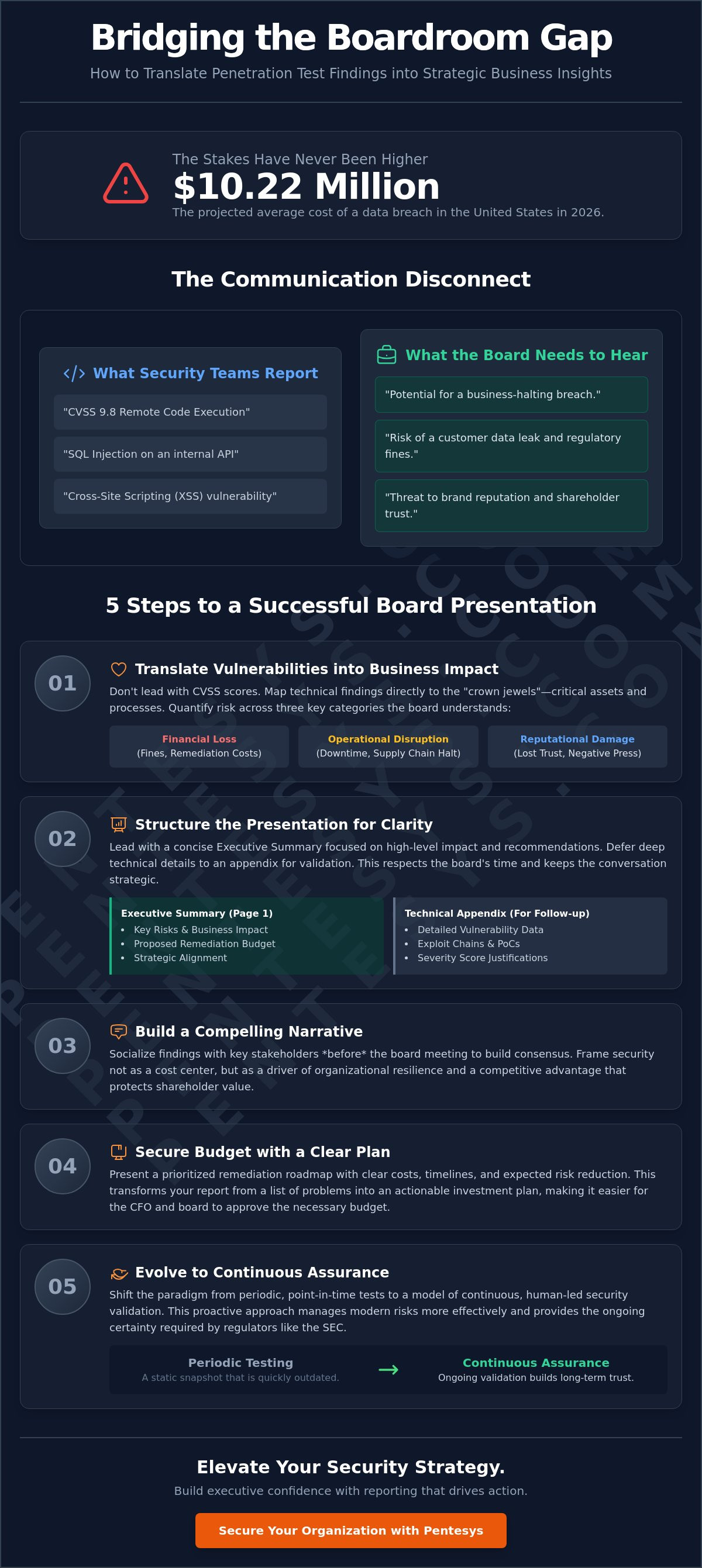
A technical severity score like a CVSS 9.8 is a useful metric for a sysadmin, but it’s often meaningless to a director. When you’re presenting penetration test findings to the board, your primary task is to define the organisation’s risk appetite. This involves determining which technical weaknesses cross the threshold from acceptable operational noise to material business threats. Effective communicating with a Board of Directors requires you to weigh the likelihood of exploitation against the specific consequence to the company’s objectives. By categorizing findings into financial, operational, and reputational impacts, you provide a framework that allows the board to make informed decisions about resource allocation.
Contextualizing your performance against industry benchmarks is also vital. Directors need to know if the discovered vulnerabilities represent a systemic failure or a localized issue common within your sector. This perspective prevents alarmism and fosters a culture of steady, methodical improvement. It shifts the conversation from a list of “broken things” to a strategic discussion about maintaining a resilient market position.
Mapping Threats to Business Processes
You must identify your “crown jewels,” the critical data assets and processes that drive revenue. If a Vulnerability Management program identifies an SQL injection, don’t just report the technical flaw. Translate it into the potential for a customer data breach, and the regulatory notification work that follows one. Distinguish between external infrastructure risks, which represent the immediate “front door” of the business, and internal risks that could allow lateral movement. This distinction helps the board understand the difference between a perimeter probe and a deep compromise of core business logic.
Quantifying Risk for the CFO
The CFO’s office views security through the lens of cost versus benefit. Use these figures to illustrate the cost of inaction. Contrast the potential multi-million dollar recovery and regulatory penalty costs with the controlled investment required for remediation. Furthermore, consider the requirements of your cyber insurance policy. Some underwriters set expectations for testing frequency and remediation timelines. Presenting penetration test findings to the board as a requirement for maintaining insurance coverage or lowering premiums provides a powerful financial incentive for immediate action.
Structuring the Presentation: Executive Summary vs. Technical Detail
The success of your presentation hinges on your ability to separate noise from signal. When you’re presenting penetration test findings to the board, you aren’t just delivering a document; you’re facilitating a high-level decision-making process. Directors don’t need to see the raw output of a technical assessment. Instead, they require a synthesized view that respects their time and focus. While the full technical report serves as the source of truth for your engineering teams, the board deck should adhere to the “One-Page” rule. This means the most critical insights must be visible and understood within seconds to drive effective governance.
Keep the technical appendix exactly where it belongs: in the final report, not the slide deck. If a director asks for specific exploit details, you can refer to the appendix, but leading with it often invites unproductive diversions into technical minutiae. It’s also vital to highlight security “wins.” If your team successfully detected an unauthorised access attempt or if your Vulnerability Management program prevented a known exploit from being viable, report it. This balanced approach builds trust and demonstrates that existing investments are yielding tangible results. It reinforces the brand of the security team as a methodical partner rather than a source of constant alarm.
The Executive Summary Framework
Your executive summary should lead with the bottom line: is the organisation’s risk profile improving? Start by comparing current results with previous benchmarks to show a logical progression in resilience. This high-level certainty is what directors look for when assessing the value of CREST accredited penetration testing UK standards. Focus on the top three critical risks and provide clear, high-level solutions for each. Most importantly, end with a specific “Ask.” Whether you need a budget for remediation or a policy change to support ongoing security measures, be direct about what you require from the board to move the needle.
Using Visual Aids Effectively
Visual data is the most efficient way to communicate complex technical states. A risk heat map allows directors to instantly grasp the relationship between impact and likelihood, moving the conversation away from abstract list-based findings. Use trend lines to visualize the reduction of technical debt over time. This shows the board that security is a managed, ongoing process rather than a series of chaotic, one-off events. Avoid over-complicated slides; simple, high-impact graphics ensure your message remains the focal point without causing “Death by PowerPoint.”
5 Strategic Steps for a Successful Board Presentation
Success in the boardroom depends on preparation long before the meeting starts. When you’re presenting penetration test findings to the board, you should have already socialized the key results with your CEO and CTO. This pre-meeting alignment prevents defensive reactions and ensures the executive team presents a united front. Frame the assessment as a routine health check rather than a pass or fail exam. This perspective shifts the focus from individual blame to organisational improvement, fostering a culture where security is viewed as a shared responsibility.
Engagement increases significantly when you move away from dry lists and toward a narrative. Describe the “Day in the Life of an Attacker” to illustrate how a threat actor could move through your environment. Show how a human expert identified a path through your defences that an automated tool would have missed. This story illustrates the real-world risk more effectively than any spreadsheet. It transforms abstract vulnerabilities into a tangible scenario that directors can easily visualize and discuss.
Step 1 & 2: Pre-Meeting Alignment and Storytelling
You should never surprise your executive stakeholders during a formal presentation. By briefing the CTO and CEO beforehand, you allow them to prepare their own responses regarding resource allocation and operational impact. Use the storytelling approach to build engagement; instead of listing CVEs, explain the journey from an initial phishing email to the compromise of a core database. This narrative framing makes the technical data relatable and highlights the importance of human intuition in your security strategy.
Step 3, 4 & 5: Methodology, Roadmap, and Long-Term Vision
Directors need to understand the methodology behind the results to trust the findings. Distinguish between simple automated scanning and expert-led Red Teaming or manual testing. Explain that manual evaluation provides high-level certainty by mimicking actual adversary behaviour. Once the methodology is clear, present a prioritised remediation roadmap. Break this down into “Quick Wins” achievable within 30 days and “Strategic Projects” that require sustained investment. This proves you have a structured plan for resolution rather than just a list of problems.
Finally, explain how this specific test integrates with your broader cyber security services strategy. Presenting penetration test findings to the board as part of a managed, ongoing process reinforces the idea that security is a consistent operational discipline. This long-term vision moves the organisation away from static, periodic evaluations toward a model of continuous security validation. It demonstrates that you’re building a resilient foundation that can adapt to the evolving threat landscape of 2026.
For organisations looking to move beyond basic compliance and achieve true operational resilience, discover how our expert-led penetration testing services provide the clarity your board requires.
The Shift to Continuous Security Validation
Adopting continuous penetration testing fundamentally changes the nature of the board conversation. Instead of “fixing the past” by addressing old vulnerabilities, the focus shifts to “securing the future” through real-time validation of your defences. Our central platform provides an executive dashboard that translates complex technical states into clear, visual risk metrics. This allows security leaders to demonstrate the ongoing reduction of technical debt and the immediate impact of remediation efforts. It transforms the security function from a cost centre into a transparent enabler of business continuity.
Why Human Expertise Still Trumps Automation
While automated tools have their place in reconnaissance, they often fail to identify the complex logic flaws that sophisticated attackers exploit. Pentesys distinguishes itself through a commitment to human intelligence and manual testing. Our experts provide the nuanced narrative and adversarial mindset that automated shortcuts lack. When presenting penetration test findings to the board, the ability to explain the “why” behind a vulnerability is just as important as the “what.” This expert-led approach ensures that your reporting is grounded in reality, providing the high-level assurance that only human intuition can deliver.
Building long-term organisational resilience requires a partner that values quality over speed and human expertise over fully automated solutions. Partner with Pentesys to provide your board with the professional security assurance and strategic clarity they require to navigate the complexities of 2026. Discover how our cyber security services can strengthen your security posture today.
What are the most important metrics to show the board after a pen test?
The most critical metrics focus on risk reduction trends and the potential impact on revenue-generating processes. Avoid presenting raw vulnerability counts, which lack business context. Instead, show the percentage of critical assets protected and the average time taken to remediate high-priority findings. This data-driven approach ensures that when you’re presenting penetration test findings to the board, you’re highlighting strategic progress rather than technical noise.
How do I handle a ‘Critical’ finding that cannot be fixed immediately?
Address the finding by presenting a formal risk mitigation strategy that includes temporary compensating controls. Explain the specific operational or technical dependencies that prevent immediate remediation while providing a clear timeline for the final fix. This methodical approach proves that the security team is managing the risk with high-level certainty, ensuring the board remains informed without unnecessary alarm or loss of trust.
Should I show the board the full list of vulnerabilities?
You should avoid presenting a comprehensive list of every minor vulnerability to the board. Directors require a synthesized view of the top strategic risks that could impact business continuity or legal compliance. Leading with an exhaustive list often leads to unproductive diversions into technical minutiae. Keep the full discovery data in the technical report and use the board meeting to focus on high-impact findings that require executive buy-in.
Founder & CEO, Pentesys
James Hinton is the founder of Pentesys, a CREST-approved UK company working only on offensive security: penetration testing, PTaaS, CTEM, external attack surface management and red teaming. He built the business around one discipline rather than a broad consultancy menu, and most of his time still goes on how engagements get scoped, delivered and reported. He writes here about the practical side of security testing and what buyers should be asking for.
LinkedIn profile