

Overview
With “highly significant” cyber incidents in the UK rising for the third consecutive year, a generic security check is no longer a viable defence. Learning how to scope a web application penetration test effectively is the difference between a superficial scan and a strategic investment that protects your capital and ensures long-term resilience.
You likely feel the pressure of ensuring every pound spent on security delivers a tangible return while satisfying the incident reporting duties proposed in the Cyber Security and Resilience Bill. It’s frustrating to see budget allocated to low-risk assets while critical vulnerabilities remain hidden. This guide provides the technical and strategic essentials to master the scoping process, ensuring your programme delivers definitive business value and technical assurance. We will explore how to identify high-risk assets, align with the latest OWASP Top 10 standards for both traditional and agentic applications, and communicate technical requirements to your board with absolute clarity.
Defining Security Return on Investment (SROI)
SROI is the ratio of risk reduction value to the cost of the security control. In a modern offensive security environment, you calculate this by weighing the cost of the assessment against the potential “Cost Avoidance” of a breach. You aren’t just buying a report; you’re investing in the prevention of remediation costs, legal fees, and the significant financial impact of service downtime.
Setting Clear Boundaries and Objectives
Precision is vital when distinguishing between in-scope assets and out-of-scope legacy systems. You don’t want your testing team to accidentally disrupt a third-party service or waste hours on a decommissioned subdomain. Clear boundaries ensure the team stays focused on the attack paths that matter most. Your objectives should align with specific threats relevant to the UK market, such as:
Establishing clear rules of engagement is the final step in this strategic phase. It ensures the testing team can simulate real-world attacks while maintaining operational stability. This methodical approach provides the high-level certainty required by modern boards and executive decision-makers, turning a technical necessity into a clear business advantage.
- Data Exfiltration: Protecting sensitive customer data to remain compliant with UK GDPR.
- Service Disruption: Ensuring high availability for customer-facing portals.
- Unauthorised Access: Testing the strength of authentication and authorisation controls.
Technical Parameters: A Step-by-Step Guide to Scoping Modern Apps
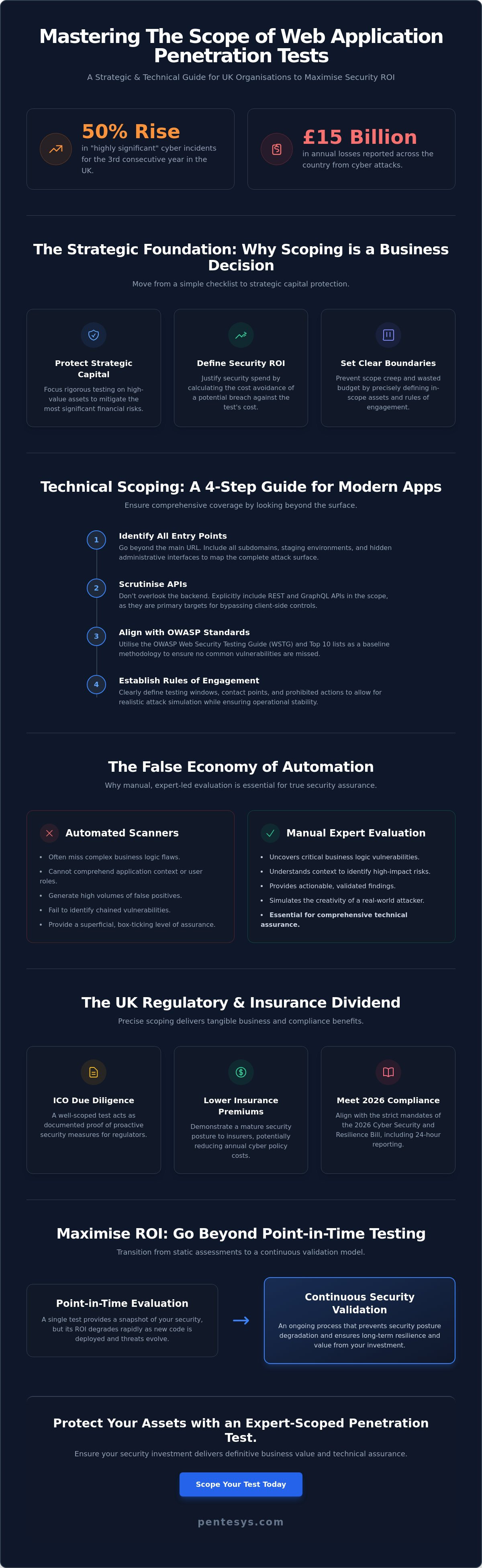
Modern web applications aren’t just single pages; they’re sprawling ecosystems of microservices and interconnected data points. Understanding how to scope a web application penetration test requires a granular look at every digital touchpoint, from public-facing URLs to hidden administrative interfaces. In 2026, the attack surface has expanded significantly. You must account for subdomains that might host legacy code or staging environments, as these are often the weakest links in your perimeter. A comprehensive scope identifies these entry points early to prevent attackers from finding a “back door” into your production environment.
A major oversight in traditional scoping is the exclusion of the APIs that power the front-end. Whether you’re using REST or GraphQL, these endpoints are often the primary targets for attackers seeking to bypass client-side controls. If your scope doesn’t include these, you’re leaving a massive blind spot in your security posture. We recommend following the methodology outlined in the OWASP Web Security Testing Guide to ensure no stone is left unturned. This structured approach ensures that your web application penetration testing covers the full breadth of modern technical risks, including those hidden within complex API integrations.
You also need to account for the “Human Element” and the shared responsibility of third-party integrations. Many applications rely on external payment gateways or identity providers. While you don’t own that infrastructure, you’re responsible for how your application interacts with it. Scoping should also consider whether integrated social engineering or simulated phishing is necessary to test how your staff handle administrative access under pressure. This ensures that your technical defences aren’t undermined by a single compromised credential.
Mapping the Application Architecture
Providing your testers with a clear understanding of your tech stack is essential for efficiency. Whether you’re running React on Node.js or a serverless architecture in AWS, knowing the environment allows testers to tailor their tools and techniques. We advocate for “Grey Box” testing, where our experts have partial architectural knowledge. This transparency helps identify data flows between the web app and backend databases that an automated scanner would likely miss, providing a higher level of certainty.
User Roles and Access Control Scoping
Access control is a frequent source of high-impact vulnerabilities. You should define the specific user roles to be tested, such as Admin, Manager, and Guest. Testing for Horizontal and Vertical Privilege Escalation is impossible without providing the testers with multiple sets of credentials. By supplying test accounts, you ensure that the expert’s time is spent on deep vulnerability discovery rather than wasting hours on brute-forcing login screens. This level of detail is what transforms a standard assessment into a sophisticated strategic asset.
The UK Regulatory and Insurance Dividend
Scoping is often viewed as a technical hurdle, but for UK organisations, it’s a sophisticated financial lever. When you master how to scope a web application penetration test, you’re building a defensible position for both insurers and regulators. This precision ensures that your security budget isn’t just an expense; it’s a strategic investment that yields tangible dividends in risk reduction and market credibility. By aligning your testing parameters with organisational risk, you move beyond simple compliance into the territory of genuine operational resilience.
The Cyber Security and Resilience Bill, currently before Parliament, proposes tighter incident notification duties for in-scope organisations. A well-scoped test report serves as documented due diligence during any subsequent investigation. If a breach occurs, the Information Commissioner’s Office (ICO) evaluates whether you took reasonable steps to secure your infrastructure. Under UK GDPR, the ICO can issue fines of up to £17.5 million or 4% of global annual turnover, whichever is higher. Demonstrating a methodical, expert-led scoping process proves you’ve prioritised high-risk attack chains over simple automated scans.
Choosing CREST accredited penetration testing UK provides a higher level of certainty for technical teams and executive stakeholders. CREST accreditation signals that the methodology used to define your test parameters meets rigorous industry standards. This level of professional assurance is vital when aligning your security posture with frameworks like ISO 27001 or SOC2, which are now standard requirements for winning high-value enterprise contracts in the UK’s tech-forward economy.
Lowering Insurance Risk Profiles
UK insurers have become highly sophisticated in their underwriting processes. They no longer accept a generic “yes” to the question of whether you perform security testing. Instead, they evaluate the depth and frequency of your assessments. By following established SANS scoping guidelines, you can demonstrate a proactive security culture that moves your organisation from “Standard” to “Preferred” risk categories. This shift often results in significantly lower annual premiums, as you’ve proven your ability to identify and remediate vulnerabilities before they can be exploited.
Compliance as a Revenue Enabler
Beyond risk mitigation, a clean, well-scoped penetration test report is a powerful revenue enabler. It accelerates complex B2B sales cycles by providing immediate technical assurance to procurement teams. Whether you’re bidding for government tenders or joining Tier-1 supply chains, showing that you understand how to scope a web application penetration test to cover all critical data flows is essential. This methodical approach avoids the “Compliance Tax” of emergency audits, allowing your business to scale with confidence and reliability.
The False Economy of Automation: Why Manual Scoping Wins
Automation is often presented as a cost-effective shortcut for modern security testing. It isn’t. When you’re deciding how to scope a web application penetration test, relying solely on automated tools creates a “false economy” that often leads to significant hidden costs. While scanners are useful for identifying low-hanging fruit, they lack the human intuition required to understand the context of your specific business operations. This gap is where the most dangerous vulnerabilities reside, as automated tools don’t understand the “intent” behind your application’s design.
The primary hidden cost of automation is “False Positive Fatigue.” Automated scans often produce hundreds of alerts that require manual triage by your internal engineering team. Every hour a developer spends investigating a non-existent vulnerability is an hour of lost productivity. In contrast, manual, expert-led evaluation filters out the noise before it reaches your desk. This methodological approach ensures that your team only receives actionable, verified findings, which significantly reduces the man-hours required for developer remediation. It’s a shift from quantity to quality that protects your bottom line.
Real-world attackers don’t look for isolated technical signatures; they look for attack chains. A manual tester can combine three seemingly “Low” severity issues to gain unauthorised “Critical” access to your database. An automated scanner sees these as three unrelated, minor bugs. Since web application breaches are frequently mapped to OWASP Top 10 categories, identifying these complex chains delivers strong ROI. If you want to ensure your testing programme focuses on high-risk attack chains rather than automated noise, our web application penetration testing provides the high-level certainty your organisation needs.
Efficiency Metrics: Triage and Remediation
Measuring the Mean Time to Remediation (MTTR) is a vital efficiency indicator for any security programme. High-quality reporting from manual tests provides clear, step-by-step guidance for your developers. This clarity eliminates the back-and-forth communication that often plagues automated-only environments. Finding one “Critical” business logic flaw that automation cannot see is worth more than a thousand automated reports, as it prevents the specific type of breach that leads to significant financial and reputational damage.
Risk-Based Prioritisation
Scoping must focus on business logic rather than just technical signatures. While CVSS scores are a useful starting point for allocating financial resources, they don’t always reflect the true risk to your organisation. We advocate for a prioritisation strategy that considers the potential business impact of each vulnerability. Hardening your architecture based on expert-led adversarial insights provides long-term value, as it addresses the root causes of insecurity rather than just the symptoms. This strategic approach ensures your security investment is always aligned with your most critical threats.
Maximising ROI through Continuous Security Validation
The traditional model of annual security assessments is increasingly insufficient for modern, agile businesses. In a rapid development environment, the technical assurance provided by a single test begins to degrade almost immediately after the final report is delivered. This “Point-in-Time” trap occurs because every new code deployment or configuration change introduces the potential for fresh vulnerabilities. When you consider how to scope a web application penetration test for 2026, you must look beyond the single event and focus on maintaining a high security posture year-round.
Adopting continuous penetration testing transforms security from a periodic hurdle into a proactive business enabler. This model ensures that new features and API endpoints are evaluated as they are released, rather than waiting for an annual audit. It also facilitates “Shift Left” security, where flaws are identified and remediated during the development phase. Fixing a vulnerability at this stage is significantly more cost-effective than attempting to patch a live production environment under the pressure of a potential breach. This methodical approach provides the high-level certainty required to protect your digital capital in a volatile threat landscape.
Effective scoping should also incorporate External Attack Surface Monitoring to identify “Shadow IT” and forgotten staging environments. These unmanaged assets often become unbudgeted liabilities, serving as easy entry points for attackers. By integrating ongoing monitoring into your strategy, you ensure that your defensive perimeter evolves alongside your infrastructure. This prevents the accumulation of technical debt and ensures that your security investment remains aligned with your actual operational footprint.
From Periodic to Proactive
The cost-per-vulnerability is often lower in a continuous assessment model compared to traditional annual tests. Real-time monitoring prevents minor configuration errors from escalating into “Critical” breaches that require expensive emergency remediation. By integrating vulnerability management into your daily operations, you move away from the chaos of a “vulnerability spike” following an annual test. This creates a steady, predictable rhythm of security validation that reinforces organisational reliability and peace of mind.
What information is needed to scope a web application penetration test?
When you prepare how to scope a web application penetration test, you must provide a list of all URLs, subdomains, and API endpoints (REST or GraphQL). You should also document the number of user roles to be tested and the complexity of the authentication mechanisms. Details about your tech stack and third-party integrations ensure the testing team can tailor their methodology for maximum efficiency.
Founder & CEO, Pentesys
James Hinton is the founder of Pentesys, a CREST-approved UK company working only on offensive security: penetration testing, PTaaS, CTEM, external attack surface management and red teaming. He built the business around one discipline rather than a broad consultancy menu, and most of his time still goes on how engagements get scoped, delivered and reported. He writes here about the practical side of security testing and what buyers should be asking for.
LinkedIn profile