

Overview
Financial applications fail in ways scanners do not model. The interesting problems sit in transaction logic, authorisation between accounts, and the handoffs to third-party providers, where every individual request looks legitimate. Testing a fintech platform properly means someone reasoning about what the application is supposed to permit, then trying to make it permit something else.
This guide provides a definitive technical and strategic checklist to ensure your application meets 2026 standards and resists sophisticated threats. We’ll examine the specific controls required to satisfy new mandates and how to demonstrate proof of security that builds trust with both investors and regulators. You’ll gain a clear roadmap for audit readiness that prioritises human intelligence over automated shortcuts, transforming compliance into a strategic asset for your business.
Regulatory Drivers in 2026
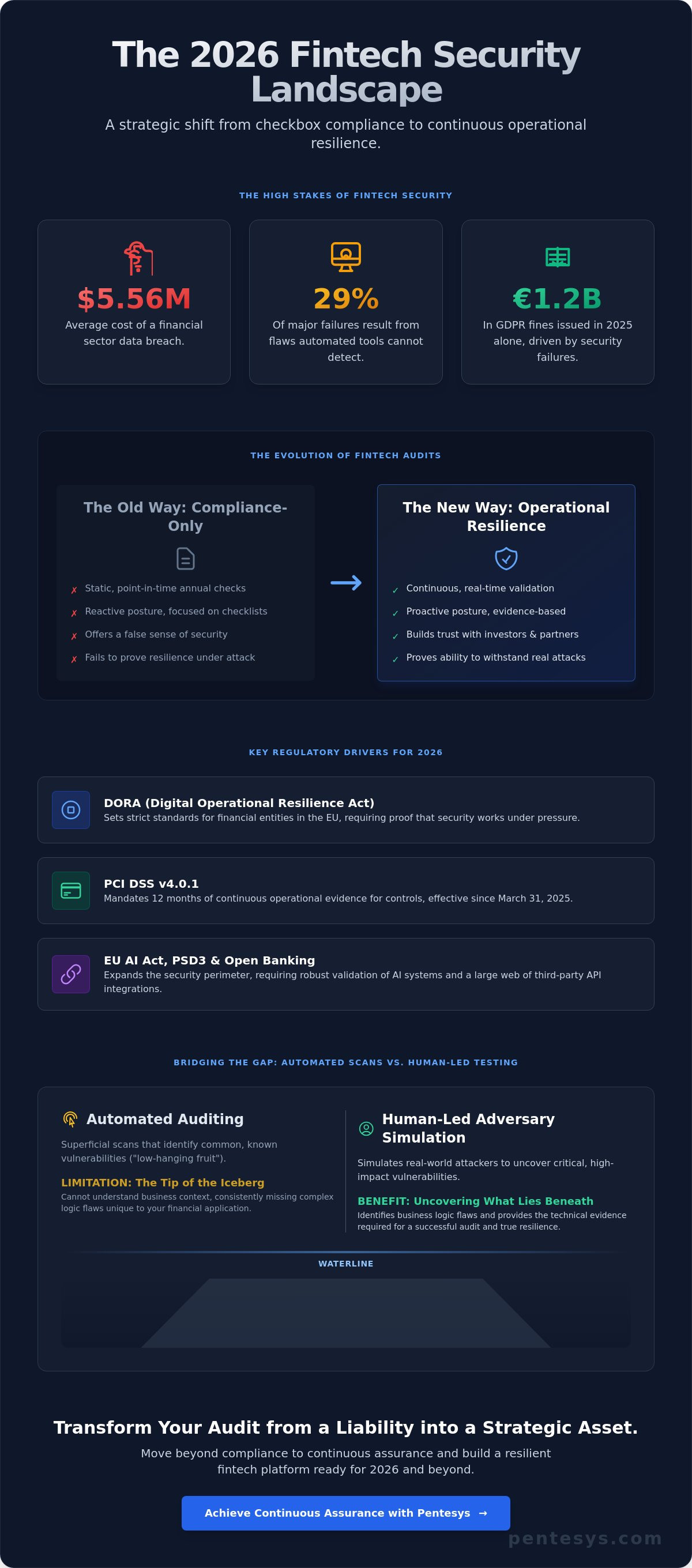
The regulatory environment in 2026 is defined by proactive enforcement. DORA now sets a strict standard for financial entities across the UK and EU, requiring organisations to demonstrate not just that they have security, but that it works under pressure. Simultaneously, PCI DSS v4.0.1 is the current version of the standard. The evolution of PSD3 and Open Banking has forced firms to secure a much larger web of third-party integrations, where a single weak link can trigger substantial GDPR fines.
Offensive Security vs. Compliance Auditing
Passing an audit doesn’t guarantee you’ll resist a breach. There is a fundamental gap between meeting a regulatory requirement and surviving a targeted adversary simulation. While automated scans can identify low-hanging fruit, they don’t catch everything. Many major security failures result from insufficient technical and organisational measures that automated tools simply couldn’t detect.
Effective security requires human-led penetration testing to uncover complex business logic flaws. By simulating real-world adversary behaviour, you generate the technical evidence needed for a successful fintech application security audit. This evidence-based approach transforms security from a cost centre into a competitive advantage, providing the transparency that modern investors and regulators now expect as a baseline for any scalable financial platform.
Technical Domains: The Fintech Audit Checklist
A successful fintech application security audit requires a deep dive into the specific technical layers where value is moved and stored. It’s not enough to check for common vulnerabilities; you must validate the complex interactions between your proprietary code and third-party financial networks. In 2026, the focus has shifted toward granular technical domains that demand specialized expertise. Relying on generic security frameworks often misses the unique risks inherent in high-velocity financial transactions.
Adopting a Zero Trust architecture is no longer optional. Moving beyond simple Multi-Factor Authentication (MFA) to a model where every request is continuously verified based on identity, device health, and context is the new baseline. This strategic approach ensures that even if a perimeter is breached, the lateral movement within your cloud environment is restricted, protecting your most sensitive ledger data from unauthorised access.
API Security and Open Banking
APIs remain the primary attack vector for modern financial services. A rigorous audit must prioritise testing for Broken Object Level Authorization (BOLA), particularly at transaction endpoints where a single flaw can allow an attacker to access another user’s financial data. Validating OAuth2 and OpenID Connect implementations is equally vital to ensure third-party access remains scoped and secure. Implementing robust rate limiting and anti-automation controls protects sensitive functions from brute-force attempts and credential stuffing. Using specialized API security testing during your audit cycle ensures these entry points are resilient against sophisticated logic attacks.
Encryption and Key Management
Protecting data at rest and in transit is a baseline requirement, but modern audits now look for protection “in use” through confidential computing. Integrating a Hardware Security Module (HSM) ensures that your key rotation policies are backed by enterprise-grade hardware rather than software-only solutions. Payment platforms are generally expected to encrypt data in transit and at rest using current algorithms, hold keys in hardware where practical, and rotate them on a defined schedule. The specifics come from PCI DSS and from your acquirer, not from a single industry standard. Tokenization continues to be a critical strategy for reducing your PCI DSS scope by replacing sensitive primary account numbers with non-sensitive equivalents that have no exploitable value.
Transactional Integrity and Logic
Business logic vulnerabilities are the most difficult to detect with automated tools because they involve the “rules” of the financial transaction. Testing must include a search for race conditions in ledger updates, where simultaneous requests might result in incorrect wallet balances or double-spending. Every input must be sanitized to prevent injection attacks, especially when your modern stack interfaces with legacy banking systems. Ensuring your audit logs are immutable and cryptographically signed provides the definitive evidence needed to prove the integrity of every transaction during a regulatory review.
Audit vs. Penetration Testing: Identifying the Gap
Automated scanners consistently miss business logic flaws in financial environments. While these tools excel at identifying known software vulnerabilities, they lack the human intuition required to exploit complex transaction chains or unauthorised data access paths. A fintech application security audit often serves as the formal verification of your controls, but the depth of that verification depends entirely on the methodology used. Relying solely on automated results creates a dangerous gap between being “compliant” and being “secure.”
To bridge this gap, high-growth firms are moving toward CREST accredited penetration testing UK to provide the technical rigor that regulators now demand. This human-led approach ensures that your audit evidence is based on actual adversary behaviour rather than theoretical risks. By shifting from point-in-time assessments to continuous penetration testing, you maintain a real-time understanding of your security posture. This proactive model aligns with the 2026 requirement for continuous operational evidence under PCI DSS v4.0.1.
The Limitations of Automated Audits
The hidden cost of automation-only approaches lies in the high rate of false positives and, more critically, false negatives. Automated tools don’t understand the context of a financial workflow. They can’t tell if a specific API call should be restricted based on a user’s subscription tier or geographical location. This lack of context is why many GDPR fines stem from insufficient technical measures that automated scans fail to flag. Human-led testing provides the context-aware analysis necessary to identify where the “rules” of your application can be manipulated to bypass security controls.
Adversarial Simulation in Fintech
True resilience is measured by your ability to detect and respond to a live threat. Red Teaming goes beyond the application layer to test your entire defensive ecosystem, including your Security Operations Center (SOC). These simulations often include social engineering to audit the “human” element, which remains a primary entry point for sophisticated attacks. Using these offensive results allows you to prioritise remediation within your vulnerability management lifecycle. Instead of fixing every minor bug, you focus your resources on the high-impact vulnerabilities that an actual attacker would use to compromise your ledger or customer data. This strategic focus ensures your fintech application security audit results in actionable insights rather than just a list of patches.
The Fintech Audit Readiness Checklist: 5 Steps to Success
Achieving a successful fintech application security audit requires a structured transition from development speed to regulatory scrutiny. Most organisations fail not because their code is inherently broken, but because they lack the documented evidence of continuous control. To navigate the 2026 landscape, you must treat audit preparation as an offensive exercise. This ensures that when the formal review begins, your team has already identified and neutralised the technical debt that often leads to failure. Following a modular, step-by-step approach allows you to build a defensible security posture that satisfies both technical testers and compliance officers.
- Step 1: Define the Audit Boundary. Scoping is the most critical phase for both PCI DSS v4.0.1 and DORA. You must identify exactly where sensitive data resides and how it moves across your environment.
- Step 2: Consolidate Documentation. Auditors require up-to-date architecture diagrams, incident logs, and policy documents. In 2026, these must reflect 12 months of continuous operational evidence.
- Step 3: Conduct a Pre-Audit Gap Analysis. Use an internal or third-party review to find misalignments before they become formal findings.
- Step 4: Execute a Deep-Dive Penetration Test. This human-led assessment identifies the complex vulnerabilities that automated tools ignore, focusing on the “low hanging fruit” that attackers exploit first.
- Step 5: Evidence Remediation. You must prove that risks are mitigated through technical validation. It’s not enough to say a patch is applied; you must show the results of a re-test.
Scoping and Boundary Definition
In 2026, scoping must account for “Special Category Data” and its entire lifecycle through your infrastructure. This includes mapping every third-party dependency and API consumer that touches your environment. You must ensure that your cloud perimeters in AWS or Azure are fully included in the audit boundary, as misconfigurations here are a common cause of security-related fines. Clear mapping prevents “scope creep” and ensures your fintech application security audit focuses on the high-risk areas that matter most to regulators.
Remediation and Validation
Once vulnerabilities are identified, you shouldn’t treat every finding with equal urgency. Prioritise your remediation efforts based on the “Likelihood” of exploitation and the potential “Financial Impact” on your operations. The role of re-testing is vital here, as it provides the definitive audit-grade evidence that a vulnerability has been successfully neutralised. Pentesys validates all remediation efforts directly through the proprietary Pentesys Portal, giving you a centralized hub to track progress and present evidence to external auditors. This structured approach ensures you are always prepared for a review. Secure your 2026 audit roadmap by moving toward a model of continuous assurance today.
Does a penetration test count as a security audit for DORA compliance?
A penetration test is a critical technical component of DORA compliance, but it doesn’t constitute a full audit on its own. While DORA requires Threat Led Penetration Testing (TLPT) for significant entities, a complete audit also evaluates governance, risk management, and incident reporting procedures. You should view penetration testing as the technical evidence that validates the effectiveness of your wider security framework.
What are the most common vulnerabilities found in fintech applications?
Broken Object Level Authorization (BOLA) and insecure third-party integrations remain the most frequent vulnerabilities in 2026. Many security failures involve insufficient technical measures for protecting customer data. Race conditions in wallet balances also pose a unique risk to transactional integrity that standard automated scanners often miss during a routine check.
How can we reduce the scope of our PCI DSS audit?
You can reduce your PCI DSS audit scope by implementing robust network segmentation and tokenization. By replacing sensitive primary account numbers with non-reversible tokens, you ensure that sensitive data never enters your internal environment. This strategic approach minimises the number of systems that must meet the rigorous requirements of PCI DSS v4.0.1, saving your team significant time and resources.
Founder & CEO, Pentesys
James Hinton is the founder of Pentesys, a CREST-approved UK company working only on offensive security: penetration testing, PTaaS, CTEM, external attack surface management and red teaming. He built the business around one discipline rather than a broad consultancy menu, and most of his time still goes on how engagements get scoped, delivered and reported. He writes here about the practical side of security testing and what buyers should be asking for.
LinkedIn profile