

Overview
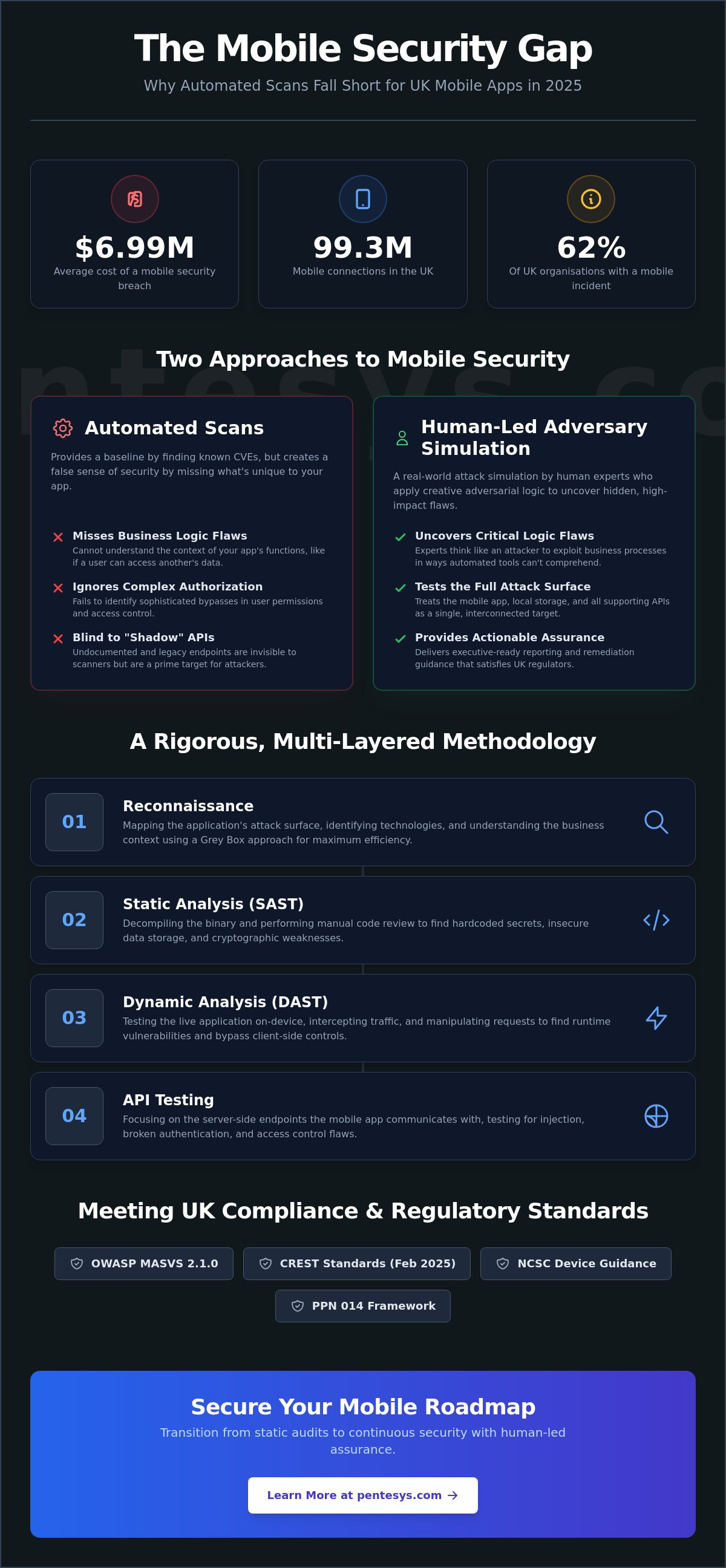
The financial risk of an insecure app is no longer a theoretical concern. When you search for mobile application penetration testing uk, you aren’t just looking for a list of vulnerabilities. You're seeking a way to protect UK mobile users while satisfying the stringent requirements of the CREST penetration testing standards updated in February 2025.
You understand that a simple automated scan won't catch the sophisticated logic flaws that lead to mobile incidents. It’s exhausting to manage the pressure of UK cyber insurance and the technical nuances of OWASP MASVS 2.1.0. This guide shows you how to achieve a clean bill of health through human-led adversarial simulation that treats your app and its APIs as a single attack surface. We’ll detail the path to actionable remediation and executive-ready assurance that aligns with the latest UK regulatory frameworks like PPN 014.
The State of Mobile Security in the UK: Why Static Testing Is No Longer Enough
Professional mobile application penetration testing uk is more than a simple compliance check; it’s a human-led simulation of real-world attacks designed to expose vulnerabilities before adversaries do. While traditional web security focuses on server-side interactions, mobile security requires a deeper look at the device itself. You must account for local data storage, binary reversing, and insecure inter-process communication. These unique risks often fall outside the scope of standard network audits. By understanding fundamental mobile security principles, organisations can better appreciate why a specialized approach is necessary for the modern threat landscape.
UK enterprises are moving away from the point-in-time annual audit. Most organisations experienced at least one mobile security incident in 2025, proving that static testing isn't keeping pace with rapid release cycles. Modern assurance focuses on continuous resilience. One of the most overlooked risks is the shadow API. These are undocumented or legacy endpoints that mobile apps communicate with, often bypassing the security controls applied to your main web infrastructure. Without manual exploration, these endpoints remain invisible to your security team and vulnerable to exploitation.
The Shift from Web to Mobile-First Business
Mobile connections in the UK now outnumber the population. Mobile apps aren’t just an extra channel; they’re the primary repository for sensitive customer and corporate data. This shift significantly increases the blast radius of any vulnerability. Whether you’re securing a B2C banking app or an internal corporate tool, the underlying risks remain high. A single flaw in an internal app can grant an attacker access to your entire enterprise network, making high-quality mobile application penetration testing uk a strategic necessity for long-term business resilience.
Human-Led Mobile Penetration Testing Methodology: iOS, Android, and API Layers
Effective mobile application penetration testing uk requires a structured, multi-layered approach that examines the client-side binary, the local device environment, and the communication channels. Pentesys follows a rigorous methodology comprising four distinct phases: Reconnaissance, Static Analysis (SAST), Dynamic Analysis (DAST), and API Testing. We favor a “Grey Box” assessment model for these engagements. By providing our testers with architectural documentation and test credentials, you allow us to focus on deep-seated logic flaws rather than spending billable hours on basic discovery. This efficiency ensures that our human experts can dedicate more time to complex adversary simulation.
During the assessment, we don’t just look at the app in isolation. We intercept and decrypt the traffic flowing between the device and your servers. Manual code review remains a vital component of our process. It allows us to identify sensitive data leakage that automated tools regularly ignore. This human-led approach ensures that hardcoded secrets, insecure cryptographic implementations, and hidden debug features are identified and remediated before they can be exploited by an external threat actor.
Deep-Dive into iOS and Android Security
Each mobile platform presents unique security challenges that demand specialized expertise. On iOS, we scrutinize Keychain implementations to ensure sensitive tokens aren’t exposed. For Android, our testers analyse Intent filters to prevent unauthorised data access between apps. We align our testing with the NCSC device security guidance to ensure your deployment meets UK government-standard security benchmarks. To simulate a real-world attacker, we actively bypass jailbreak and root detection mechanisms. This allows us to test the app’s resilience in a compromised environment where an adversary has full control over the operating system. We also perform a granular analysis of local storage, checking for insecure file permissions that could lead to data theft by malicious side-loaded applications.
The Critical Role of API Interception
A mobile app is essentially a graphical interface for a complex web of back-end services. It’s only as secure as the API it communicates with. We use specialized proxy tools to validate the integrity of data transfers and test for Broken Object Level Authorization (BOLA). This is a critical vulnerability where an attacker manipulates IDs to access records belonging to other users. By intercepting the encrypted traffic, we can observe how the server responds to malformed requests and unauthorised commands. If you’re looking for long-term resilience, you might consider how continuous penetration testing can secure your API roadmap as your codebase evolves. Our methodology ensures that every endpoint, including those “shadow APIs” mentioned in previous sections, is subjected to rigorous adversarial logic.
Navigating UK Compliance: OWASP MASVS and CREST Standards
Compliance within the UK’s mobile landscape is no longer a discretionary activity. As of February 2025, the publication of PPN 014 established that CREST accreditation is a mandatory requirement for suppliers providing penetration testing services to the UK government. This regulatory shift reflects a broader trend across the private sector, where many UK businesses experienced a cyber attack in 2025. For these organisations, CREST accredited penetration testing uk serves as the primary mechanism for satisfying ISO 27001 Annex A controls and meeting the rigorous data protection requirements of the UK GDPR.
Beyond regulatory obligations, professional mobile application penetration testing in the UK supports discussions with insurers about cover and terms. Insurers increasingly ask for evidence of human-led testing rather than automated reports alone. By demonstrating that your iOS and Android applications have been subjected to rigorous adversary simulation, you provide the “executive-ready assurance” that underwriters require. This strategic approach transforms security from a cost centre into a documented business asset that facilitates smoother audits and reduces liability.
Aligning with OWASP MASVS
The OWASP Mobile Application Security Verification Standard (MASVS) version 2.1.0, released on January 18, 2024, provides the technical framework for our assessments. We categorize our testing into three distinct levels of verification. MASVS-L1 establishes a baseline for all mobile apps, while L2 is designed for high-security applications like those used in healthcare or finance. For apps requiring protection against physical tampering, we apply L2+R. Our methodology maps every finding to specific MASVS categories, including Architecture, Storage, Cryptography, and Network. This mapping allows your developers to follow a structured remediation path. To align with these standards during your SDLC, your team should focus on:
- Enforcing strong certificate pinning to prevent intercepting encrypted traffic.
- Implementing secure local storage that avoids caching sensitive data in cleartext.
- Validating all server-side inputs to prevent Broken Object Level Authorization (BOLA).
- Removing all debug symbols and hardcoded credentials before production releases.
Why CREST Accreditation is Non-Negotiable
Maintaining CREST membership requires a level of technical rigour that automated-only providers simply cannot match. It ensures that the firm adheres to a strict code of ethics and employs testers who have passed rigorous, proctored examinations. At Pentesys, we believe that cybersecurity is about trust. By ensuring all tests are led by CREST-certified professionals, we provide stakeholders with the peace of mind that their data is being handled by verified experts. This accreditation acts as a quality marker, distinguishing between a “tick-box” exercise and a deep-dive assessment that uncovers the logic flaws that most successful phishing-led breaches eventually exploit.
Preparation and Execution: What to Expect During a Mobile Security Assessment
The effectiveness of mobile application penetration testing uk relies on a precise execution framework. We don’t believe in generic assessments. Instead, we begin with a rigorous scoping phase that defines the boundaries of the engagement. This stage is critical because a scan of 38,912 mobile applications in 2025 revealed an average of 8.9 vulnerabilities per app. To catch these flaws, we must identify every platform, user role, and API endpoint within your architecture. This methodical approach ensures that our human experts focus their creative adversarial logic on the areas of highest risk.
Scoping Your Mobile Digital Estate
We determine the depth of testing by evaluating your app’s risk profile against the OWASP MASVS levels. If your application handles financial data, we’ll likely suggest an L2 assessment with deeper manual investigation. We also discuss the environment. Testing a production build ensures we see what an attacker sees, while a staging environment allows for more aggressive testing without risking live data. Accurate scoping prevents budget creep and ensures comprehensive coverage.
To begin the technical work, we require specific prerequisites. You’ll provide the APK or IPA files and test credentials for each user role. This “Grey Box” approach allows our testers to bypass basic authentication hurdles and focus immediately on complex logic flaws. By providing these assets upfront, you maximise the value of the engagement, ensuring that every billable hour is spent on high-level vulnerability discovery rather than basic reconnaissance.
Do you need the source code for mobile application testing?
We don’t strictly require the source code, but providing it allows for a more thorough “White Box” assessment. Access to the code helps our testers identify insecure cryptographic implementations and hardcoded secrets that might be missed during a “Black Box” test. Most UK clients choose a “Grey Box” approach. This provides our experts with enough architectural context to work efficiently without needing full repository access.
Can you test both iOS and Android apps simultaneously?
We frequently test both platforms in parallel to provide a holistic view of your security posture. This approach is highly efficient because many vulnerabilities, particularly those in the back-end API, are shared across both versions. Testing simultaneously allows our human experts to compare platform-specific implementations, such as how iOS handles Keychain security versus Android’s use of the Keystore system, ensuring consistent protection for all users.
What are the common vulnerabilities found in UK mobile applications?
Broken Object Level Authorization (BOLA) and insecure local data storage are the most frequent findings in our recent assessments. The 2024 update to the OWASP Mobile Top 10 also highlighted a significant rise in supply chain vulnerabilities within third-party libraries. Many apps still fail to implement proper certificate pinning, which allows attackers to intercept encrypted traffic. These flaws contributed to a majority of organisations experiencing a mobile incident in 2025.
Founder & CEO, Pentesys
James Hinton is the founder of Pentesys, a CREST-approved UK company working only on offensive security: penetration testing, PTaaS, CTEM, external attack surface management and red teaming. He built the business around one discipline rather than a broad consultancy menu, and most of his time still goes on how engagements get scoped, delivered and reported. He writes here about the practical side of security testing and what buyers should be asking for.
LinkedIn profile