

Overview
The gap between the cheapest and the most expensive quote for the same scope is often wider than the scope itself. Usually that reflects genuinely different work: one provider is running a scanner and formatting the output, another is putting consultants on it for a fortnight. Telling them apart before you sign comes down to asking about methodology, who does the testing, and what the report looks like.
We understand the frustration of receiving generic, automated reports that lack context or struggle to justify their ROI to your board. You deserve more than a checkbox exercise. This guide helps you master the criteria for selecting a high-tier security partner to ensure technical resilience beyond simple compliance. We look at what CREST approval actually covers, and where NCSC CHECK applies: CHECK team leader status matters when the systems in scope fall under that scheme, and not otherwise. You will gain a clear framework for vetting technical depth and a roadmap for long-term security resilience, moving your organisation from static evaluations to a state of continuous, expert-led assurance.
The Evolving Landscape of UK Penetration Testing in 2026
Offensive security in the United Kingdom has transitioned from a periodic compliance obligation to a central pillar of operational resilience. The 2026 UK threat environment is defined by sophisticated adversarial tactics that easily bypass traditional defences. Relying on a once-a-year penetration test is no longer a viable strategy for organisations managing complex digital estates. Instead, the focus has shifted toward proactive risk management, where security assessments are integrated into the continuous lifecycle of an application or network. This approach ensures that technical vulnerabilities are identified and remediated before they can be exploited by malicious actors.
This evolution is driven by a domestic landscape that demands high technical certainty. Choosing a penetration testing provider UK requires an understanding of how local legal frameworks and national authorities set the benchmark for quality. A national focus ensures that your security partner understands the specific nuances of the UK’s critical national infrastructure and the high standards expected by domestic stakeholders. It moves the conversation away from simple evaluation toward a partnership-driven model of long-term resilience.
Regulatory Drivers for UK Businesses
Compliance requirements have become more prescriptive. The UK Data Protection Act 2018 and UK GDPR continue to mandate robust technical measures to protect personal data. However, 2026 brings additional pressure from the Digital Operational Resilience Act (DORA) and updated ISO 27001 standards, which emphasize the need for regular, deep-dive testing of critical systems. Cyber insurance providers have also tightened their criteria. Some now ask for evidence of accredited testing, treating it as a marker of a mature security posture. Meeting the requirements of the NCSC’s CHECK scheme remains essential for those within the public sector supply chain, where team leaders must now hold specific chartered titles as of March 2025.
The 2026 Threat Horizon
The nature of attacks has changed. Adversaries now leverage AI to automate discovery phases and craft highly targeted exploits. This shift makes testing cloud-native architectures and API-heavy environments a priority. Standard automated scans cannot replicate the intuition of a human tester when identifying complex logic flaws in bespoke software. Supply chain security is another critical area. Few UK businesses currently review the cyber risks of their immediate suppliers, so choosing a penetration testing provider UK with the capability to assess third-party interfaces is vital. Your testing strategy must account for several key areas:
Building a resilient organisation requires moving beyond the checkbox. It demands a methodical approach that prioritises human intelligence over simple automation.
- Web Application Penetration Testing to secure sensitive customer data.
- API Security Testing for interconnected microservices.
- Cloud Security Assessments to identify configuration errors in AWS, Azure, or GCP.
- Social Engineering to evaluate the human element of your security perimeter.
Evaluating Technical Competence: Beyond the Compliance Checkbox
Technical competence is often reduced to a list of logos on a website. However, when choosing a penetration testing provider UK, you must look deeper than the compliance checkbox to identify a partner capable of uncovering sophisticated vulnerabilities. A fundamental distinction exists between a vulnerability scan and a true penetration test. While automated tools excel at identifying known software versions with documented CVEs, they lack the contextual understanding required to exploit them. A high-tier provider uses scanning only as a preliminary step, moving quickly into manual exploitation to determine the actual impact on your business operations.
Establishing this baseline of technical certainty requires a methodology that aligns with global best practices. The PCI SSC Penetration Testing Guidance provides a rigorous framework for this, emphasizing that testing must be a goal-oriented engagement rather than a simple search for missing patches. To verify the real-world experience of the team assigned to you, ask for specific case studies or redacted reports that demonstrate their ability to navigate complex environments similar to your own. Technical authority is built on the ability to demonstrate control and foresight throughout the engagement.
The Value of Expert-Led Manual Testing
Automated tools consistently miss business logic vulnerabilities. These flaws exist in the way an application handles data or user permissions, and they require human intuition to uncover. A skilled tester identifies how an attacker might manipulate a checkout process or bypass authentication by understanding the intended flow of the system. At Pentesys Limited, we prioritise human intelligence over “click-button” automation because we recognise that the most dangerous exploit paths often involve chaining multiple low-level flaws together. If you’re looking for a partner that provides this level of technical depth, you can explore our approach to Infrastructure Penetration Testing.
Understanding UK Accreditations
Accreditations serve as a critical marker of reliability and ethical conduct. For corporate assurance, crest accredited penetration testing uk remains the primary indicator of a provider’s commitment to high technical standards. It’s vital to differentiate between individual tester certifications, such as OSCP or CRT, and company-level memberships like CREST. A company-level accreditation ensures that the firm maintains rigorous internal quality management processes and follows a structured methodology for every engagement. This distinction provides the high-level certainty that executive decision-makers require when choosing a penetration testing provider UK to manage their long-term resilience.
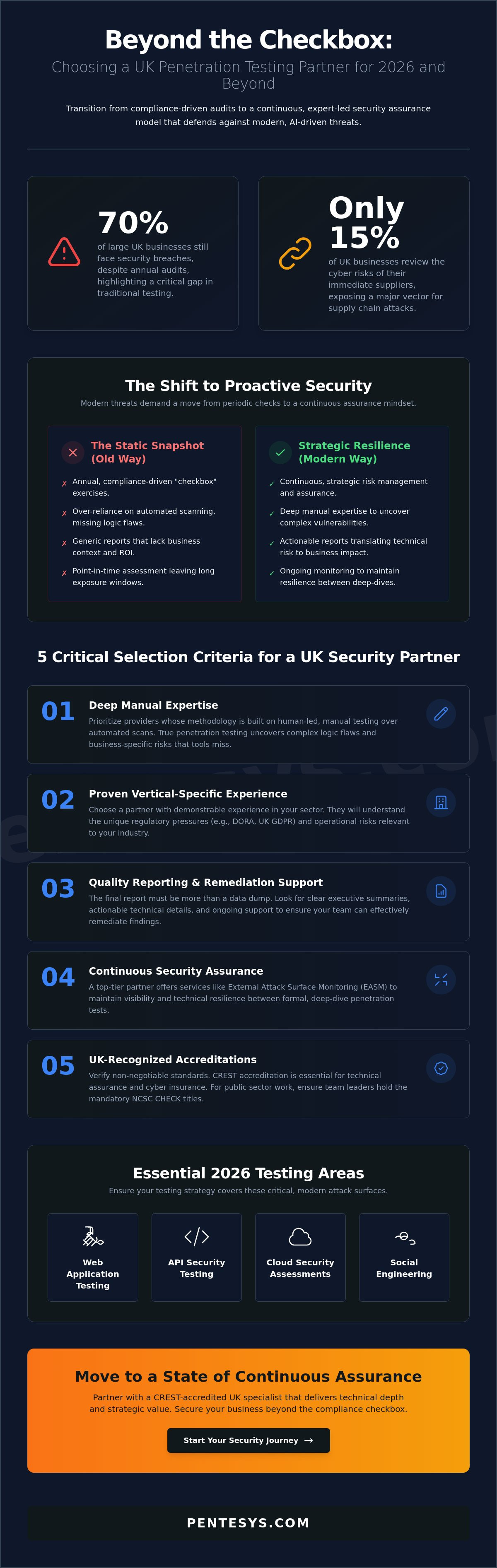
The 5 Critical Selection Criteria for a UK Security Partner
Selecting a partner for offensive security requires a framework that moves beyond simple price comparisons. When choosing a penetration testing provider UK, decision-makers must evaluate five core pillars: vertical expertise, methodology transparency, technical depth, scoping integrity, and remediation support. Vertical-specific experience is non-negotiable in 2026. A provider familiar with the nuances of Fintech or Healthcare understands the specific regulatory pressures of DORA or the NHS Data Security and Protection Toolkit. This specialized knowledge ensures that the assessment addresses the risks most relevant to your specific sector operations.
Transparency in methodology is equally vital. Reliable firms align their processes with recognised standards, such as the NCSC guidance on penetration testing, which provides a foundation for high-quality technical assessments. We deliver our services through a proprietary central platform that acts as the primary hub for service delivery. This technology ensures that every stage of the engagement, from initial scoping to final reporting, is documented and accessible. It provides the high-level certainty required to manage complex security estates effectively and ensures the technology feels inseparable from the expertise provided.
The Selection Matrix
A robust selection matrix prioritises manual methodology over automated reliance. While tools identify low-hanging fruit, expert-led evaluation uncovers the logic flaws that lead to significant breaches. Organisations should evaluate the quality of previous sample reports to ensure they provide actionable insights rather than generic data. Post-test support is another critical differentiator. A premium provider remains a strategic ally after the testing phase, offering clear remediation guidance to help your technical teams close security gaps efficiently. This approach prioritises long-term resilience over temporary fixes.
Scoping Accuracy and Ethics
Scoping integrity defines the success of an engagement. Some providers use under-scoping tactics to present lower initial quotes, often omitting critical assets that later emerge as necessary. This leads to budget creep or, worse, incomplete assessments that leave your organisation vulnerable. Ensure your provider establishes clear Rules of Engagement (RoE) that comply with the UK legal context. Ethical disclosure and data handling policies are also paramount. Your partner must demonstrate how they protect the sensitive information gathered during testing, ensuring your data remains secure throughout the lifecycle of the partnership.
Assessing Reporting Quality and Post-Test Remediation Support
A penetration test is only as valuable as the remediation it triggers. If the final report sits in a digital drawer without driving technical change, the engagement has failed to provide true security value. When you’re choosing a penetration testing provider UK, you must evaluate how they translate complex technical findings into a strategic roadmap for your business. The report shouldn’t be a static list of flaws. It should be a dynamic tool that builds high-level certainty for both your technical teams and your executive board.
High-quality reporting bridges the gap between specialized execution and corporate objectives. For the board, an executive summary must provide a clear overview of the organisation’s security posture without getting lost in technical jargon. It needs to articulate risk in terms of business impact, such as potential data loss or operational downtime. For your IT teams, the report must offer granular detail. This includes the exact steps required to reproduce a finding and specific, actionable advice for fixing it. Re-testing is a critical component of this lifecycle. It’s the only way to verify that patches have been applied correctly and that the vulnerability is truly closed.
The Anatomy of a Strategic Security Report
A sophisticated report moves beyond generic CVSS scores to prioritise vulnerabilities based on your unique business context. We believe that risk scoring should reflect the actual impact on your operations, not just a theoretical number. Every finding must be backed by clear evidence of exploitation, such as screenshots or server logs, to prove the vulnerability exists in your environment. This transparency ensures that your team doesn’t waste time chasing false positives. Finally, remediation advice must be tailored to your specific infrastructure, providing a clear path forward rather than generic industry templates.
Transitioning from Point-in-Time Audits to Continuous Security Assurance
The traditional model of the annual penetration test has become a significant risk factor for modern digital estates. In 2026, software deployment cycles and infrastructure changes happen daily, meaning a point-in-time audit only provides technical certainty for the moment the assessment concludes. Relying on a “snapshot” leaves a dangerous gap where new vulnerabilities can emerge and remain undetected for months. When you’re choosing a penetration testing provider UK, it’s essential to select a partner that facilitates a transition toward continuous security assurance. This proactive approach ensures that your defences evolve at the same pace as the threat landscape.
Continuous Attack Surface Monitoring (CASM) and Penetration Testing as a Service (PTaaS) have emerged as the standard for UK organisations requiring high-level oversight. These models move away from isolated events toward an ongoing partnership where security is a managed process. By integrating offensive security into your broader cyber security services strategy, you create a feedback loop that informs your defensive posture in real-time. This methodology prioritises long-term resilience, ensuring that your organisation remains a difficult target for increasingly sophisticated adversaries.
The Benefits of Continuous Monitoring
Ongoing oversight provides visibility that periodic audits cannot match. It’s particularly effective at identifying “shadow IT”—unauthorised assets or cloud instances that technical teams may have overlooked. Real-time discovery allows for a significant reduction in the Mean Time to Remediate (MTTR) for critical flaws, closing windows of opportunity for attackers. Our approach at Pentesys Limited combines deep manual expertise with automated external monitoring, delivered through our central platform. This ensures that while technology identifies perimeter changes, human intelligence remains the primary driver for evaluating the actual risk to your business logic.
Does our provider need to be CHECK accredited for private sector work?
Private sector organisations don’t strictly require a CHECK-accredited provider unless they handle government data or critical national infrastructure. For most commercial entities, CREST accreditation serves as the primary benchmark for technical and ethical standards. Choosing a penetration testing provider UK with CREST membership ensures the firm follows a rigorous methodology recognised by domestic insurers and regulators.
What qualifications should the individual pen testers hold?
Individual testers should hold recognised certifications such as CREST Registered (CRT) or Certified (CCT) status, or the Offensive Security Certified Professional (OSCP) designation. In 2026, you should also check for professional titles from the UK Cyber Security Council, such as Practitioner or Chartered status. These credentials ensure the individual has the technical expertise and ethical grounding required for choosing a penetration testing provider UK that delivers high-level security oversight.
Founder & CEO, Pentesys
James Hinton is the founder of Pentesys, a CREST-approved UK company working only on offensive security: penetration testing, PTaaS, CTEM, external attack surface management and red teaming. He built the business around one discipline rather than a broad consultancy menu, and most of his time still goes on how engagements get scoped, delivered and reported. He writes here about the practical side of security testing and what buyers should be asking for.
LinkedIn profile