

Overview
A cut-price automated vulnerability scan rebranded as a premium professional engagement puts your UK compliance strategy at risk. Many medium and large UK businesses treat cyber security as a high priority, yet fall victim to “compliance theatre” that fails to stop actual breaches. You’ve likely felt the frustration of reviewing technical proposals that seem identical despite wildly different price points. Identifying the correct questions to ask a penetration testing provider is the only way to ensure you’re paying for human-led expertise rather than a glorified automated report.
We’ll provide your team with a strategic vetting guide to distinguish between basic scanning and true security assurance. You’ll learn how to demand actionable remediation guidance that fits your specific infrastructure and meets the rigorous standards of ISO 27001 or SOC2. This article outlines the exact benchmarks needed to find a partner that prioritises quality and human intelligence, ensuring your security posture remains resilient long after the testing window closes.
The High Stakes of Offensive Security in the UK
UK enterprises face a wide range of cyber threats, with many businesses reporting an attack in the last 12 months according to government data. Opting for “cheap” tests usually leads to higher long-term remediation costs because the underlying root causes remain unaddressed. Static, annual assessments are no longer sufficient for dynamic cloud environments. We advocate for a shift toward continuous assurance. This model ensures that security isn’t a one-off event but a managed process integrated into your business lifecycle. Relying on a premium, accredited partner provides the peace of mind that your most sensitive data is protected by experts who think like attackers.
Defining Your Internal Requirements Before the First Call
You need a clear internal roadmap before engaging a specialist. Identify which assets require the highest level of scrutiny. For instance, an external-facing API or a complex AWS environment requires a different skill set than a standard web application. You must also determine the necessary level of depth. A “Black Box” test simulates an outsider with no prior knowledge, while a “White Box” test provides the consultant with full architectural details for a deeper, more efficient analysis. Establishing your timeline and budget constraints early allows for realistic proposals. Having these details ready helps you refine the questions to ask a penetration testing provider to ensure their methodology aligns with your specific technical and operational needs.
Essential Questions Regarding Accreditations and Expertise
Selecting a partner for security assurance requires a deep dive into the technical pedigree of their team. One of the primary questions to ask a penetration testing provider concerns the distinction between company-level badges and individual certifications. While a firm may market itself as an expert, the actual value lies in the hands of the consultant performing the work. You need to know that the person probing your perimeter has the technical intuition to find what automated tools miss.
Decoding Cybersecurity Certifications
Distinguishing between firm-wide accreditations and individual qualifications is vital for UK compliance. CREST remains the gold standard in the United Kingdom; it mandates rigorous technical assessments and ethical conduct for its member companies. When vetting a provider, ask for the specific certifications held by the testers assigned to your project. Look for Offensive Security Certified Professional (OSCP) or CREST Registered Tester (CRT) designations to ensure high-level technical proficiency.
Verifying these claims involves more than a cursory glance at a logo. Reputable firms provide evidence of their standing and align their methodologies with industry-standard penetration testing guidance. This ensures the testing process is methodical and repeatable. Human intelligence is the core of this process. Automated tools cannot replicate the intuition of a certified professional who understands how to chain minor vulnerabilities into a significant exploit.
Evaluating Industry-Specific Experience
Technical skill must be paired with contextual understanding. A provider proficient in traditional on-premise infrastructure might lack the nuance required for a cloud-native Kubernetes environment or complex AWS architectures. Many UK enterprises identify sector-specific experience as a top requirement when selecting security partners. Ask how the provider handles regulatory frameworks like ISO 27001 or GDPR, as these often dictate the scope and reporting style of the engagement.
Sector-specific knowledge in areas like Fintech, SaaS, or Healthcare allows testers to identify logic flaws that generic scans miss. You should request case studies that mirror your specific tech stack and business model. This level of transparency builds the trust necessary for a long-term partnership. Our team at Pentesys focuses on this tailored approach, ensuring every engagement provides actionable insights via the Pentesys Portal, which serves as a central hub for your security roadmap. This structured delivery ensures your internal teams move directly from identification to remediation without technical ambiguity.
- Individual Certifications: Do they hold OSCP, CRT, or CCT (CREST Certified Tester) status?
- Company Accreditation: Is the firm a CREST member company for the specific service you require?
- Knowledge Retention: How does the firm support continuous learning for their testers to keep pace with 2024 exploit techniques?
- Relevant References: Can they provide three examples of testing within your specific industry from the last 18 months?
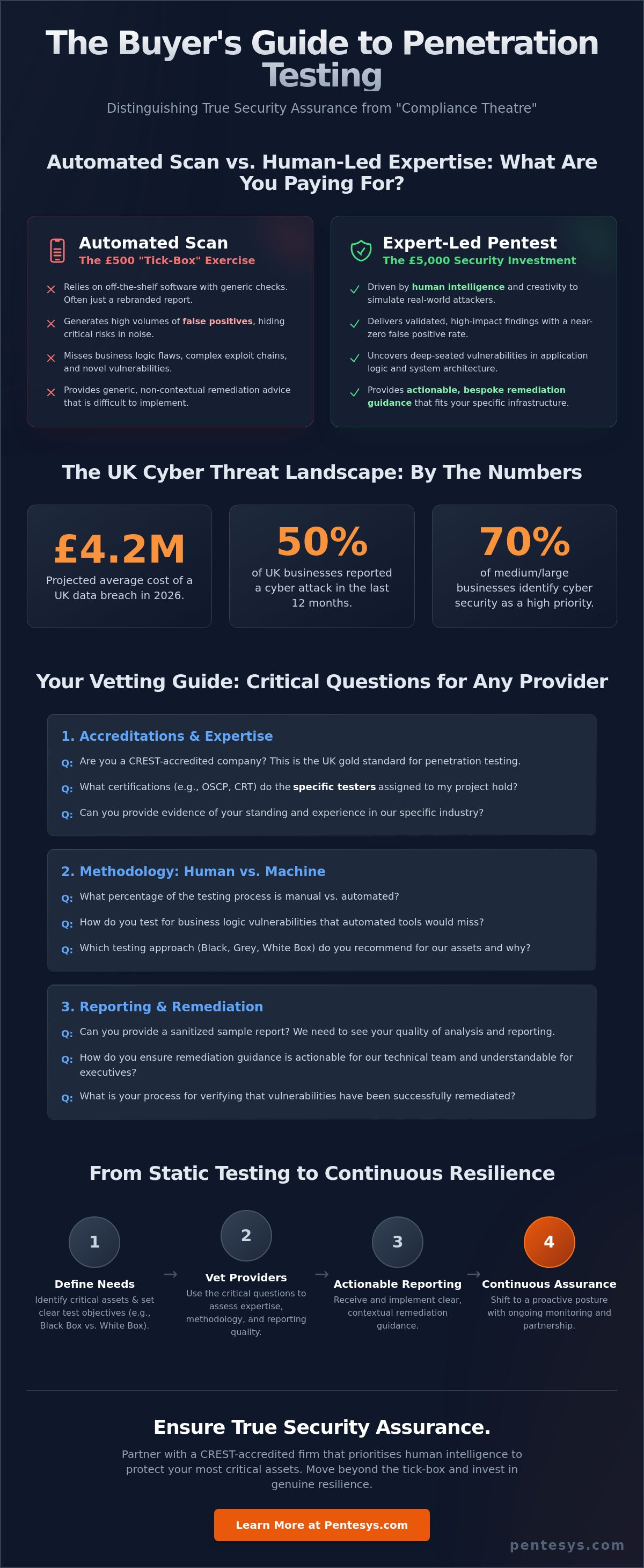
Vetting the Methodology: Human Intelligence vs. Automated Scanning
A common pitfall in procurement is failing to distinguish between a basic vulnerability scan and a true penetration test. While automated tools are efficient for identifying known CVEs, they cannot replicate the intuition of a skilled adversary. When evaluating questions to ask a penetration testing provider, your first enquiry should focus on the manual versus automated split. A high-assurance engagement is mostly manual testing, where security experts use tool outputs merely as a starting point for deeper exploitation.
The “Automated Scan” Trap
Some low-cost providers package a Nessus or Qualys report and sell it as a bespoke penetration test. You can spot this by asking about their specific toolset and custom exploit scripts. If the provider cannot explain how they chain multiple low-impact vulnerabilities to achieve a high-impact compromise, they aren’t providing true offensive security. The real value lies in human-led penetration hacking. This approach identifies complex logic flaws, such as broken access controls or insecure business processes, that automated scanners consistently miss. Humans understand context; software does not.
- Validation: How do you verify findings? A professional firm manually validates every vulnerability to ensure you aren’t chasing false positives that waste your internal IT team’s time.
- Customisation: Ask if they develop custom scripts for your specific tech stack rather than relying on generic, out-of-the-box checks.
Operational Transparency and Scoping
Operational stability is a priority for any enterprise. Your provider must outline a clear Rules of Engagement (RoE) document before any packets are sent. This document defines the testing windows, emergency contact points, and restricted IP ranges to prevent business disruption. If a tester discovers a critical vulnerability or an active breach mid-test, they should notify you immediately via a secure channel rather than waiting for the final report. This proactive communication ensures that high-risk threats are remediated in real-time while the engagement is still active.
Ensuring the scope covers your entire external attack surface is another vital area for questions to ask a penetration testing provider. Testing a single web application while leaving your VPN endpoints or cloud storage buckets unexamined creates a false sense of security. Comprehensive testing requires a methodical approach that mirrors how a real-world attacker views your organisation’s digital footprint. Every claim should be backed by a clear methodology that prioritises depth over speed.
Post-Test Support: Reporting and Remediation Guidance
The value of a security assessment lies in the clarity of its output. When considering the right questions to ask a penetration testing provider, you must focus on the transition from discovery to remediation. A professional report isn’t just a list of bugs; it’s a strategic document that guides your technical team and informs your board. It bridges the gap between raw technical data and actionable business intelligence.
Evaluating the Quality of the Deliverables
Request a sample report before signing any contract. It must be structured for two distinct audiences. The Executive Summary should translate technical risk into business impact, using language suitable for a UK board of directors. For the technical team, findings must include CVSS 3.1 or 4.0 scores, but these numbers shouldn’t stand alone. A high score on a non-critical asset might be less urgent than a medium score on a customer-facing database. The report needs to provide this context clearly.
Effective remediation advice goes beyond a simple link to a CVE database. Your provider should offer bespoke guidance tailored to your specific infrastructure. Ask if a post-test debrief is included in the fee. A 45-minute walkthrough with the lead tester often resolves more queries than a week of back-and-forth emails. This human-led approach ensures your internal team understands not just what is broken, but how to fix it permanently.
- Prioritisation: Does the report provide a clear, risk-based action plan?
- Evidence: Are there screenshots and reproduction steps for every finding?
- Clarity: Is the impact described in terms of data loss, service downtime, or regulatory fines?
The Shift to Continuous Security Validation
Point-in-time testing is increasingly insufficient for UK enterprises operating in dynamic cloud environments. Breaches and attacks remain common among UK businesses, highlighting the need for constant vigilance. Integrating human-led testing with continuous attack surface monitoring allows you to identify shadow IT and misconfigurations before adversaries do. You should leverage your provider for periodic adversary simulations and red teaming to test your detection and response capabilities against realistic threat actors.
Red Flags: When to Walk Away
During your vetting process, certain indicators suggest a provider lacks the depth required for enterprise-grade security. Walk away if you encounter these red flags:
- Reliance on automated scanner outputs with minimal manual validation.
- Lack of CREST accreditation or equivalent industry-recognised certifications.
- Vague methodologies that don’t align with established frameworks like OSSTMM or OWASP.
- Inability to provide clear, actionable remediation advice for complex vulnerabilities.
- Hidden costs for re-testing or access to the primary delivery portal.
What should I do if a provider isn’t CREST accredited?
You should exercise caution if a provider lacks CREST accreditation, as this is the UK industry benchmark for technical competence and ethical conduct. CREST members undergo rigorous audits and their staff must pass high-level examinations. Choosing an accredited partner ensures your questions to ask a penetration testing provider are answered with verified expertise and that the methodology meets international standards. It’s a critical marker of quality and trust.
Founder & CEO, Pentesys
James Hinton is the founder of Pentesys, a CREST-approved UK company working only on offensive security: penetration testing, PTaaS, CTEM, external attack surface management and red teaming. He built the business around one discipline rather than a broad consultancy menu, and most of his time still goes on how engagements get scoped, delivered and reported. He writes here about the practical side of security testing and what buyers should be asking for.
LinkedIn profile