

Overview
In an environment where cyber incidents are common across UK businesses, relying on a standard automated scan is a risk your organisation cannot afford. Technical accreditation is now the baseline; the true differentiator is a provider’s ability to mirror real-world adversarial ingenuity. Choosing a penetration testing company UK organisations can rely on requires a move away from “checkbox” compliance toward a model of continuous, manual expertise.
You’ve likely felt the frustration of sifting through identical marketing claims while worrying that a “standard” assessment might miss a critical flaw. It’s often difficult to justify the cost difference between providers when the deliverables seem indistinguishable on paper. This guide provides a professional framework for evaluating technical expertise and strategic value, ensuring your security investment translates into genuine resilience. We’ll outline a clear checklist for interviewing providers and explain how to align your testing with the duties proposed in the Cyber Security and Resilience Bill to ensure long-term peace of mind.
The 2026 UK Cyber Landscape: Why Your Choice of Partner Matters
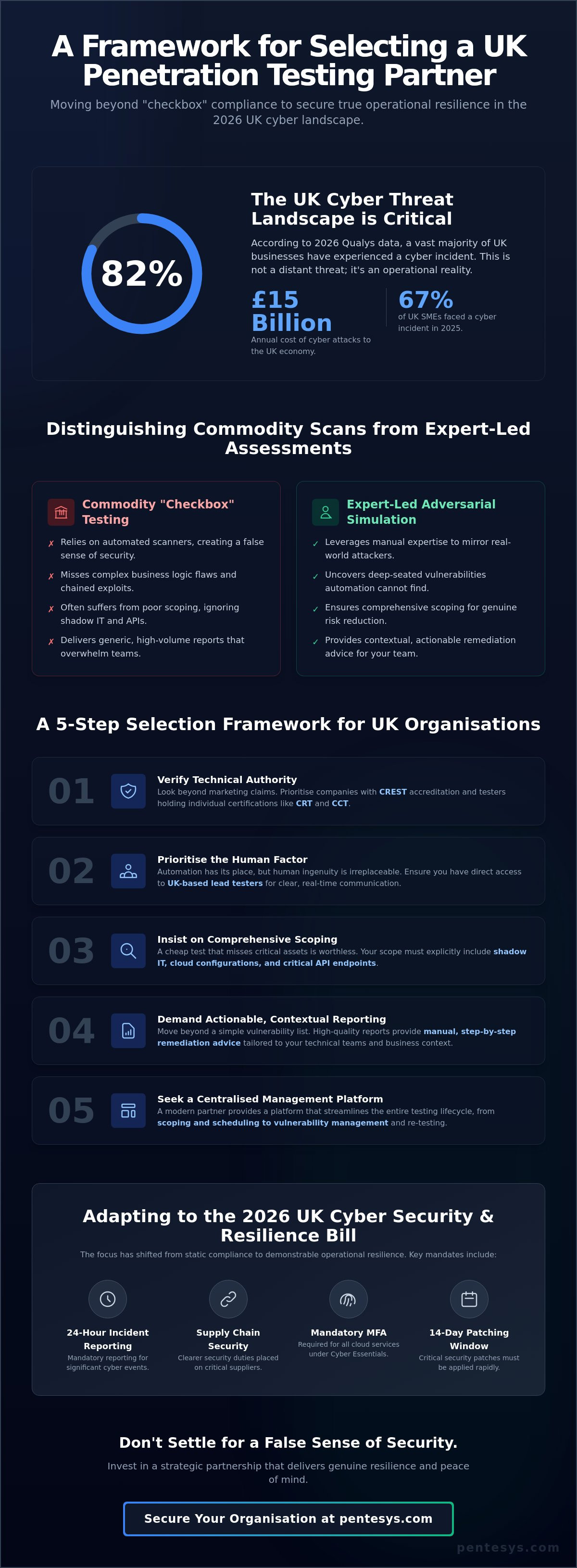
The Cyber Security and Resilience Bill, introduced to Parliament and not yet in force, signals a shift from static compliance toward demonstrable operational resilience. This legislative change means organisations must prove they can withstand and recover from attacks rather than simply ticking a box on an annual audit. Cyber attacks carry serious financial and reputational stakes for UK businesses. To understand the baseline of these assessments, it’s helpful to define what is a penetration test and how it serves as a controlled simulation of a real-world breach. Choosing a penetration testing company uk businesses can trust involves finding a partner that understands these shifting legal duties, particularly the requirement for 24-hour incident reporting for significant events.
Supply chain security has also become a non-negotiable priority. Recent legislative updates place clearer security duties on suppliers working with critical national infrastructure. If your organisation sits within a larger supply chain, your security posture is no longer just your concern; it’s a contractual requirement for your partners. This shift is driving a change in how cyber insurance providers operate. In 2026, insurers are increasingly demanding evidence of regular, high-quality testing rather than accepting basic self-assessment questionnaires. They recognise that cyber incidents are common among UK businesses, making robust verification a prerequisite for coverage.
Identifying the Risks of Commodity Security Testing
Low-cost commodity providers often rely on automated vulnerability scanners that miss complex logic flaws. While automation is a functional part of the process, it cannot replace human intuition and specialized expertise. Choosing a penetration testing company uk leaders rely on means looking for manual, expert-led evaluation that can uncover deep-seated vulnerabilities. Automated reports often lead to a false sense of security, which is dangerous given how many SMEs face incidents. Poor scoping is another common failure in commodity testing. If a provider ignores shadow IT or critical APIs, the resulting report is incomplete. The long-term cost of a missed vulnerability far outweighs the upfront investment in a high-quality, expert assessment.
Evaluating Technical Authority: Accreditations and the Human Factor
Penetration testing remains an unregulated field in the UK. This lack of formal oversight means any provider can claim expertise, making industry-leading accreditations the primary filter for quality. When choosing a penetration testing company uk organisations should prioritise partners that demonstrate a clear commitment to rigorous, third-party validation. Technical authority is not just about the tools a firm uses; it is about the documented skill and ethical standing of the people behind those tools. While automated scanners identify low-hanging fruit, they lack the manual ingenuity required to uncover complex business logic vulnerabilities. Only a human expert can understand the context of your specific workflows and identify how an adversary might chain minor flaws together to achieve a major breach.
Reliability in this sector is built on a foundation of formal standards and clear communication. You should expect direct access to the lead tester throughout the engagement. UK-based support is vital for discussing findings in real-time and ensuring that the nuances of your local regulatory environment are understood. A partnership-driven approach ensures that the assessment results in actionable intelligence rather than a generic list of vulnerabilities. If you are looking to maintain this level of oversight beyond a single test, integrating a structured vulnerability management process can help bridge the gap between periodic evaluations.
Vetting the Expertise Behind the Report
You must look beyond the firm’s brand and investigate the specific team assigned to your project. Experience levels vary significantly across the industry. A Practitioner level tester (CPSA) typically has around 2,500 hours or two years of experience. In contrast, a Registered level tester (CRT) has approximately 6,000 hours, while a Certified level expert (CCT) has invested over 10,000 hours in the field. Ask if your testers have specialist experience in niche areas like API security or mobile application testing. A firm that invests in continuous training for its offensive security team will be better equipped to handle the sophisticated threats of 2026.
The Role of CREST in UK Security Assurance
Securing CREST accredited penetration testing UK services is often a prerequisite for government and financial contracts. This accreditation ensures the provider follows a consistent, documented methodology and adheres to a strict code of ethics. It also provides a robust complaints procedure, giving you a layer of protection that unaccredited firms cannot offer. Always verify a company’s current status through the official CREST member portal before signing any contracts. This step confirms that the firm’s policies, data handling, and technical processes meet the high standards required for modern cyber resilience.
The Quality of Output: Beyond the Vulnerability List
The true value of an offensive security engagement is not found in the activity of the test itself, but in the clarity of the resulting intelligence. A high-quality report serves as a strategic bridge between technical vulnerabilities and business risk. When choosing a penetration testing company uk executives should evaluate the deliverable structure to ensure it serves both the boardroom and the server room. A professional report must include a clear executive summary that translates technical risk into business impact, alongside a granular technical section that provides developers with everything they need to implement a fix. This documentation should be treated as a roadmap for resilience rather than a simple ledger of flaws.
Contextual risk scoring is another marker of a premium provider. While the Common Vulnerability Scoring System (CVSS) provides a standardised baseline, it does not account for your specific environment. A “Critical” vulnerability in an isolated development environment may carry less actual risk than a “Medium” flaw in a customer-facing production API. Your partner should provide a business impact analysis that prioritises remediation based on the actual threat to your operations. A post-test debrief is essential to this process. This session allows your internal teams to discuss findings directly with the lead tester, ensuring no nuance is lost in translation and that every remediation step is fully understood.
Actionable Intelligence vs. Static Data
When reviewing sample reports, look for evidence of manual ingenuity. High-quality documentation includes detailed reproduction steps, screenshots, and proof-of-concept exploits. This level of detail proves that the vulnerability is exploitable and prevents your team from wasting time on false positives. Mitigation strategies must be tailored to your infrastructure rather than copied from a generic database. This ensures that the suggested fixes are practical and consider the specific constraints of your existing technology stack. Actionable intelligence helps you allocate your limited internal resources to the areas that offer the greatest security ROI.
The Remediation Lifecycle and Re-testing
A penetration test should never be viewed as a one-off event. The remediation lifecycle is a managed process that requires ongoing support from your testing partner. Re-testing is a critical component of this cycle; it provides the high-level certainty that your fixes are effective and haven’t introduced new weaknesses. Many organisations are now moving toward continuous penetration testing to maintain visibility over their evolving attack surface. This structured approach allows you to track security improvements over time and provides a clear narrative of resilience for auditors, insurers, and stakeholders. A partner that supports you through the entire lifecycle demonstrates a commitment to your long-term security posture.
A 5-Step Selection Framework for UK Organisations
Selecting the right partner is a structured process that moves from internal alignment to external validation. When choosing a penetration testing company uk organisations often rush the initial stages, leading to mismatched expectations or incomplete coverage. This five-step framework ensures your selection is rooted in strategic value rather than just cost. First, define your primary objectives. Are you testing for compliance with the April 2026 Cyber Essentials updates, or are you seeking to identify deep-seated vulnerabilities in a new product launch? Knowing whether you prioritise compliance, security, or customer assurance will dictate the depth of testing required.
Second, ensure the scoping process is comprehensive. A professional provider will insist on a scoping call to identify critical assets, including APIs and cloud-hosted services that might otherwise be ignored. Third, evaluate the methodology. Ask for a deep dive into their manual testing process to ensure they don’t rely solely on automated tools. Fourth, verify industry-specific references. A provider that understands the regulatory burdens of Fintech will offer different insights than one focused on manufacturing. Finally, assess the partnership potential. You aren’t just hiring a vendor; you’re looking for a strategic ally that provides clear remediation advice and supports your long-term resilience.
Mastering the Scoping Process
Providing enough information for an accurate quote is a delicate balance. Over-scoping leads to inflated costs, while under-scoping results in a “checkbox” exercise that misses critical flaws. You should understand the difference between testing approaches. Black-box testing simulates an outside attacker with no prior knowledge, while grey-box testing provides limited credentials to assess internal logic. White-box testing offers full transparency, allowing for the most thorough evaluation of your code and architecture. An onsite or virtual scoping call is a hallmark of a methodical provider; it ensures no “shadow IT” or legacy systems are left out of the perimeter. If you are ready to secure your perimeter, you can book an infrastructure penetration testing assessment to begin the scoping process.
Assessing Industry-Specific Experience
The threat landscape is not uniform across all sectors. Fintech firms must focus on transaction integrity and data encryption, while healthcare providers prioritise the availability of critical systems and patient privacy. You must verify that a provider understands the specific regulatory requirements of your sector, such as the duties proposed in the Cyber Security and Resilience Bill. Ask to see relevant, anonymized case studies that demonstrate success in your specific technology stack. This evidence proves the provider can handle the nuances of your environment and deliver findings that are both technically accurate and contextually relevant to your business operations.
Human Intelligence Powered by Modern Technology
Pentesys Limited champions the use of human intuition to uncover the complex flaws that automated tools consistently miss. While we utilise External Attack Surface Monitoring and Vulnerability Management, these are always guided by our specialists’ adversarial insights. This partnership-driven approach positions Pentesys Limited as a sophisticated ally that prioritises quality and human intelligence over the shortcuts of fully automated solutions. We focus on providing a narrative of security that feels both authoritative and easy to follow for your entire business.
What information do I need to provide for a penetration testing quote?
You need to provide the target URLs, the number of distinct user roles, and an overview of the application’s functionality. For infrastructure assessments, provide the count of internal and external IP addresses. Providing clear documentation for APIs, such as Swagger files or Postman collections, is also essential for an accurate scoping process and a functional quote.
How do I know if a penetration testing company is truly expert-led?
An expert-led provider will demonstrate a high ratio of manual testing compared to automated scanning. You should ask for the specific certifications of the testers assigned to your project, looking for credentials like CRT or CCT. Truly expert firms provide tailored remediation advice that considers your business context rather than just delivering a generic list of automated findings.
Founder & CEO, Pentesys
James Hinton is the founder of Pentesys, a CREST-approved UK company working only on offensive security: penetration testing, PTaaS, CTEM, external attack surface management and red teaming. He built the business around one discipline rather than a broad consultancy menu, and most of his time still goes on how engagements get scoped, delivered and reported. He writes here about the practical side of security testing and what buyers should be asking for.
LinkedIn profile