

Overview
Scanners are good at breadth: known CVEs, missing patches, weak TLS configuration, exposed services. They are poor at anything that requires understanding what the application is for, which is where access control failures, business logic flaws and chained attack paths live. The two are not substitutes, and buying one while believing you have bought the other is a common and expensive mistake.
This strategic guide provides a clear framework to help you decide when to deploy rapid automated tools and when to invest in deep, expert-led evaluation. You’ll discover how to satisfy modern regulatory standards like CMMC 2.0 while focusing your resources on the threats that truly matter to your organisation’s longevity. By the end of this article, you’ll have a roadmap for building a proactive security posture that balances the speed of innovation with the precision of human intelligence.
Defining the Roles of Automated Scanning and Manual Penetration Testing
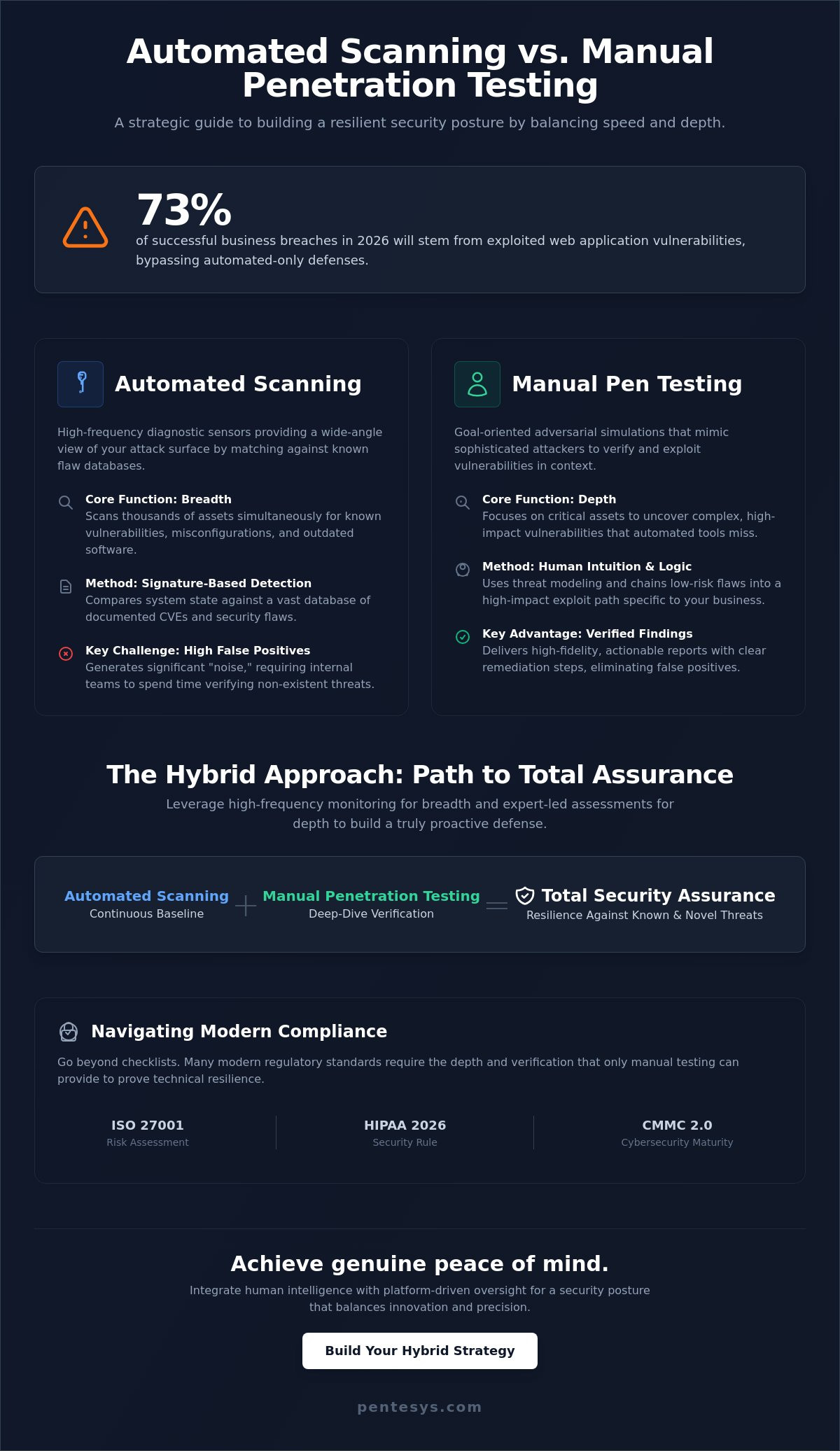
Understanding the fundamental distinction between automated vulnerability scanning vs manual penetration testing is the first step toward building a resilient security posture. Automated tools function as high-frequency diagnostic sensors. They provide a wide-angle view of your environment, identifying known patterns and outdated software versions across a vast network. Manual penetration testing, however, is a deep, goal-oriented adversarial simulation. It doesn’t just look for flaws; it mimics the logic of a sophisticated attacker to see how those flaws can be weaponized against your specific business objectives.
The core difference lies in the transition from detection to verification. Scanners are primarily “detect-only” systems. They flag potential issues based on predefined databases, often resulting in a high volume of data that requires significant internal filtering. Human testers operate on an “exploit-and-verify” model. They confirm whether a theoretical weakness actually poses a risk to your data. For UK organisations, this distinction is the bridge to true Security Assurance. It’s the difference between knowing a door is unlocked and knowing whether an intruder can actually reach the safe once they’re inside.
The Mechanism of Automated Vulnerability Management
Automated systems rely heavily on signature-based detection. These tools compare your infrastructure against a comprehensive Vulnerability Assessment database of documented security flaws. This method is exceptionally efficient for maintaining a consistent baseline, particularly when used for External Attack Surface Monitoring. It allows your team to catch unpatched software, expired certificates, and common misconfigurations in real-time. Because these tools run at scale, they provide the breadth necessary to monitor thousands of assets simultaneously, ensuring that simple entry points don’t remain exposed between deeper assessments.
The Anatomy of a Human-Led Penetration Test
A human-led assessment begins long before any exploit is attempted. It starts with meticulous reconnaissance and threat modelling. During this phase, experts analyse your unique architecture to identify which assets are most attractive to an adversary. Unlike a tool, a human tester uses intuition to chain multiple low-risk flaws together. A scanner might report three minor, unrelated bugs; a human sees those same three bugs as a structured path to a full system compromise. This expertise is what transforms a standard evaluation into a strategic roadmap. The final report provides clear, prioritised instructions for remediation, ensuring your technical teams focus on the vulnerabilities that represent the highest actual risk to the business.
The Technical Divide: Breadth of Automation vs Depth of Human Intuition
The strategic balance between automated vulnerability scanning vs manual penetration testing determines whether your security posture is merely compliant or truly resilient. Automated tools provide essential surface-level coverage, scanning thousands of endpoints for known signatures with remarkable speed. However, this breadth often comes at the cost of depth. Scanners frequently struggle with the specific context of an application, leading to a high volume of false positives. These incorrect alerts create significant friction for IT teams, who must spend valuable hours manually validating reports that turn out to be harmless noise.
Even more concerning is the issue of false negatives. These are critical risks that automated tools are fundamentally blind to because they don’t follow a predefined pattern. Most successful breaches in the business sector involve exploited vulnerabilities in web applications, many of which are logic-based flaws that bypass standard scans. Understanding the nuance of Penetration testing vs. vulnerability scanning is vital for leaders who want to close this window of exposure. Human testers apply a level of intuition that software can’t replicate, accounting for the specific business objectives and data flows of your organisation.
Where Automation Excels: Scaling Security Oversight
Automation is the only viable way to maintain oversight across large-scale infrastructure and complex cloud environments. Within a modern CI/CD pipeline, automated scanning supports continuous security by providing developers with near-instant feedback on common CVEs. It’s an excellent tool for identifying unpatched software and basic misconfigurations before they reach production. This speed of delivery allows teams to maintain a consistent security baseline without slowing down the pace of innovation. For organisations managing vast external attack surfaces, these tools act as a reliable first line of defence.
The Human Edge: Identifying Logic Flaws and Zero-Days
The human edge is indispensable for identifying sophisticated threats like Insecure Direct Object References (IDOR) or multi-stage privilege escalation. These vulnerabilities are invisible to scanners because they require a deep understanding of how an application processes permissions. Business logic flaws are vulnerabilities that arise from the way an application is designed to function. Detecting these requires the lateral thinking of CREST accredited penetration testing UK professionals. By simulating real-world adversarial behaviour, human experts uncover novel exploits that haven’t yet been documented in signature databases. If you’re concerned about the resilience of your proprietary software, a professional Web Application Penetration Testing engagement provides the high-level certainty that automation alone can’t offer.
Comparing ROI, Accuracy, and Compliance Requirements
Financial efficiency in cybersecurity is often misunderstood. While the initial cost-per-scan of an automated tool appears lower than a human engagement, the true return on investment depends on the quality of the findings. Automated tools frequently generate a high volume of data that lacks context, leading to remediation fatigue. Your IT team can spend hours chasing false positives that pose no actual risk to the business. In contrast, manual testing focuses on high-impact vulnerabilities, delivering a higher value-per-finding by ensuring that every identified flaw is a verified threat. While UK standards are the primary focus, aligning with international NIST 800-171 guidance provides a robust framework for understanding why both methods are necessary for a comprehensive defence.
The choice between automated vulnerability scanning vs manual penetration testing also carries significant regulatory weight. National compliance frameworks and cyber insurers increasingly look for more than a surface-level scan. They require proof of technical resilience that only human adversarial simulation can provide. Relying solely on a tool creates a point-in-time snapshot that quickly becomes obsolete. A sophisticated strategy moves beyond these static evaluations toward a model of continuous oversight that meets modern security needs.
Meeting UK Compliance Standards (ISO 27001 & Cyber Essentials)
A basic vulnerability scan is often insufficient for meeting the rigorous requirements of ISO 27001 Annex A controls. Independent validation is a core component of satisfying third-party audits and demonstrating due diligence. Auditors look for evidence that your security measures have been tested against realistic attack scenarios. Achieving professional security assurance supports these data protection obligations by providing documented proof of your organisation’s commitment to long-term resilience. This level of certainty is essential for maintaining trust with partners and stakeholders who expect high-level oversight.
Accuracy and the Cost of Remediation
The true cost of security isn’t the test itself; it’s the time spent fixing the results. Manual remediation advice is actionable and prioritised, unlike the generic output of most scanning tools. Human experts provide specific instructions that account for your unique environment, preventing developers from wasting time on non-exploitable bugs. This precision significantly reduces the window of exposure by allowing your team to focus their efforts where they will have the greatest impact. An expert-led technical security posture evaluation provides the strategic clarity needed to allocate your budget effectively, ensuring that your most critical assets remain protected against evolving threats.
Building a Hybrid Security Strategy: When to Automate and When to Assess
Resilience requires a shift from binary thinking to a layered orchestration of resources. A “Defence-in-Depth” strategy ensures that while automation maintains a consistent baseline, human expertise validates the technical barriers protecting your most sensitive assets. When balancing automated vulnerability scanning vs manual penetration testing, the goal is to align the method with the level of risk and the rate of change within your environment. By integrating both into a cohesive Vulnerability Management program, you bridge the gap between high-frequency monitoring and deep-dive adversarial simulation.
Identifying the right triggers for each method is essential for operational clarity. Automated scanning should be a continuous process, triggered by daily code deployments in CI/CD pipelines or the release of new high-severity CVEs. It provides the necessary oversight for broad infrastructure and External Attack Surface Monitoring. Manual penetration testing, however, is reserved for high-stakes events. These include major software releases, significant architectural change, and audit cycles for frameworks such as SOC 2. This structured approach ensures that no critical change goes unverified by a human expert.
The 2026 Selection Framework
Effective resource allocation starts with a 3-step selection framework. First, assess your risk profile by categorising assets based on data sensitivity and exposure. High-risk applications containing customer PII require both continuous scanning and periodic human-led testing. Second, determine the frequency of assessment based on how often the asset changes. Finally, select the methodology that matches the objective. This transition from static, periodic testing to continuous security validation allows your organisation to maintain a state of high-level certainty rather than just meeting a point-in-time compliance requirement.
Optimising Your Security Budget
Maximising your security spend involves balancing recurring automation costs with project-based expert fees. A sophisticated strategy uses automation to “clean up” common misconfigurations and unpatched software before an engagement begins. This ensures that when you invest in Infrastructure Penetration Testing, the experts spend their time uncovering complex logic flaws rather than reporting simple bugs your team could have identified with a tool. The long-term ROI of this approach is significant. Preventing a single high-impact breach through manual testing far outweighs the initial cost of the assessment, providing the peace of mind that comes from a truly resilient posture.
Why Human Expertise Remains the Gold Standard
Adversarial simulations and Red Teaming remain the gold standard for validating technical barriers in 2026. While software can flag a missing patch, it can’t replicate the creative logic an attacker uses to bypass complex security controls. Our methodology is transparent and methodical, focusing on the foundational importance of reliability. By employing human intelligence to chain vulnerabilities and test business logic, we provide the peace of mind that comes from formal accreditation and expert oversight. This expert-led evaluation serves as a signature quality marker, distinguishing our service from standard automated processes.
Can automated tools find zero-day vulnerabilities?
Automated tools are typically unable to identify zero-day vulnerabilities. These scanners operate by checking your systems against databases of documented flaws and known signatures. Since a zero-day is unknown to the wider security community and lacks a predefined signature, it requires the creative adversarial logic and manual reconnaissance of a human expert to be discovered and mitigated before it’s exploited.
Why do automated scanners produce so many false positives?
Automated scanners produce false positives because they lack situational awareness and business context. They identify potential weaknesses based on generic patterns without checking if your specific environment or existing security layers prevent exploitation. This results in a high volume of noise that requires manual validation by your technical team to determine which findings represent an actual risk to the business.
Founder & CEO, Pentesys
James Hinton is the founder of Pentesys, a CREST-approved UK company working only on offensive security: penetration testing, PTaaS, CTEM, external attack surface management and red teaming. He built the business around one discipline rather than a broad consultancy menu, and most of his time still goes on how engagements get scoped, delivered and reported. He writes here about the practical side of security testing and what buyers should be asking for.
LinkedIn profile