

Overview
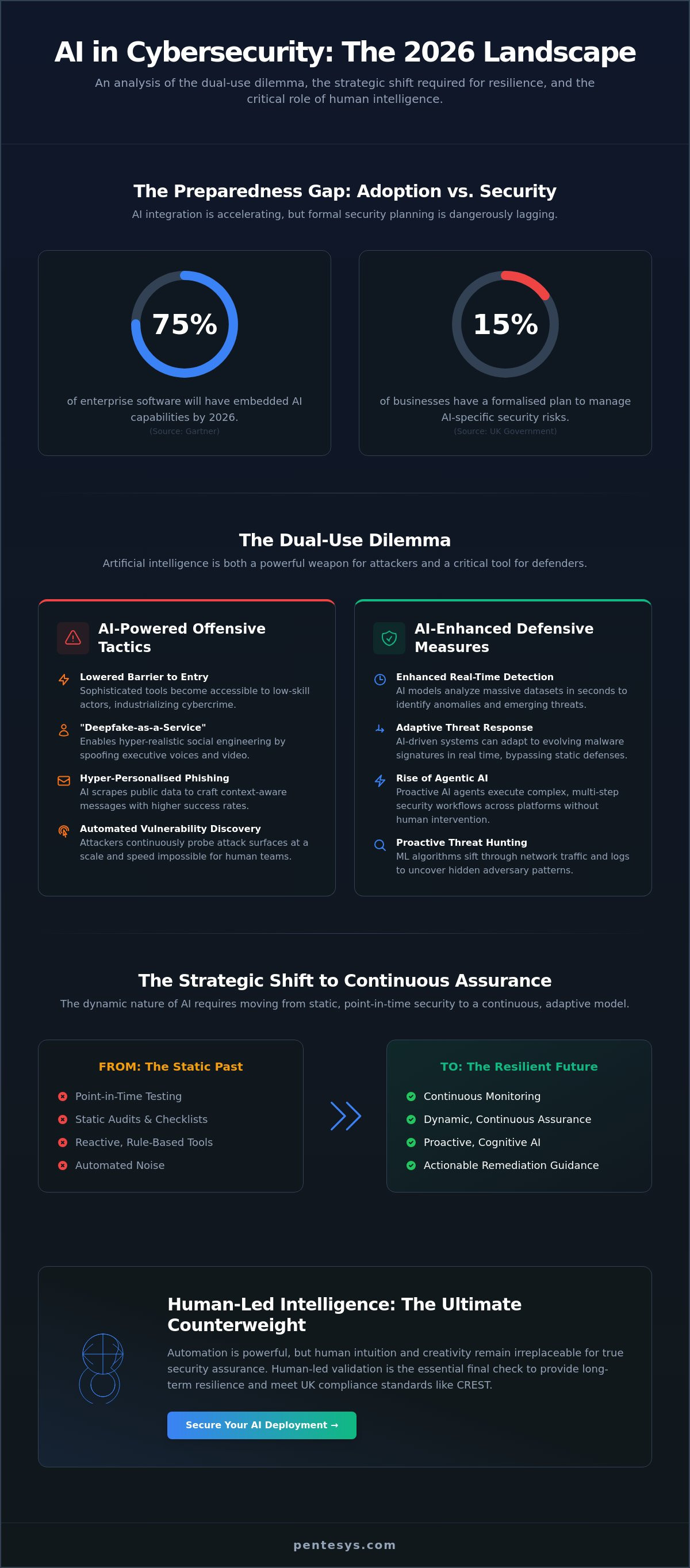
Embedded artificial intelligence capabilities are becoming standard across enterprise software, yet most UK businesses still lack a formalised plan to manage the unique security risks these systems introduce. It’s understandable if you feel caught between the competitive necessity of AI adoption and the very real threat of AI-powered adversary simulations targeting your infrastructure. You know that automation alone isn’t enough to protect a complex UK enterprise from sophisticated actors who are already weaponising large language models.
This strategic analysis clarifies how artificial intelligence is reshaping the cybersecurity landscape, moving beyond the hype to provide a framework for genuine resilience. You’ll discover why human-led validation remains the essential final check for security assurance and how to align your innovation goals with the UK’s evolving regulatory requirements. We’ll examine the specific transition from point-in-time testing to continuous monitoring, ensuring your 2026 strategy prioritises actionable insights and clear remediation guidance over automated noise.
The Evolution of Artificial Intelligence: Defining the 2026 Landscape
Artificial intelligence represents the most significant shift in enterprise technology since the advent of the internet. By 2026, the definition has matured beyond simple automation. It now describes technology that enables machines to simulate complex human cognition and exercise high levels of autonomy. This progression is evident when reviewing the history of artificial intelligence, which transitioned from rule-based systems to the self-learning architectures we secure today.
UK enterprises are navigating a landscape where 2026 marks the definitive end of the experimentation phase. Organisations have moved past isolated pilot programs into full-scale enterprise-wide integration. This transition is a core pillar of the UK’s national security strategy and digital economy goals. The government’s commitment to AI safety, backed by targeted research funding, ensures that the UK remains a competitive hub for high-assurance technology. Leaders must adopt a strategic approach to ensure that high-level autonomy doesn’t compromise corporate integrity.
From Machine Learning to Generative AI
Statistical patterns form the backbone of traditional Machine Learning (ML). These systems analyse historical data to make predictions about future outcomes. Generative AI builds upon this by creating original content and complex solutions from structured data. Large Language Models (LLMs) are now the primary engines in modern business workflows. They don’t just process information; they synthesize it. This allows technical teams to derive actionable insights from massive datasets in seconds, a process that previously required weeks of manual labor.
The Rise of Agentic AI Systems
Proactive systems are replacing the reactive “Weak AI” models of the previous decade. These AI agents execute multi-step tasks across multiple platforms without constant human intervention. They handle complex workflows by interacting directly with internal APIs. This autonomy introduces specific security implications. Granting an agent access to sensitive internal systems requires rigorous adversary simulation and continuous monitoring. You must verify that these agents operate within defined parameters to prevent unauthorised data exfiltration. Agentic AI is the next frontier of autonomous software. Pentesys provides the necessary technical assurance to deploy these agents, ensuring that innovation is balanced with long-term resilience.
The Dual-Use Dilemma: AI as a Tool for Attack and Defence
The landscape of artificial intelligence in 2026 is defined by a persistent arms race. UK enterprises now operate in an environment where sophisticated offensive tools are accessible to low-skill actors, significantly lowering the barrier to entry for cyber crime. This shift requires a move away from static, point-in-time security measures. The UK National AI Strategy emphasizes the necessity of building long-term resilience as these technologies mature, highlighting that security must be an inherent component of innovation rather than an afterthought.
Traditional security boundaries have dissolved. Relying solely on a static firewall configuration is insufficient when AI-driven malware can adapt its signature in real time to evade detection. Adversaries now use machine learning to scan for vulnerabilities at a scale and speed that human teams cannot match. This creates a high-pressure environment where the time between a vulnerability being discovered and it being exploited has shrunk from weeks to minutes.
AI-Powered Offensive Tactics
Attackers have industrialized the reconnaissance phase of the kill chain. By 2026, “Deepfake-as-a-Service” platforms have become a primary tool for social engineering, allowing criminals to spoof executive voices or video during high-value financial transactions. These hyper-personalised phishing campaigns achieve higher success rates by scraping LinkedIn and corporate sites to craft context-aware messages. Furthermore, automated vulnerability discovery tools now allow attackers to probe external attack surfaces continuously, identifying weak points in cloud environments or legacy systems with surgical precision. Traditional biometric and multi-factor authentication methods are under pressure as AI models learn to replicate human typing patterns and bypass voice recognition systems.
AI-Enhanced Defensive Models
To counter these threats, defensive models must leverage predictive analytics. AI is now essential for triaging the thousands of low-level security alerts that typically overwhelm Security Operations Centres (SOC). By 2026, enterprise-grade systems use artificial intelligence to filter noise and identify the “signal” of a true breach. While automated responses can isolate compromised endpoints instantly, the most resilient UK firms balance this with strategic oversight. Professional cyber security services provide the human intuition necessary to interpret complex adversary simulations. This human-led approach ensures that defensive logic aligns with business objectives rather than just technical checkboxes.
Continuous monitoring is the only viable path forward for the modern enterprise. Through the Pentesys Portal, our partners gain real-time visibility into their security posture, moving beyond the limitations of annual testing. If you are looking to strengthen your resilience against AI-driven threats, our team can provide a comprehensive security assessment tailored to your specific risk profile.
Securing the AI Frontier: Identifying Model-Specific Vulnerabilities
Traditional software testing relies on deterministic logic, where a specific input always yields the same output. Artificial intelligence operates on probabilistic weights, meaning the same prompt can produce different results. This shift requires a new methodology for technical security assessments. Pentesys moves beyond simple vulnerability scanning by evaluating the entire AI pipeline, from the integrity of training datasets to the security of the inference engine. Our approach aligns with the research conducted by the AI Security Initiative, focusing on the unique ways these systems can be manipulated.
We leverage the Pentesys Portal to provide continuous visibility into these complex environments. Our human-led testing prioritises the logic of AI integration within your web applications and APIs. Automated tools frequently miss the nuanced ways that an AI agent might be coerced into performing unauthorised actions. By combining technical expertise with a strategic approach, we ensure that your enterprise-grade models don’t become an entry point for sophisticated adversaries.
Adversarial Machine Learning Threats
- Prompt Injection: Attackers use hidden instructions to bypass safety filters. In 2024, researchers demonstrated that complex prompts can force LLMs to leak proprietary system data or ignore corporate governance rules.
- Data Poisoning: This involves injecting malicious data into training sets. A 2023 study showed that even a tiny amount of data contamination can create reliable backdoors, allowing attackers to trigger specific model behaviours later.
- Model Evasion: Malicious actors craft inputs that the AI misclassifies. For instance, an attacker might modify a malware file just enough to trick an AI-driven security scanner into seeing it as a safe document.
Infrastructure and API Risks
Auditing AI decision-making is complicated by the “Black Box” problem. When an artificial intelligence makes a biased or insecure decision, tracing the exact cause is difficult. Pentesys addresses this by implementing continuous monitoring through the Pentesys Portal. We provide UK enterprises with clear remediation guidance, turning opaque model behaviours into actionable insights. This ensures your implementation remains a strategic asset rather than a liability.
Adopting a Continuous Validation Mindset
Static testing can’t keep pace with the iterative nature of machine learning. Continuous monitoring is essential to detect model drift, where an AI’s performance degrades or its decision-making logic shifts over time. We integrate these ongoing assessments into the Pentesys Portal, providing your leadership team with real-time visibility into your security posture. This centralized hub allows for immediate remediation guidance as new gaps emerge. Security validation must move at the speed of AI deployment to remain effective.
Meeting Regulatory and Compliance Standards
The UK government’s approach to artificial intelligence regulation emphasizes safety and transparency, placing the burden of proof on the enterprise. Adopting accredited testing helps organisations align with the ISO 42001 standard for AI Management Systems. It also provides a defensible audit trail for UK GDPR compliance, particularly when models process special category data. Protecting sensitive information requires more than just encryption; it demands verified proof that your AI won’t leak data through unintended outputs. Our methodology ensures your deployment meets the high bar set by the UK AI Safety Institute.
Human-Led Intelligence: The Ultimate Counterweight to AI
As we approach 2026, the reliance on artificial intelligence across UK enterprise operations creates a unique paradox. While algorithms process data at incredible speeds, they lack the creative intuition required to think like a sophisticated adversary. Human-led penetration testing remains the ultimate counterweight to these digital threats. Pentesys operates on a philosophy where technology empowers human experts instead of replacing them. We focus on the nuanced logic flaws that automated tools consistently overlook, ensuring your defences are tested against genuine human ingenuity.
The Limits of Automated Scanners
Automated scanners often struggle with context. The Cyber Security Breaches Survey continues to show that a large share of UK businesses identify a breach or attack each year. Many of these firms rely on off-the-shelf automation that produces high rates of false positives. These tools cannot determine if a vulnerability actually threatens a core business objective. Pentesys provides expert-led assessments that deliver actionable insights through the Pentesys Portal. We interpret findings through the specific lens of your business risk, ensuring remediation guidance is practical and prioritised. This human-led approach identifies complex attack chains that automated scanners simply don’t see.
Can artificial intelligence replace human penetration testers?
Artificial intelligence can’t replace the nuanced intuition and creative problem-solving of a human penetration tester. While automated tools identify common vulnerabilities, they lack the strategic context to understand complex business logic or chain multiple exploits together. Pentesys prioritises human-led testing to ensure your security posture remains resilient against sophisticated adversary simulations that automated bots simply miss.
What is prompt injection and why should I be concerned?
Prompt injection is a technique where an attacker provides crafted input to an LLM to override its original instructions and execute unintended actions. It’s a critical concern because it can lead to data exfiltration or the execution of malicious code within your internal network. Organisations using AI-driven chatbots are particularly vulnerable if they lack strict input validation and output filtering protocols.
Does Pentesys offer specific testing for AI and LLM implementations?
Pentesys provides specialised security assurance for AI and Large Language Model (LLM) deployments through our proprietary Pentesys Portal. Our methodology combines human expertise with advanced adversary simulation to identify vulnerabilities specific to neural networks and API integrations. We deliver actionable insights that help you build long-term resilience, ensuring your innovative technologies don’t become your biggest security liabilities.
Founder & CEO, Pentesys
James Hinton is the founder of Pentesys, a CREST-approved UK company working only on offensive security: penetration testing, PTaaS, CTEM, external attack surface management and red teaming. He built the business around one discipline rather than a broad consultancy menu, and most of his time still goes on how engagements get scoped, delivered and reported. He writes here about the practical side of security testing and what buyers should be asking for.
LinkedIn profile