

Overview
Remediation usually stalls for organisational reasons rather than technical ones. Nobody owns the fix, the deadline is nominal, and the finding sits in a spreadsheet until the next test rediscovers it. A remediation plan is the artefact that prevents that: it names an owner, sets a date, and defines what evidence closes the item.
We understand that proving to auditors that you’ve effectively closed security gaps is just as important as the fix itself. You likely want a process that moves beyond reactive patching and toward strategic resilience. This guide will help you master the art of closing those gaps with a professional framework and strategic implementation guide. We’ll move beyond static CVSS scores to help you prioritise based on active threat intelligence and organisational risk. By following this roadmap, you’ll establish a clear, audit-ready process to reduce your mean time to remediate (MTTR) and build a security posture that delivers measurable ROI for your business.
What is a Vulnerability Remediation Plan and Why Do Standard Templates Fail?
A vulnerability remediation plan is far more than a simple checklist of software updates. It’s a formalized, strategic roadmap designed to identify, prioritise, and resolve security flaws within an organisation’s digital environment. While many IT teams confuse patching with remediation, there’s a fundamental difference. Patching is a tactical, localized action; it’s the act of applying a fix to a specific piece of software. In contrast, remediation is a strategic process that addresses the root cause of a vulnerability and validates that the risk has been permanently mitigated. Without this distinction, organisations often find themselves in a cycle of repetitive fixes that don’t actually improve their long-term security posture.
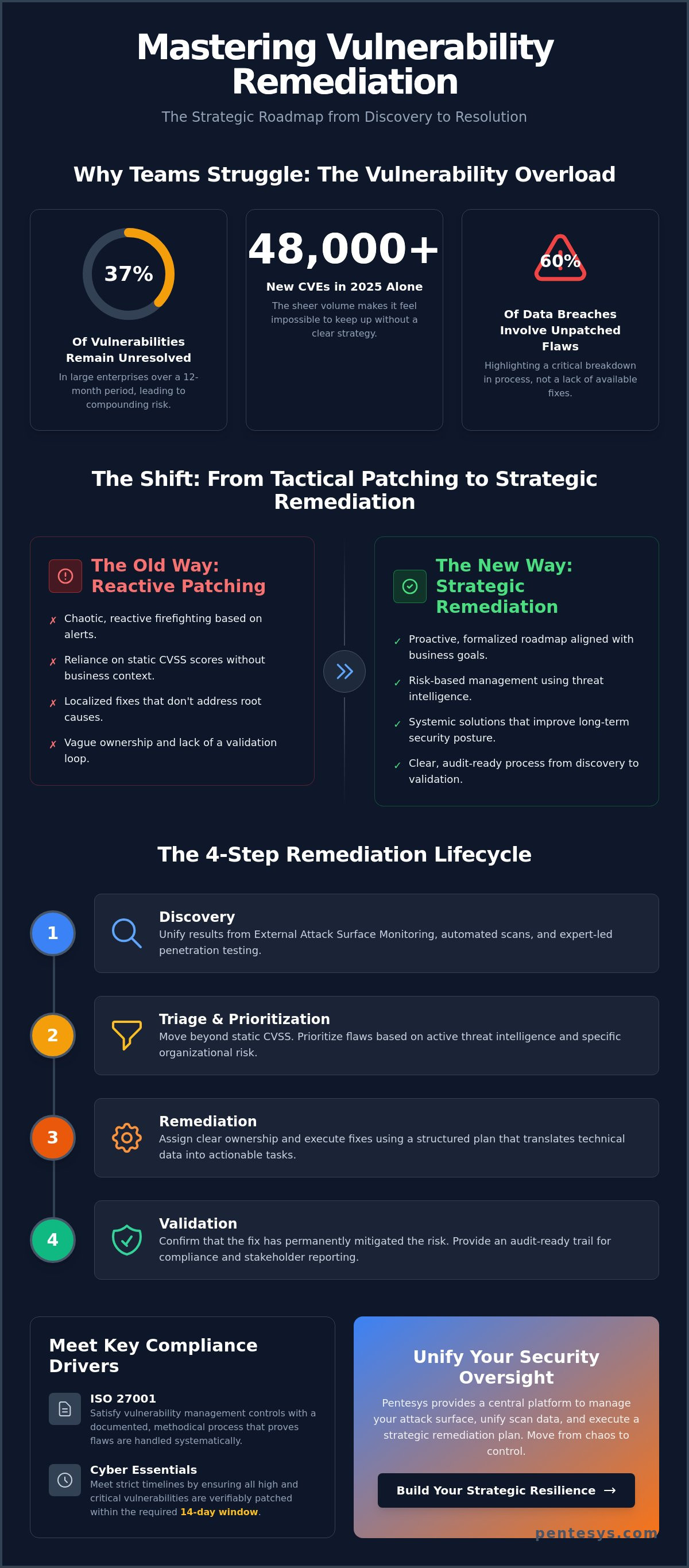
Standard templates often fail because they treat security as a static event. They lack the necessary business context to help teams decide which flaws actually matter to the bottom line. Without clear ownership or a verification loop, these documents become shelfware that provides little actual protection. Many data breaches involve unpatched vulnerabilities where a fix was already available. This highlights a breakdown in the process rather than a lack of technology. Effective Vulnerability management requires a dynamic vulnerability remediation plan template that evolves alongside the threat landscape, ensuring that technical teams and executive stakeholders stay aligned on risk priorities.
The Role of Remediation in Modern Cybersecurity
Modern security has shifted from the traditional model of annual audits to a state of proactive, ongoing defence. A robust remediation plan supports continuous External Attack Surface Monitoring by ensuring that every newly discovered asset or flaw is immediately funneled into a structured resolution workflow. This transition allows your organisation to maintain a high level of technical authority, moving away from the chaos of reactive firefighting toward a model of professional assurance. By treating remediation as a constant lifecycle, you ensure that temporary fixes don’t become permanent liabilities. It’s about building a system that values human intelligence and expert-led evaluation over the shortcuts of fully automated solutions.
Compliance Drivers: ISO 27001 and Cyber Essentials
Regulatory pressure is a significant driver for structured remediation. For organisations pursuing ISO 27001, a documented plan is essential to satisfy specific vulnerability management controls, proving to auditors that flaws are handled methodically. In the UK, Cyber Essentials certification imposes even stricter timelines, requiring that all high and critical vulnerabilities are patched within a 14-day window. Beyond certification, a verifiable remediation history helps during cyber insurance underwriting. Insurers now look for evidence of a mature process that prioritises long-term resilience over one-off evaluations. Using a professional vulnerability remediation plan template ensures these compliance milestones are met with absolute clarity and consistency.
The Anatomy of an Effective Remediation Template
A superior vulnerability remediation plan template acts as the single source of truth between security analysts and IT operations. It must translate raw scan data into actionable business intelligence that technical teams can execute with precision. While generic spreadsheets often focus solely on technical IDs, a strategic template prioritises the data points that drive resolution and provide professional assurance to stakeholders. By structuring your documentation correctly, you move away from chaotic spreadsheets and toward a methodical, audit-ready process.
Core Fields for Technical Clarity
Technical clarity is the foundation of any successful remediation effort. Without specific identifiers, teams waste valuable time cross-referencing reports. Every entry should include:
- Vulnerability ID (CVE) and Description: Using standardised identifiers like the Common Vulnerabilities and Exposures (CVE) system ensures everyone understands the specific flaw being addressed.
- Affected Assets: You must distinguish between staging, production, and critical infrastructure. A vulnerability on a public-facing web server requires a different response than the same flaw on an isolated development machine.
- Severity vs. Priority: These are not the same. A “High” severity flaw on a non-critical, internal asset may actually be a lower priority than a “Medium” flaw on your primary database. Effective vulnerability management requires this distinction to ensure resources are allocated where they offer the most protection.
Operational Fields for Accountability
Ownership is where many plans fail. Assigning a task to “IT” or “Security” leads to diffusion of responsibility. A functional template requires clear accountability through specific operational fields:
Beyond these basics, a strategic template must include a “Business Context” field. This allows you to justify prioritisation to executive stakeholders by explaining how a vulnerability impacts specific business functions. It’s also vital to track “Exceptions”. Not every flaw can be fixed immediately due to legacy software constraints or operational downtime. Documenting these exceptions, along with compensating controls, is a requirement for ISO 27001 compliance. Finally, “Verification Status” is the most vital field. A fix is not complete until it has been validated through follow-up testing. This verification loop provides the high-level certainty that defines a mature security posture, ensuring that gaps aren’t just hidden, but truly closed.
- Ownership: Assign specific individuals or functional teams. This ensures that when an auditor asks who was responsible for a fix, the answer is documented.
- Target Remediation Date: These deadlines must align with your organisation’s risk appetite and compliance requirements. For example, meeting the 14-day patching window for Cyber Essentials certification requires strict date tracking.
- Remediation Action: Clearly define whether the solution is a patch, a configuration change, or the decommissioning of a legacy asset.
Prioritising Vulnerabilities: Beyond the CVSS Score
Fixing every vulnerability in order of its Common Vulnerability Scoring System (CVSS) rating is a common mistake that often leads to wasted resources and lingering high-risk exposure. While a CVSS score provides a theoretical measure of severity, it doesn’t account for the real-world likelihood of exploitation or the specific business context of your environment. Transitioning to risk-based vulnerability management allows your team to focus on the flaws that actually present a path for attackers. By integrating threat intelligence into your vulnerability remediation plan template, you can distinguish between a high-severity flaw on an isolated development server and a medium-severity flaw on a public-facing gateway.
Modern prioritisation requires more than just static scores. Tools like the Exploit Prediction Scoring System (EPSS) help security teams estimate the probability that a specific vulnerability will be exploited within the next 30 days. This data-driven approach ensures that your remediation efforts are aligned with active threats rather than theoretical risks. When you enrich your template with EPSS data and real-world exploitability evidence, you provide your technical teams with a clear, defensible roadmap that prioritises impact over volume.
The Human Element: Why Manual Testing Trumps Automation
Automated scanners are efficient at identifying known software versions and missing patches, but they often miss complex logic flaws and chained vulnerabilities. This is where manual penetration testing serves as the ultimate prioritisation filter. Expert-led evaluations can determine if a vulnerability is truly reachable and exploitable in your specific configuration. For instance, a red teaming exercise might reveal that a “Low” severity information disclosure actually provides the credentials needed for lateral movement. By including these manual insights in your vulnerability remediation plan template, you ensure that your most critical gaps are addressed based on confirmed technical authority rather than automated guesses.
Calculating Business Risk
True risk calculation must balance technical severity with organisational impact. You should evaluate the sensitivity of the data stored on the affected asset and the potential for an attacker to move laterally within your network. A vulnerability on a server containing customer PII or intellectual property naturally carries more weight than one on a guest Wi-Fi controller. You must also balance remediation urgency with operational uptime requirements. A strategic plan identifies these conflicts early, allowing for the implementation of compensating controls when an immediate patch isn’t feasible. This methodical approach ensures that your security posture remains resilient without causing unnecessary business disruption.
Implementing the Plan: From Discovery to Validation
Executing a vulnerability remediation plan template requires a transition from strategic prioritisation to operational action. This lifecycle ensures that every identified flaw is tracked from its initial discovery through to a confirmed, validated fix. Without a structured workflow, remediation efforts often stall after the initial scan, leaving the organisation exposed to the very risks it sought to identify. A methodical approach transforms security from a series of disjointed tasks into a managed, ongoing process that provides long-term resilience.
The Discovery and Triage Phase
The first stage involves aggregating raw data from multiple streams, including web application penetration testing and infrastructure audits. This centralises all findings into your vulnerability remediation plan template, creating a unified view of your security posture. During this phase, it’s essential to filter out false positives to prevent team fatigue and ensure resources are focused on genuine threats. Triage is the process of determining the order and priority of remediation. By applying the risk-based filters discussed earlier, you ensure that the most impactful vulnerabilities are addressed first, rather than simply reacting to the most recent scan results.
When an immediate patch is unavailable due to legacy system requirements or vendor delays, you must implement compensating controls. These are temporary measures, such as firewall rules or tightened access policies, that reduce the risk of exploitation until a permanent fix is possible. Documenting these controls within your plan ensures that auditors see a proactive management of risk, even when technical constraints prevent an instant resolution. This level of detail provides the technical authority needed to justify operational decisions to stakeholders.
From Static Templates to Real-Time Dashboards
Excel spreadsheets have significant limitations when it comes to managing complex, multi-cloud environments. Data becomes stale almost immediately after a scan; version control issues often lead to confusion between technical teams and management. By moving your vulnerability remediation plan template into a dynamic platform, you gain a modular, step-by-step view of your security posture. This transition from periodic, point-in-time evaluations to proactive, ongoing oversight ensures that your security posture remains resilient in the face of evolving threats. It replaces the chaos of manual updates with a structured, dependable rhythm that aligns with your broader corporate objectives.
What is the difference between vulnerability remediation and mitigation?
Remediation refers to the permanent removal of a vulnerability through a patch, code change, or decommissioning of the asset. Mitigation involves implementing compensating controls to reduce the risk of exploitation without actually fixing the underlying flaw. While mitigation provides immediate relief when a patch is unavailable, your long-term goal should always be full remediation to ensure lasting resilience.
How do we handle vulnerabilities that cannot be patched immediately?
Vulnerabilities that cannot be patched immediately should be moved into an exceptions log within your template. You must implement compensating controls, such as network segmentation or enhanced monitoring, to protect the asset in the interim. Documenting these steps provides a clear audit trail for compliance frameworks like ISO 27001 and ensures that the risk is managed rather than ignored.
What are the most important metrics to track in a remediation plan?
The most critical metrics include Mean Time to Remediate (MTTR) and the percentage of unresolved high-severity flaws over a 12-month period. You should also track your verification success rate to identify if patches are failing during implementation. These data points allow you to demonstrate the measurable ROI of your security investments to executive stakeholders and auditors alike.
Founder & CEO, Pentesys
James Hinton is the founder of Pentesys, a CREST-approved UK company working only on offensive security: penetration testing, PTaaS, CTEM, external attack surface management and red teaming. He built the business around one discipline rather than a broad consultancy menu, and most of his time still goes on how engagements get scoped, delivered and reported. He writes here about the practical side of security testing and what buyers should be asking for.
LinkedIn profile