

Overview
Receiving a 120-page penetration testing report often feels less like a security win and more like a logistical burden. With industry experts projecting a median of 59,000 CVE disclosures in 2026 alone, the sheer volume of data can quickly lead to information overload. You likely recognise the frustration of trying to explain technical risk to executive stakeholders while your internal teams struggle with severe resource constraints. Knowing how to prioritise vulnerabilities after a pen test is the difference between a reactive patching cycle and a proactive security posture.
We understand that a CVSS v4.0 score, while technically accurate, doesn’t always reflect the specific risks to your unique business environment. This article provides a strategic framework to transform dense technical findings into a high-impact remediation roadmap. You’ll learn how to weigh exploitability against actual business impact, ensuring your efforts align with organisational goals. We’ll explore a methodical approach to reducing your mean-time-to-remediate while maintaining the reliability your stakeholders expect from a professional security partnership.
Beyond the PDF: Why CVSS Scores Alone Are Insufficient for Prioritisation
Organisations often treat a penetration test report as a simple to-do list where the highest score wins the most attention. This approach is fundamentally flawed. True prioritisation is a strategic decision-making process, not just a technical checkbox. Understanding how to prioritise vulnerabilities after a pen test requires looking beyond the PDF and engaging with the strategic reality of your unique infrastructure. While the Common Vulnerability Scoring System (CVSS), currently at version 4.0, provides a standardised way to rate the severity of security flaws, these scores represent a vulnerability in a vacuum. They don’t account for your specific network architecture or the value of the data stored on the affected system.
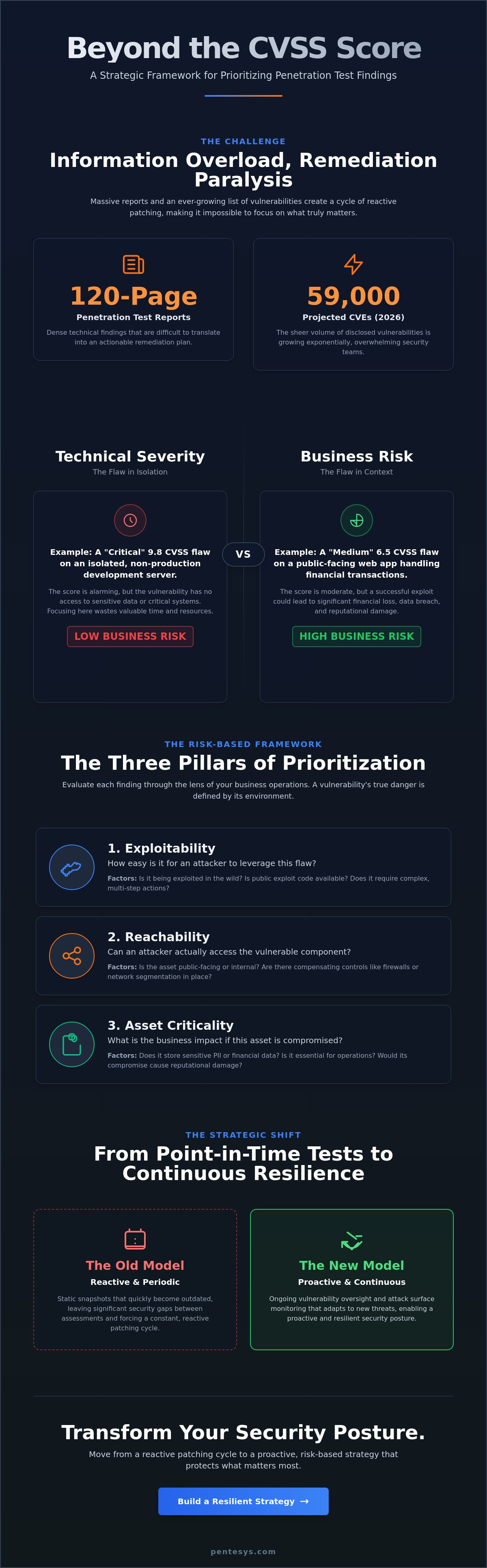
Relying solely on abstract numbers leads to inefficient resource allocation. Consider the “Severity vs. Risk” paradox. A “High” severity flaw might exist on an isolated development server with no access to sensitive data. Conversely, a “Medium” severity flaw could exist on a public-facing web application that handles financial transactions. In this scenario, the “Medium” flaw represents a significantly higher risk to the business. Automated scanners often exacerbate this issue by flagging thousands of alerts. These tools lack the intuition to understand how multiple minor flaws can be chained together to form a devastating attack path. Professional penetration testing goes beyond these static lists. It identifies the genuine adversarial paths that actually threaten your resilience.
The Difference Between Technical Severity and Business Risk
Technical severity is a measure of how “broken” a specific piece of software or configuration is. It looks at factors like how easy it is to exploit and what level of access it grants. Business risk is different. It considers the likelihood of an actual attack and the specific impact that attack would have on your operations, reputation, and bottom line. Vulnerability prioritisation is the alignment of remediation effort with potential business loss. By focusing on risk rather than just severity, you ensure that your security budget and team hours are spent where they matter most. This assessment stage is a critical part of the broader vulnerability management lifecycle, moving your team from a state of constant reaction to one of controlled oversight.
Why Context is the Missing Ingredient in Automated Reports
Environment-specific factors can completely nullify a high CVSS score. Effective network segmentation or the presence of robust endpoint detection can act as compensating controls. These are safeguards that an automated scanner cannot see, but a human tester can evaluate. Expert-led testing provides the narrative context required for prioritisation, helping you understand how a flaw fits into the larger picture of your security posture. When you understand how to prioritise vulnerabilities after a pen test using human expertise, you move away from the noise of automated scanners and focus on the vulnerabilities that pose a genuine threat to your organisational continuity.
The Risk-Based Framework: Mapping Technical Flaws to Business Impact
Developing a defensible strategy requires a shift from technical obsession to risk management. When determining how to prioritise vulnerabilities after a pen test, you must evaluate each finding through the lens of your business operations. A vulnerability does not exist in isolation; its danger is defined by its environment. We utilise a framework built on three fundamental pillars: Exploitability, Reachability, and Asset Criticality. This approach ensures that remediation efforts are concentrated on the paths an attacker is most likely to take.
Integrating real-world threat intelligence is a vital component of this framework. It allows you to identify which flaws are currently being exploited “in the wild” rather than just those that are theoretically possible. A robust model for this is the Stakeholder-Specific Vulnerability Categorization (SSVC), which prioritises decision-making based on the specific context of the stakeholder. By understanding the “Blast Radius”, which is the potential extent of lateral movement following an initial breach, you can better assess the true threat to your infrastructure. Weighting vulnerabilities based on the sensitivity of the data they expose, such as Special Category Data, is also essential for maintaining regulatory compliance and trust.
Assessing Exploitability and Reachability
Exploitability distinguishes between a theoretical weakness and a weaponised threat. A vulnerability with a publicly available exploit script poses a much higher immediate risk than one requiring specialized, custom-built tools. Reachability determines the ease of access. Is the service exposed to the open internet, or is it buried behind multiple layers of authentication? You must also account for “Chaining”. Adversaries rarely rely on a single Critical flaw. They often combine multiple Low-priority findings into a sophisticated, High-impact attack path that automated scanners frequently overlook. Our expert-led vulnerability management services help teams identify these hidden connections before they can be exploited.
Defining Asset Criticality Within Your Organisation
Not all hardware or software carries the same weight. You should categorise your assets into tiers to guide your response. A Tier 1 asset, such as a core customer database, is vital for operations. A Tier 3 asset, like an internal testing development box, is non-critical. A Medium flaw on a Tier 1 asset always trumps a Critical flaw on a Tier 3 asset because the potential for financial, legal, or reputational damage is far greater. Aligning asset value with business impact ensures that your technical teams aren’t wasting resources on low-value targets while critical systems remain exposed. This structured approach provides the clarity needed for effective executive decision-making and long-term resilience.
Navigating Compliance Requirements vs. Real-World Threat Landscapes
A common question arises once the final report is delivered: can we simply remediate the Critical findings to pass our upcoming audit? While this approach might satisfy a checklist, it often leaves the organisation vulnerable to sophisticated attackers who don’t follow a compliance schedule. Determining how to prioritise vulnerabilities after a pen test requires balancing the rigid timelines of regulatory frameworks with the fluid nature of the modern threat landscape. Compliance provides a necessary baseline for security, but it should never be mistaken for a complete defence against a determined adversary.
The tension between being compliance-led and threat-led is a constant challenge for security teams. Compliance-led strategies focus on obtaining a certificate or meeting a specific standard, whereas threat-led strategies focus on the actual techniques used by attackers. To find a middle ground, many organisations adopt CISA’s SSVC decision tree model. This methodology allows you to satisfy auditors by showing a structured process while ensuring that remediation effort is directed toward vulnerabilities that pose a genuine operational risk.
UK Compliance Drivers: ISO 27001 and Cyber Essentials
UK organisations face specific pressures from domestic and international frameworks. ISO 27001 Clause 6.1.2, for instance, requires a formal risk assessment process for all identified vulnerabilities. It isn’t enough to just fix the flaws; you must document the decision-making process behind why certain items were addressed before others. Similarly, Cyber Essentials Plus introduces a strict operational constraint. It requires the remediation of all Critical and High vulnerabilities within 14 days to maintain certification. Utilising CREST accredited penetration testing is often the most reliable way to satisfy these external auditors. This accreditation provides the high-level certainty that the assessment was conducted to a rigorous, industry-recognised standard.
The Danger of Compliance-Only Prioritisation
Passing an audit doesn’t mean your infrastructure is impenetrable. In many Red Teaming exercises, we’ve seen “Low” severity flaws, such as minor information disclosures or weak service configurations, used as the initial foothold for a full domain compromise. If you only focus on the top tier of a report, you miss the subtle gaps that allow for lateral movement. A strategic way to manage this is through a “Risk Acceptance” log. This allows you to document why certain vulnerabilities cannot be patched immediately for compliance purposes while still tracking them as active threats internally. This dual-track approach ensures you remain compliant without becoming complacent about the nuanced ways an attacker might bypass your primary defences.
The Remediation Workflow: From Pen Test Report to Verified Resolution
The delivery of the final report marks the beginning of the operational phase. Once you have established a strategy for how to prioritise vulnerabilities after a pen test, you must execute a structured remediation workflow. This process begins with triage and validation. It’s essential to confirm that each finding is applicable to your current environment and not a false positive before assigning resources. Some findings might be technically accurate but irrelevant due to specific local configurations. Following validation, stakeholder assignment ensures that specific technical teams own the fix, preventing critical issues from falling through organisational gaps. Clear ownership is the foundation of a successful security roadmap.
During this phase, you may need to choose between mitigation and remediation. Remediation involves a permanent fix, such as a software patch, code change, or hardware replacement. Mitigation, however, uses temporary “band-aids”—like a Web Application Firewall (WAF) rule or a temporary configuration change—to reduce risk while a permanent solution is developed. This distinction is vital for maintaining uptime while addressing high-risk flaws. The final, non-negotiable step is verification. A fix isn’t complete until an expert re-tests it to ensure the vulnerability is truly closed. This prevents the “whack-a-mole” scenario where one fix inadvertently opens a new gap elsewhere.
Managing Stakeholders and Remediation Buy-In
Presenting technical findings to the Board requires a shift in language. Avoid technical jargon that causes panic. Instead, translate technical debt into business terms such as potential downtime, regulatory fines, or loss of customer trust. Establishing a Remediation Service Level Agreement (SLA) with internal IT teams provides clear expectations for resolution times based on the risk levels identified in your framework. This structured approach builds confidence among executive stakeholders and ensures accountability across the organisation. It moves the conversation from a list of problems to a managed, business-centric recovery plan.
The Vital Role of Re-Testing
Updating software or changing a configuration setting doesn’t guarantee security. Patching processes can sometimes introduce new misconfigurations or fail to apply correctly across all instances. Relying on an internal “all clear” without external validation is a significant risk. We provide formal verification to close the loop on identified risks, ensuring your defences are as robust as intended. This human-led verification ensures that the remediation has been successful and hasn’t introduced secondary weaknesses. If you want to ensure your remediation efforts are effective and defensible, consider partnering with Pentesys for expert-led security assessments.
The Evolution of Vulnerability Management
The annual audit cycle is increasingly mismatched with the 24/7 reality of modern threat actors. Continuous Security Validation represents a significant maturity milestone for any organisation. It replaces the chaotic rush of post-test remediation with a steady, structured rhythm of discovery and resolution. Real security is found in the interval between formal tests. It’s the ongoing process of maintaining a hardened perimeter that truly deters sophisticated adversaries. This evolution ensures that your security posture remains dependable and aligned with the latest threat intelligence throughout the entire year.
How do we handle vulnerabilities that cannot be patched immediately?
When a patch isn’t immediately available or deployable, you should implement compensating controls to mitigate the risk. This might involve applying specific Web Application Firewall rules or temporary configuration changes to limit the vulnerability’s reachability. This “band-aid” approach provides essential protection while your technical teams work toward a permanent remediation, ensuring that the business remains resilient and secure during the interim period.
What is a “Risk Acceptance” and when is it appropriate to use one?
A Risk Acceptance is a formal document where a business stakeholder acknowledges a specific security risk and chooses not to remediate it immediately. This is appropriate when the cost or operational impact of a fix outweighs the risk itself. It’s a standard part of a mature how to prioritise vulnerabilities after a pen test strategy, provided the decision is reviewed periodically by leadership.
Why do different pen testing firms give different scores for the same flaw?
Scoring differences often arise because different firms apply varying levels of contextual analysis to a finding. While the CVSS score is a technical standard, the final risk rating depends on how a tester perceives the flaw’s reachability and asset criticality within your specific environment. This is why human intuition and manual evaluation are superior to fully automated scoring systems that lack an understanding of your business.
Founder & CEO, Pentesys
James Hinton is the founder of Pentesys, a CREST-approved UK company working only on offensive security: penetration testing, PTaaS, CTEM, external attack surface management and red teaming. He built the business around one discipline rather than a broad consultancy menu, and most of his time still goes on how engagements get scoped, delivered and reported. He writes here about the practical side of security testing and what buyers should be asking for.
LinkedIn profile