

Overview
Threat-led penetration testing differs from a standard red team exercise in where the scenarios come from. Rather than agreeing objectives directly with the client, a threat intelligence provider builds a picture of who realistically targets organisations like yours and how they operate, and the testing team works to those scenarios. Frameworks such as TIBER-EU formalise this, and DORA has brought it into scope for more financial entities.
Understanding Vulnerability Management Tools in 2026
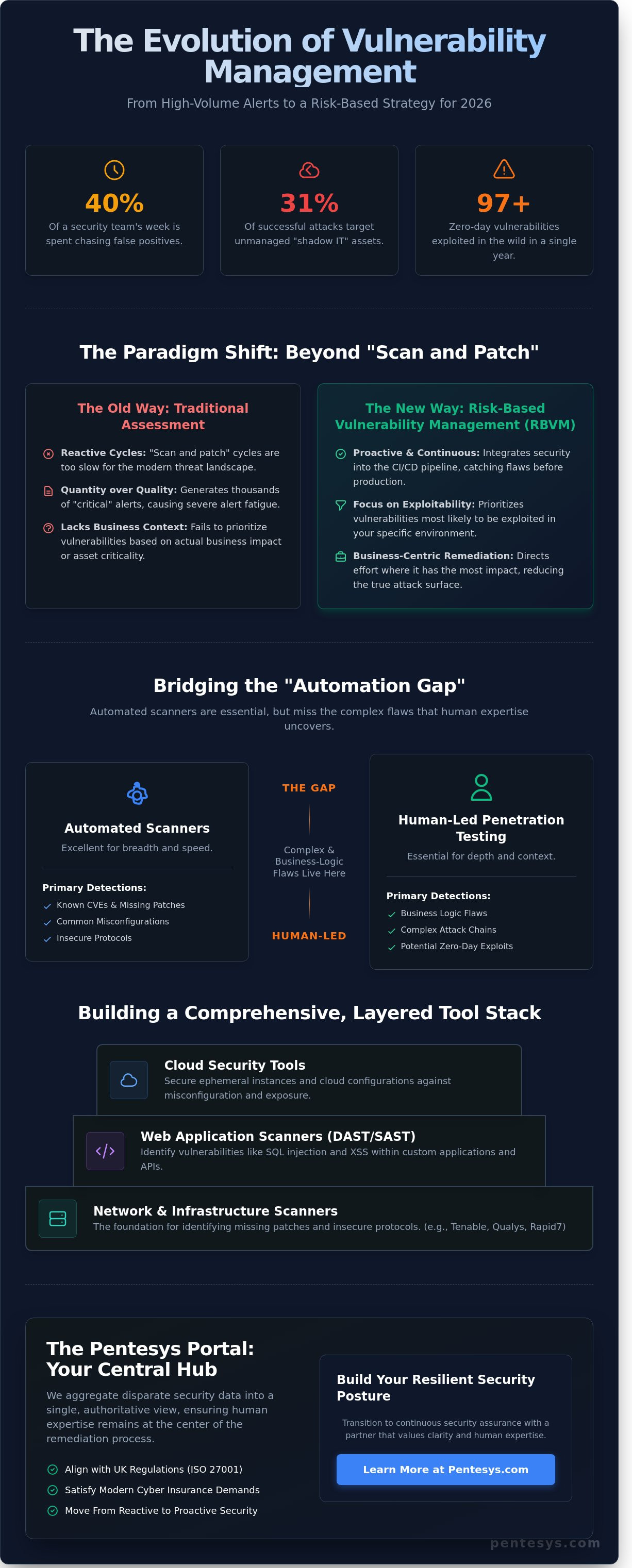
Vulnerability management tools have moved past the era of simple network scanning. By 2026, UK organisations have realised that a list of 10,000 “critical” vulnerabilities is a burden rather than a benefit. Modern security requires a transition from basic assessment to Risk-Based Vulnerability Management (RBVM). This shift reflects a maturing market where the focus is on exploitability and business impact rather than just technical severity. Understanding Vulnerability Management as a continuous lifecycle is now a prerequisite for operational resilience, especially as UK regulators move away from accepting annual point-in-time testing as sufficient proof of security.
The Pentesys Portal serves as the central hub for this modern approach. It aggregates disparate security data into a single, authoritative view, allowing technical teams to move beyond spreadsheet-based tracking. By centralising findings from various vulnerability management tools, the portal ensures that human expertise remains at the centre of the remediation process. It’s about providing assurance that’s grounded in real-world threat intelligence, not just automated outputs.
The Core Components of a Modern VM Programme
Effective protection starts with comprehensive asset discovery. You can’t protect what you can’t see; unmanaged shadow IT is a common target for successful cyber attacks. Modern programmes utilise a blend of active and passive scanning. Active methods provide deep visibility into system configurations, while passive scanning monitors network traffic to identify devices without interrupting critical services. Prioritisation is the final pillar. While CVSS scores provide a baseline, they lack business context. A modern vulnerability management tools strategy must weigh a vulnerability’s severity against the criticality of the asset it affects and the presence of compensating controls.
Why “Scan and Patch” is No Longer Sufficient
The speed of exploitation has reached a point where traditional “scan and patch” cycles are too slow to be effective. In 2023, Mandiant reported that 97 zero-day vulnerabilities were exploited in the wild, a significant increase that highlights the volatility of the threat landscape. Security teams must now integrate their tools directly into CI/CD pipelines to catch flaws before code reaches production. RBVM represents the shift from quantity to quality in risk reduction by focusing on the vulnerabilities most likely to be exploited within a specific business environment. This methodology ensures that remediation efforts are directed where they’ll have the most significant impact on reducing the organisation’s overall attack surface.
Categorising the Toolset: Infrastructure, Web, and Cloud
Effective Threat-Led Penetration Testing (TLPT) relies on a diverse array of vulnerability management tools to map an organisation’s attack surface accurately. UK businesses operating in 2024 must account for hybrid environments where traditional on-premise hardware sits alongside ephemeral cloud instances. A singular tool cannot provide total visibility; instead, a layered approach ensures that infrastructure, web applications, and cloud configurations are all scrutinised under a unified methodology. Breaches and attacks remain common among UK businesses, highlighting the necessity of this multi-layered technical oversight.
Network and Infrastructure Scanning
Infrastructure scanners serve as the primary diagnostic layer for network security. Industry leaders like Tenable, Qualys, and Rapid7 provide the technical foundation for identifying missing patches and insecure protocols. Choosing between agent-based and agentless scanning remains a pivotal decision for security teams. Agentless scanning allows for rapid, non-intrusive discovery of assets across a network, while agent-based solutions provide deeper visibility into remote devices that don’t always connect to the corporate VPN. These tools are essential for identifying misconfigurations in firewall settings and server hardening. Following OWASP’s guide to vulnerability management ensures these scans are integrated into a wider lifecycle rather than treated as isolated events. While these tools provide the data, our experts use the Pentesys Portal to contextualise these findings, moving beyond raw data to provide actionable remediation guidance.
Application and API Security Tools
As organisations shift toward SaaS and API-first architectures, the focus of vulnerability management tools has moved up the stack. Web Application Security Testing involves both Dynamic Analysis (DAST) and Static Analysis (SAST). Burp Suite Professional remains the definitive choice for hybrid testing, allowing our consultants to combine automated crawling with manual logic checks. This human-led intervention is vital; automated tools often miss complex authorisation flaws that a specialist can identify in minutes. For organisations managing complex software supply chains, Software Composition Analysis (SCA) is now a requirement to identify vulnerabilities in third-party libraries. Securing the API layer requires looking beyond the standard OWASP Top 10 to address Broken Object Level Authorisation (BOLA) and mass assignment issues. You can view our full range of testing services to see how we integrate these technical checks into a broader security assurance framework.
Modern resilience requires more than just a list of bugs. It demands a strategic approach to cloud security. Cloud Security Posture Management (CSPM) tools for platforms like AWS and Azure are now indispensable. These tools identify “shadow IT” and misconfigured S3 buckets that often lead to data exposure. By combining these automated insights with human intuition, Pentesys ensures your organisation transitions from point-in-time testing to a state of continuous security assurance.
Automated Scanning vs. Human-Led Penetration Testing
Effective security isn’t a choice between software and people. It’s a strategic alignment of both. Automated vulnerability management tools excel at scale. They can scan thousands of assets in minutes, identifying known CVEs and misconfigurations that would take a human weeks to find. However, these tools operate within fixed parameters. They lack the cognitive flexibility to chain minor issues together into a catastrophic breach.
The “Automation Gap” represents the space where business logic resides. A scanner might confirm that a web form accepts input, but it won’t realise that a specific sequence of inputs allows an unauthorised user to change a product’s price from £500 to £0.01. This is why CISA’s approach to vulnerability management highlights the need for a comprehensive view of risk that goes beyond simple detection. Human-led adversarial simulation fills this gap by replicating the creative, unpredictable nature of a real-world attacker.
The Limitations of Automated Scanners
Automated scanners often generate a high volume of false positives. Security teams spend a significant share of their time chasing alerts that pose no actual threat. This drain on developer productivity creates friction between security and engineering teams. While a tool finds the open door, a pen tester finds the reason the lock was broken. Scanners identify the symptom, but they cannot diagnose the systemic failure that allowed the vulnerability to exist in the first place.
Human Intelligence as a Force Multiplier
Human intelligence provides the contextual risk assessment that software cannot replicate. An expert tester understands if a vulnerability is actually exploitable within your specific UK environment, considering existing controls and network architecture. This leads to precise remediation guidance. Instead of a generic patch list, you receive a prioritised roadmap for long-term resilience. This strategic approach ensures that resources are directed where they provide the most significant security ROI.
The Pentesys philosophy centres on this expert-led evaluation. We don’t just deliver a PDF of scan results. Our consultants use the Pentesys Portal to provide actionable insights, moving your organisation toward a “Continuous Assurance” model. This hybrid approach uses vulnerability management tools for baseline visibility while deploying human expertise for deep-dive adversarial testing. It’s a methodical process that replaces technical noise with genuine peace of mind, ensuring your security posture remains robust against sophisticated threats.
Selecting a Tool Stack for UK Regulatory Compliance
UK organisations face a tightening regulatory environment where point-in-time assessments are no longer sufficient. The transition to ISO 27001:2022 requires a strategic shift towards continuous monitoring and automated evidence collection, specifically under Annex A 8.8. Selecting the right vulnerability management tools is now a requirement for maintaining compliance and securing cyber insurance renewals. UK insurers increasingly ask for proof of active vulnerability remediation rather than an annual check-box exercise.
To meet these standards, your tool stack must do more than just identify flaws. It needs to provide a clear audit trail that links technical findings to business risk. Centralising this data within a dedicated reporting hub, such as the Pentesys Portal, allows executive teams to present a unified security posture during audits. This structured approach ensures that complex technical data becomes actionable insight for board-level stakeholders, bridging the gap between deep-tech execution and enterprise-grade resilience.
Compliance-Driven Tool Selection
Modern audits for GDPR and ISO 27001 demand granular audit trails. Your chosen vulnerability management tools should provide timestamped records of discovery, prioritisation, and remediation. Automated scanning supports this by providing continuous visibility, while external attack surface monitoring (EASM) identifies forgotten assets that often fall outside traditional scopes. More medium to large businesses now use automated tools to identify security gaps than in previous years.
The CREST Standard for UK Businesses
While automation provides scale, CREST-accredited testing remains the gold standard for UK security assurance. Accreditation ensures that the human intelligence behind your testing adheres to rigorous ethical and technical standards. Professional, human-led testing is essential to validate the efficacy of your automated tools, ensuring that false positives don’t clutter your remediation pipeline. This combination of technology and expertise provides the “assurance” rather than just “testing” that regulators expect.
You can learn more about how these standards protect your business by reading about CREST Accredited Penetration Testing UK Benefits. This accreditation acts as a seal of quality, confirming that your security partners possess the high-level competence required for complex adversary simulations.
Build a resilient compliance framework with a partner that values human intuition as much as technical innovation. Contact Pentesys today to align your security testing with UK regulatory standards.
The PTaaS Revolution
Static PDF reports are historical documents the moment they’re exported. Penetration Testing as a Service (PTaaS) replaces these relics with real-time dashboards that offer immediate visibility into your security posture. This model effectively eliminates the 364-day visibility gap left by traditional annual testing cycles. By integrating continuous feedback loops, your internal teams can validate remediations as soon as they’re implemented.
The Pentesys Portal serves as the central hub for this transformation. It turns raw data into actionable business insights, allowing stakeholders to track progress and prioritise resources where they’ll have the most significant impact. PTaaS represents the logical conclusion of the journey for firms that have outgrown basic vulnerability management tools and require a more sophisticated, enterprise-grade solution.
- Real-time updates: Move away from static reporting to a dynamic view of your attack surface.
- Accelerated remediation: Shorten the time between discovery and fix with direct access to testing experts.
- Operational efficiency: Integrate security findings directly into your existing development workflows.
Delivering Comprehensive Threat Intelligence for TIBER-EU
At Pentesys, we recognise the critical role that threat intelligence plays in the successful execution of Threat-Led Penetration Testing under the TIBER-EU framework. Our dedicated team of cybersecurity experts delivers precise and actionable threat intelligence designed specifically for your organisation’s unique risk environment. By leveraging our extensive knowledge and cutting-edge tools, we provide you with the insights needed to identify potential vulnerabilities and anticipate emerging threats.
Our threat intelligence services are meticulously tailored to support TIBER testing, ensuring that your institution is prepared to face the sophisticated threat landscape. By seamlessly integrating threat intelligence with our TLPT solutions, we enable you to not only comply with regulatory demands but also strengthen your resilience against future cyber threats.
Through our commitment to excellence, Pentesys stands as your trusted partner in navigating the complexities of cybersecurity compliance and maintaining robust operational resilience.
Delivering Expert Red Teaming for TIBER-EU
Recognising the importance of rigorous testing in enhancing cybersecurity resilience, Pentesys delivers expert red teaming services as part of our comprehensive TIBER-EU solutions. Our red teaming exercises simulate realistic attack scenarios, mirroring the tactics, techniques, and procedures (TTPs) used by potential adversaries. This allows your organisation to evaluate its security posture and uncover areas of improvement.
Our team of seasoned security professionals meticulously designs each red teaming engagement to align with your specific objectives, risk appetite, and threat landscape. By employing state-of-the-art methodologies and adhering to the TIBER-EU framework, we ensure that your testing process is both robust and compliant.
Ultimately, our red teaming services empower you to enhance your defensive strategies, improve incident response capabilities, and foster a culture of perpetual security improvement. By choosing Pentesys, you are investing in a proactive approach to cybersecurity that not only meets regulatory expectations but also fortifies your organisation against evolving threats.
Founder & CEO, Pentesys
James Hinton is the founder of Pentesys, a CREST-approved UK company working only on offensive security: penetration testing, PTaaS, CTEM, external attack surface management and red teaming. He built the business around one discipline rather than a broad consultancy menu, and most of his time still goes on how engagements get scoped, delivered and reported. He writes here about the practical side of security testing and what buyers should be asking for.
LinkedIn profile