

Overview
Special category data under Article 9, covering health, biometrics, ethnicity and the rest, attracts stricter handling than ordinary personal data. In practice it rarely leaks from the database designed to hold it. It leaks through logs, exports, support tooling, analytics pipelines and integrations built by people who did not know what the field contained.
This guide provides a clear, actionable roadmap to master these legal requirements and implement technical security measures that stand up to rigorous scrutiny. We’ll examine the specific data types defined under UK GDPR, outline a strategic approach to remediation, and show you how to provide the human-led assurance your stakeholders and insurers demand. By moving from static compliance to a model of continuous resilience, you can secure your most sensitive assets while building long-term trust.
What is Special Category Data? Defining Sensitivity in 2026
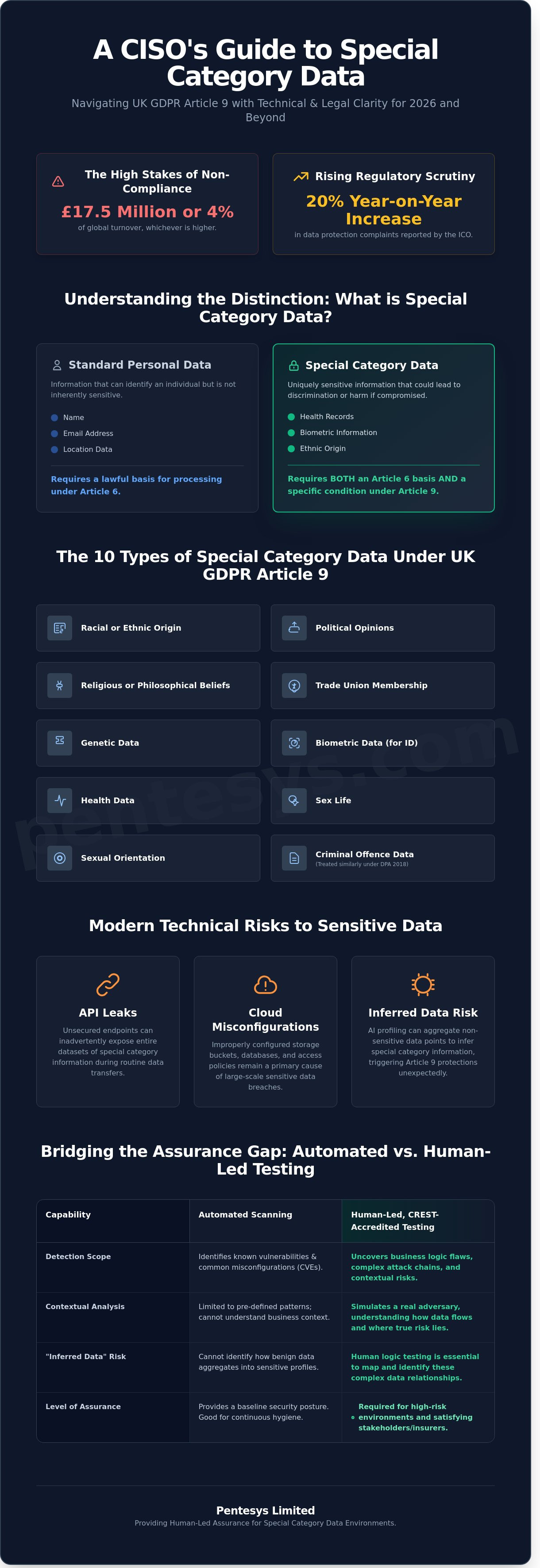
Special category data represents personal information that is uniquely sensitive, posing significant risks to an individual’s fundamental rights and freedoms if it’s compromised. Under the General Data Protection Regulation, this classification includes details regarding racial or ethnic origin, political opinions, religious beliefs, trade union membership, genetic data, biometric data for identification, health data, and information concerning a person’s sex life or sexual orientation. The core principle driving this distinction is the potential for discrimination or severe personal harm. Unlike standard personal identifiers like an email address or name, these data points require a higher threshold of security and a specific legal justification for processing.
Compliance requires a dual-track approach. You must first establish a lawful basis under Article 6, such as consent or legitimate interests. However, processing sensitive information also demands meeting one of the ten specific conditions outlined in Article 9. This isn’t a mere administrative hurdle; it’s a technical mandate. Extra protection means implementing robust encryption, strict access controls, and continuous monitoring to ensure the data remains isolated from unauthorised exposure during network transfers. For a modern enterprise, these requirements transform security from a checkbox exercise into a foundational element of technical architecture.
The Legal Framework: UK GDPR and the Data (Use and Access) Act
The legislative landscape shifted significantly with the implementation of the Data (Use and Access) Act in 2025. This update refines how British businesses manage digital identities and data sharing while maintaining the high standards set by the Information Commissioner’s Office (ICO). Documentation alone is no longer sufficient for modern UK compliance audits. The ICO now prioritises evidence of operational resilience over static policy papers. Organisations must demonstrate active risk management through regular technical assurance and documented remediation guidance to prove they meet 2026 standards.
Inferred Data: When General Info Becomes Special Category
The rise of sophisticated AI profiling means that non-sensitive data can quickly transition into special category data through high-level analysis. For example, a series of location pings near a specialist medical clinic or a pattern of specific retail purchases can reveal health status or religious affiliations. The ICO’s 2026 guidance clarifies that if an organisation uses data to infer sensitive traits, that data must be treated with Article 9 protections immediately. Pentesys identifies these hidden data risks during assessments by combining human-led logic testing with automated analysis within the Pentesys Portal to map how seemingly benign data strings aggregate into sensitive profiles.
The 10 Types of Special Category Data Under Article 9
Many organisations confuse business-sensitive information with the legal definition of special category data. While a proprietary price list or a strategic merger plan is sensitive to your commercial interests, they don’t trigger the stringent protections of Article 9 of the UK GDPR. Special category data refers specifically to information that is inherently personal and potentially discriminatory. Under the current regulatory framework, there are 10 distinct types of data that require a specific condition for processing beyond a standard lawful basis. These include racial origin, ethnic origin, political opinions, religious beliefs, philosophical beliefs, trade union membership, genetic data, biometric data used for identification, health data, and information concerning an individual’s sex life or sexual orientation.
Processing this information in a commercial environment is prohibited unless you meet one of the specific conditions outlined in the legislation, such as explicit consent or the necessity for employment law obligations. A common mistake occurs when firms treat employee sick notes or diversity monitoring forms with the same security protocols as standard contact details. According to 2023 enforcement trends from the ICO, a significant number of data protection complaints stem from the internal mishandling of employee health records. For a detailed breakdown of these legal requirements, you should consult the ICO guidance on special category data to ensure your compliance framework is robust.
Health, Genetic, and Biometric Information
Health data represents the most frequent special category risk for UK employers. It’s often scattered across email attachments and HR systems. Biometric data, such as fingerprint scans or facial recognition, only falls under Article 9 when it’s used specifically for identification purposes. To maintain security, genetic data must be isolated within cloud environments using hardware-based encryption. Our remediation guidance ensures that these high-risk assets aren’t left exposed during routine network transfers.
Political, Religious, and Philosophical Beliefs
Information regarding trade union membership or political affiliations is a high-value target for state actors and hacktivists. These groups seek to exploit such data for reputational damage or targeted social engineering. During our adversary simulation exercises, we often find that staff members inadvertently reveal these vulnerabilities through seemingly benign internal surveys. Protecting this data requires more than just encryption; it requires a culture of technical assurance where access is restricted to the absolute minimum number of users.
Racial, Ethnic, and Sexual Orientation Data
Organisations often collect diversity and inclusion data to meet ESG goals, yet they fail to apply appropriate technical safeguards to the resulting databases. Legacy systems are particularly vulnerable, as they often lack the granular access controls needed to protect these identities. We recommend a strategy of pseudonymisation, where identifying markers are stored separately from the attributes themselves. This ensures that even if a database is compromised, the special category data remains disconnected from the individual’s identity, providing a critical layer of resilience.
In addition to technical safeguards, fostering an inclusive environment requires accessible communication; for instance, organisations can explore British Sign Language (BSL) Interpreting to ensure their engagement strategies align with modern accessibility and governance standards.
Technical Risks and Vulnerabilities in Sensitive Data Handling
Security professionals treat special category data as the ultimate “crown jewel” during adversary simulations. This information carries a high resale value on illicit markets, making it a primary target for sophisticated threat actors. The cost of a data breach in the United Kingdom often escalates when sensitive Article 9 data is involved. According to ICO guidance on special category data, these datasets require a higher standard of protection because they are more sensitive by nature. Technical flaws like misconfigured cloud buckets or weak encryption protocols frequently undermine these protections, leaving organisations vulnerable to targeted attacks.
Pentesys Limited provides the necessary assurance by simulating real-world adversary tactics to identify unauthorised access paths. While automated tools might flag a missing header, our human-led testing uncovers complex logic flaws that allow lateral movement toward sensitive data stores. We validate the “extra protection” mandate through a rigorous methodology that ensures security controls aren’t just present but effective against sophisticated threats. Our team focuses on identifying the specific routes an attacker would take to reach your most sensitive assets, providing actionable insights for remediation.
API Security and Data Exfiltration
APIs are the primary conduit for data exchange in UK Fintech, yet they often serve as the weakest link in the security chain. We frequently identify Broken Object Level Authorisation (BOLA) during assessments of health-tech platforms. In these scenarios, one user can access another’s medical records by simply changing an ID in a request. Automated vulnerability scans consistently fail to detect these logical errors because they don’t understand the underlying business context. Our expert-led API testing methodology goes beyond surface-level checks to interrogate the business logic, preventing data exfiltration before it occurs.
Cloud Misconfigurations and Identity Management
Identity sprawl is a growing concern in AWS and Azure environments. It often results in excessive permissions that grant users or services more access than required for their roles. Our team focuses on hardening these environments to prevent lateral movement, which is a common tactic used by attackers to reach sensitive databases. We identify over-privileged accounts that could serve as entry points for an adversary. Continuous monitoring through the Pentesys Portal prevents configuration drift in sensitive environments by providing real-time visibility into security posture changes. This proactive approach ensures that the rigorous standards established during initial deployment remain intact over time.
Best Practices for Securing Special Category Data
Effective protection of special category data starts with a “Security by Design” approach. This is not merely a conceptual framework; it is a legal obligation under Article 25 of the UK GDPR. You must integrate data protection into your system architecture from the initial planning phase rather than treating it as an afterthought. Completing a Data Protection Impact Assessment (DPIA) is mandatory for all high-risk processing activities. This document identifies specific risks to individuals and establishes the necessary mitigations to reduce those risks to an acceptable level.
The concept of proactive protection extends beyond digital systems to the physical environments where sensitive data, such as children’s health information, is often collected; for instance, facility managers can discover SoftplayToys4kids to find safety-first soft play mats that enhance the security and well-being of their physical spaces.
Under the Data Protection Act 2018, processing sensitive info often requires an “appropriate policy document”. This internal record explains your procedures for complying with the principles of Article 5. We help you structure technical controls so they align directly with these policy requirements. This ensures your operational reality matches your legal obligations. In the event of an ICO audit, having this alignment documented is vital for demonstrating accountability.
Insurers increasingly ask for granular proof of security validation when offering cover. Regular security validation provides the objective evidence needed to satisfy these underwriters. It shifts your strategy from static, point-in-time testing to a model of continuous assurance, which is essential for maintaining long-term resilience.
Encryption and Access Control Strategies
Standard “encryption at rest” is no longer sufficient for modern network transfers. You need robust end-to-end protection that secures special category data during every stage of its journey. Implementing a Zero Trust architecture ensures that no user or device is trusted by default, regardless of their location on the network. We use the Pentesys Portal to provide a clear, centralised view of your security posture. This proprietary hub allows your team to track the remediation of access control flaws in real time, moving from discovery to resolution with absolute clarity.
Staff Training and Social Engineering
The human element remains the primary vulnerability in any security chain. The ICO has reported that most data breaches involve some form of human error or social engineering. Technical shields cannot stop an employee from inadvertently sharing sensitive information if they are targeted by a sophisticated adversary simulation. Simulated phishing tests provide a safe environment to evaluate how employees handle requests for sensitive info. These exercises help create a culture of security that respects the gravity of Article 9 data, transforming your staff into an informed line of defence.
Expert-Led Penetration Testing and Red Teaming
Automated tools often miss the nuanced logic flaws that sophisticated attackers exploit. We prioritise human-led testing because automated scans can’t replicate human intuition or adversarial creativity. Our penetration tests are customised to focus on your most critical data assets, ensuring that special category data remains isolated and protected during transfer.
Detailed reporting provides actionable insights for both IT departments and Data Protection Officers (DPOs). We bridge the gap between technical vulnerabilities and business risk. Our red teaming exercises go a step further, providing adversarial simulations that prove your detection and response capabilities. This isn’t just about finding holes; it’s about validating that your security team can see and stop an active threat in real-time.
Continuous Security Validation
Static annual testing is no longer sufficient for high-stakes environments. The UK Government’s Cyber Security Breaches Survey 2024 found that many UK businesses experienced a breach or attack in the previous 12 months. Relying on a point-in-time assessment leaves gaps that attackers can exploit between audits. Pentesys helps you transition to a proactive posture through continuous external attack surface monitoring.
This ongoing oversight ensures that new vulnerabilities are identified the moment they appear. It transforms security from a chaotic yearly event into a managed, dependable process. By monitoring your environment 24/7, we provide the peace of mind that your defensive controls are evolving as fast as the threat landscape. It’s time to move beyond reactive fixes and embrace professional assurance.
Contact Pentesys today for a professional security assessment to secure your organisation’s future.
Is criminal offence data considered special category data under UK GDPR?
Criminal offence data isn’t classified as special category data; it’s managed under a separate framework in Article 10 of the UK GDPR. While it requires similar levels of protection, the Data Protection Act 2018 provides distinct rules for its processing. You must identify both a lawful basis under Article 6 and a specific condition for processing under Schedule 1 of the 2018 Act to handle this information legally.
What is the “Appropriate Policy Document” and when is it required?
An Appropriate Policy Document (APD) is a concise record that outlines how you comply with data protection principles when processing sensitive information. You need an APD whenever you process special category data under the specific conditions set out in Parts 1, 2, or 3 of Schedule 1 of the Data Protection Act 2018. It must explain your procedures for securing the data and specify your internal retention and erasure policies.
Is biometric data always classified as special category data?
Biometric data is only classified as special category data when it’s processed for the purpose of uniquely identifying a natural person. If you use facial recognition for security access, it falls under Article 9. However, using a digital photograph for a standard ID badge doesn’t usually meet this threshold unless it’s processed through specific technical means to confirm an identity or extract physiological data.
Founder & CEO, Pentesys
James Hinton is the founder of Pentesys, a CREST-approved UK company working only on offensive security: penetration testing, PTaaS, CTEM, external attack surface management and red teaming. He built the business around one discipline rather than a broad consultancy menu, and most of his time still goes on how engagements get scoped, delivered and reported. He writes here about the practical side of security testing and what buyers should be asking for.
LinkedIn profile