

Overview
An internal team knows the estate in a way no external tester will after a week of scoping. That familiarity is also the limitation: people who helped design a system rarely attack it the way a stranger would, and internal findings carry less weight with auditors and customers. Organisations that can afford both tend to run an internal capability for continuous coverage and bring in external testers for depth and independence.
We understand that choosing a security model isn’t just about headcount; it’s about establishing a defensible posture that satisfies UK GDPR and the duties proposed in the Cyber Security and Resilience Bill. This guide provides a clear framework to help you evaluate the strategic value of building an internal function versus partnering with specialized offensive security experts. You’ll gain a roadmap for achieving long-term resilience through expert-led evaluation, ensuring your chosen path provides the independent validation necessary for modern compliance.
The Evolution of Offensive Security: In-House vs Outsourced Models
The landscape of offensive security has moved past simple vulnerability scanning. In 2026, the debate regarding in-house vs outsourced penetration testing is no longer just about cost; it’s about strategic alignment and technical certainty. The UK regulatory environment, specifically through the Network and Information Systems (NIS) Regulations and the Cyber Security and Resilience Bill currently before Parliament, points toward a level of oversight that static, internal-only assessments struggle to provide. Organisations must now prove they have the resilience to withstand sophisticated targeted attacks, not just that they’ve run a script.
Many organisations previously viewed penetration testing as an annual compliance checkbox. This approach fails in an era of rapid deployment and complex cloud architectures. Corporate governance now requires independent validation to ensure that security measures are effective against real-world threats rather than just meeting minimum legal standards. Relying solely on internal teams can lead to institutional blindness where vulnerabilities are missed because they’re part of the daily operational landscape. A fresh, external perspective is often the only way to break through this bias.
What is In-House Penetration Testing?
Building an in-house function involves hiring a permanent team of offensive security researchers within your organisation. This model excels at providing deep internal context. These testers understand the nuances of your legacy systems and bespoke architectures better than an external party might. By integrating into the product lifecycle, they can identify flaws during the development phase. The primary focus here is on continuous integration and long-term familiarity with the internal environment. However, it’s often difficult to maintain an adversarial mindset when you’re part of the same team you’re testing.
What is Outsourced Penetration Testing?
Outsourcing involves partnering with specialized offensive security firms for either point-in-time or continuous assessments. This model prioritises objectivity and technical authority from accredited experts. External partners bring diverse industry experience. They’ve seen attack patterns across various sectors that an internal team wouldn’t encounter. This approach provides a level of professional assurance that satisfies both internal stakeholders and external regulators. It often utilises a central platform to manage vulnerabilities in real-time, moving away from static reports toward a dynamic security posture that emphasizes human intelligence over automated shortcuts.
The Operational Reality of Building an In-House Team
While many organisations consider building an internal capability to gain more control, the operational reality often proves more complex than initially anticipated. Evaluating in-house vs outsourced penetration testing requires an honest look at the long-term management of specialized human capital. It isn’t just about the base salary; it’s about the infrastructure and culture required to sustain an offensive mindset within a defensive organisation. Managing a team of researchers whose primary goal is to break systems requires a different leadership approach than managing standard IT operations.
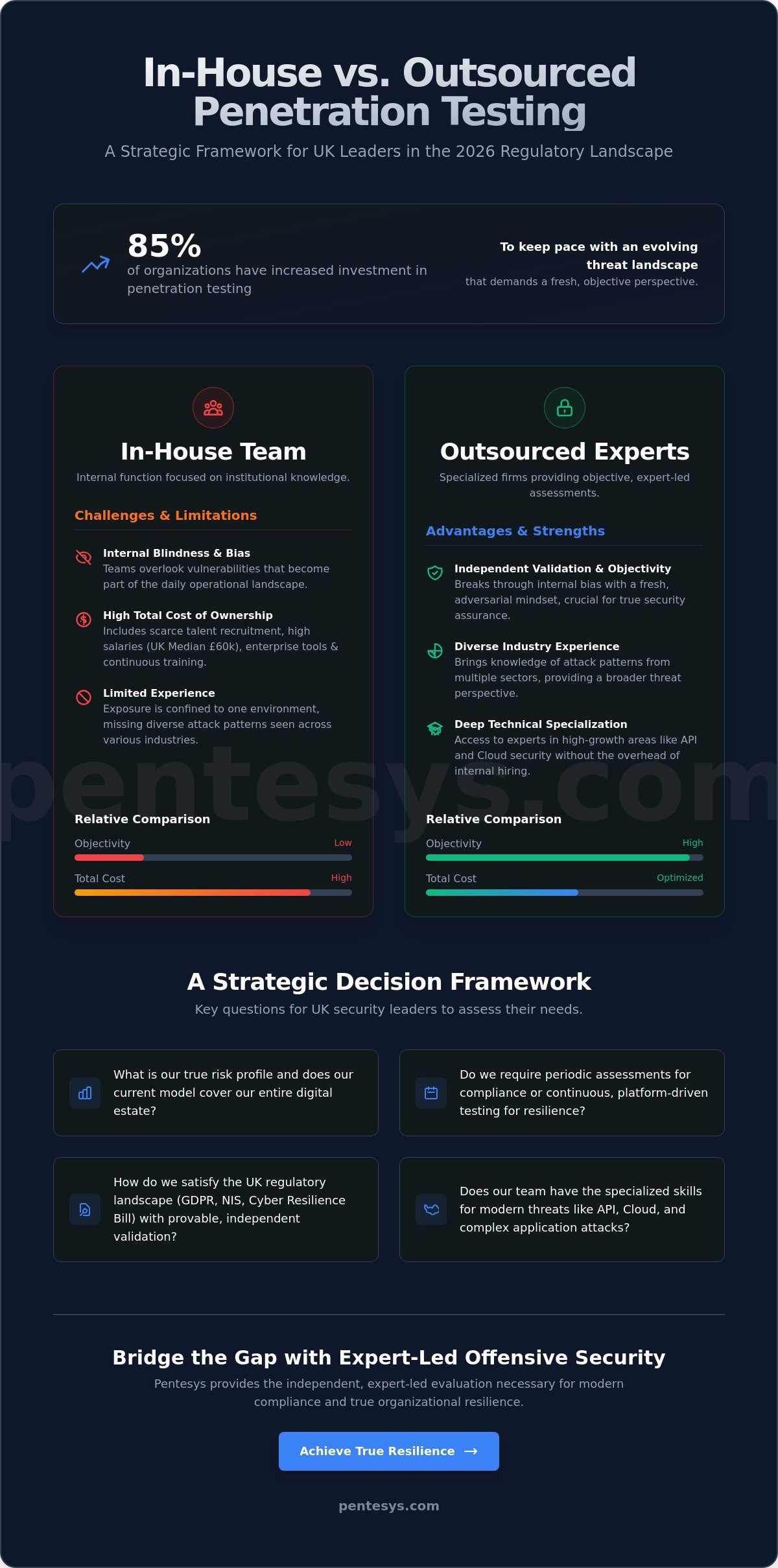
One of the most significant strategic risks is cognitive bias. Internal teams often become accustomed to the organisation’s architectural quirks, leading to a phenomenon known as internal blindness. They might overlook a critical misconfiguration because it has become a standard part of the operational landscape. This is where balancing in-house and third-party penetration testing becomes critical. An external partner brings the adversarial rigor necessary to challenge established norms without the baggage of internal politics or departmental silos.
The Recruitment and Retention Hurdle
Top-tier offensive talent is exceptionally scarce in the current market. Most high-level practitioners prefer the variety found in consultancy, where they encounter diverse environments and complex challenges every week. For an internal team, this creates a high risk of a single point of failure. If your lead tester departs for a more varied role, your entire offensive security program can stall for months during a difficult recruitment cycle.
Tooling and Infrastructure Overhead
The cost of an internal team extends far beyond headcount. Effective testing requires a dedicated, isolated laboratory environment that mimics real-world attack infrastructure. You must also account for the ongoing cost of enterprise-grade vulnerability scanners and specialized exploitation frameworks, which often carry substantial annual licensing fees. Beyond commercial tools, your team will likely develop bespoke scripts to handle unique architectures. Managing the technical debt of these internally developed tools ensures they remain effective as your digital estate evolves, adding another layer of unbudgeted management overhead.
If you find that the burden of managing internal labs and recruitment cycles is detracting from your core strategic objectives, consider how expert-led security assessments can streamline your defensive strategy while maintaining high-level certainty.
Why Outsourcing Provides Superior Security Assurance
When weighing the benefits of in-house vs outsourced penetration testing, the primary advantage of the latter is the preservation of total objectivity. An external partner operates without the constraints of internal politics or the desire to protect a colleague’s code. This independence ensures that findings are presented with technical authority, providing executive stakeholders with a clear, unbiased view of the organisation’s risk profile. It transforms security from a subjective internal debate into a rigorous, evidence-based discipline.
Specialization is another critical factor. While an internal team might be proficient in general network security, they rarely possess the deep expertise required for niche areas like API Security Testing, mobile application hardening, or complex cloud configurations. By partnering with an offensive security firm, you gain access to a diverse pool of specialists who spend their entire careers focused on specific attack vectors. This depth of knowledge is essential for securing modern, distributed architectures that rely on thousands of interconnected endpoints.
From a governance perspective, outsourcing is often a prerequisite for high-level compliance. Many UK industries require CREST Accredited Penetration Testing UK to satisfy external auditors and regulatory bodies. This accreditation provides a baseline of reliability and technical competence that internal teams, regardless of their skill level, often cannot officially match. It serves as a seal of quality that demonstrates to partners and clients that your security posture has been validated by an independent, industry-recognised authority.
The Value of an External Perspective
External testers bring the benefit of cross-pollination. Because they work across multiple industries, they’ve encountered a vast array of attack patterns and defensive failures. This experience allows them to identify logic flaws that internal developers often overlook because they’re too close to the project. These flaws aren’t always technical bugs; they’re often conceptual errors in how a business process is handled, which can only be spotted by someone looking at the system through a fresh, adversarial lens.
Human Intuition vs Automated Shortcuts
The signature quality marker of high-end testing is the reliance on manual, expert-led evaluation rather than automated shortcuts. While automated tools are useful for identifying low-hanging fruit, they lack the intuition required to chain multiple minor vulnerabilities into a significant breach. Human hackers can understand context, spot subtle anomalies, and pivot through a network in ways a script cannot. Human-led red teaming provides a level of detection testing that automated scanning simply cannot replicate, as it simulates the persistence and creative lateral movement of a real-world adversary. This methodical approach ensures a level of certainty that automation alone will never achieve.
A Strategic Decision Framework for UK Security Leaders
The choice between in-house vs outsourced penetration testing is rarely a binary one. Instead, sophisticated UK organisations adopt a hybrid model based on the complexity of their digital estate. A clear decision framework prioritises high-value assets and regulatory obligations while optimizing internal resources for daily operational hygiene. You must evaluate your risk profile against the speed of your development cycles; a CI/CD pipeline requires a different level of oversight than a stable legacy infrastructure. Technical certainty is the ultimate goal, and achieving it requires a balance of internal context and external rigor.
Compliance is a significant driver in this framework. Many UK security leaders find that achieving or maintaining ISO certification requires a level of independent validation that an internal team cannot provide. Auditors look for the absence of conflict of interest, making external evaluation a non-negotiable requirement for high-stakes corporate governance. When calculating the true ROI of your security function, you must weigh the total cost of ownership (TCO) of an internal department against the precision and scalability of external partnerships. An internal function might seem cost-effective initially, but the recurring expenses for continuous training and tool maintenance often shift the balance in favor of a managed, expert-led model.
When to Keep it In-House
Internal resources are best utilised where high-frequency, low-complexity testing is required. If your development squads need real-time feedback on minor changes, embedding security champions within those squads ensures that security remains a foundational part of the build process. This model is also effective for managing highly sensitive, air-gapped environments where strict physical access controls make external engagement logistically complex. In these cases, internal staff provide the daily operational support needed to maintain basic security hygiene and ensure that immediate, tactical fixes are implemented without delay.
When Outsourcing is Non-Negotiable
Outsourcing becomes essential when technical certainty and deep specialization are paramount. Before major releases, rigorous Web Application Penetration Testing ensures that complex logic flaws are identified by experts who specialize in breaking modern web architectures. Similarly, when testing your incident response capabilities, executing high-pressure Red Teaming simulations provides a realistic assessment of how your defences hold up against a sophisticated adversary. These engagements provide the board-level reporting necessary to prove resilience to stakeholders and regulators, offering a level of assurance that internal self-assessment simply cannot match.
If you’re ready to move beyond static evaluations and establish a more resilient security posture, explore our expert-led offensive security services to align your testing model with your 2026 business objectives.
Our Methodology: Precision and Clarity
We follow a modular, step-by-step methodology designed to convey complex technical risks with absolute clarity. Whether we’re assessing cloud environments or traditional infrastructure, our process remains structured and dependable. Each engagement results in a detailed report that bridges the communication gap between technical teams and executive decision-makers. We provide actionable remediation advice, ensuring your IT department has a clear roadmap to strengthen the organisation’s posture. This focus on technical assurance provides the peace of mind that your security model meets the most rigorous UK standards.
Is it cheaper to hire an in-house penetration tester or outsource?
Outsourcing is generally more cost-effective for most organisations when you consider the total cost of ownership. An internal tester in the UK commands a significant salary, which doesn’t include benefits, continuous training, or expensive enterprise tool licensing. Outsourcing allows you to access a full team of specialists for a fraction of that annual overhead while avoiding the costs of a specialized laboratory environment.
What are the main risks of relying solely on an in-house security team?
The primary risks include cognitive bias, single points of failure, and limited technical breadth. The decision between in-house vs outsourced penetration testing often reveals that internal staff become blind to recurring misconfigurations over time. Additionally, the high turnover rate in the UK security market means your offensive capability can vanish if a key lead departs, leaving your organisation vulnerable during a lengthy recruitment cycle.
Can we use a hybrid model of in-house and outsourced testing?
A hybrid model is often the most resilient approach for sophisticated organisations. Internal “security champions” can handle day-to-day hygiene and provide real-time feedback within development squads to catch low-level flaws early. Meanwhile, outsourced partners provide the deep specialization and independent validation required for high-stakes releases, Red Teaming simulations, and regulatory compliance audits, ensuring a balanced and defensible security posture.
Founder & CEO, Pentesys
James Hinton is the founder of Pentesys, a CREST-approved UK company working only on offensive security: penetration testing, PTaaS, CTEM, external attack surface management and red teaming. He built the business around one discipline rather than a broad consultancy menu, and most of his time still goes on how engagements get scoped, delivered and reported. He writes here about the practical side of security testing and what buyers should be asking for.
LinkedIn profile