

Overview
In 2026, a penetration test is no longer a discretionary security expense; it’s a technical audit that validates your organisation’s market valuation and operational resilience. While the average penetration testing cost uk businesses encounter can vary significantly based on scope, the real price of an assessment is measured by the depth of assurance it provides. You likely feel the pressure of budget fatigue from an ever-expanding stack of security tools, making it difficult to justify why human-led testing remains a non-negotiable requirement.
It’s challenging to quantify the value of preventing a breach that hasn’t happened yet, especially when low-assurance automated alternatives seem more cost-effective on paper. This guide helps you bridge that gap by providing a clear framework for calculating ROI and articulating the strategic necessity of manual expertise. You’ll learn how to align your security objectives with the UK’s Cyber Security and Resilience (CS&R) Bill. We will provide the executive-ready language needed to ensure your budget request speaks the language of risk management and corporate accountability that your board expects.
The 2026 Security Landscape: Why “Good Enough” is a Financial Liability
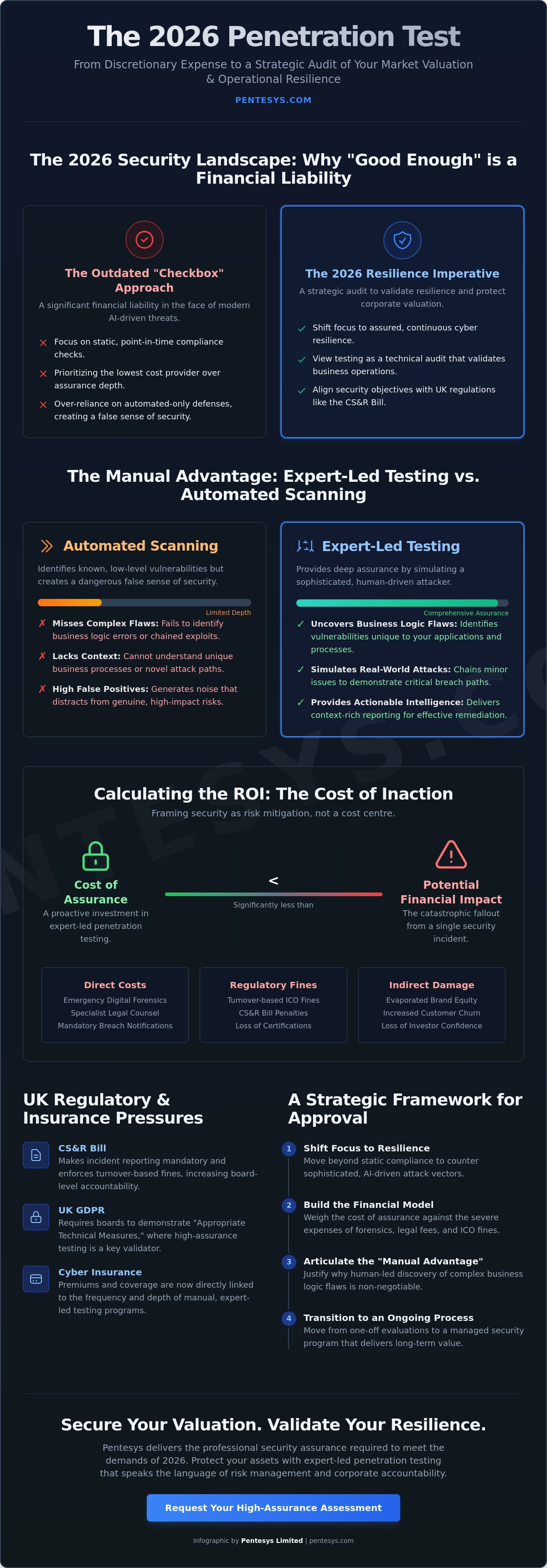
The security environment in 2026 demands a fundamental shift in how UK businesses perceive risk. For years, many organisations viewed security as a checkbox exercise. They often prioritised the lowest penetration testing cost uk providers to satisfy basic compliance. This approach is now a significant financial liability. Modern threats have evolved. Attackers now use sophisticated AI to automate the discovery of vulnerabilities, making “good enough” security a primary target. Understanding the total penetration testing cost uk involves looking beyond the day rate and considering the cost of a failed audit or a successful breach.
High-assurance testing provides a clear contrast to these automated threats. It is a methodical, expert-led evaluation of your entire digital estate. Understanding what penetration testing is helps clarify why it serves as a strategic audit rather than just a technical scan. It validates your corporate valuation by proving that your operational resilience can withstand targeted, human-driven attacks. We are seeing a move away from periodic, point-in-time checks toward a model of continuous resilience validation that aligns with business objectives.
The Failure of Automated-Only Defences
Automated scanners are helpful for identifying known, low-level vulnerabilities, but they often miss the complex logic flaws inherent in modern SaaS and API architectures. These tools look for patterns they already know. They cannot understand the context of a unique business process or how multiple minor issues can be chained together to create a critical breach. Relying solely on software creates a dangerous false sense of security. A green light on a dashboard doesn’t mean you’re safe; it just means the scanner didn’t find the specific things it was programmed to see. Human intuition remains the only reliable way to identify novel exploit paths that sophisticated adversaries use.
Regulatory and Insurance Pressures in the UK
The UK regulatory environment has tightened significantly. The Cyber Security and Resilience Bill would extend UK incident reporting duties for in-scope organisations. Check where your sector sits before assuming it applies to you. This puts immense pressure on boards to demonstrate “Appropriate Technical Measures” under UK GDPR. UK cyber insurance providers have also matured. Premiums are now directly linked to the frequency and depth of manual testing. To maintain certifications like ISO 27001 or Cyber Essentials Plus, you must show more than just a list of patched vulnerabilities. You need to demonstrate a proactive, ongoing commitment to resilience. High-quality testing isn’t just a cost; it’s a prerequisite for staying insurable and compliant in a high-stakes market.
Calculating the ROI: Transitioning from Cost Centre to Risk Mitigation
Security budgets are often viewed as a sunk cost, yet this perspective fails to account for the catastrophic financial exposure of a successful breach. To secure executive approval, you must frame high-assurance testing as a strategic asset. In the UK, the average penetration testing cost uk businesses encounter represents a small fraction of the potential fallout from a single security incident. Shifting the conversation from “what we spend” to “what we protect” allows the board to see testing as a form of financial hedging.
A breach triggers a chain reaction of immediate and long-term expenses. Direct costs include emergency digital forensics, specialist legal counsel, and any regulatory notifications you are obliged to make. These are followed by turnover-based fines from the ICO. Indirectly, the damage is often more profound. Brand equity evaporates, customer churn increases, and investor confidence can take a visible hit. A professional test acts as a technical audit that validates your resilience, ensuring the penetration testing cost uk organisations pay remains a proactive investment rather than a reactive penalty.
The “Cost of Inaction” (COI) Formula
CFOs and Financial Directors prioritise data-driven decisions. You can articulate security risk using a simple COI formula: (Probability of Breach x Potential Financial Impact) vs. Cost of Assurance. High-assurance testing directly reduces the “Probability” variable by identifying and remediating vulnerabilities before they are exploited. This approach aligns with guidance from CISA regarding the necessity of proactive assessments. Defining your “Risk Appetite” in these terms allows the finance team to treat security as a managed business risk rather than a discretionary technical expense.
Protecting Corporate Valuation and Trust
Security is now a primary competitive advantage in the UK B2B sector. Procurement teams and immediate suppliers increasingly demand proof of recent manual testing before awarding high-value contracts. A transparent and robust security posture accelerates the sales cycle by removing friction during due diligence. This commercial necessity is why many firms are now moving toward continuous penetration testing explained as a method to maintain trust year-round. Protecting your corporate valuation requires a commitment to reliability that partners can verify. If you want to strengthen your market position, aligning with a specialist testing partner can help you quantify and mitigate your current exposure accurately.
Expert-Led Testing vs. Automated Scanning: Justifying the Premium
Automated scanning is a functional component of a modern security stack. It handles the high-volume task of identifying known, low-level vulnerabilities across a large attack surface. However, when evaluating the total penetration testing cost uk organisations face, it’s vital to distinguish between these automated scans and a true, expert-led assessment. Automated tools follow pre-programmed scripts. They lack the cognitive ability to understand business context or chain multiple minor issues into a significant compromise. This is why automated results often fail to reflect the actual risk posed by a determined adversary.
The “Manual Advantage” lies in the human tester’s ability to identify business logic flaws. These are vulnerabilities that arise from how an application is designed to function, rather than a simple coding error. A human expert mimics actual adversary behaviour, looking for ways to bypass authorisation or manipulate data flows. This level of scrutiny is essential for high-assurance environments and is a core requirement of CREST accredited penetration testing UK. Without this human intuition, your organisation remains blind to the very exploits that sophisticated attackers prioritise.
The Limitations of Commodity Testing
Many budget providers offer “cheap” tests that are little more than automated vulnerability assessments mislabelled as penetration tests. This creates a dangerous false economy. You might receive a 200-page report filled with “report bloat,” which is automated noise that lacks prioritisation or context. This is fundamentally different from a professional engagement. As outlined in NIST’s Technical Guide to Information Security Testing, a robust methodology involves active exploitation and analysis that software simply cannot replicate. “Cheap” tests result in higher long-term costs because they leave critical risks undiscovered, leading to a much higher penetration testing cost uk when the inevitable breach occurs.
Manual Testing as a Strategic Audit
Think of an expert-led penetration test as a strategic audit of your internal IT team’s performance. It provides an objective, external perspective on how well your security controls actually work in practice. The most valuable part of a manual engagement isn’t just the discovery of flaws; it’s the remediation advice phase. A specialist doesn’t just tell you what’s broken. They explain how to fix it in the context of your specific infrastructure. This provides the “High Certainty” required for Board-level sign-off. It transforms a technical report into a roadmap for long-term resilience, ensuring your security investment produces measurable organisational value.
Building the Business Case: A Strategic Framework for Executive Approval
Securing a budget for high-assurance testing requires a shift in communication. You must move away from technical vulnerability lists and toward a strategic framework that resonates with board-level priorities. When presenting the penetration testing cost uk to your executive team, start by aligning the test scope with specific business objectives. If you’re launching a new API or expanding into a regulated market, the test isn’t just a security check. It’s a validation of that project’s viability and safety.
Your business case should follow a modular, logical progression. Map every testing requirement to your current regulatory and contractual obligations, such as the UK’s CS&R Bill or specific supply chain requirements from B2B partners. Instead of a single quote, present a tiered options paper. Contrast a basic compliance check with comprehensive resilience testing. This allows the CFO to choose between meeting a baseline and investing in genuine organisational safety. Always lead with a “Risk Reduction” narrative. Executives care about the probability of operational downtime, not the technical nuances of a cross-site scripting flaw. Finally, define a clear post-test roadmap. Showing how you’ll manage remediation and monitoring proves that the budget isn’t just for a one-off event, but for a managed process of improvement.
Translating Technical Risk into Business Impact
A successful pitch translates technical findings into the language of the balance sheet. Use a simple translation table to make the “So What?” clear for every vulnerability. For example, a critical SQL injection vulnerability isn’t just a database flaw; it represents a high probability of a UK GDPR data breach and subsequent turnover-based fines. Broken authentication is more than a login issue; it’s the potential for total account takeover and loss of customer trust. By using active, functional language, you describe the impact on business operations, making the penetration testing cost uk feel like a necessary insurance premium for your digital assets.
The Power of the Executive Summary
The executive summary is the most critical page of your proposal. It’s often the only part the CFO reads in detail. Focus on three primary metrics: Risk Coverage, Compliance Status, and Return on Security Investment (ROSI). Explain that the cost of delay far outweighs the cost of proactive discovery. If you need assistance in framing your requirements for a board-level audience, contact Pentesys Limited for a strategic scoping session to ensure your business case is robust and defensible.
Our Methodology: Human Intelligence, Technical Precision
Pentesys Limited specializes in high-level certainty across Web Application Penetration Testing, Infrastructure Penetration Testing, and Cloud Security Assessments. We use adversarial simulations to evaluate your detection and response capabilities, providing a realistic view of your security posture. Central to our delivery is our proprietary platform, which serves as the primary hub for all service activity. This technology ensures a structured and transparent experience, making the assessment process inseparable from our brand identity and commitment to reliability.
Can I use penetration testing to lower my cyber insurance premiums?
Yes, many UK insurers now link premium levels and coverage terms to the frequency and quality of your security assessments. By demonstrating a proactive commitment to manual testing and remediation, you provide the evidence of “Appropriate Technical Measures” that underwriters require. This proactive stance often results in more favorable terms because it reduces the insurer’s perceived risk of a major claim and demonstrates a mature approach to risk management.
What happens if the penetration test finds critical vulnerabilities?
Finding critical vulnerabilities is a positive outcome that allows you to remediate risks before they are exploited by malicious actors. A professional provider will issue an immediate alert for high-risk findings so your team can begin patching vulnerabilities straight away. Following the initial test, you’ll receive a structured report with prioritised recommendations and a roadmap for retesting to confirm that your fixes are effective and your resilience is restored.
Founder & CEO, Pentesys
James Hinton is the founder of Pentesys, a CREST-approved UK company working only on offensive security: penetration testing, PTaaS, CTEM, external attack surface management and red teaming. He built the business around one discipline rather than a broad consultancy menu, and most of his time still goes on how engagements get scoped, delivered and reported. He writes here about the practical side of security testing and what buyers should be asking for.
LinkedIn profile