

Overview
The promise of thousands of global researchers finding every vulnerability in your stack sounds like the ultimate security net, yet many organisations find themselves drowning in a sea of low-quality reports and unpredictable costs. While crowdsourced models offer breadth, they often lack the depth and methodological rigor required for true organisational resilience. You’re likely weighing up the bug bounty program vs penetration testing debate to decide where your security budget delivers the most reliable value.
It’s a common challenge to manage a “pay-per-bug” model that complicates your ISO 27001 or SOC2 compliance efforts rather than streamlining them. This guide provides a clear framework to help you choose between these two distinct models. You’ll discover which method offers a better ROI for remediation and how to align your strategy with the proposals in the UK Cyber Security and Resilience Bill. We’ll examine the transition from static evaluations to managed security oversight, ensuring your defence remains as sophisticated as the threats you face.
Defining the Models: Bug Bounty Programs and Penetration Testing
Offensive security has matured into a sophisticated discipline where strategic oversight is prioritised over simple vulnerability discovery. By 2026, UK enterprises have recognised that resilience isn’t a one-off achievement but a managed, ongoing process. This shift has placed the bug bounty program vs penetration testing debate at the centre of corporate security strategy. While both models fall under the offensive security umbrella, they offer different levels of reliability. Penetration testing provides a controlled, deep-dive evaluation of specific assets, while bug bounties offer a broad, incentive-driven net.
The Bug Bounty Philosophy: Crowdsourced Resilience
The bug bounty model operates on the principle of crowdsourced intelligence. To understand what is a bug bounty program, you must view it as an incentive-based ecosystem where independent researchers, or “bounty hunters,” compete for financial rewards. These programs are governed by a Vulnerability Disclosure Policy (VDP), which outlines the rules of engagement and the scope of testing. The primary appeal lies in its continuous nature; assets are under constant scrutiny by a global crowd. However, this model often rewards “the lucky find” over a systemic review. Researchers naturally gravitate toward vulnerabilities that are easiest to exploit or offer the highest payouts, which can leave quieter, more complex architectural flaws untouched.
The Penetration Testing Philosophy: Methodical Assurance
Methodical assurance is the hallmark of professional penetration testing. Unlike the fragmented efforts of a crowd, a penetration test is a structured engagement led by accredited experts who follow rigorous methodologies like OWASP for applications or NIST for infrastructure. This approach ensures that every corner of the target environment is evaluated, regardless of whether a “bounty” is attached to it. Human expertise remains the critical differentiator here. A skilled tester uses intuition to chain multiple low-severity issues into a significant exploit, providing a level of depth that automated tools cannot replicate.
Choosing between a bug bounty program vs penetration testing often depends on the maturity of the asset being tested. For UK organisations, the structured approach of a penetration test provides the formal accreditation and documented evidence anticipated by the Cyber Security and Resilience Bill. It moves the conversation from “did we find a bug?” to “is our entire system resilient?” by providing clear, actionable remediation paths and direct access to the testing team for strategic guidance. This level of professional assurance is a primary differentiator for enterprises that value high-level certainty over the volume-heavy reports of the crowd.
Methodology vs. Serendipity: How Vulnerabilities are Discovered
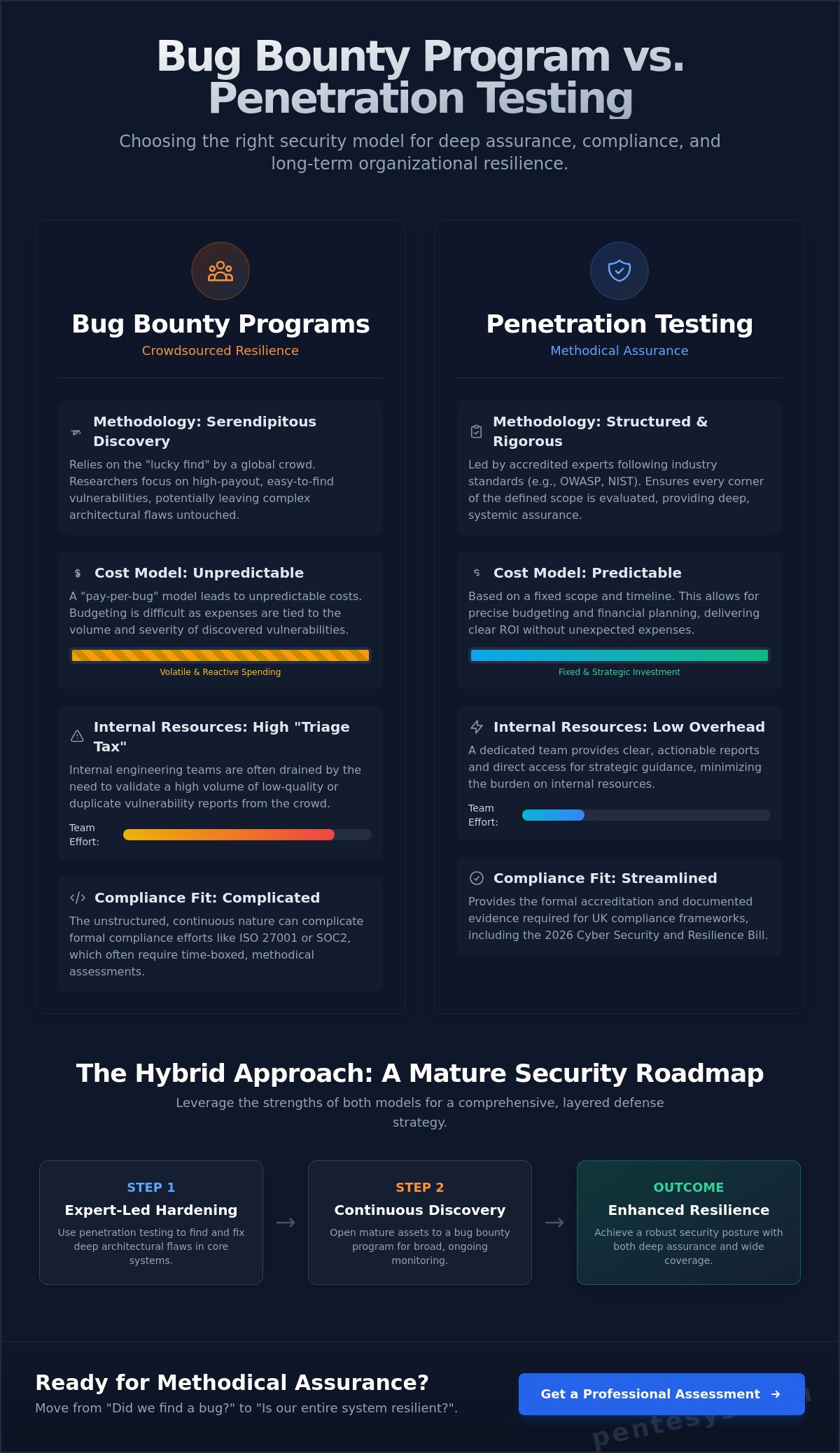
The core distinction in the bug bounty program vs penetration testing comparison lies in how the assessment is executed. One relies on a systematic, comprehensive review, while the other depends on the curiosity and availability of a decentralized crowd. Professional penetration testing is built on a foundation of methodology. It ensures that every asset within a defined scope is scrutinized, regardless of how “exciting” or “profitable” a specific vulnerability might be to an individual researcher. This structured approach moves beyond the “lucky find” to provide a holistic view of your security posture.
Structured Scope: The Advantage of Penetration Testing
When you engage in professional Infrastructure Penetration Testing, the goal isn’t just to find a single way into the network. It’s to validate the entire security posture of your estate. This provides what’s known as “negative assurance.” This concept is vital for executive peace of mind; it’s the professional confirmation that a system is resilient because it’s been rigorously tested against a full spectrum of threats, not just because no one has reported a bug yet. By defining clear boundaries, you ensure that critical business logic and less obvious entry points are thoroughly evaluated by experts who understand your specific operational context.
Crowdsourced Chaos: The Reality of Bug Bounty Hunting
In contrast, the bug bounty model often leads to a “race to the bottom.” Because hunters are only paid for unique, valid reports, they naturally focus on high-reward, easy-to-identify vulnerabilities. This competitive pressure often results in shallow testing. A researcher might spend thirty minutes scanning for a common misconfiguration but skip the deep, context-heavy analysis required to find a complex flaw in your unique application architecture. Without a direct line of communication between the hunter and your developers, the context required to uncover deep-seated architectural issues is often lost.
This lack of structured coverage can create a false sense of security. If a thousand hunters look at your external attack surface and find nothing, it doesn’t mean your systems are safe. It might simply mean the bounty wasn’t high enough to justify the hours of manual, expert-led evaluation required to bypass your specific defences. Professional testers, however, simulate specific adversarial TTPs (Tactics, Techniques, and Procedures) to replicate how a persistent threat actor would actually target your business. This methodical approach identifies systemic weaknesses that the crowd, driven by quick payouts, will likely overlook.
The ROI Reality: Cost, Triage, and Internal Resource Drain
The financial appeal of a “pay-per-vulnerability” model often masks the true operational costs involved. Many organisations initially favor the bug bounty approach because they believe it limits spending to successful outcomes. However, a strategic comparison of a bug bounty program vs penetration testing reveals that the former often introduces significant hidden expenses. These costs frequently manifest as a “triage tax” that drains internal engineering resources and complicates annual budgeting.
Hidden Costs of Bug Bounty Programs
Managing a crowdsourced program requires a constant commitment of time and capital. Beyond the bounty payouts themselves, platform fees can often exceed the actual rewards paid to researchers. The most significant hidden cost, however, is the internal resource drain. For every critical vulnerability discovered by the crowd, security teams often have to filter through dozens of duplicate, out-of-scope, or low-quality reports. This triage process requires full-time attention from senior engineers who could otherwise be focused on high-value development or remediation tasks.
Budget volatility also presents a challenge for CFOs. A bug bounty program is inherently unpredictable; a single discovery of a critical smart contract flaw or a major architectural weakness can result in a massive payout requirement during a low-cash month. This lack of predictability makes it difficult to align security spending with broader corporate financial cycles. Without a fixed-cost structure, the program can quickly become an open-ended financial commitment rather than a controlled security investment.
The Efficiency of Professional Security Assessments
Professional penetration testing offers a more predictable and efficient alternative. By utilising a fixed-cost model, organisations gain absolute certainty over their security spend. This allows for precise financial planning while ensuring that the depth of the assessment isn’t limited by the current bounty budget. A professional report delivers high-signal, expert-verified findings that eliminate the noise common in crowdsourced results. This clarity allows your development team to move straight to remediation without spending hours debating the validity of a report.
Direct access to the testing team further increases efficiency. When an engineer has a question about a specific finding, they can speak directly with the expert who discovered it. This collaborative approach reduces the time spent in “back-and-forth” communications, which is a common frustration in bug bounty ecosystems. For organisations that require both frequency and reliability, Continuous Penetration Testing provides a modern solution that balances ongoing oversight with the predictable ROI of an expert-led engagement. This ensures that security remains a managed process rather than a series of chaotic, one-off events.
Compliance and Professional Assurance in the UK
For UK enterprises, the choice between a bug bounty program vs penetration testing is often dictated by the rigorous demands of regulatory frameworks and audit standards. While a crowdsourced model identifies individual flaws, it rarely provides the formal documentation required to satisfy a discerning auditor. Professional assurance isn’t just about finding bugs; it’s about proving that a methodical, repeatable process has been applied to secure your most sensitive data assets.
Meeting Regulatory and Audit Standards
Auditors for ISO 27001 and SOC2 require more than a list of addressed vulnerabilities. They look for evidence of a structured methodology and a “clean” report that details the exact scope of testing activity. A bug bounty summary often lacks this depth, as researchers don’t document the areas they tested where no vulnerabilities were found. This lack of “negative assurance” makes it difficult to prove comprehensive coverage during a third-party risk assessment.
In the context of GDPR and the protection of special category data, the accountability lies with the organisation to demonstrate proactive security oversight. CREST Accredited Penetration Testing has become the gold standard in the UK because it guarantees that the testing is performed by vetted professionals bound by a strict code of conduct. This level of professional liability is a critical requirement for UK Cyber Insurance underwriting, where insurers prioritise the predictable rigor of accredited firms over the variable results of an anonymous crowd.
The Hybrid Approach: Building a Mature Security Roadmap
The most resilient UK organisations don’t view the bug bounty program vs penetration testing debate as a binary choice. Instead, they treat these models as complementary stages of a maturing security posture. By orchestrating these methods into a phased roadmap, businesses move from reactive vulnerability discovery to managed, proactive oversight. This progression ensures that resources are allocated efficiently while maintaining the highest levels of professional assurance.
A strategic roadmap typically follows a three-phase progression:
- Phase 1: Baseline Hardening. Every roadmap begins with expert-led assessments. Before inviting the public to test an application, you must ensure that common vulnerabilities are identified and remediated. Engaging in Web Application Penetration Testing or Cloud Security Assessment provides the foundational certainty needed to proceed.
- Phase 2: Vulnerability Disclosure Policy (VDP). Once your environment is hardened, implementing a VDP establishes a formal channel for ethical researchers to report findings. This provides a structured way to handle unsolicited reports without the immediate financial pressure of a full bounty program.
- Phase 3: Crowdsourced Expansion. A full bug bounty program is reserved for mature, battle-tested applications. At this stage, your internal teams are equipped to handle the triage process, and the “low-hanging fruit” has already been cleared by professional testers.
Integrating Penetration Testing into the SDLC
In 2026, the shift from point-in-time annual audits to continuous validation is essential. Integrating testing directly into your Software Development Life Cycle (SDLC) allows for rapid feedback loops. Our central platform facilitates this by managing External Attack Surface Monitoring alongside ongoing testing schedules. This ensures every new release is professionally validated before it hits the crowd. This methodical approach prevents the “triage tax” discussed earlier by ensuring that only complex, novel vulnerabilities remain for researchers to find.
When to Launch a Bug Bounty Program
Launching a program too early is a common strategic error. If your application hasn’t undergone a recent, deep-dive assessment, the volume of reports from a crowd will likely overwhelm your engineering team. A “Maturity Test” determines if your remediation cycles can keep pace with the influx of data. Many firms find success by starting with a private bounty program. This limits the participants to a small group of vetted researchers, acting as a controlled middle ground in the bug bounty program vs penetration testing journey. The final recommendation for any sophisticated enterprise is clear: build your foundation on professional assurance, then scale your reach with the crowd.
Do I need a Vulnerability Disclosure Policy (VDP) if I have penetration testing?
Yes, a VDP is a vital component of a mature security strategy. While penetration testing provides deep, expert-led evaluation of specific assets, a VDP creates a legal and structured channel for ethical researchers to report flaws they might discover incidentally. It acts as a continuous safety net for your wider estate, ensuring that any external findings are handled through a managed, transparent process.
Can bug bounty hunters test my internal network and cloud infrastructure?
Bug bounty hunters typically focus on public-facing web applications and APIs. Testing internal networks or complex cloud configurations requires the deep access and controlled environment of a professional Infrastructure Penetration Test or Cloud Security Assessment. These expert-led engagements allow for a thorough review of internal configurations and lateral movement risks that are generally outside the scope of a public bounty program.
Founder & CEO, Pentesys
James Hinton is the founder of Pentesys, a CREST-approved UK company working only on offensive security: penetration testing, PTaaS, CTEM, external attack surface management and red teaming. He built the business around one discipline rather than a broad consultancy menu, and most of his time still goes on how engagements get scoped, delivered and reported. He writes here about the practical side of security testing and what buyers should be asking for.
LinkedIn profile