

Overview
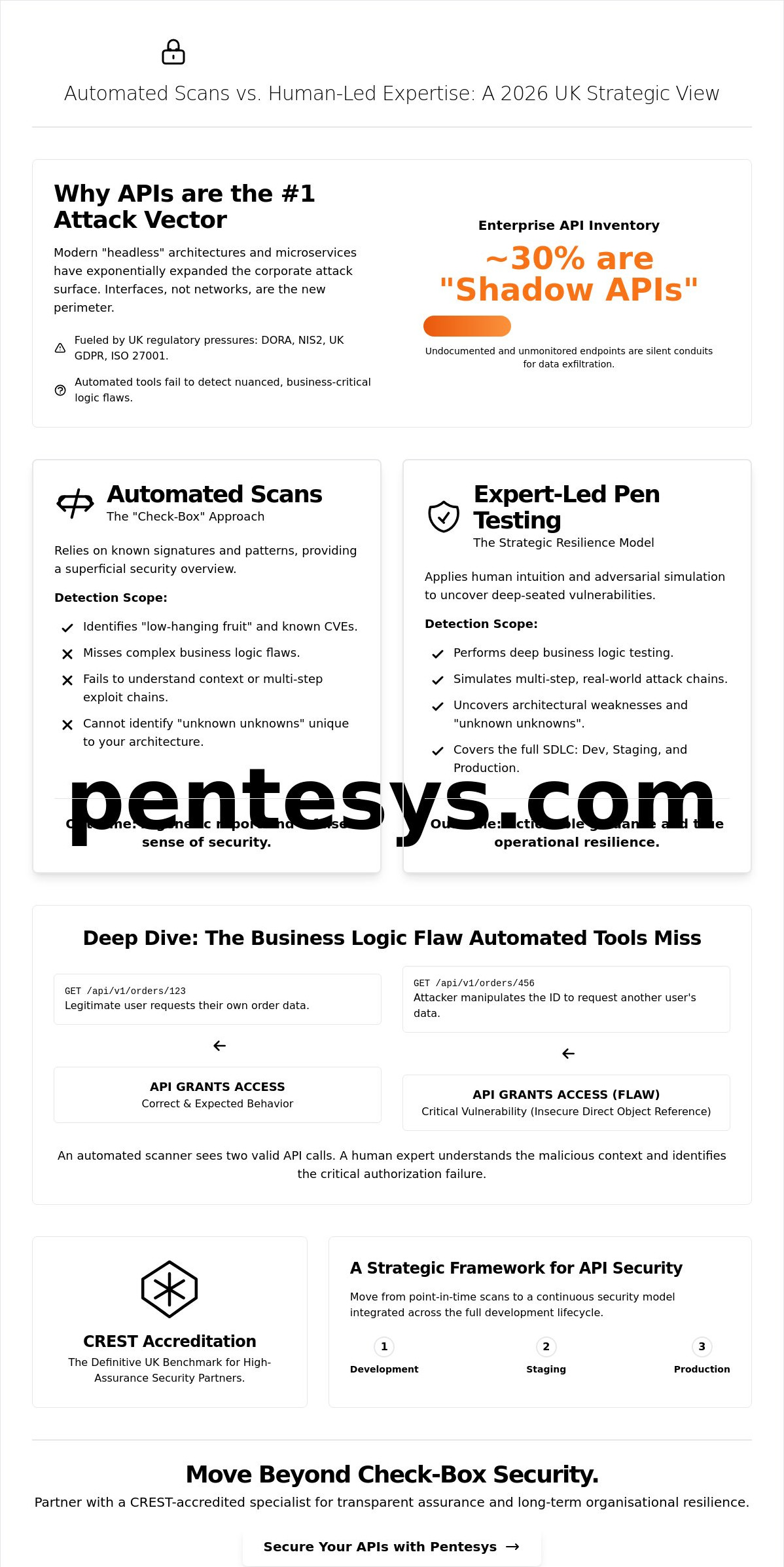
APIs fail most often on authorisation. The endpoint works, the token is valid, the request is well formed, and it returns another customer's record because nothing checked that the caller owns the object being requested. Scanners rarely find this, because from the outside every request looks correct.
This 2026 strategic guide helps you evaluate api penetration testing services uk by focusing on human-led methodology and actionable remediation guidance. We’ll show you how to secure your business logic and provide the transparent assurance your stakeholders require. You’ll learn how to shift from point-in-time testing to a continuous security model that prioritises long-term resilience. We will break down the essential criteria for selecting a specialist who acts as a strategic ally in your security journey, ensuring your technical security and business value remain aligned.
The Critical Role of API Penetration Testing in 2026
API penetration testing is a targeted adversarial simulation designed to identify and exploit vulnerabilities within interface endpoints before malicious actors can. Unlike broad network scans, this process focuses on the logic, authentication, and data handling of the Application Programming Interfaces that power modern business. For UK enterprises, api penetration testing services uk have transitioned from an optional security layer to a core requirement for operational resilience. This shift reflects a move away from traditional web application security toward API-first architectures, where the interface itself is the perimeter.
Professional testing provides a level of assurance that basic automated vulnerability assessments cannot match. While automated tools are efficient at spotting known signatures, they often miss complex logic flaws or multi-step exploit chains. Human-led testing focuses on the nuances of how an API handles requests, ensuring that business logic remains intact under pressure. By understanding API testing fundamentals, organisations can better appreciate why manual verification is necessary to uncover the “unknown unknowns” that threaten data stability.
Why APIs are the #1 Attack Vector
The “headless” nature of modern applications has significantly expanded the corporate attack surface. In 2026, the proliferation of microservices means that a single user action might trigger dozens of internal API calls, each representing a potential point of failure. Shadow APIs, which are undocumented or legacy endpoints forgotten by development teams, make up a large share of an average enterprise’s interface inventory. These hidden gateways often lack the security headers and rate limiting found on primary channels. API security is the verification of data-in-transit integrity. Without rigorous testing, these endpoints become silent conduits for large-scale data exfiltration.
API Security and the UK Regulatory Landscape
The UK regulatory environment has become increasingly stringent regarding digital resilience. The Digital Operational Resilience Act (DORA) and the NIS2 Directive now place direct responsibility on UK financial and infrastructure sectors to maintain robust security protocols for all data interfaces. Failing to secure APIs can lead to significant fines and reputational damage under UK GDPR, especially when sensitive personal data is exposed through insecure endpoints.
Structured testing also plays a vital role in achieving and maintaining ISO certification. Auditors look for evidence of proactive risk management and human-led validation of security controls. By integrating these assessments into your annual strategy, you demonstrate a commitment to the “security by design” principles that UK regulators demand. It’s about moving beyond checkbox compliance to a state of continuous technical assurance.
Technical Methodology: How Expert-Led API Testing Works
The Pentesys methodology prioritises human intelligence over superficial automated scans. While automated tools identify low-hanging fruit, our experts focus on the complex vulnerabilities that scripts consistently miss. Effective api penetration testing services uk must cover the full lifecycle to be truly resilient. We advocate for testing in development to prevent costly late-stage fixes, in staging to ensure environmental parity, and in production to provide final assurance in a live environment.
Our approach utilises Black Box, Grey Box, and White Box assessments. Black Box simulates an external attacker with zero prior knowledge. Grey Box provides partial access, reflecting a standard user profile. White Box involves full architectural transparency. By 2026, business logic testing has become the gold standard of security. It identifies flaws where an API functions exactly as programmed but allows for malicious outcomes. For example, a user might manipulate a resource ID to access another person’s private data despite the system appearing functional.
When procuring these specialized services, many UK organisations rely on accredited providers listed on the UK government’s Digital Marketplace to ensure they meet rigorous public sector standards for technical competence.
Testing REST, GraphQL, and gRPC Frameworks
REST remains the most common architecture, but GraphQL and gRPC present unique risks that require specialized knowledge. GraphQL introspection features often leak entire schema details, while deep query nesting can lead to Denial of Service (DoS) attacks. For REST, we focus on Broken Object Level Authorization (BOLA) and Mass Assignment. Testing gRPC requires decoding protocol buffers to identify serialization flaws that traditional scanners ignore. Our team ensures that every endpoint, regardless of the framework, is resilient against modern exploitation techniques.
Authenticated vs. Unauthenticated Testing
Unauthenticated testing identifies what an anonymous attacker can see. However, authenticated testing is vital for discovering deep logic flaws. It simulates the “Insider Threat,” a category highlighted in the Verizon Data Breach Investigations Report. We verify JSON Web Token (JWT) security to ensure tokens cannot be forged or reused after a session ends. This deep-dive approach ensures your API logic remains secure against sophisticated abuse from legitimate user accounts. You can explore our assurance packages to see how we tailor these tests to your specific architecture.
Evaluating API Penetration Testing Services in the UK
Selecting api penetration testing services uk requires a shift in perspective. You aren’t just buying a report; you’re investing in a strategic partnership. High-assurance security partners distinguish themselves through technical pedigree and a transparent methodology. They move beyond automated scripts to identify complex logic flaws that could lead to data exfiltration. The quality of your testing partner directly impacts your long-term resilience.
The CREST Accreditation Advantage
For UK firms, CREST accredited penetration testing UK is the non-negotiable benchmark for 2026. This accreditation ensures that the provider follows a strict, legally defensible methodology. It isn’t just a badge; it’s a commitment to a rigorous audit trail required by the NCSC and the Financial Conduct Authority. For firms handling government data or operating under specific UK regulations, unaccredited providers present a significant compliance risk. CREST ensures that the individual testers have passed rigorous examinations, rather than just the company holding a generic certificate.
Effective API testing must align with the OWASP API Security Top 10. This framework helps testers target the most critical vulnerabilities, such as Broken Object Level Authorization (BOLA). Human-led testing is essential here. Automated tools often miss the nuances of business logic. A skilled tester understands how an attacker might chain small vulnerabilities together to compromise an entire enterprise environment. This level of expertise is what separates a checkbox exercise from a true security assurance project.
Reporting and the Pentesys Portal
Static PDF reports are a legacy format that creates friction for modern development teams. They’re often outdated the moment they’re emailed. The Pentesys Portal replaces these static documents with a centralized hub for remediation tracking. It transforms raw technical data into actionable business risk insights. Instead of a 100-page document that sits on a shelf, the portal allows for real-time communication between your developers and our security experts. This ensures that remediation is a collaborative, ongoing process rather than a frantic scramble after an annual audit.
The Pentesys Portal provides a clear advantage when managing api penetration testing services uk for large-scale infrastructures. It allows security teams to track the lifecycle of a vulnerability from discovery to verified fix. This level of transparency builds trust. It ensures that your security posture strengthens with every test, providing the peace of mind that comes from methodical, expert-led assurance. We focus on the following key portal features:
- Real-time Remediation: Track progress as your team applies fixes.
- Direct Expert Access: Communicate with the testers who found the flaws.
- Historical Benchmarking: Compare current test results against previous years to measure improvement.
- Executive Summaries: Translate technical findings into business risk for stakeholders.
Scoping Your API Assessment
Effective scoping begins with a comprehensive inventory of all endpoints, including those hidden in microservices or legacy systems. You must define the rules of engagement to ensure testing remains within agreed boundaries. This process should include:
Frequency is the next critical decision. While an annual test might satisfy basic compliance, it leaves gaps in a rapid deployment environment. Integrating security into your CI/CD pipeline is essential for teams releasing code weekly. Many forward-thinking UK enterprises are moving toward continuous penetration testing to match the pace of modern software development. This approach provides persistent assurance rather than a single point-in-time snapshot.
Budgeting for these services requires a clear understanding of value. Low-cost automated scans rarely uncover complex business logic flaws or authorisation bypasses. High-quality, human-led testing typically requires a larger investment but delivers actionable insights that automation cannot replicate. You’re paying for the intuition of an expert who can think like an attacker to find what a script misses.
- Identifying Critical Data Flows: Pinpoint exactly where sensitive data, such as customer PII or financial records, moves through your architecture.
- Mapping Third-Party Integrations: External dependencies often introduce vulnerabilities that internal teams overlook.
- Defining Testing Windows: Schedule assessments to minimise impact on production performance while ensuring realistic adversary simulation.
Remediation and Re-Testing
The value of a penetration test isn’t found in the discovery of vulnerabilities, but in their resolution. You must prioritise fixes based on their actual business impact. A critical vulnerability in a public-facing API requires immediate remediation, whereas a low-risk finding might be scheduled for a future sprint. Post-remediation testing is non-negotiable. It’s the only way to verify that a fix is effective and hasn’t introduced new security gaps. Building a long-term partnership with your provider fosters resilience, turning security from a one-off event into a managed, strategic asset.
What is the difference between a web app pen test and an API pen test?
Web application tests focus on the user interface and client-side vulnerabilities, while API penetration testing services UK target the underlying communication layer between software systems. API testing prioritises data validation, authentication tokens, and endpoint logic rather than browser-based risks. According to the OWASP API Security Project, logic flaws like Broken Object Level Authorization are a common cause of API breaches that standard web tests often overlook.
What information is required to scope an API penetration test?
To provide an accurate scope, we require a total count of endpoints, authentication types, and access to technical documentation like Swagger or OpenAPI files. We also need to define the number of user roles to test for horizontal and vertical privilege escalation. Providing complete documentation at the start allows our team to focus on adversary simulation rather than manual discovery, increasing the depth of the final results.
Founder & CEO, Pentesys
James Hinton is the founder of Pentesys, a CREST-approved UK company working only on offensive security: penetration testing, PTaaS, CTEM, external attack surface management and red teaming. He built the business around one discipline rather than a broad consultancy menu, and most of his time still goes on how engagements get scoped, delivered and reported. He writes here about the practical side of security testing and what buyers should be asking for.
LinkedIn profile