

Overview
CREST accreditation tells you something specific: the company has been independently assessed on its processes, and its testers have passed examinations that are renewed rather than held for life. It does not tell you that the consultant assigned to your engagement is the strongest tester available, or that the scope you agreed is the right one. Knowing what it covers makes it more useful, not less.
Discover how the benefits of CREST certified testers provide the technical certainty and regulatory compliance your enterprise requires to maintain long-term resilience. We’ll examine why these accredited experts are essential for meeting the current Cyber Essentials requirements and how their manual, expert-led evaluations outperform standard automated processes. This guide outlines the transition from periodic check-box exercises to a structured, platform-driven methodology that aligns your technical security with core business objectives and helps reduce cyber insurance premiums through rigorous, verified testing.
What are CREST Certified Testers? Defining the Industry Standard
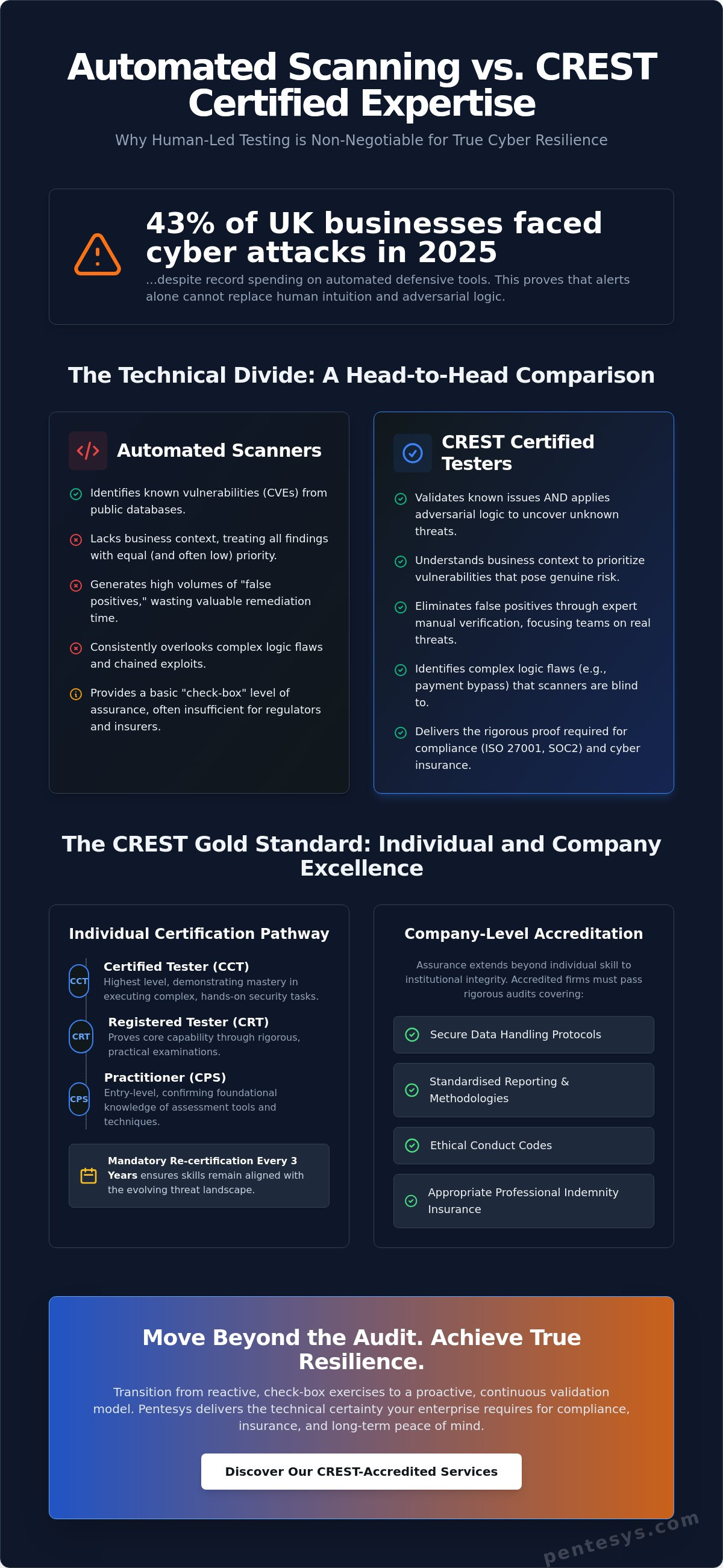
CREST, the Council for Registered Ethical Security Testers, serves as the international gold standard for Defining the Industry Standard in offensive security. For UK enterprises, the benefits of CREST certified testers extend beyond a simple badge of merit; they represent a commitment to technical certainty in an environment where automated tools often fail to catch nuanced vulnerabilities. While scanners provide a baseline of visibility, CREST-accredited professionals apply human intuition and adversarial logic to identify the gaps that matter most to your business continuity.
The UK government and primary regulators prioritise CREST-approved providers because the accreditation provides a verified baseline of competence. With the Cyber Security and Resilience Bill proposing to widen the scope of regulated entities, this formal verification is increasingly expected in supply chain contracts. The core mission of the organisation is to move the industry away from static, check-box evaluations toward a model of high-level certainty. This ensures that every assessment provides a definitive proof of security posture rather than a list of theoretical risks.
The Rigour of CREST Individual Certifications
CREST offers a structured career path that demands escalating levels of expertise, moving from the Practitioner level to the Registered Tester (CRT) and eventually the Certified Tester (CCT) pathways. These certifications aren’t earned through simple multiple-choice questions. Candidates must pass hands-on, practical examinations in a proctored environment to prove they can execute complex technical tasks under pressure. CREST examinations are time-limited, so individual certifications have to be renewed rather than held indefinitely. This cycle ensures their knowledge remains aligned with the latest tactics used by modern adversaries, including the use of AI to automate and scale attacks.
Company-Level Accreditation Requirements
It’s vital to distinguish between an individual holding a certificate and a company being CREST-accredited. To achieve accreditation, a firm must pass a rigorous audit of its internal business processes. This oversight includes a review of data handling protocols, reporting standards, and ethical conduct codes. The audit verifies that the company holds appropriate professional indemnity insurance and follows a methodology that ensures consistent results across different business units. One of the primary benefits of CREST certified testers working within an accredited firm is the assurance that your sensitive data is handled within a secure, audited framework. This institutional oversight transforms a technical exercise into a reliable, managed process that supports your long-term resilience goals.
Technical Rigour: Why Accreditation Outperforms Automated Scanning
Automated scanners are proficient at identifying known vulnerabilities, or CVEs, but they lack the cognitive ability to understand business context. Relying solely on automation often creates a false sense of security. One of the primary benefits of CREST certified testers is their ability to distinguish between a theoretical risk and a practical exploit. While a scanner might flag an outdated software version, a certified professional determines if that version is actually reachable or exploitable within your specific environment. This manual verification eliminates the noise of false positives, allowing your internal teams to focus on remediation efforts that actually reduce risk.
The benefits of CREST certified testers become even more apparent during the identification of complex logic flaws. These are vulnerabilities that don’t trigger automated alerts because they involve the legitimate use of functions in unintended ways. For instance, an automated tool won’t understand if a user can bypass a payment gateway by manipulating session tokens. Professional testers apply human intuition to simulate the creative thinking of a real-world attacker. This level of scrutiny provides the Compliance, Insurance, and Stakeholder Trust necessary for modern enterprise governance.
Manual Expertise vs. Automated Noise
Scanners are essentially bots following a pre-defined script. In contrast, expert-led web application penetration testing focuses on the unique architecture of your digital assets. Certified testers can navigate complex multi-factor authentication (MFA) flows and single sign-on (SSO) integrations that often cause automated scanners to stall or fail. By understanding how your specific application processes data, these experts identify risks that are invisible to generic code analysis tools, ensuring your most sensitive entry points are truly secure.
Adversarial Mindset and Exploit Chaining
True security isn’t found in a static list of individual bugs. It’s found in understanding the narrative of a potential attack. CREST testers excel at “exploit chaining,” a process where multiple low-severity issues are combined to achieve a high-impact breach. A minor misconfiguration in a cloud bucket, when paired with a weak API endpoint, could lead to a full database compromise. This adversarial mindset tests the actual effectiveness of your internal detection and response teams. It’s a proactive measure that ensures your Blue Team is prepared for the sophisticated, AI-driven threats prevalent in 2026. By simulating real-world attack vectors that automated tools simply can’t replicate, these experts provide a level of technical certainty that protects your reputation. If you’re looking to validate your current defences, a structured infrastructure penetration testing assessment with Pentesys Limited is a logical next step to gain absolute clarity on your security posture.
Strategic Advantages: Compliance, Insurance, and Stakeholder Trust
Beyond the technical depth of the assessment itself, the strategic benefits of CREST certified testers manifest most clearly in the boardroom. For UK enterprises in 2026, security is no longer a siloed IT concern; it’s a fundamental component of corporate governance and risk management. When you present a CREST-accredited report to stakeholders, you aren’t just showing a list of patched vulnerabilities. You’re providing a formal declaration of technical certainty that satisfies the rigorous demands of global compliance frameworks like SOC2 and PCI DSS. This level of professional assurance builds immediate trust with enterprise clients who now mandate third-party validation as a prerequisite for any supply chain partnership.
The transition from manual, expert-led evaluation to a structured reporting format allows executive decision-makers to understand technical debt in the context of business risk. These reports translate complex exploit chains into actionable intelligence. By aligning your testing schedule with the NCSC CHECK Scheme Requirements, your organisation demonstrates a commitment to the highest national standards. This is particularly critical for entities operating within critical national infrastructure or those bidding for high-value government contracts where accredited oversight is non-negotiable.
Supporting ISO 27001 and Regulatory Audits
Accredited reports directly satisfy the “Independent Review of Information Security” requirement found in many international standards. Rather than providing a vague summary, a CREST-backed audit offers a clear remediation roadmap that auditors can easily verify during follow-up assessments. Ensuring your crest accredited penetration testing uk meets these standards reduces the friction often associated with annual certification cycles. It transforms a mandatory compliance task into a strategic asset that proves your organisation’s long-term resilience.
Maximising Cyber Insurance Value
The cyber insurance market has undergone a significant shift. By 2026, insurers have moved away from basic self-assessment questionnaires, now requiring evidence of high-level certainty before underwriting high-limit policies. One of the key benefits of CREST certified testers is their ability to provide the rigorous proof of “due diligence” that insurers demand. A comprehensive testing history can lead to several advantages:
By adopting a methodical, CREST-backed remediation plan, you lower your overall risk profile in a way that is visible and quantifiable to underwriters. This proactive stance ensures your insurance remains a viable safety net rather than a contested liability.
- Premium Reduction: Proving a proactive security posture through accredited testing often results in more favourable premium rates.
- Claim Assurance: In the event of a breach, having a documented history of expert-led testing proves you took reasonable steps to protect your data.
- Policy Eligibility: Many insurers now refuse to cover organisations that rely solely on automated scanning for their primary defence validation.
Operational Reliability: Minimising Risk Through Standardised Methodologies
Operational reliability is the conceptual anchor of a successful security audit. For large organisations with complex, distributed environments, consistency is vital. One of the most significant benefits of CREST certified testers is their adherence to a standardised, repeatable testing methodology. This ensures that when you assess different business units or geographic locations, the results are comparable and the quality of oversight remains uniform. It moves the process away from the unpredictability of “freestyle” hacking toward a structured, managed service that provides technical certainty.
This methodical approach is particularly important when managing the risk of system downtime. Intrusive testing phases, if handled by unaccredited individuals, can inadvertently cause service disruptions. CREST-certified professionals are trained to balance the need for deep technical probing with the operational requirements of a live production environment. They follow a logical progression that prioritises system stability, ensuring that the search for vulnerabilities doesn’t result in an unintended outage that affects your bottom line.
The CREST Code of Conduct
The distinction of being “Registered Ethical Security Testers” carries significant weight because it’s backed by a formal ethical framework. Every engagement begins with a clear Rules of Engagement (RoE) document. This contract defines the legal and technical boundaries of the test, protecting your organisation from overreach. Because these testers are professionally accountable to the CREST body, you have a clear path for escalation if concerns arise regarding conduct or methodology. This transparency builds a sense of security, positioning the tester as a sophisticated strategic ally rather than a detached third party.
Reporting Standards for Executive Action
Effective security isn’t just about finding bugs; it’s about how those findings are communicated to the people who hold the budget. CREST standards require that technical debt is translated into financial and operational risk. By using standardised severity ratings like the Common Vulnerability Scoring System (CVSS), these experts allow your internal teams to prioritise remediation based on actual impact. Reports include executive summaries that strip away technical jargon, providing the logical progression and clarity needed for Board-level decision-making. This ensures that your security investments are always aligned with core corporate objectives.
If you’re ready to move beyond static evaluations and implement a more dependable security process, you can schedule a professional security assessment to begin your journey toward long-term resilience.
Continuous Security vs. Annual Compliance
Many enterprises are now adopting continuous penetration testing to maintain a defendable posture throughout the year. Rather than waiting for a yearly audit, you gain the ability to validate changes in real-time. Accredited testers monitor your attack surface as it evolves, identifying new vulnerabilities before they can be exploited by adversarial AI. This shift ensures your security measures are a constant operational reality rather than a periodic event. It allows your business to move fast without sacrificing the foundational importance of reliability.
What is the difference between a CREST certified tester and a standard penetration tester?
A CREST certified tester has passed rigorous, proctored examinations that verify their technical proficiency in real-world scenarios. Standard penetration testers might possess general knowledge, but they lack the formal, independent verification of their skills and ethical conduct. Choosing accredited professionals ensures your assessment follows a structured, high-quality methodology rather than an unverified or ad-hoc process.
Is CREST accreditation recognised outside of the UK?
CREST is an international body with a presence across the Americas, Europe, and Asia. This global reach ensures that the standards for offensive security remain consistent regardless of where your business units are located. For enterprises with a global footprint, the benefits of CREST certified testers include maintaining a uniform security baseline that is respected by international partners and regulators.
Founder & CEO, Pentesys
James Hinton is the founder of Pentesys, a CREST-approved UK company working only on offensive security: penetration testing, PTaaS, CTEM, external attack surface management and red teaming. He built the business around one discipline rather than a broad consultancy menu, and most of his time still goes on how engagements get scoped, delivered and reported. He writes here about the practical side of security testing and what buyers should be asking for.
LinkedIn profile